House of AnandaMovement · Stillness · Wisdom · Journey

The reference room

The Buddhist visual atlas

Forty-two visuals: twenty teaching infographics, sacred symbols, historical artworks and contemporary spiritual imagery, with interpretation and sources.

House of Ananda study notes · Reviewed 24 September 2026

A library for the eye and the mind

Images open a door.
Context takes us further.

Explore 42 visuals with explanations, sources and questions for reflection. Start with a familiar symbol or follow a teaching into a diagram. Each is a doorway into a wider tradition.

Historical works are credited to their collections and makers. Teaching diagrams are modern study aids. The contemporary artwork is labelled as an AI-assisted interpretation.

A familiar symbol, carefully understood

Yin and yang.
Relationship and change.

What do the dark and light shapes mean? Why is this Chinese philosophical symbol included in a Buddhist library? Explore its meanings while preserving the differences between traditions.

Read the illustrated guide ↗

Yin–yang thought belongs to a wider Chinese intellectual heritage. It is not a core symbol originating with the historical Buddha.

Yin and yang with a four-part explanation of the taijitu

01 · Visual Dharma

Twenty ways into the teachings

Open a diagram at full size, download its SVG, or expand the text interpretation. Every label is also available in the reading key.

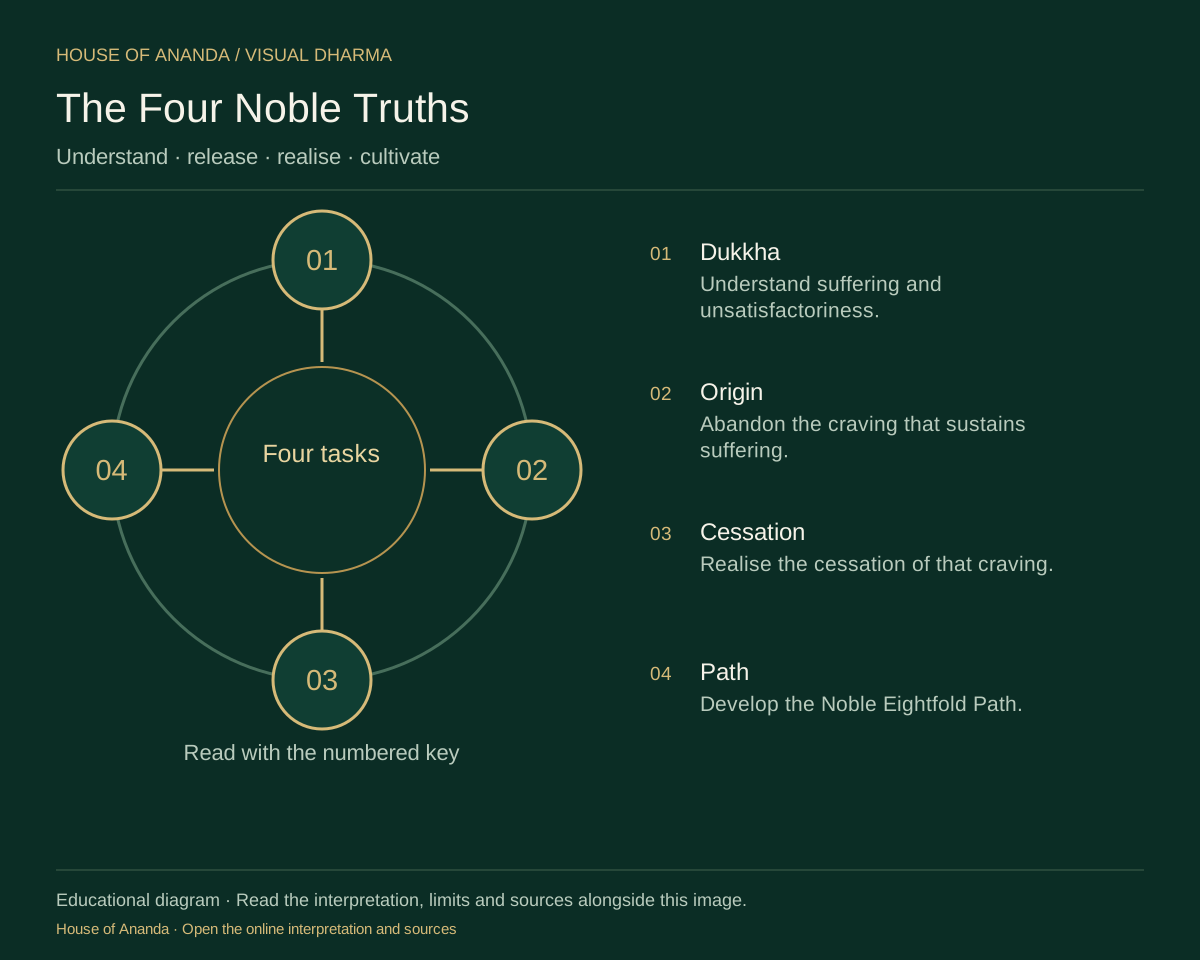
The Four Noble Truths. A teaching about suffering and freedom, expressed as four truths with four corresponding tasks.
House of Ananda educational infographic

Understand · release · realise · cultivate

The Four Noble Truths

A teaching about suffering and freedom, expressed as four truths with four corresponding tasks.

Read the diagram & interpretation
  1. DukkhaUnderstand suffering and unsatisfactoriness.
  2. OriginAbandon the craving that sustains suffering.
  3. CessationRealise the cessation of that craving.
  4. PathDevelop the Noble Eightfold Path.

Read each truth together with its task. The teaching asks for understanding, letting go, direct realisation and ongoing cultivation; it is more than a list of beliefs. The circular layout here shows their relationship, not a promise of a quick progression.

Keep in mind Dukkha does not mean that every moment of life is miserable. Nor does the teaching blame a person for every painful event.

Explore the teaching ↗
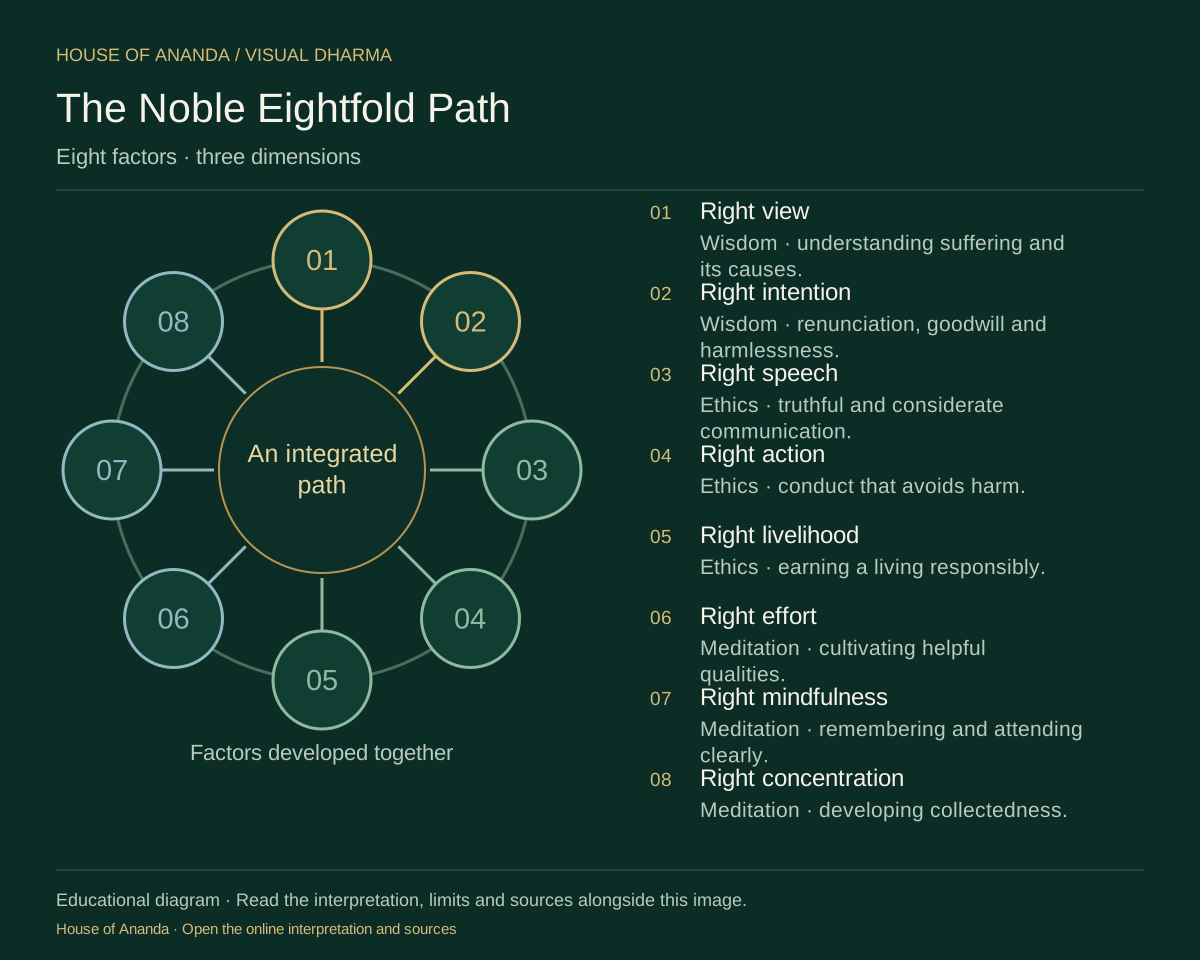
The Noble Eightfold Path. Eight mutually supporting factors develop understanding, ethical conduct and the mind.
House of Ananda educational infographic

Eight factors · three dimensions

The Noble Eightfold Path

Eight mutually supporting factors develop understanding, ethical conduct and the mind.

Read the diagram & interpretation
  1. Right viewWisdom · understanding suffering and its causes.
  2. Right intentionWisdom · renunciation, goodwill and harmlessness.
  3. Right speechEthics · truthful and considerate communication.
  4. Right actionEthics · conduct that avoids harm.
  5. Right livelihoodEthics · earning a living responsibly.
  6. Right effortMeditation · cultivating helpful qualities.
  7. Right mindfulnessMeditation · remembering and attending clearly.
  8. Right concentrationMeditation · developing collectedness.

The gold, green and slate segments mark wisdom, ethics and meditation. Begin anywhere your life gives you an opportunity, while returning to the whole path. “Right” refers to what supports awakening, rather than a demand for personal perfection.

Keep in mind These are eight factors to develop together, not eight levels that must each be finished before the next.

Explore the teaching ↗
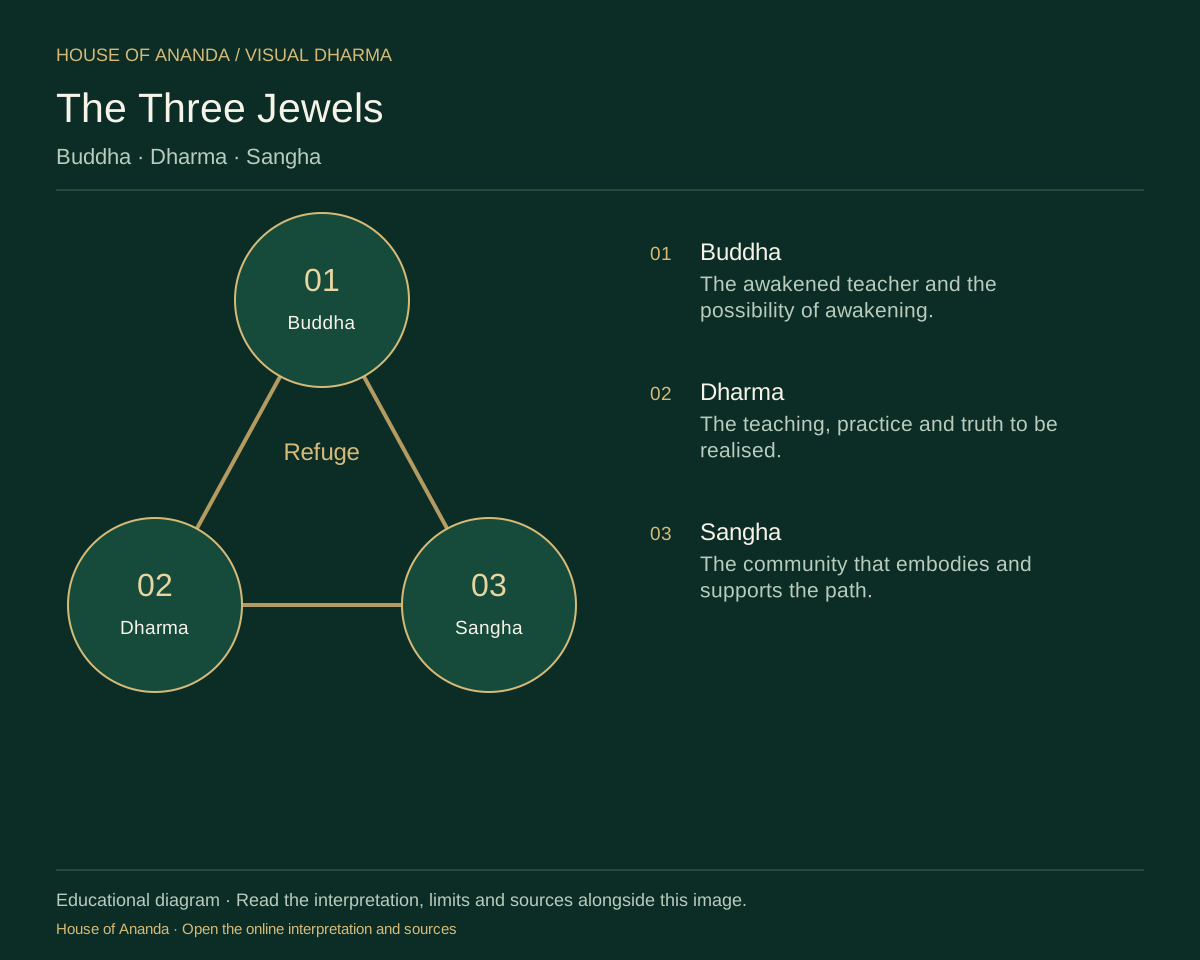
The Three Jewels. Three interrelated points of orientation in Buddhist life.
House of Ananda educational infographic

Buddha · Dharma · Sangha

The Three Jewels

Three interrelated points of orientation in Buddhist life.

Read the diagram & interpretation
  1. BuddhaThe awakened teacher and the possibility of awakening.
  2. DharmaThe teaching, practice and truth to be realised.
  3. SanghaThe community that embodies and supports the path.

The triangle places teacher, teaching and community in relationship. Refuge is a lived orientation, and formal taking of refuge has particular forms in different Buddhist communities. “Sangha” may mean the monastic community, the noble community or, in some modern settings, a wider practice community.

Keep in mind Reading a diagram does not confer religious refuge or community membership.

Explore the teaching ↗
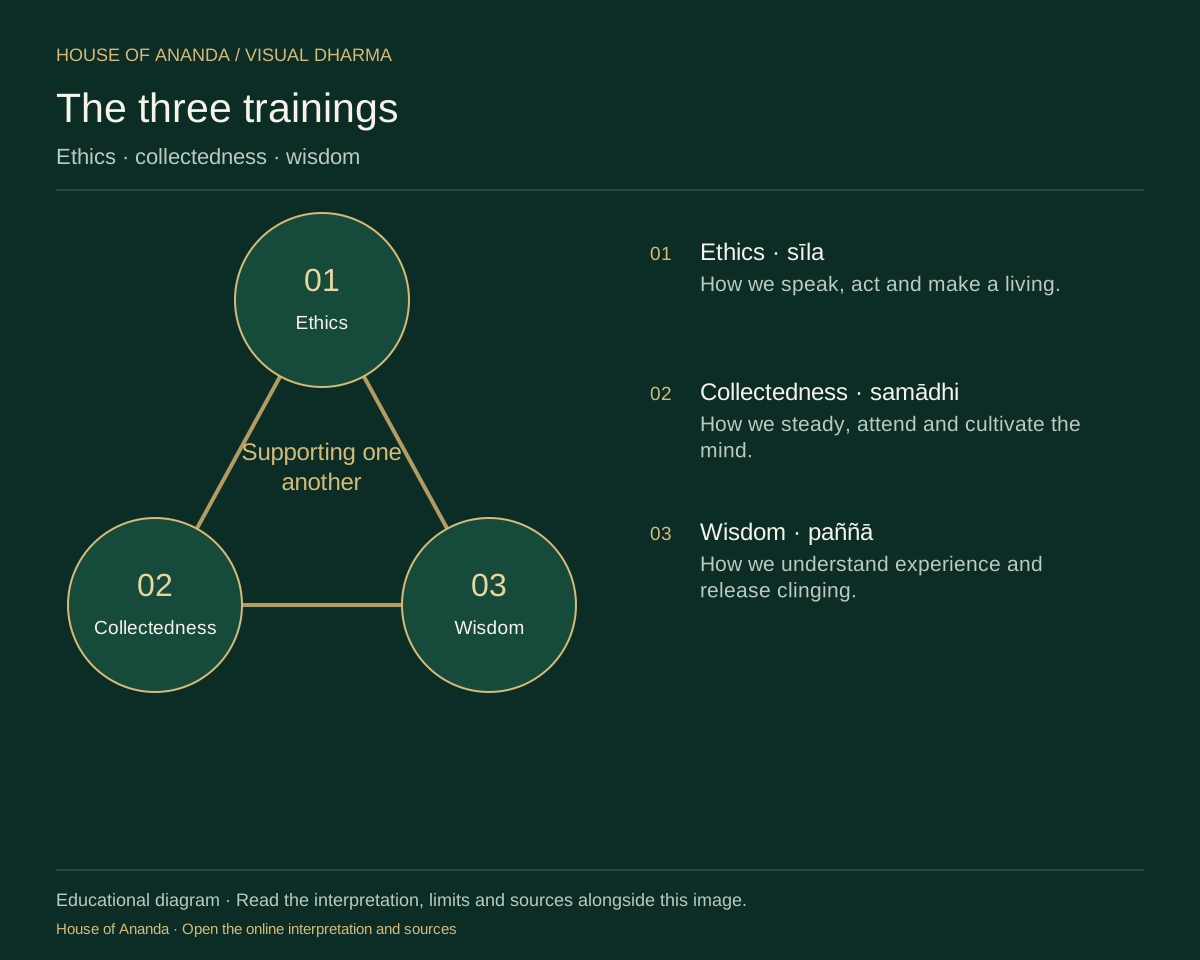
The three trainings. The path can be understood through three areas of training that strengthen each other.
House of Ananda educational infographic

Ethics · collectedness · wisdom

The three trainings

The path can be understood through three areas of training that strengthen each other.

Read the diagram & interpretation
  1. Ethics · sīlaHow we speak, act and make a living.
  2. Collectedness · samādhiHow we steady, attend and cultivate the mind.
  3. Wisdom · paññāHow we understand experience and release clinging.

Ethical choices can reduce remorse; steadiness can support observation; understanding can deepen care. The connecting lines indicate reciprocal support. The Eightfold Path gives a more detailed account of these three trainings.

Keep in mind Meditation is one part of a wider path that also concerns relationships and conduct.

Explore the teaching ↗
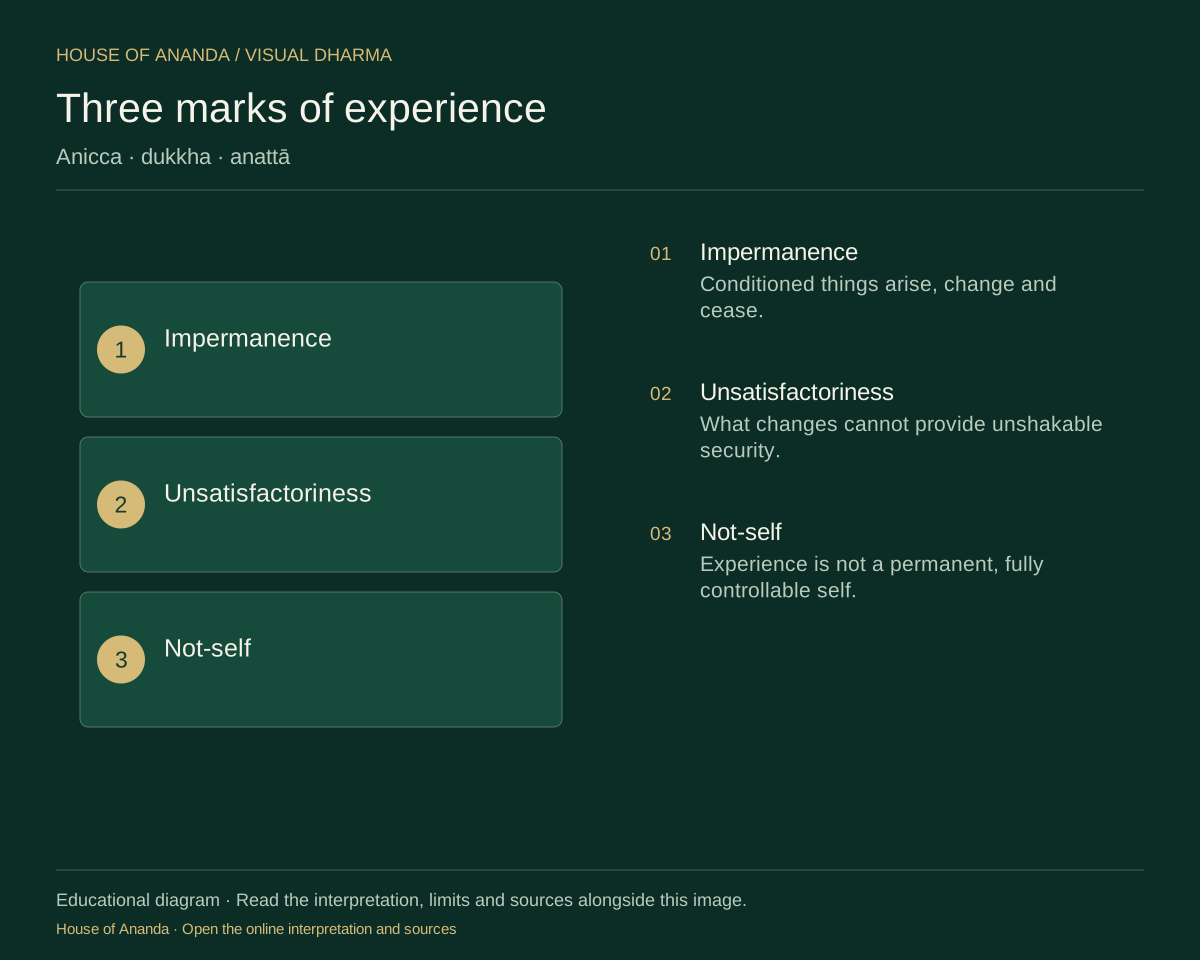
Three marks of experience. A framework for examining change, unreliability and the limits of ownership.
House of Ananda educational infographic

Anicca · dukkha · anattā

Three marks of experience

A framework for examining change, unreliability and the limits of ownership.

Read the diagram & interpretation
  1. ImpermanenceConditioned things arise, change and cease.
  2. UnsatisfactorinessWhat changes cannot provide unshakable security.
  3. Not-selfExperience is not a permanent, fully controllable self.

Consider a sound, a feeling or a plan. Notice its conditions, its change and the limits of your control. This is a starting point for inquiry, not a proof produced by a single exercise. In traditional formulations, impermanence and unsatisfactoriness concern conditioned phenomena; not-self is stated more broadly.

Keep in mind Not-self is not an instruction to deny ordinary identity, responsibility or the reality of another person’s pain.

Explore the teaching ↗
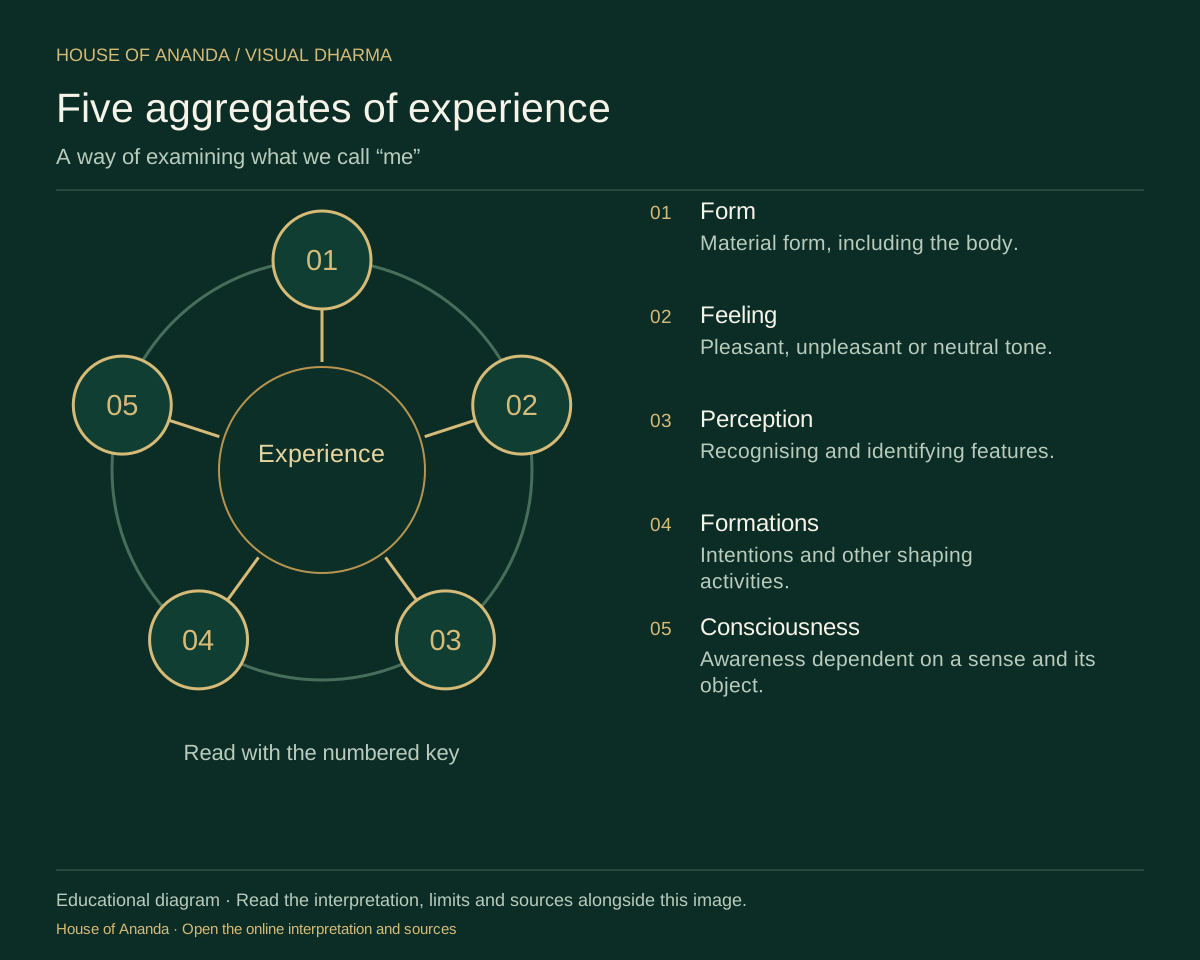
Five aggregates of experience. Five categories help analyse experience without treating it as a fixed possession.
House of Ananda educational infographic

A way of examining what we call “me”

Five aggregates of experience

Five categories help analyse experience without treating it as a fixed possession.

Read the diagram & interpretation
  1. FormMaterial form, including the body.
  2. FeelingPleasant, unpleasant or neutral tone.
  3. PerceptionRecognising and identifying features.
  4. FormationsIntentions and other shaping activities.
  5. ConsciousnessAwareness dependent on a sense and its object.

At the sound of a message alert, there may be bodily sensation, pleasant or unpleasant tone, recognition, a wish to respond and auditory awareness. This is an editorial example, not five isolated compartments or a fixed neurological sequence.

Keep in mind Feeling tone is not the same category as the whole complexity of emotion. The aggregate model is a contemplative analysis, not a brain scan.

Explore the teaching ↗
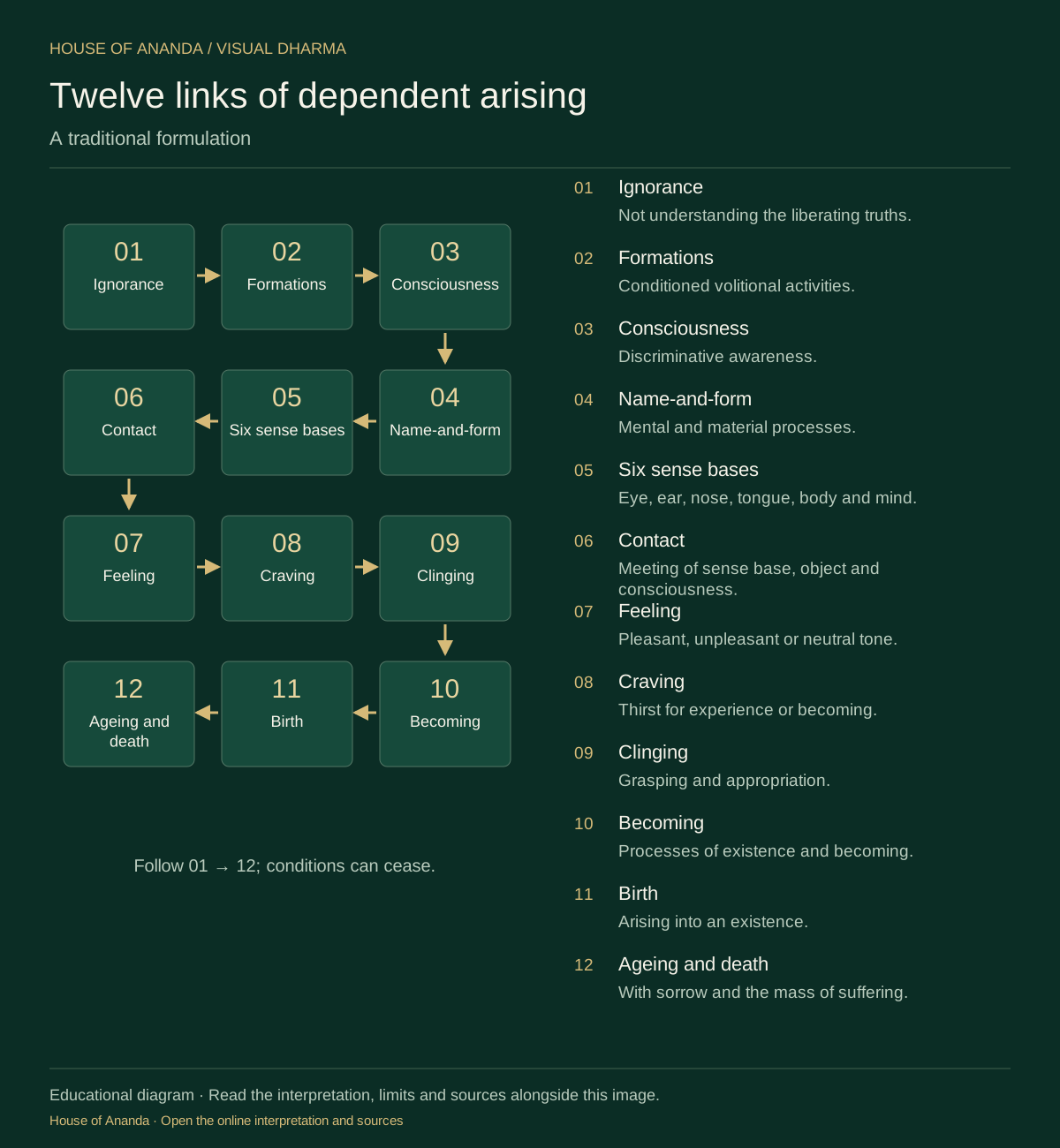
Twelve links of dependent arising. The twelve-link account describes the conditioned arising of suffering.
House of Ananda educational infographic

A traditional formulation

Twelve links of dependent arising

The twelve-link account describes the conditioned arising of suffering.

Read the diagram & interpretation
  1. IgnoranceNot understanding the liberating truths.
  2. FormationsConditioned volitional activities.
  3. ConsciousnessDiscriminative awareness.
  4. Name-and-formMental and material processes.
  5. Six sense basesEye, ear, nose, tongue, body and mind.
  6. ContactMeeting of sense base, object and consciousness.
  7. FeelingPleasant, unpleasant or neutral tone.
  8. CravingThirst for experience or becoming.
  9. ClingingGrasping and appropriation.
  10. BecomingProcesses of existence and becoming.
  11. BirthArising into an existence.
  12. Ageing and deathWith sorrow and the mass of suffering.

Follow the numbers in the diagram. Traditional commentaries explain this formulation in different ways, including across lives. Some modern presentations also examine patterns in immediate experience. Neither reading makes this a universal twelve-step timeline for every event.

Keep in mind The teaching also describes cessation when sustaining conditions cease. A useful place for ordinary observation is how feeling can lead into craving.

Explore the teaching ↗
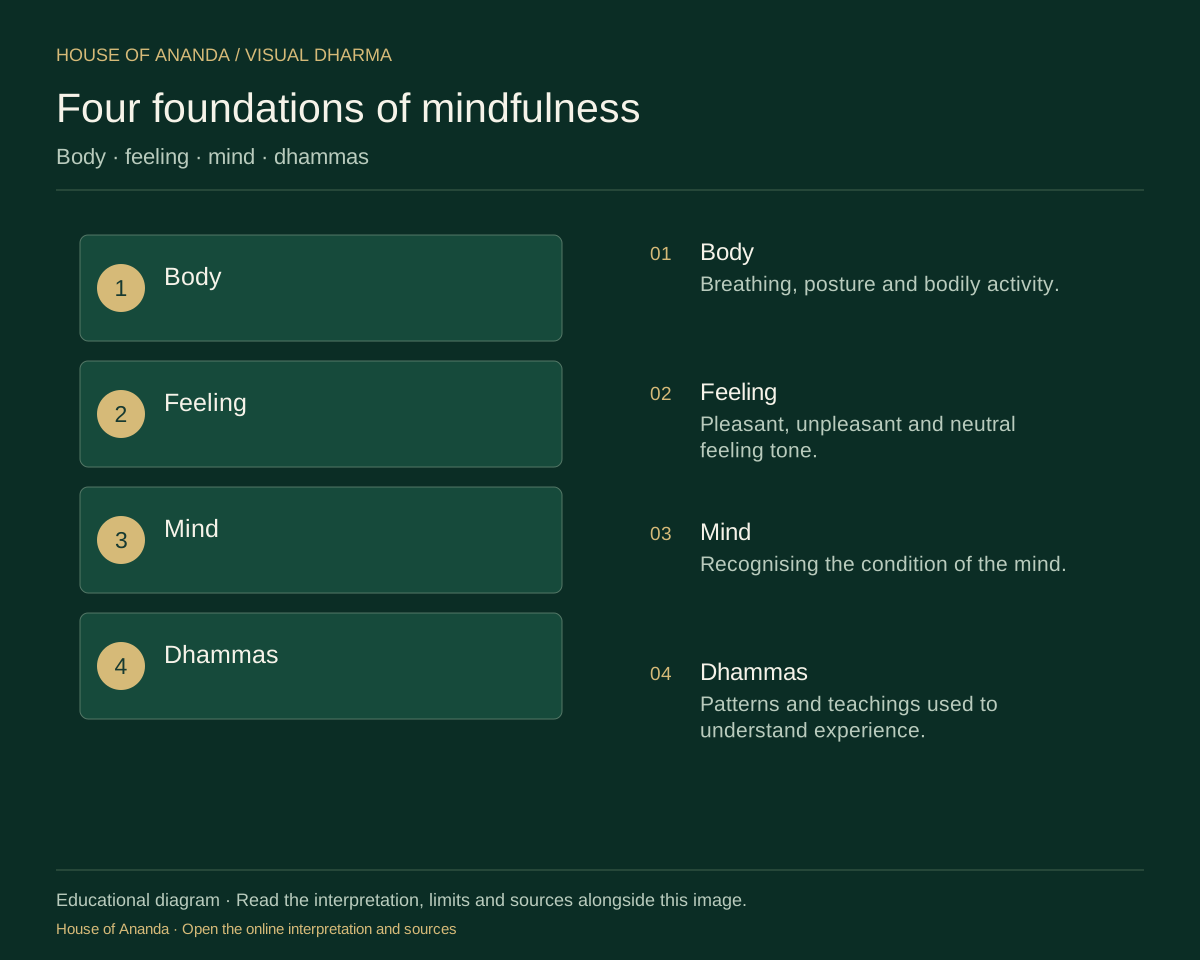
Four foundations of mindfulness. Four fields of contemplation within the wider Buddhist path.
House of Ananda educational infographic

Body · feeling · mind · dhammas

Four foundations of mindfulness

Four fields of contemplation within the wider Buddhist path.

Read the diagram & interpretation
  1. BodyBreathing, posture and bodily activity.
  2. FeelingPleasant, unpleasant and neutral feeling tone.
  3. MindRecognising the condition of the mind.
  4. DhammasPatterns and teachings used to understand experience.

The four panels organise domains of attention; they are not four locations in the body. Mindfulness includes recognising what is present and remembering the purpose and framework of practice. Dhammas has several translation choices; the discourse includes hindrances and other teaching frameworks.

Keep in mind Mindfulness is not only non-judgmental awareness: these texts also concern understanding and cultivating a path away from suffering.

Explore the teaching ↗
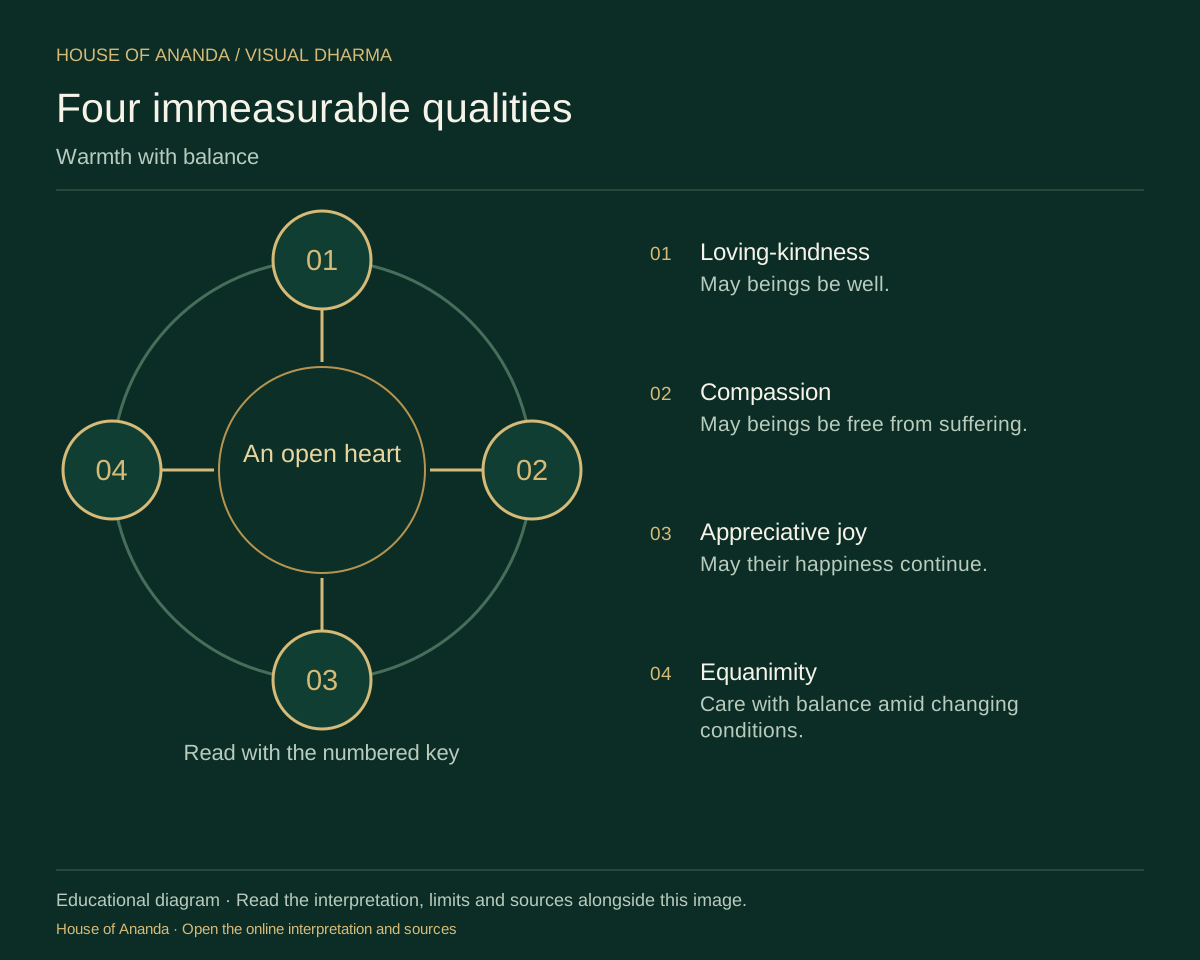
Four immeasurable qualities. Four qualities extend care beyond narrow preference.
House of Ananda educational infographic

Warmth with balance

Four immeasurable qualities

Four qualities extend care beyond narrow preference.

Read the diagram & interpretation
  1. Loving-kindnessMay beings be well.
  2. CompassionMay beings be free from suffering.
  3. Appreciative joyMay their happiness continue.
  4. EquanimityCare with balance amid changing conditions.

The wording in the panels is an introductory House of Ananda adaptation. The qualities support each other: compassion can be steadied by equanimity, and joy can loosen the habit of comparing ourselves with others. Begin with an accessible person or situation rather than forcing a difficult emotional state.

Keep in mind Equanimity is not indifference, compassion need not become overwhelm, and kindness can coexist with firm boundaries.

Explore the teaching ↗
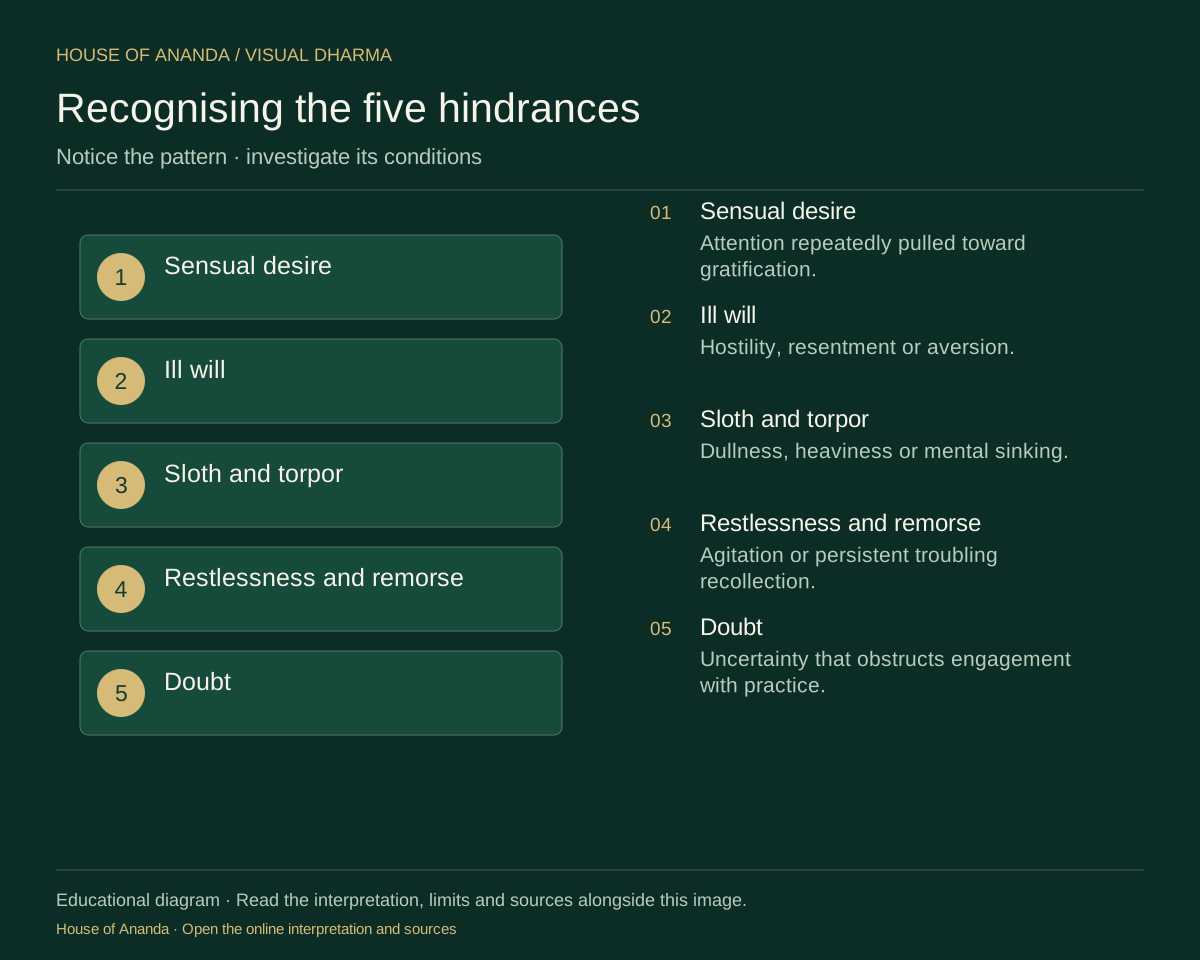
Recognising the five hindrances. Traditional obstacles to steadiness and understanding are patterns to recognise, not permanent identities.
House of Ananda educational infographic

Notice the pattern · investigate its conditions

Recognising the five hindrances

Traditional obstacles to steadiness and understanding are patterns to recognise, not permanent identities.

Read the diagram & interpretation
  1. Sensual desireAttention repeatedly pulled toward gratification.
  2. Ill willHostility, resentment or aversion.
  3. Sloth and torporDullness, heaviness or mental sinking.
  4. Restlessness and remorseAgitation or persistent troubling recollection.
  5. DoubtUncertainty that obstructs engagement with practice.

Naming a pattern can create room for a wiser response. Ask what is feeding it: exhaustion, conflict, stimulation, unrealistic effort or a question that needs an answer? The traditional account of nourishment and its removal invites attention to conditions.

Keep in mind Ordinary fatigue may need rest, and honest inquiry is not a moral failure. This framework is not a diagnosis.

Explore the teaching ↗
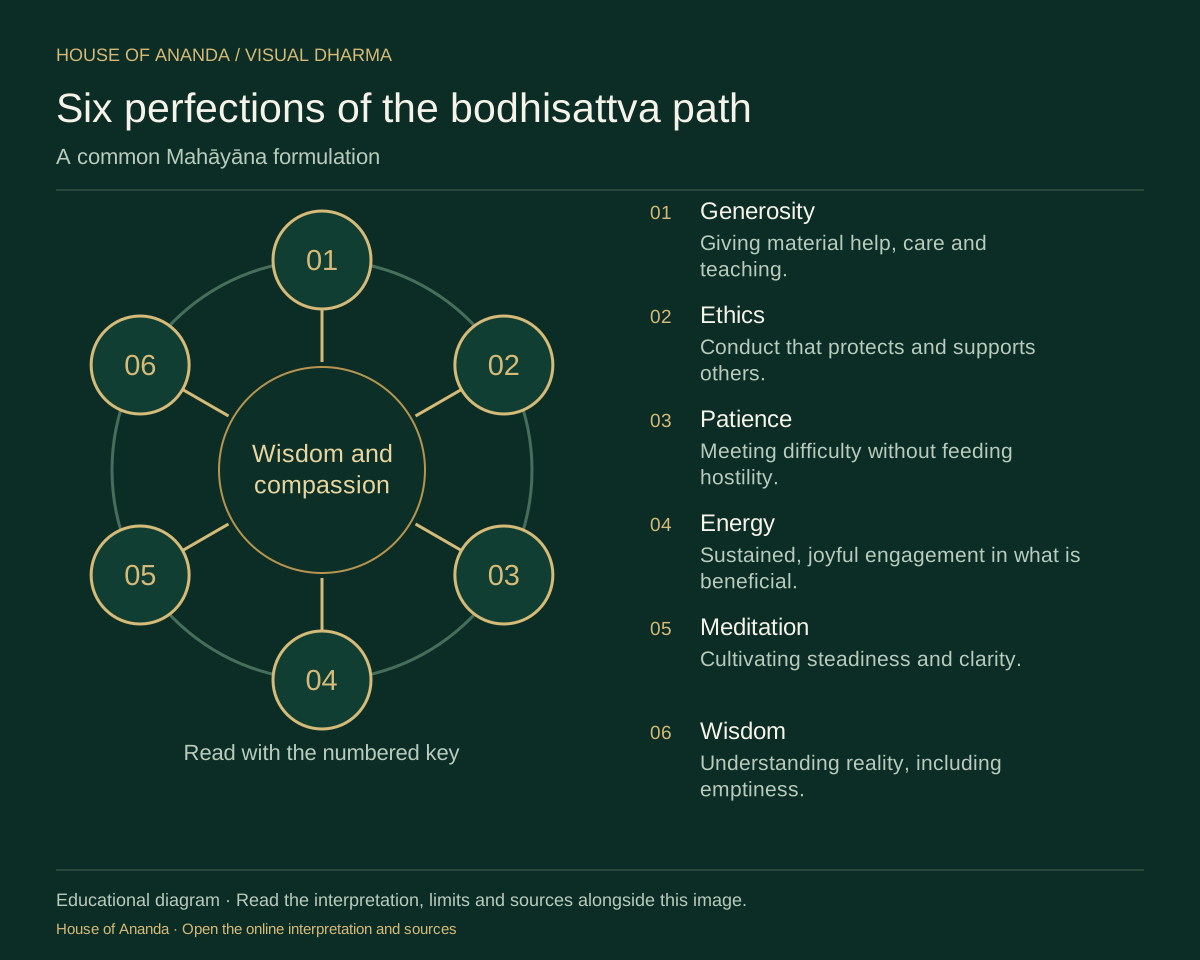
Six perfections of the bodhisattva path. Six far-reaching qualities connect insight with the work of benefiting beings.
House of Ananda educational infographic

A common Mahāyāna formulation

Six perfections of the bodhisattva path

Six far-reaching qualities connect insight with the work of benefiting beings.

Read the diagram & interpretation
  1. GenerosityGiving material help, care and teaching.
  2. EthicsConduct that protects and supports others.
  3. PatienceMeeting difficulty without feeding hostility.
  4. EnergySustained, joyful engagement in what is beneficial.
  5. MeditationCultivating steadiness and clarity.
  6. WisdomUnderstanding reality, including emptiness.

The circular form emphasises their interdependence. Giving can require patience; ethical action can require courage; wisdom informs how help is offered. Traditions also teach expanded lists, including ten perfections. This sixfold map is not a complete account of every bodhisattva curriculum.

Keep in mind Patience does not mean submitting to abuse, and generosity can include a careful assessment of what is actually helpful.

Explore the teaching ↗
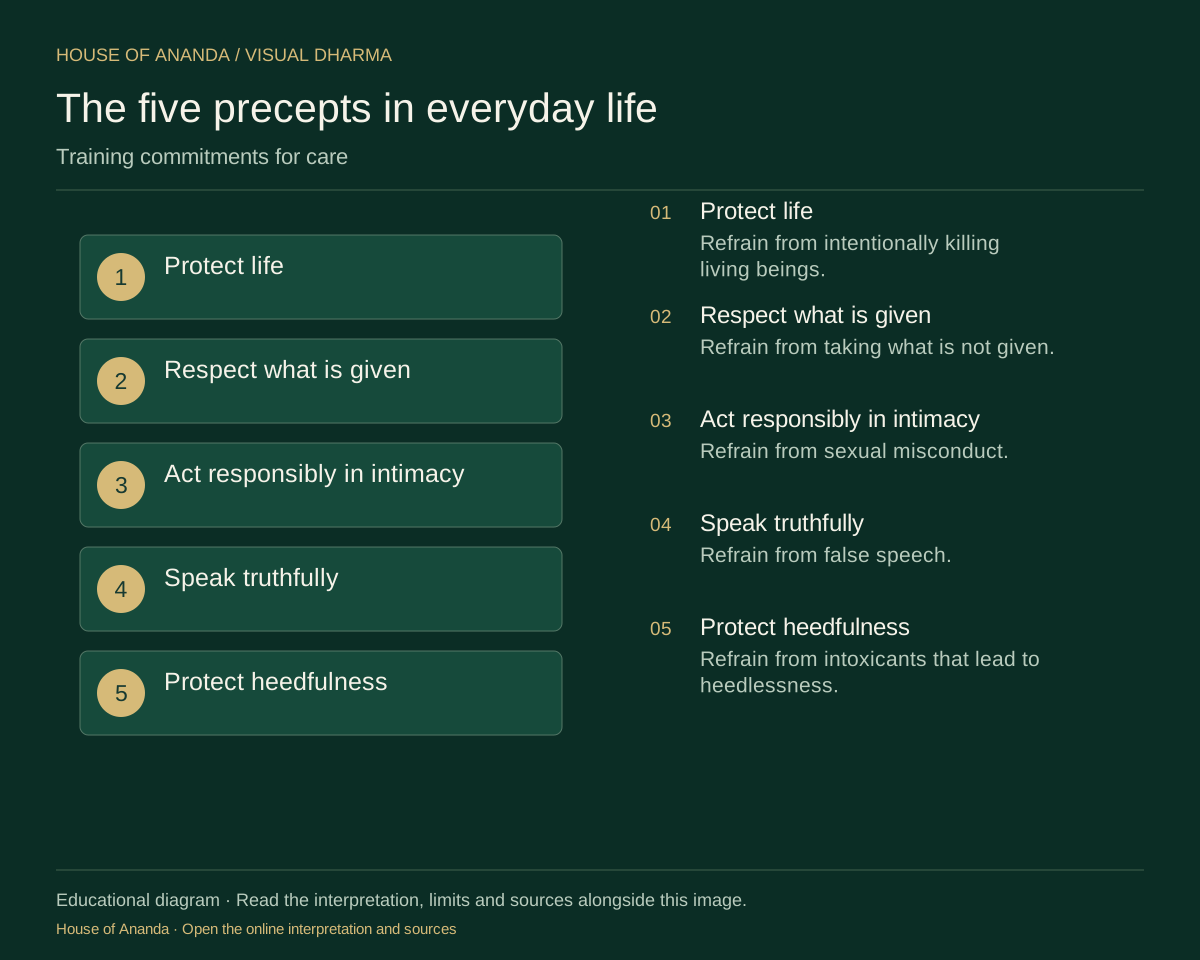
The five precepts in everyday life. A common lay ethical framework, paired here with everyday reflection prompts.
House of Ananda educational infographic

Training commitments for care

The five precepts in everyday life

A common lay ethical framework, paired here with everyday reflection prompts.

Read the diagram & interpretation
  1. Protect lifeRefrain from intentionally killing living beings.
  2. Respect what is givenRefrain from taking what is not given.
  3. Act responsibly in intimacyRefrain from sexual misconduct.
  4. Speak truthfullyRefrain from false speech.
  5. Protect heedfulnessRefrain from intoxicants that lead to heedlessness.

Ask how a commitment can become concrete today: a truthful correction, a respectful boundary, care for an animal, returning an item or reconsidering a habit that clouds attention. These examples are reflections, not a replacement for a community’s formulation or explanation of its precepts.

Keep in mind A precept is a training commitment. Compassionate accountability includes recognising harm, making repair where possible and practising again.

Explore the teaching ↗
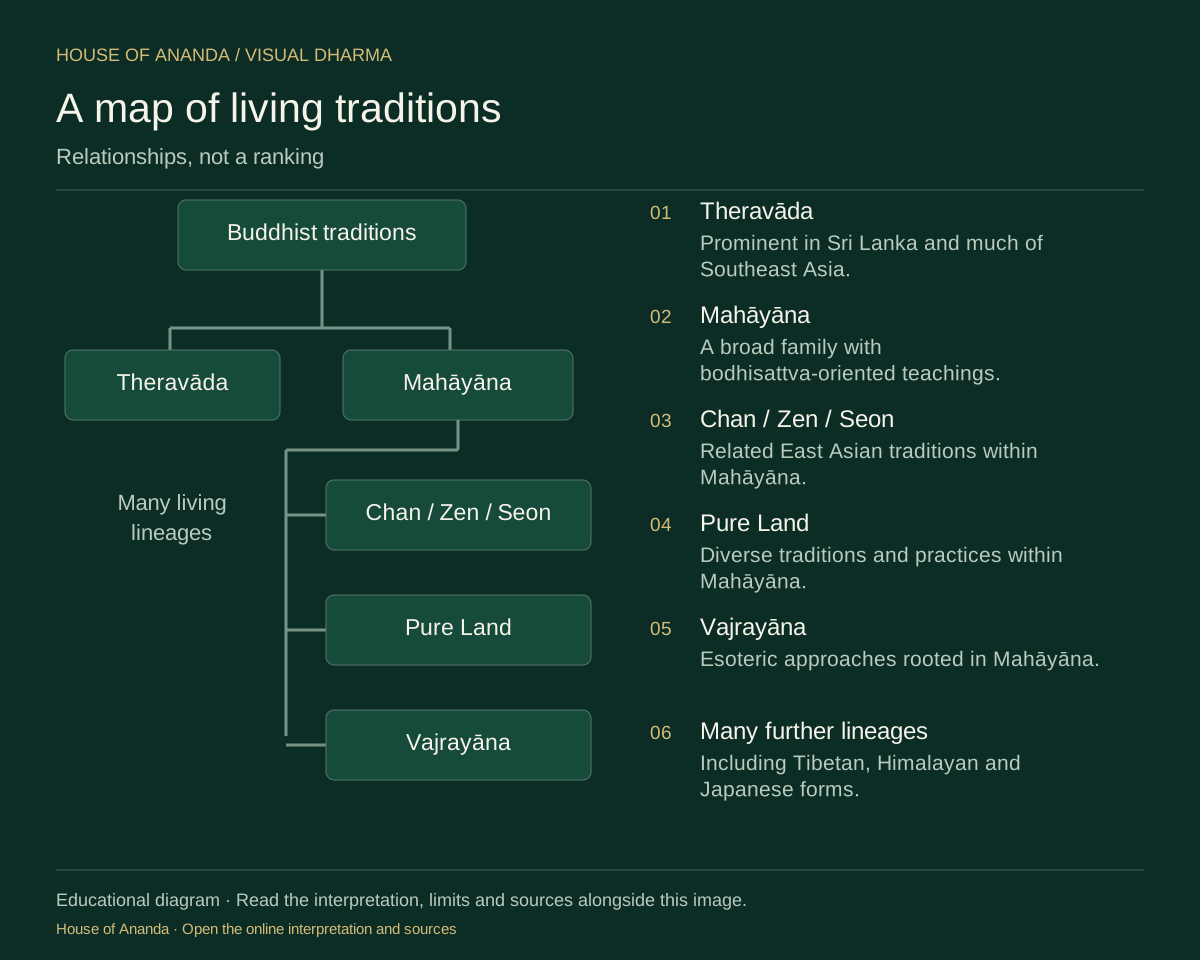
A map of living traditions. A simplified orientation to large families and selected lineages.
House of Ananda educational infographic

Relationships, not a ranking

A map of living traditions

A simplified orientation to large families and selected lineages.

Read the diagram & interpretation
  1. TheravādaProminent in Sri Lanka and much of Southeast Asia.
  2. MahāyānaA broad family with bodhisattva-oriented teachings.
  3. Chan / Zen / SeonRelated East Asian traditions within Mahāyāna.
  4. Pure LandDiverse traditions and practices within Mahāyāna.
  5. VajrayānaEsoteric approaches rooted in Mahāyāna.
  6. Many further lineagesIncluding Tibetan, Himalayan and Japanese forms.

Read the branches as broad relationships. Zen and Pure Land are not always separate memberships: practices can coexist. Vajrayāna is not a wholly independent third religion beside Mahāyāna; it develops within a Mahāyāna setting. Communities now live throughout the world.

Keep in mind This is a study map, not a complete historical family tree. Geographic associations are neither exclusive nor fixed.

Explore the teaching ↗
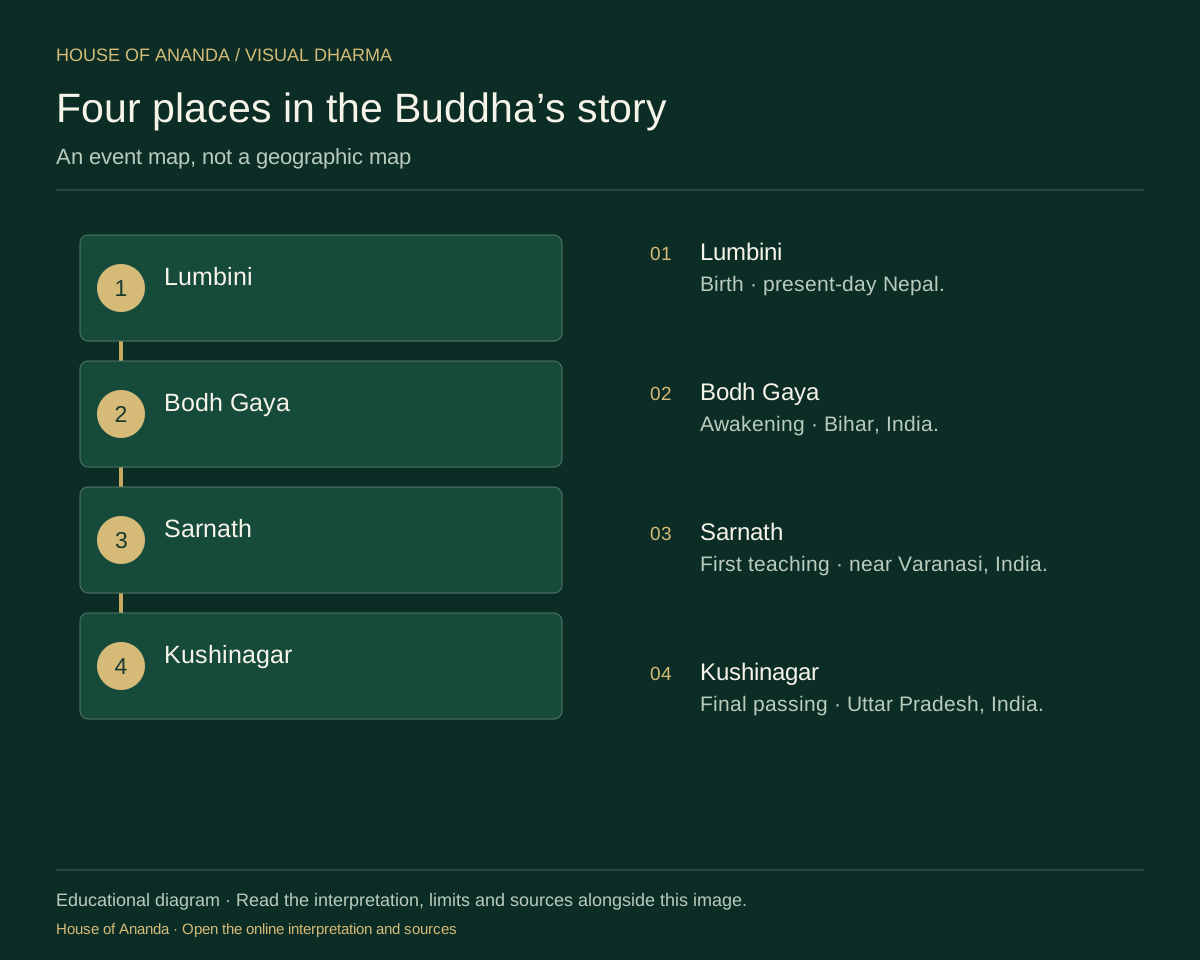
Four places in the Buddha’s story. Four pilgrimage associations connect a traditional biography to places in Nepal and India.
House of Ananda educational infographic

An event map, not a geographic map

Four places in the Buddha’s story

Four pilgrimage associations connect a traditional biography to places in Nepal and India.

Read the diagram & interpretation
  1. LumbiniBirth · present-day Nepal.
  2. Bodh GayaAwakening · Bihar, India.
  3. SarnathFirst teaching · near Varanasi, India.
  4. KushinagarFinal passing · Uttar Pradesh, India.

Read from birth to final passing. These places matter as centres of memory, devotion, archaeology and living community. The diagram arranges them by narrative order; distances and compass directions are intentionally not represented.

Keep in mind Traditional biography and archaeological evidence answer different kinds of question. The Buddha’s precise lifetime remains debated.

Explore the teaching ↗
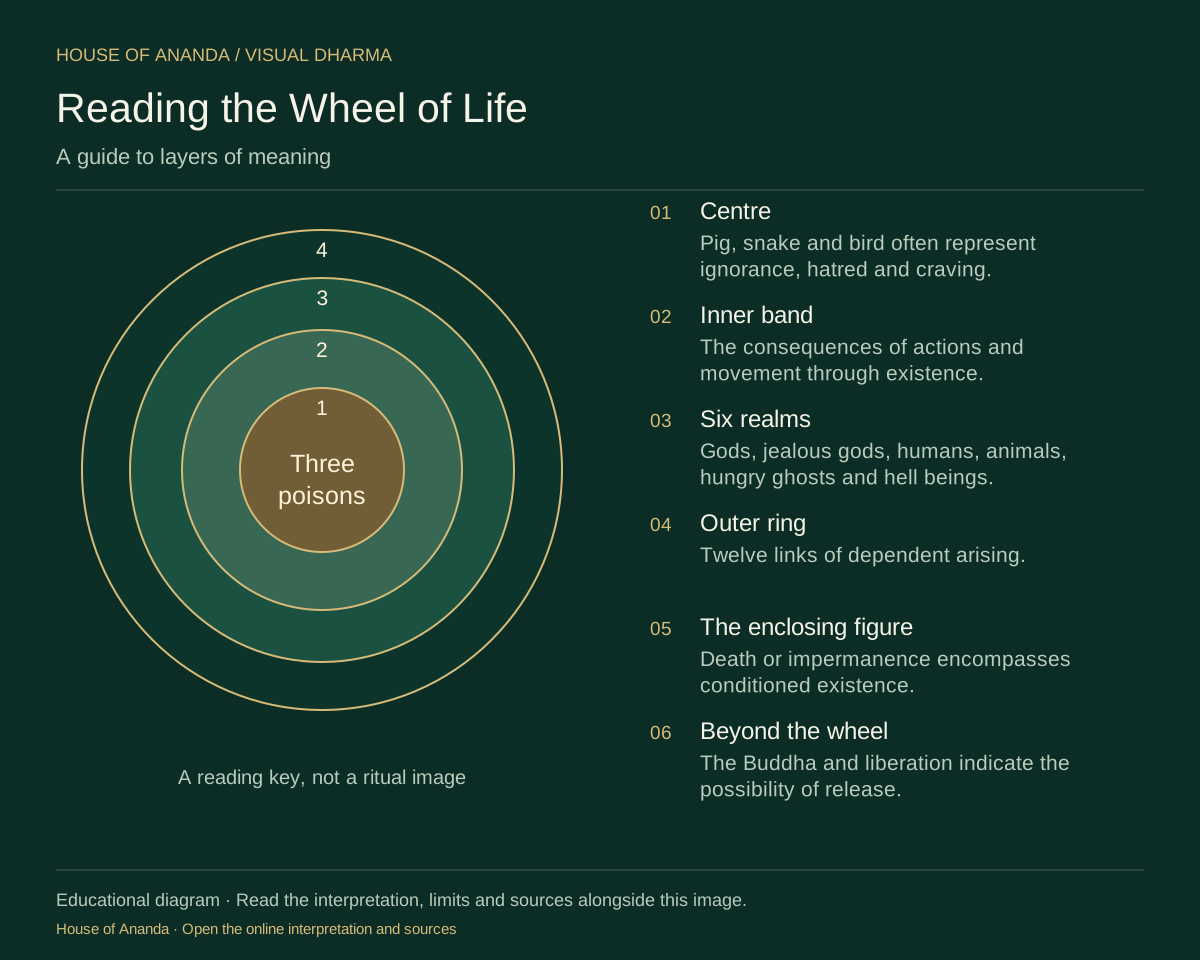
Reading the Wheel of Life. A schematic reading key for the bhavacakra found in Tibetan Buddhist art.
House of Ananda educational infographic

A guide to layers of meaning

Reading the Wheel of Life

A schematic reading key for the bhavacakra found in Tibetan Buddhist art.

Read the diagram & interpretation
  1. CentrePig, snake and bird often represent ignorance, hatred and craving.
  2. Inner bandThe consequences of actions and movement through existence.
  3. Six realmsGods, jealous gods, humans, animals, hungry ghosts and hell beings.
  4. Outer ringTwelve links of dependent arising.
  5. The enclosing figureDeath or impermanence encompasses conditioned existence.
  6. Beyond the wheelThe Buddha and liberation indicate the possibility of release.

Read inward and outward: habits, actions, kinds of existence and sustaining conditions belong to one account of saṃsāra. Traditional cosmological readings take the realms seriously as rebirth destinations; some teachers also use them to illuminate familiar states of mind. Paintings vary.

Keep in mind This labelled graphic is a modern teaching schematic, not a reproduction, a consecrated image or an exhaustive account of a particular painting.

Explore the teaching ↗
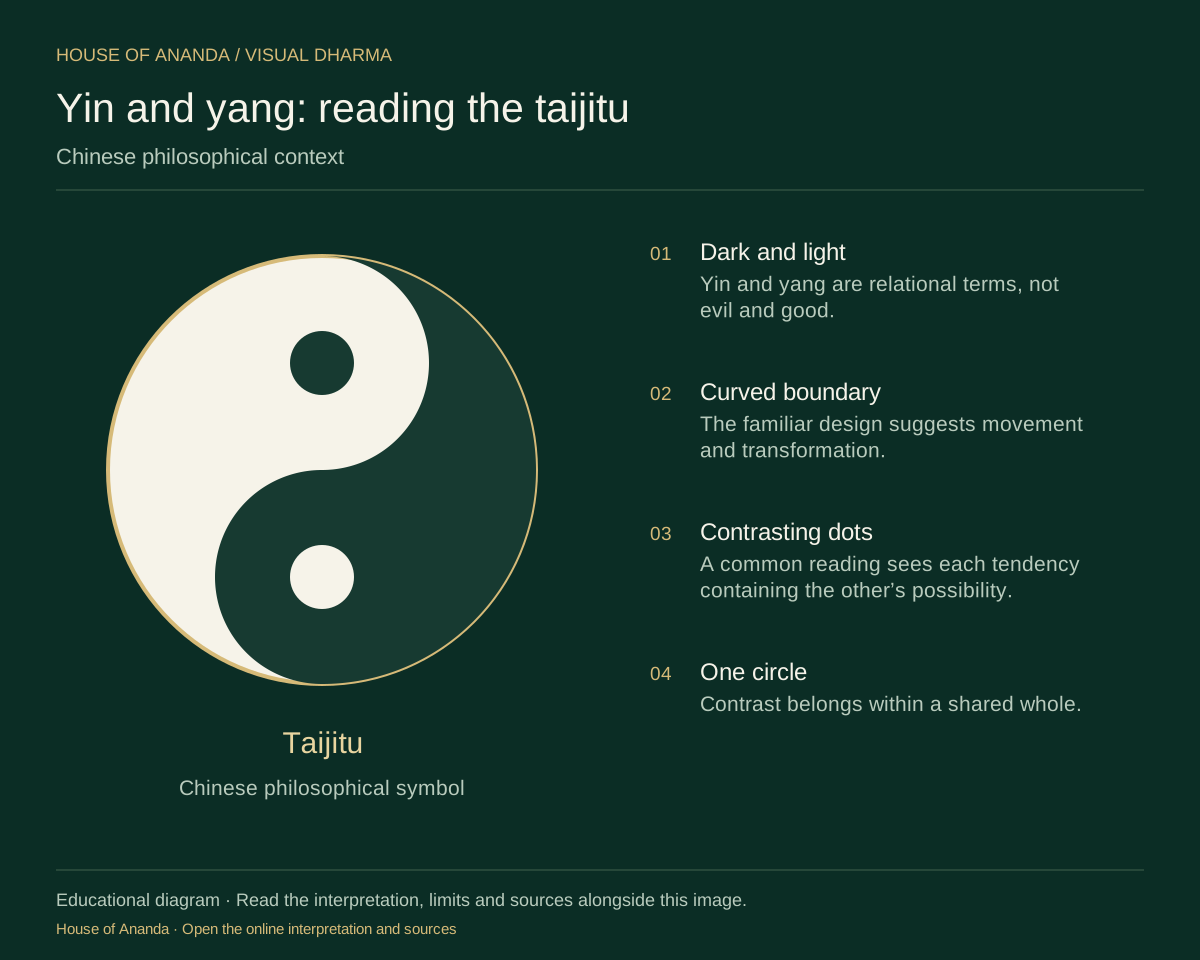
Yin and yang: reading the taijitu. The familiar dark-and-light diagram invites attention to complementary tendencies and change.
House of Ananda educational infographic

Chinese philosophical context

Yin and yang: reading the taijitu

The familiar dark-and-light diagram invites attention to complementary tendencies and change.

Read the diagram & interpretation
  1. Dark and lightYin and yang are relational terms, not evil and good.
  2. Curved boundaryThe familiar design suggests movement and transformation.
  3. Contrasting dotsA common reading sees each tendency containing the other’s possibility.
  4. One circleContrast belongs within a shared whole.

Yin and yang are important across Chinese intellectual and cultural traditions, including Daoist and Confucian thought. The familiar taijitu is not a core emblem taught by the historical Buddha. Chinese Buddhism developed in conversation with this wider culture without becoming identical to it.

Keep in mind The diagram is not a scientific measurement, a fixed personality test or a reason to assign rigid roles to women and men.

Explore the teaching ↗
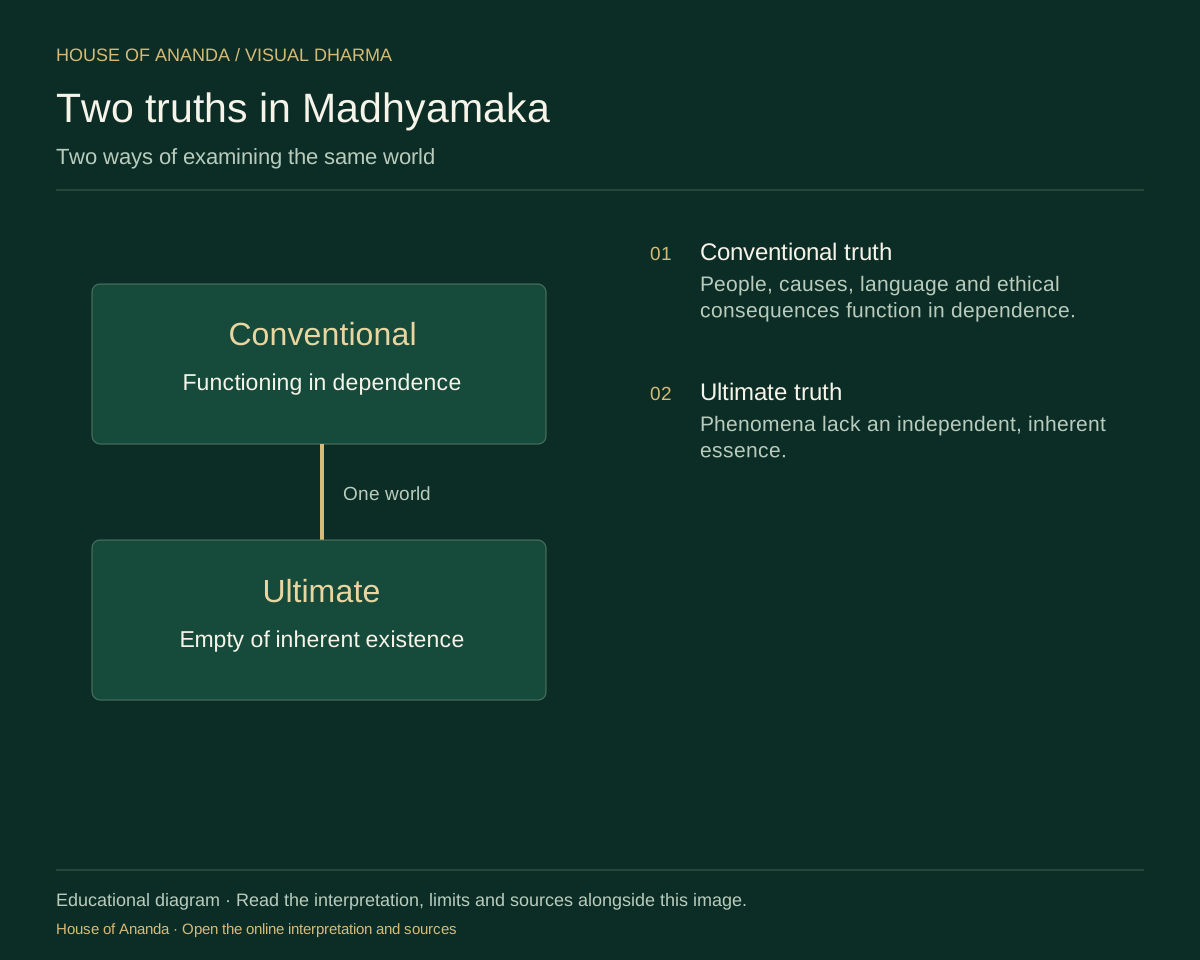
Two truths in Madhyamaka. An introductory map of conventional and ultimate truth in a Mahāyāna philosophical tradition.
House of Ananda educational infographic

Two ways of examining the same world

Two truths in Madhyamaka

An introductory map of conventional and ultimate truth in a Mahāyāna philosophical tradition.

Read the diagram & interpretation
  1. Conventional truthPeople, causes, language and ethical consequences function in dependence.
  2. Ultimate truthPhenomena lack an independent, inherent essence.

The two panels are connected because emptiness does not erase conventional functioning. A person can lack an independent essence and still be someone whose pain matters. This framing follows a Madhyamaka context; Buddhist schools differ on how the two truths are explained.

Keep in mind “Empty” does not mean nonexistent. The panels do not depict two separate worlds or a good reality above a bad one.

Explore the teaching ↗
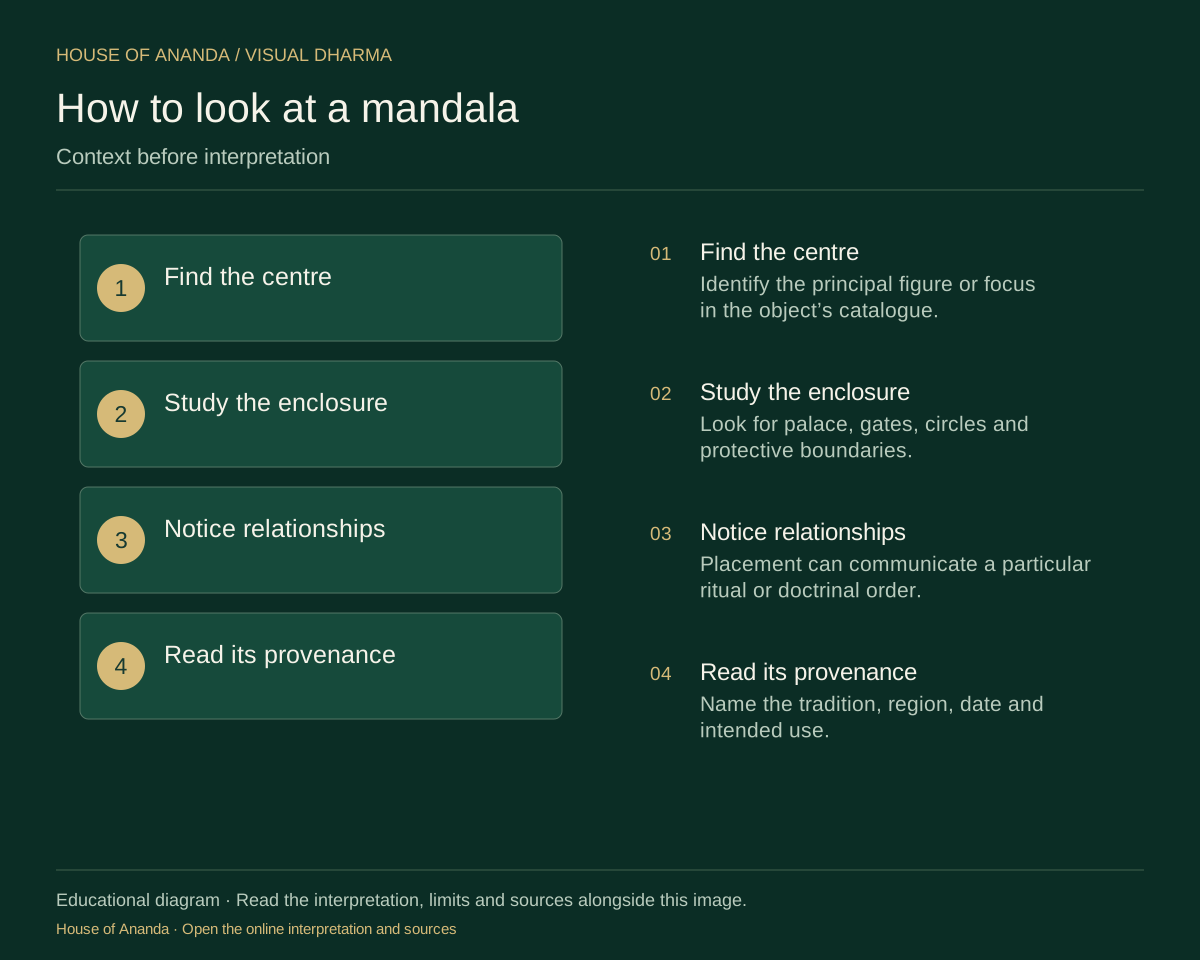
How to look at a mandala. A viewing guide for a sacred arrangement, not a universal symbolic decoder.
House of Ananda educational infographic

Context before interpretation

How to look at a mandala

A viewing guide for a sacred arrangement, not a universal symbolic decoder.

Read the diagram & interpretation
  1. Find the centreIdentify the principal figure or focus in the object’s catalogue.
  2. Study the enclosureLook for palace, gates, circles and protective boundaries.
  3. Notice relationshipsPlacement can communicate a particular ritual or doctrinal order.
  4. Read its provenanceName the tradition, region, date and intended use.

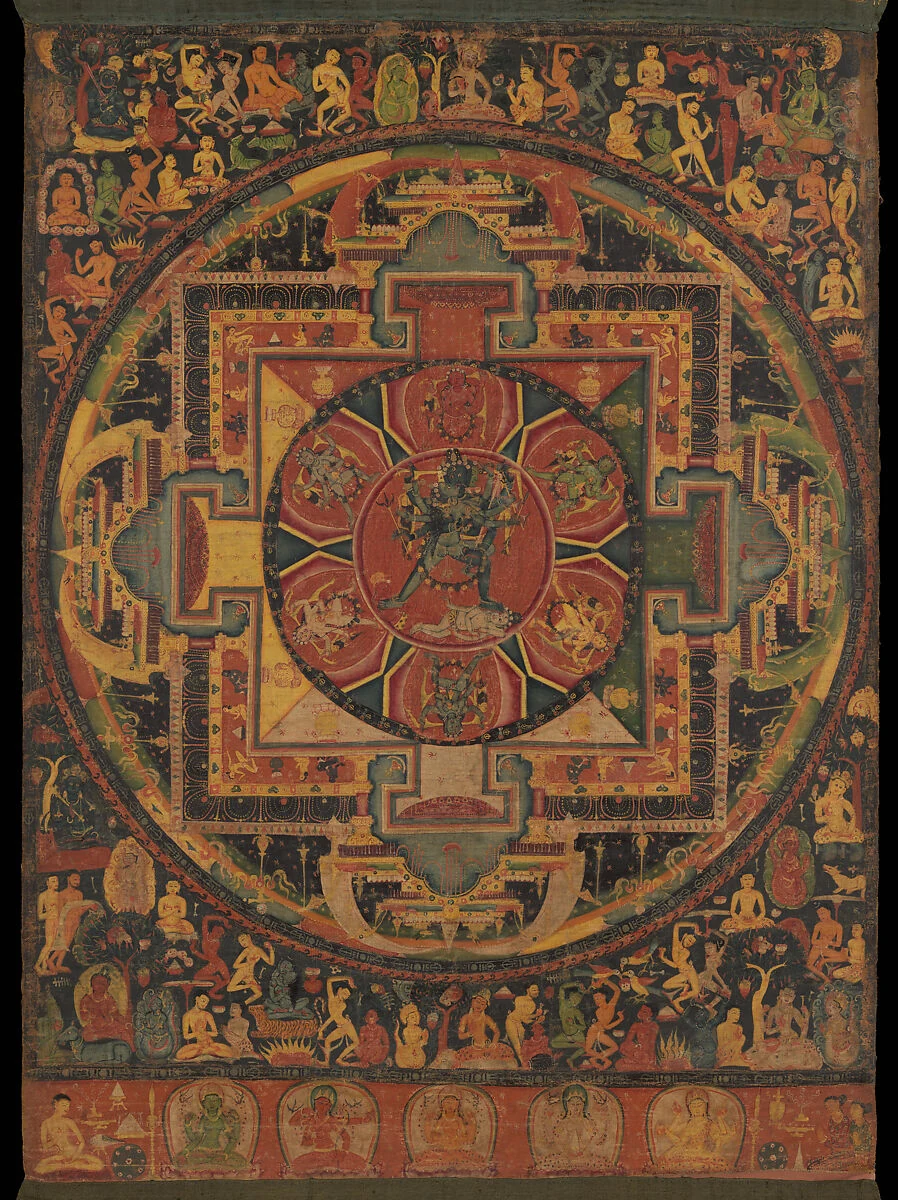
Mandalas have different structures and functions. The Nepalese Chakrasamvara mandala in this collection represents a specific sacred assembly; its figures cannot be replaced with a generic explanation about balance. A contemporary radial pattern may be beautiful without having this ritual identity.

Keep in mind This is an art-reading sequence. It is not an initiation or an instruction to perform a restricted visualisation.

Explore the teaching ↗
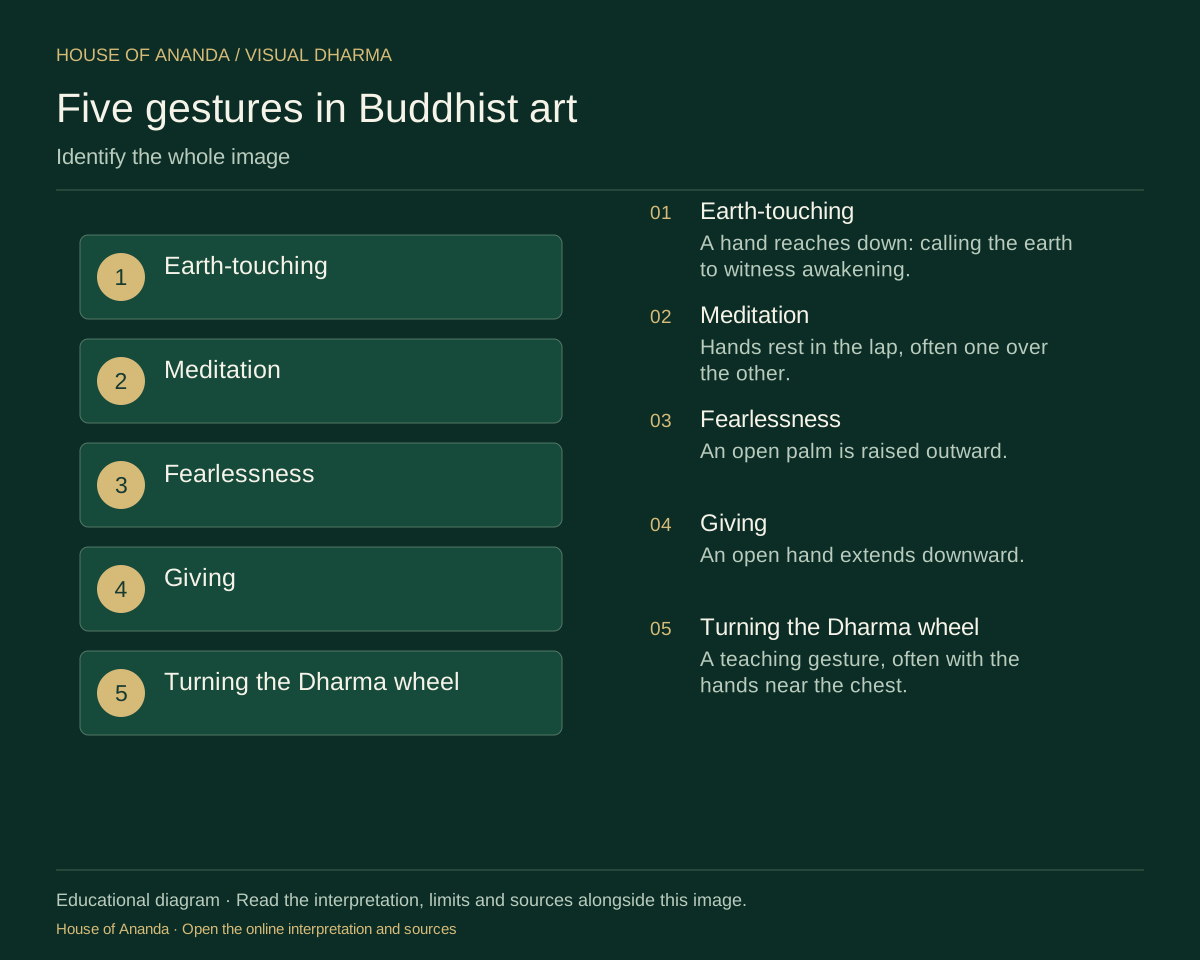
Five gestures in Buddhist art. Common hand gestures offer clues to what an image expresses.
House of Ananda educational infographic

Identify the whole image

Five gestures in Buddhist art

Common hand gestures offer clues to what an image expresses.

Read the diagram & interpretation
  1. Earth-touchingA hand reaches down: calling the earth to witness awakening.
  2. MeditationHands rest in the lap, often one over the other.
  3. FearlessnessAn open palm is raised outward.
  4. GivingAn open hand extends downward.
  5. Turning the Dharma wheelA teaching gesture, often with the hands near the chest.

Look at palm direction, hand position and the surrounding story. Similar gestures can differ across regions and periods. A catalogue identification should take precedence over guessing from one feature. The historical sculptures below provide real examples to examine.

Keep in mind A hand position alone cannot reliably identify every figure. This guide describes art and does not teach esoteric ritual hand sequences.

Explore the teaching ↗
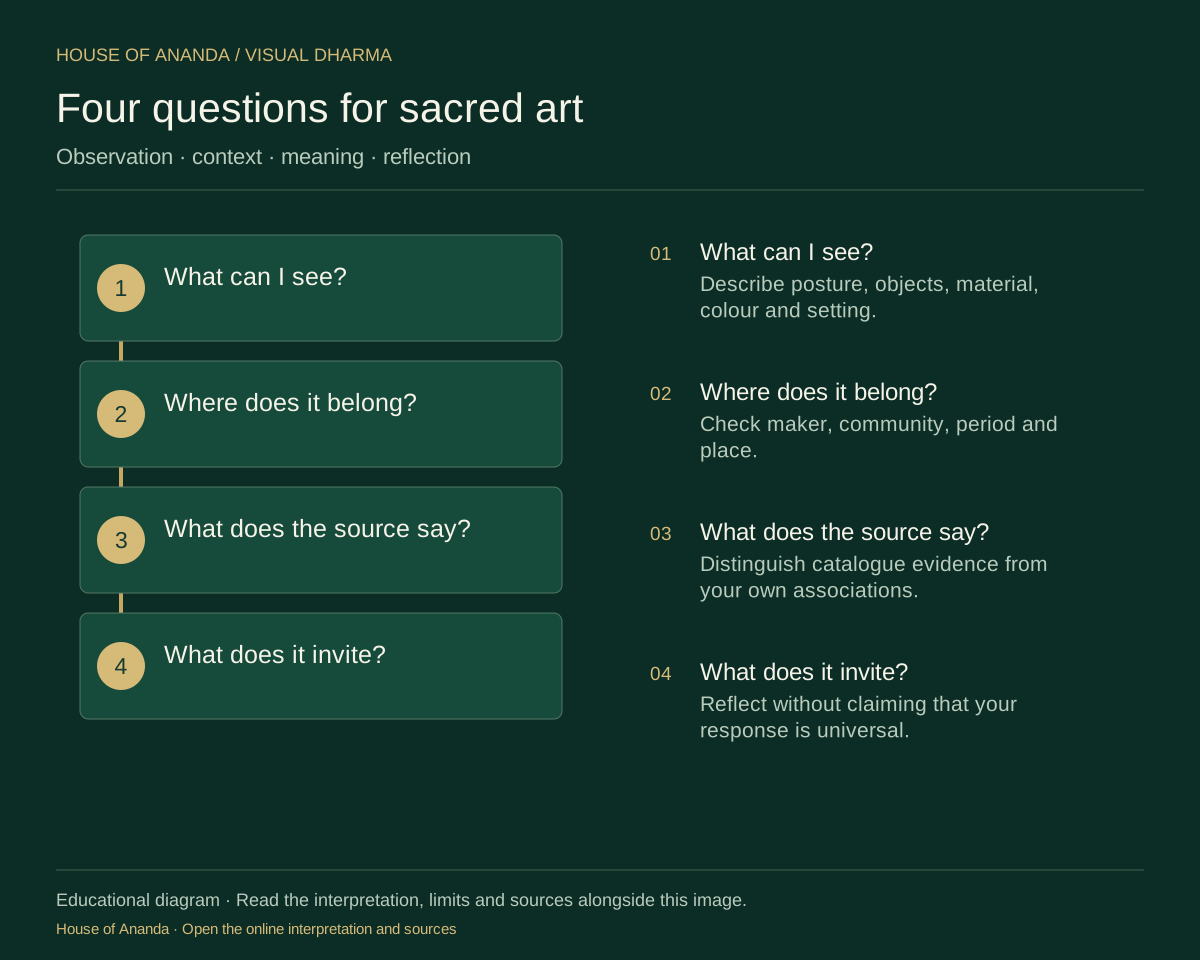
Four questions for sacred art. A practical way to make visual study more thoughtful.
House of Ananda educational infographic

Observation · context · meaning · reflection

Four questions for sacred art

A practical way to make visual study more thoughtful.

Read the diagram & interpretation
  1. What can I see?Describe posture, objects, material, colour and setting.
  2. Where does it belong?Check maker, community, period and place.
  3. What does the source say?Distinguish catalogue evidence from your own associations.
  4. What does it invite?Reflect without claiming that your response is universal.

Begin with observable detail, then consult reliable context. An image may serve devotion, teaching, ritual, remembrance or several purposes at once. Ask what is known and what is inferred. The maker’s community may understand a detail differently from a modern museum visitor.

Keep in mind These four questions are an original House of Ananda study framework, not a traditional Buddhist list.

Explore the teaching ↗

02 · A language of auspiciousness

Eight symbols, many layers

A common Tibetan Buddhist set. Forms, ordering and interpretations vary; each explanation is a starting point for study.

Read the full guide to the eight symbols ↗
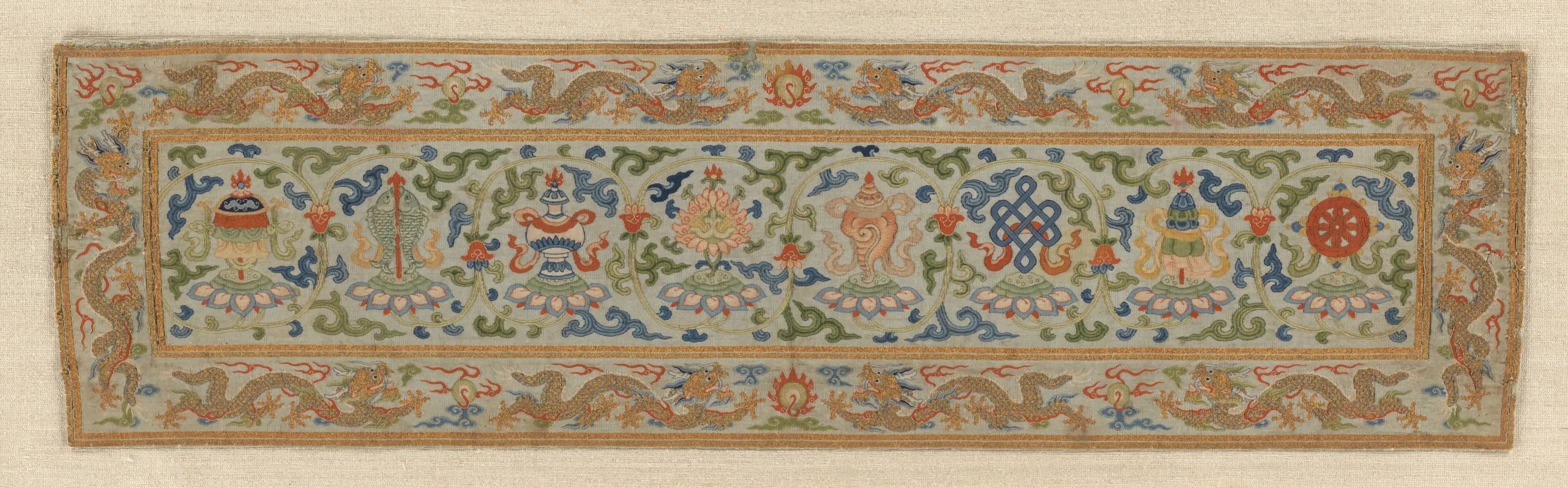
A Chinese silk sutra cover displaying eight auspicious emblems from left to right: parasol, fish, vase, lotus, conch, knot, canopy and wheel.
Sutra Cover with Eight Buddhist Treasures · China · 18th century. The Met names the seventh emblem a canopy; it occupies the place of the banner in this Chinese presentation.
  1. 1. Parasol
  2. 2. Two fish
  3. 3. Treasure vase
  4. 4. Lotus
  5. 5. Conch
  6. 6. Endless knot
  7. 7. Canopy / banner
  8. 8. Dharma wheel

Artist unknown · The Metropolitan Museum of Art · 2012.559. Purchase, Barbara and William Karatz Gift, in honor of James C. Y. Watt, 2012. Object / image record ↗ · Public domain / CC0. Resized and converted to WebP; image content unchanged.

Dharma wheel — a traditional-style illustration of the auspicious symbol.

01 · Dharmacakra

Dharma wheel

The wheel represents the Buddha’s teaching. Eight spokes commonly recall the eight factors of the path.

Interpretation & reflection

Look closely. Notice the relationship of hub, spokes and rim: distinct parts make one functioning wheel. The eightfold association is especially useful when the image actually has eight spokes.

A question. Which part of the path needs attention in your daily life?

The Dharma wheel and the Wheel of Life are different images with different teaching functions.

Christopher J. Fynn. Object / image record ↗ · CC BY-SA 4.0. Original SVG, unmodified.

Read in context ↗
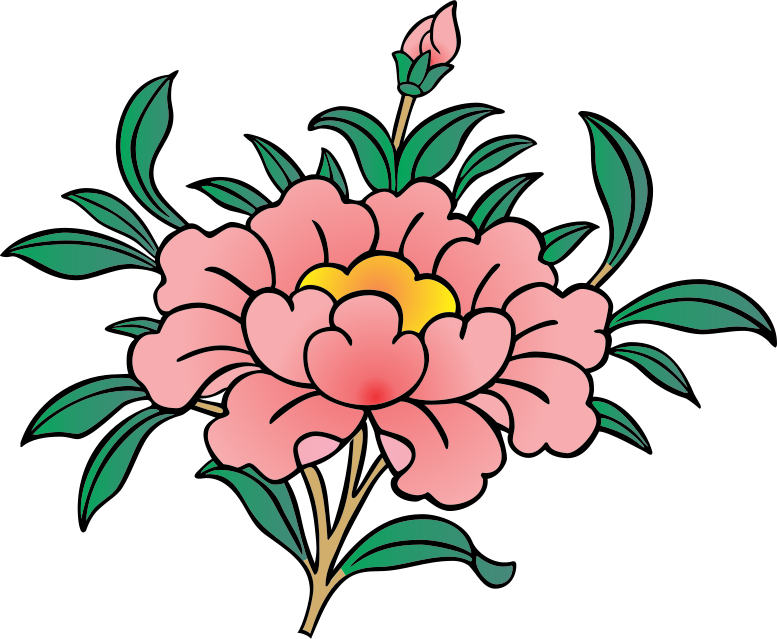
Lotus — a traditional-style illustration of the auspicious symbol.

02 · Padma

Lotus

A widespread image of purity and awakening, expressed through a flower associated with water and mud.

Interpretation & reflection

Look closely. Look at bud, open petals, stem and seat. A lotus held by a figure is an attribute within a particular image; a lotus throne can carry another layer of meaning.

A question. What might grow through care within conditions you cannot make perfect?

Colour associations depend on tradition and context; a modern coloured flower is not enough to identify a deity.

Christopher J. Fynn. Object / image record ↗ · CC BY-SA 4.0. Original SVG, unmodified.

Read in context ↗
Endless knot detail from the eighteenth-century Chinese sutra cover.

03 · Śrīvatsa · glorious knot

Endless knot

A continuous interlaced design associated with the Buddha’s inexhaustible wisdom; it can also invite reflection on relationship and continuity.

Interpretation & reflection

Look closely. Trace the interwoven line. Notice how crossing and connection make a pattern without a prominently declared beginning or end.

A question. Which relationships support something you usually think of as your own achievement?

A personal reflection about connection is not a complete explanation of every ritual use of this design.

Detail displayed from the historical sutra cover shown above. Open the image to see the whole textile.

Artist unknown · The Metropolitan Museum of Art · 2012.559. Purchase, Barbara and William Karatz Gift, in honor of James C. Y. Watt, 2012. Object / image record ↗ · Public domain / CC0. Resized and converted to WebP; image content unchanged.
Read in context ↗
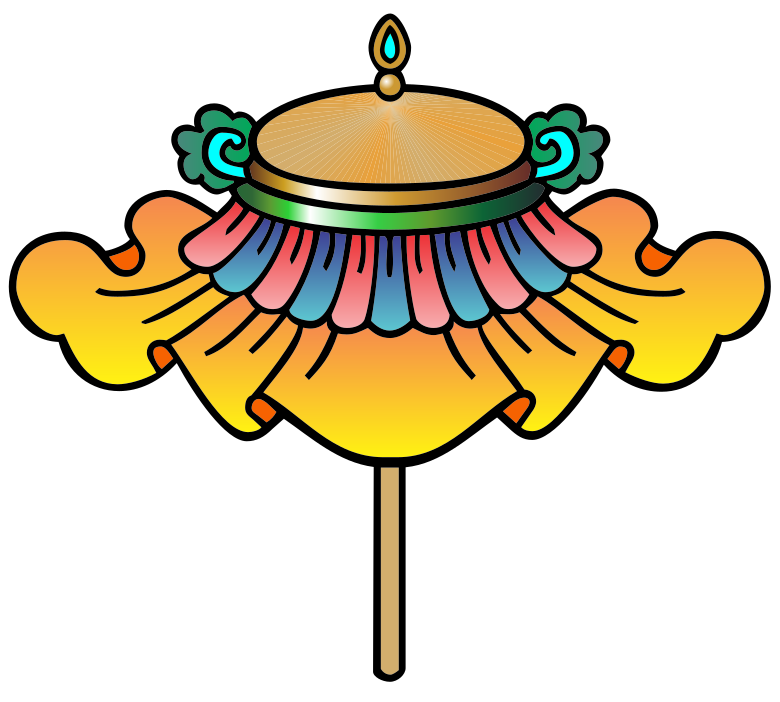
Precious parasol — a traditional-style illustration of the auspicious symbol.

04 · Chatra

Precious parasol

A sign associated with dignity and spiritual protection, drawing on the elevated status of the royal umbrella.

Interpretation & reflection

Look closely. Notice the canopy, handle and hanging ornaments. The canopy’s ordinary ability to provide shade helps make the image of shelter understandable.

A question. What kind of environment helps people feel able to learn and practise?

A symbol of protection is not a guarantee that difficult events cannot happen.

Christopher J. Fynn. Object / image record ↗ · CC BY-SA 4.0. Original SVG, unmodified.

Read in context ↗
Two golden fish detail from the eighteenth-century Chinese sutra cover.

05 · Suvarṇamatsya

Two golden fish

The paired fish are auspicious emblems associated with good fortune and freedom.

Interpretation & reflection

Look closely. Observe the two bodies, their orientation and their relationship. Pairing is a visible feature of this symbol; it should not automatically be read as the Chinese yin–yang diagram.

A question. Where does fear make your actions more constrained than they need to be?

The fish appear within a particular family of auspicious symbols. Similar-looking fish in another culture may mean something different.

Detail displayed from the historical sutra cover shown above. Open the image to see the whole textile.

Artist unknown · The Metropolitan Museum of Art · 2012.559. Purchase, Barbara and William Karatz Gift, in honor of James C. Y. Watt, 2012. Object / image record ↗ · Public domain / CC0. Resized and converted to WebP; image content unchanged.
Read in context ↗
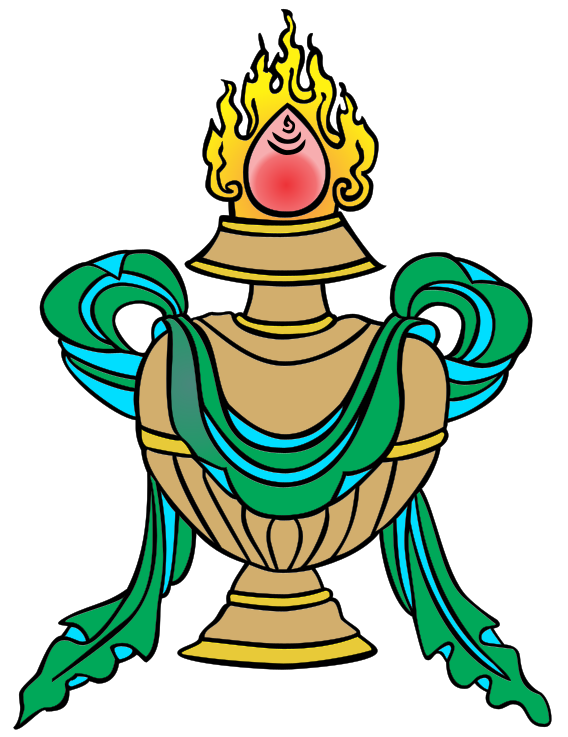
Treasure vase — a traditional-style illustration of the auspicious symbol.

06 · Kalaśa · bumpa

Treasure vase

A symbol of abundance, including material well-being and spiritual riches.

Interpretation & reflection

Look closely. Identify the rounded vessel, its neck, covering and jewel-like details. Its recognisable container form gives the idea of holding something precious a visual presence.

A question. What form of generosity can increase well-being without merely accumulating more possessions?

Its auspicious meaning should not be turned into a promise of wealth from displaying an image.

Christopher J. Fynn. Object / image record ↗ · CC BY-SA 4.0. Original SVG, unmodified.

Read in context ↗
Right-turning conch detail from the eighteenth-century Chinese sutra cover.

07 · Śaṅkha

Right-turning conch

The conch is associated with the proclamation and spreading of the Buddha’s teaching.

Interpretation & reflection

Look closely. Notice the spiral and its direction. A shell can also be a sounding instrument, making the association with a teaching heard by others especially vivid.

A question. What makes a message worth listening to: its volume, its truthfulness or its usefulness?

This symbol is usually specified as right-turning; mirrored decorative reproductions can lose that distinction.

Detail displayed from the historical sutra cover shown above. Open the image to see the whole textile.

Artist unknown · The Metropolitan Museum of Art · 2012.559. Purchase, Barbara and William Karatz Gift, in honor of James C. Y. Watt, 2012. Object / image record ↗ · Public domain / CC0. Resized and converted to WebP; image content unchanged.
Read in context ↗
Victory banner detail from the eighteenth-century Chinese sutra cover.

08 · Dhvaja

Victory banner

An emblem of the teaching and wisdom overcoming ignorance.

Interpretation & reflection

Look closely. Notice its upright form and stacked or hanging fabric elements. The language of victory is directed toward freedom from affliction, not contempt for another community.

A question. What would it mean to overcome a harmful habit without hating yourself?

Spiritual victory is not a claim that Buddhists should dominate people of other beliefs.

Detail displayed from the historical sutra cover shown above. Open the image to see the whole textile.

Artist unknown · The Metropolitan Museum of Art · 2012.559. Purchase, Barbara and William Karatz Gift, in honor of James C. Y. Watt, 2012. Object / image record ↗ · Public domain / CC0. Resized and converted to WebP; image content unchanged.
Read in context ↗

03 · Encounter the historical image

Art, gesture & sacred presence

Meet Buddhas and bodhisattvas, examine ritual implements and look closely at a historical mandala. Open each image to enlarge it; follow its record for the collection’s interpretation.

How to read Buddhist sacred art ↗
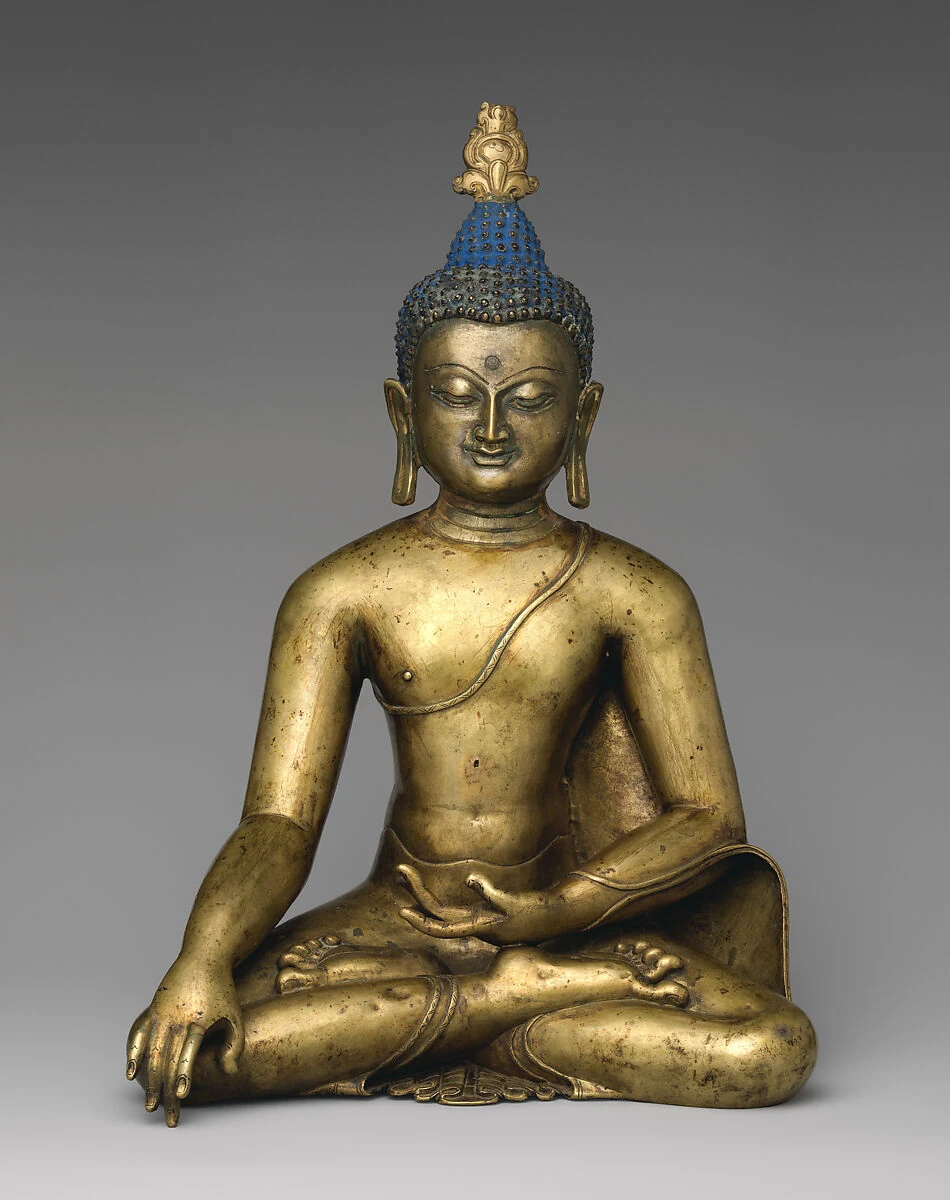
Seated bronze Buddha with the right hand reaching down and the left hand resting in the lap.
Buddha Shakyamuni · Central Tibet · 12th century

Buddha & gesture

Śākyamuni: the earth as witness

The downward right hand is the earth-touching gesture, associated with the traditional story of awakening. The robe and seated posture help establish the figure’s contemplative setting. This is a twelfth-century Central Tibetan sculpture, rather than a portrait made during the Buddha’s lifetime.

Look closelyCompare the lowered right hand with the left hand in the lap. What story does this difference tell?

Continue studying ↗

Artist unknown · The Metropolitan Museum of Art · 2012.458. Object / image record ↗ · Public domain / CC0. Resized and converted to WebP; image content unchanged.
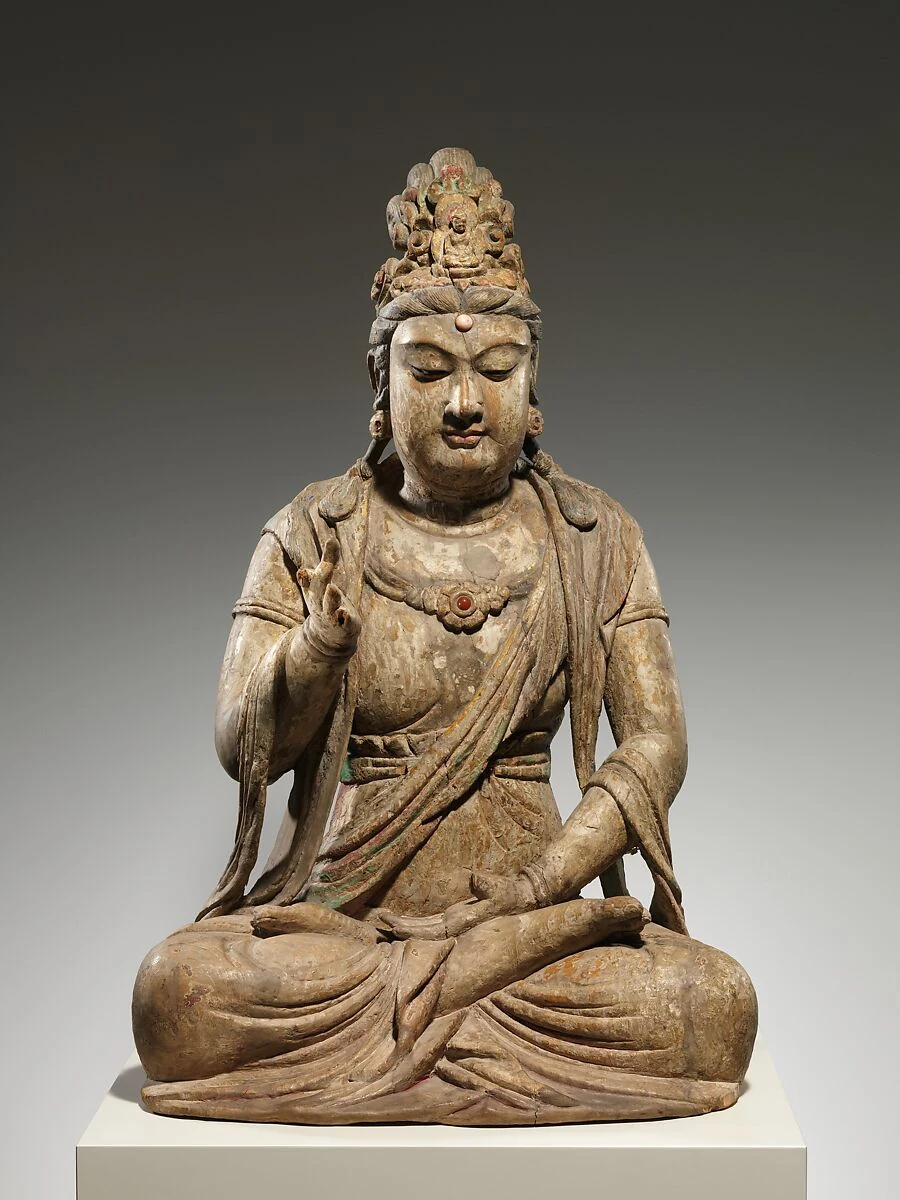
A carved seated Guanyin figure wearing an ornate crown, with layered robes and jewellery.
Bodhisattva Avalokiteshvara (Guanyin) · China · late 10th–early 11th century

Bodhisattva

Avalokiteśvara / Guanyin: compassion

Avalokiteśvara is associated with compassion; Guanyin is the Chinese name. This Chinese sculpture belongs to a long and varied history of the figure’s representation. Its particular posture should be studied through the object record rather than assumed to be the standard form everywhere.

Look closelyNotice the ornament and headdress. Compare them with the plain robe of the Śākyamuni sculpture.

Continue studying ↗

Artist unknown · The Metropolitan Museum of Art · 33.116. Object / image record ↗ · Public domain / CC0. Resized and converted to WebP; image content unchanged.
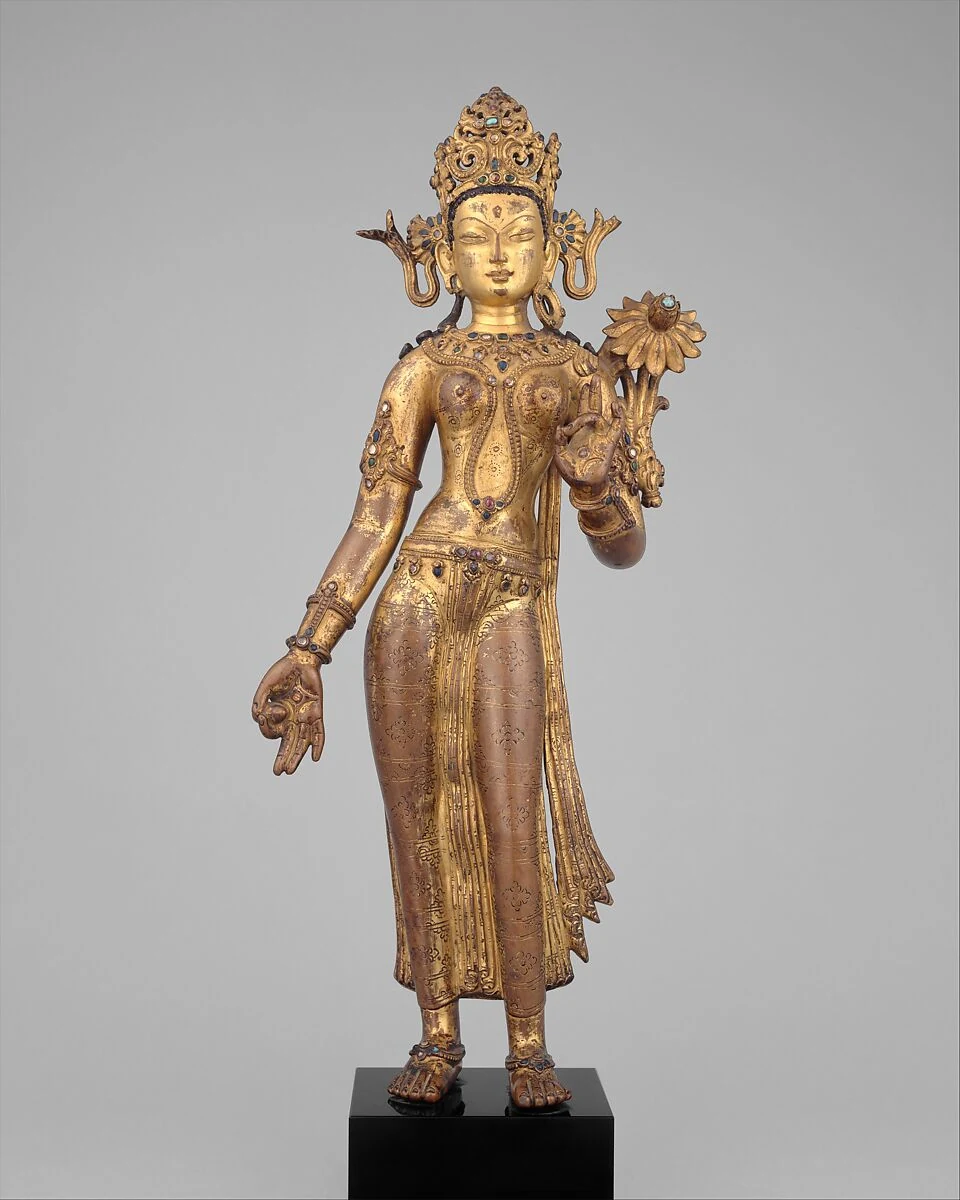
A standing bronze Tara with a high crown, a lowered open hand and a lotus at the shoulder.
Tara, the Buddhist Savior · Nepal, Kathmandu Valley · 14th century

Sacred figure

Tārā: responsive care

The Met identifies this Nepalese figure as probably White Tārā. The lowered hand expresses giving, and the lotus is an important attribute. Tārā has multiple forms, so this example should not be renamed Green Tārā merely because that form is widely familiar.

Look closelyFollow the line from the lower hand to the upper body and the flower. How does the standing posture affect your response?

Continue studying ↗

Artist unknown · The Metropolitan Museum of Art · 66.179. Object / image record ↗ · Public domain / CC0. Resized and converted to WebP; image content unchanged.
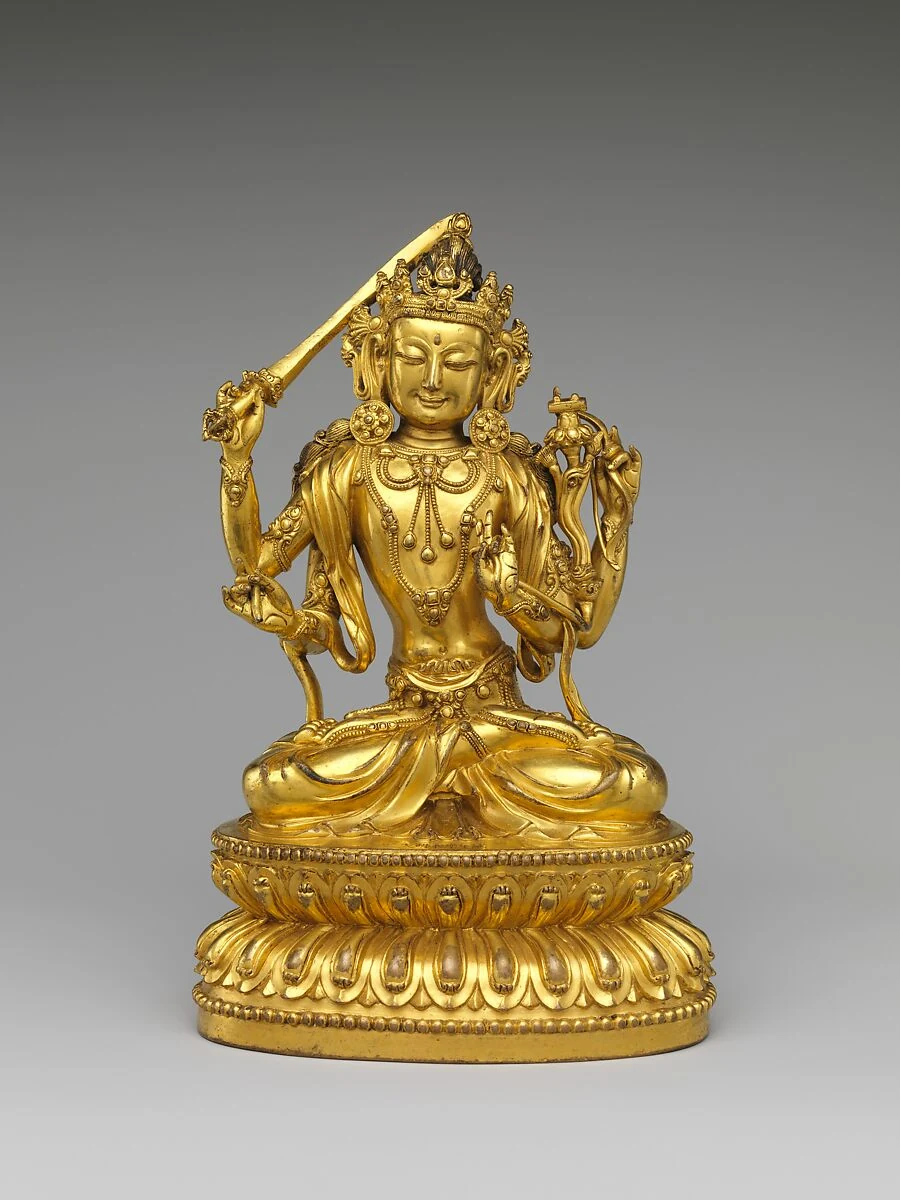
A gilded four-armed Manjushri seated on a lotus pedestal, holding attributes including a sword and book.
Bodhisattva Manjushri · China · Yongle period (1403–24)

Bodhisattva

Mañjuśrī: the clarity of wisdom

Mañjuśrī is associated with wisdom. In this Chinese image, the sword and book help communicate that identity: the sword is read in relation to cutting through ignorance, while the book points toward wisdom teaching. Several arms allow several attributes to be represented together.

Look closelyFind the attributes before reading them as symbols. Which would be difficult to recognise without a catalogue?

Continue studying ↗

Artist unknown · The Metropolitan Museum of Art · 2001.59. Object / image record ↗ · Public domain / CC0. Resized and converted to WebP; image content unchanged.
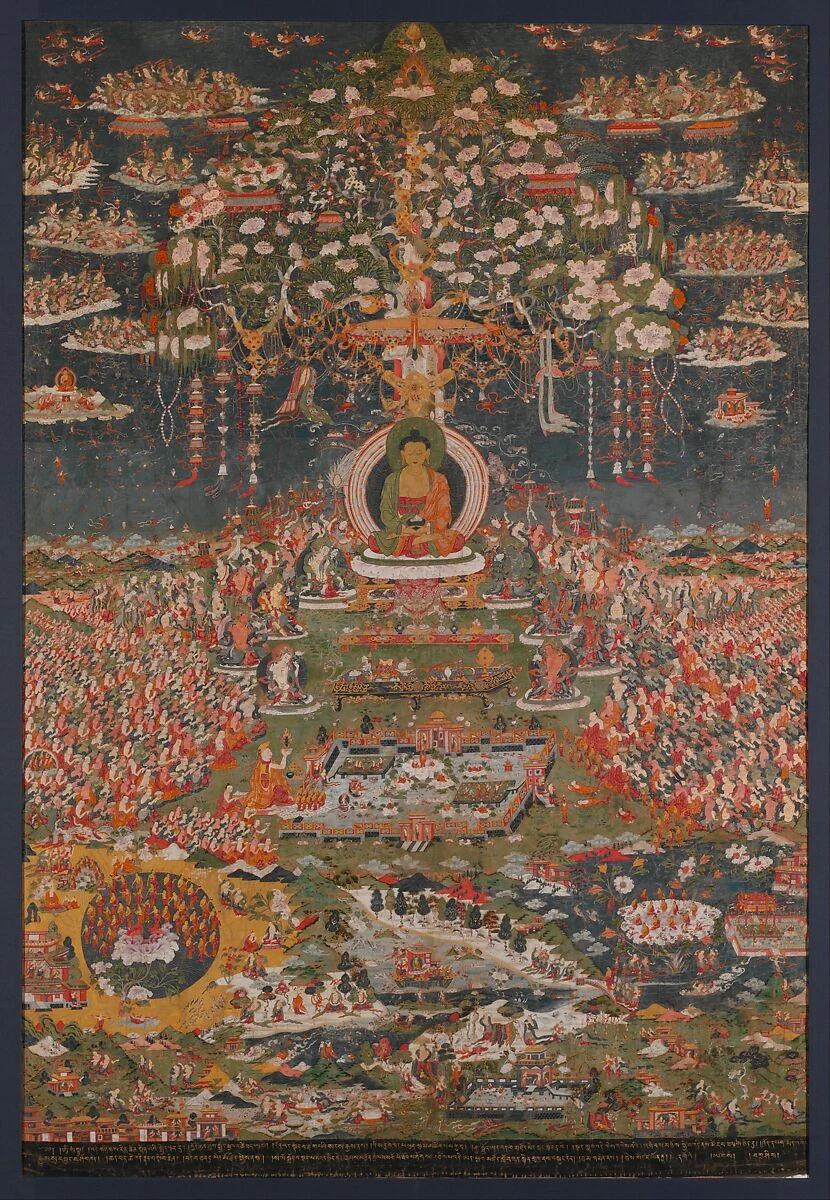
A Tibetan painting showing Amitabha seated centrally within a densely populated sacred landscape.
Amitabha, the Buddha of the Western Pure Land (Sukhavati) · Central Tibet · ca. 1700

Buddha & sacred landscape

Amitābha and the Pure Land

This Tibetan painting places Amitābha within Sukhāvatī, the Western Pure Land. It is a sacred landscape shaped by Buddhist devotion and imagination, not a map to a physical travel destination. Pure Land teachings and practices have distinct expressions across Buddhist communities.

Look closelyBegin with the central Buddha, then examine how the surrounding figures and landscape direct attention back toward the centre.

Continue studying ↗

Artist unknown · The Metropolitan Museum of Art · 2004.139. Object / image record ↗ · Public domain / CC0. Resized and converted to WebP; image content unchanged.
An early Nepalese mandala painting with central figures, surrounding circles and registers of sacred figures.
Chakrasamvara Mandala · Nepal · ca. 1100

Ritual painting

A mandala as sacred arrangement

This Nepalese painting, dated around 1100, depicts Chakrasamvara and Vajravarahi within a specific tantric assembly. Its placement of figures communicates a particular sacred order. It offers a historical example against which to distinguish modern ornamental circular patterns.

Look closelyLook for centre, surrounding assembly and outer registers. Use the museum explanation before assigning meanings to individual figures.

Continue studying ↗

Artist unknown · The Metropolitan Museum of Art · 1995.233. Object / image record ↗ · Public domain / CC0. Resized and converted to WebP; image content unchanged.
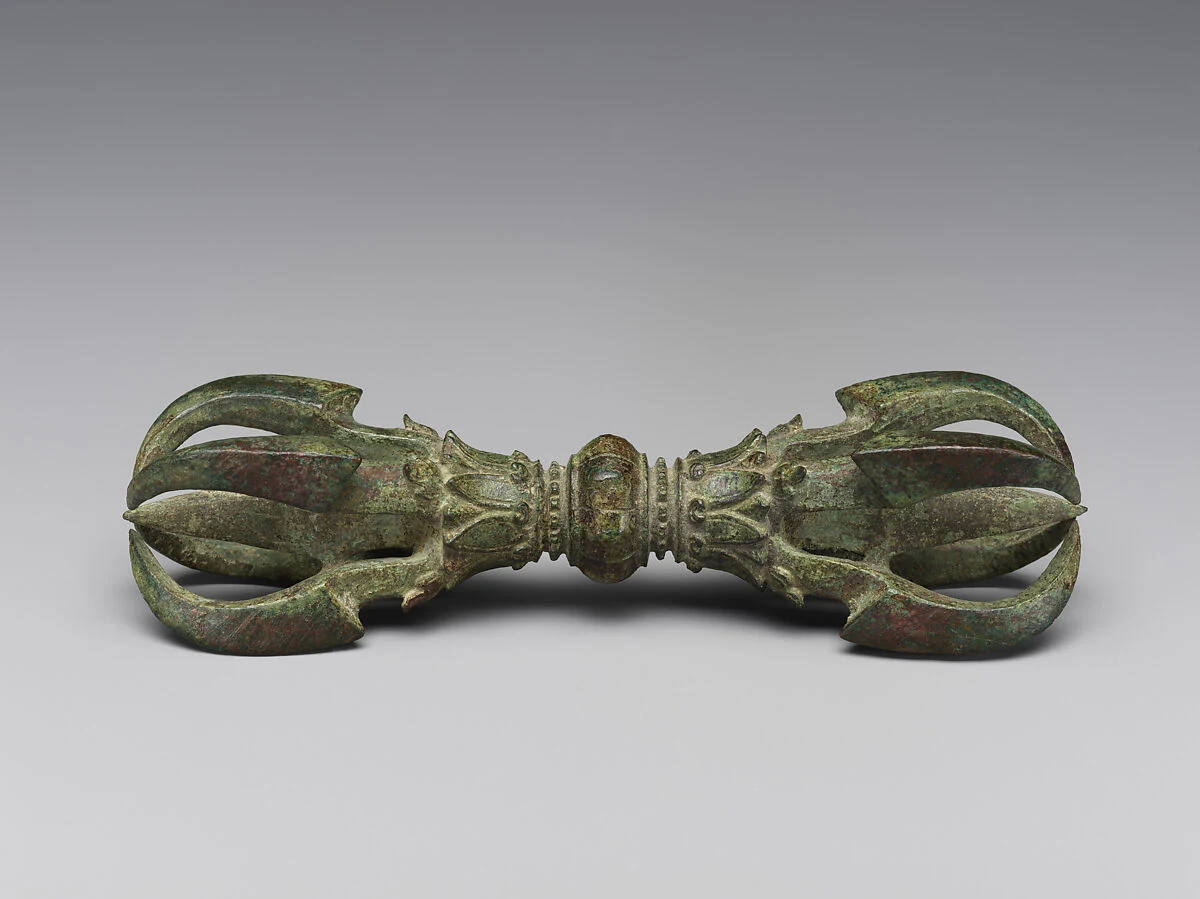
A horizontal metal vajra with prongs curving toward the ends and a narrow central grip.
Vajra · Indonesia, Java · ca. 10th century

Ritual object

Vajra: a ritual implement from Java

This Javanese object shows the double-ended form of a vajra. In common tantric Buddhist explanations, the vajra is associated with compassionate method and paired symbolically with the wisdom of the bell. Its geographic origin is part of its history and should not be replaced with a generic Tibetan label.

Look closelyNotice symmetry, prongs and central grip. Ask how a hand-held object differs from an image painted on a wall.

Continue studying ↗

Artist unknown · The Metropolitan Museum of Art · 1987.142.297. Object / image record ↗ · Public domain / CC0. Resized and converted to WebP; image content unchanged.
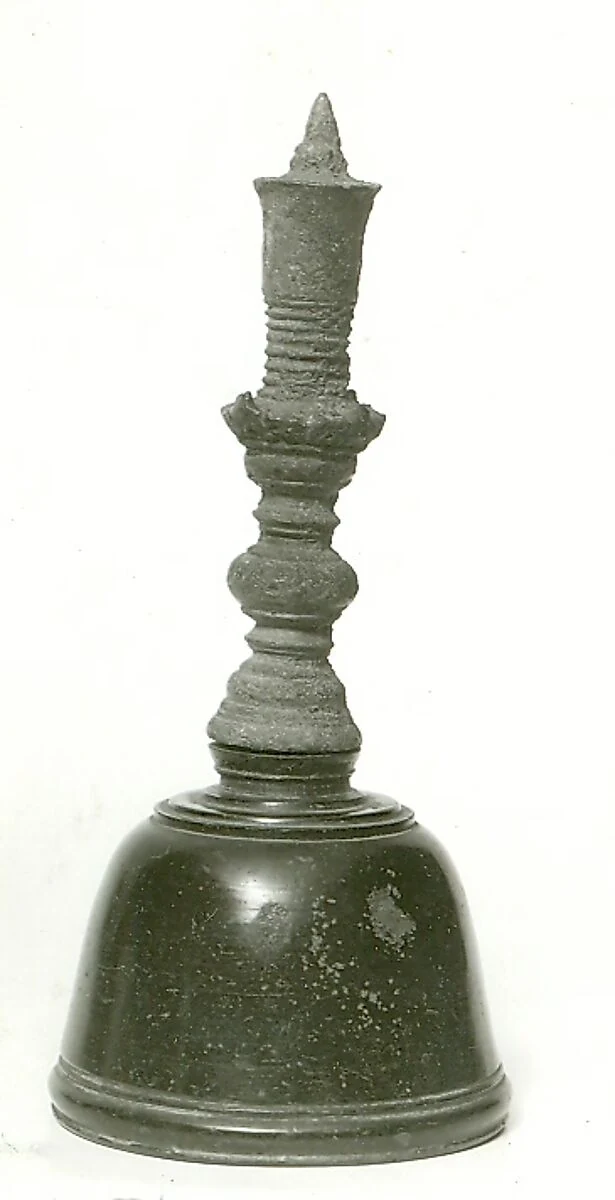
A historical metal prayer bell with a broad bell body and a decorated upright handle.
Gheṇṭa (prayer bell) · East Java, Indonesia · 11th century

Ritual object

A prayer bell from East Java

This eleventh-century Javanese bell belongs to a history of ritual instruments. The bell can represent wisdom in tantric Buddhist pairings with the vajra. These two museum objects are shown for comparison and are not documented as an original matched set.

Look closelyConsider sound as well as shape. A photograph records an object’s appearance but not the ceremony in which it was used.

Continue studying ↗

Artist unknown · The Metropolitan Museum of Art · 30.87.4. Object / image record ↗ · Public domain / CC0. Resized and converted to WebP; image content unchanged.
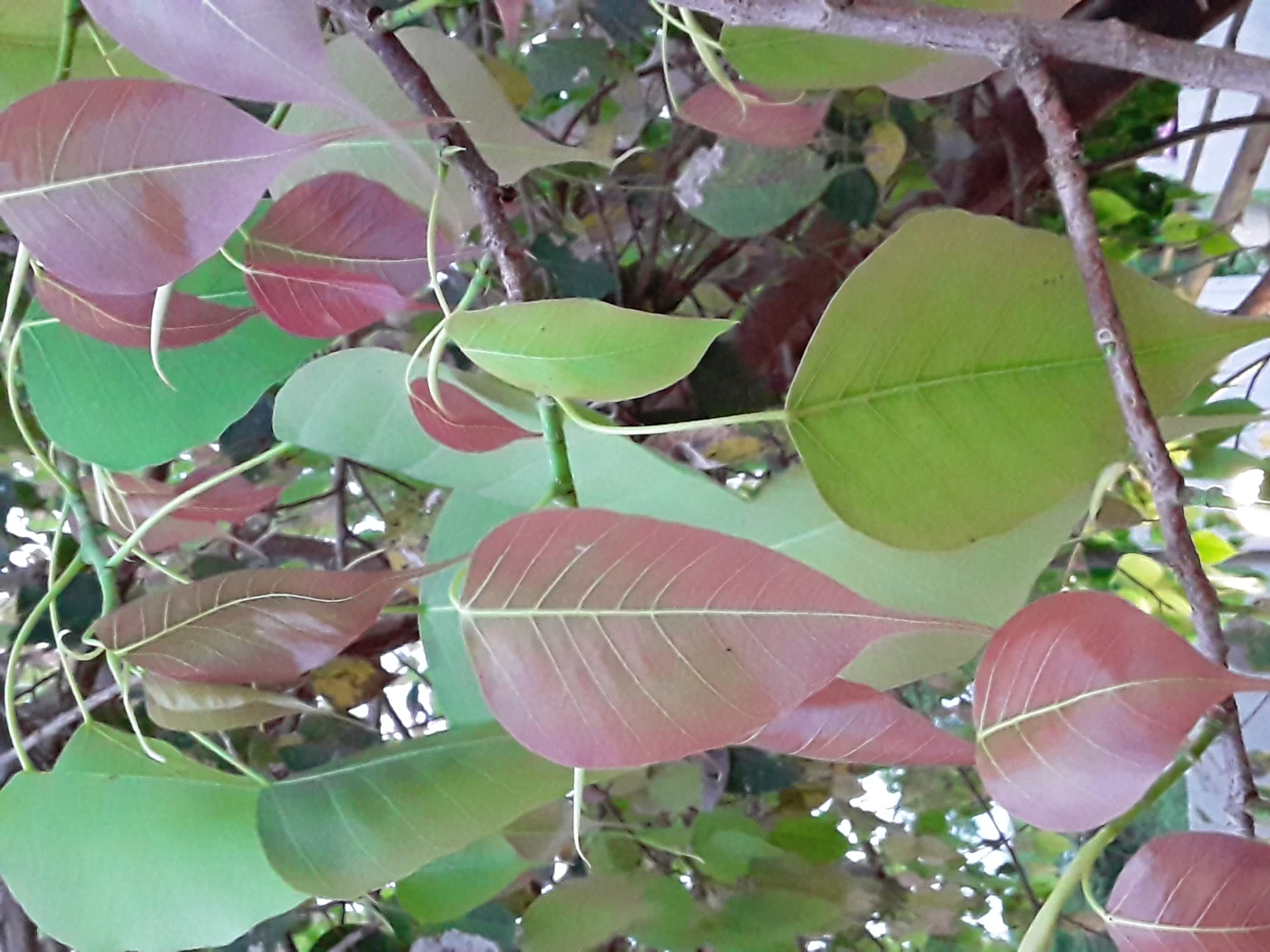
Heart-shaped Bodhi tree leaves with long tapering tips, photographed on their branches.
Bo tree leaf · 7 May 2020

Nature & sacred memory

The Bodhi leaf: remembering awakening

The Bodhi tree is associated with the Buddha’s awakening. A leaf’s recognisable shape can become a reminder of that story, while the living tree continues to grow and change. This is a modern botanical photograph, not a claim to show a leaf from the ancient tree.

Look closelyObserve the tapering tip, veins and variation between leaves. How does a living form carry a remembered story?

Continue studying ↗

Kamindamanuraj. Object / image record ↗ · CC BY-SA 4.0. Resized and converted to WebP; image content unchanged.

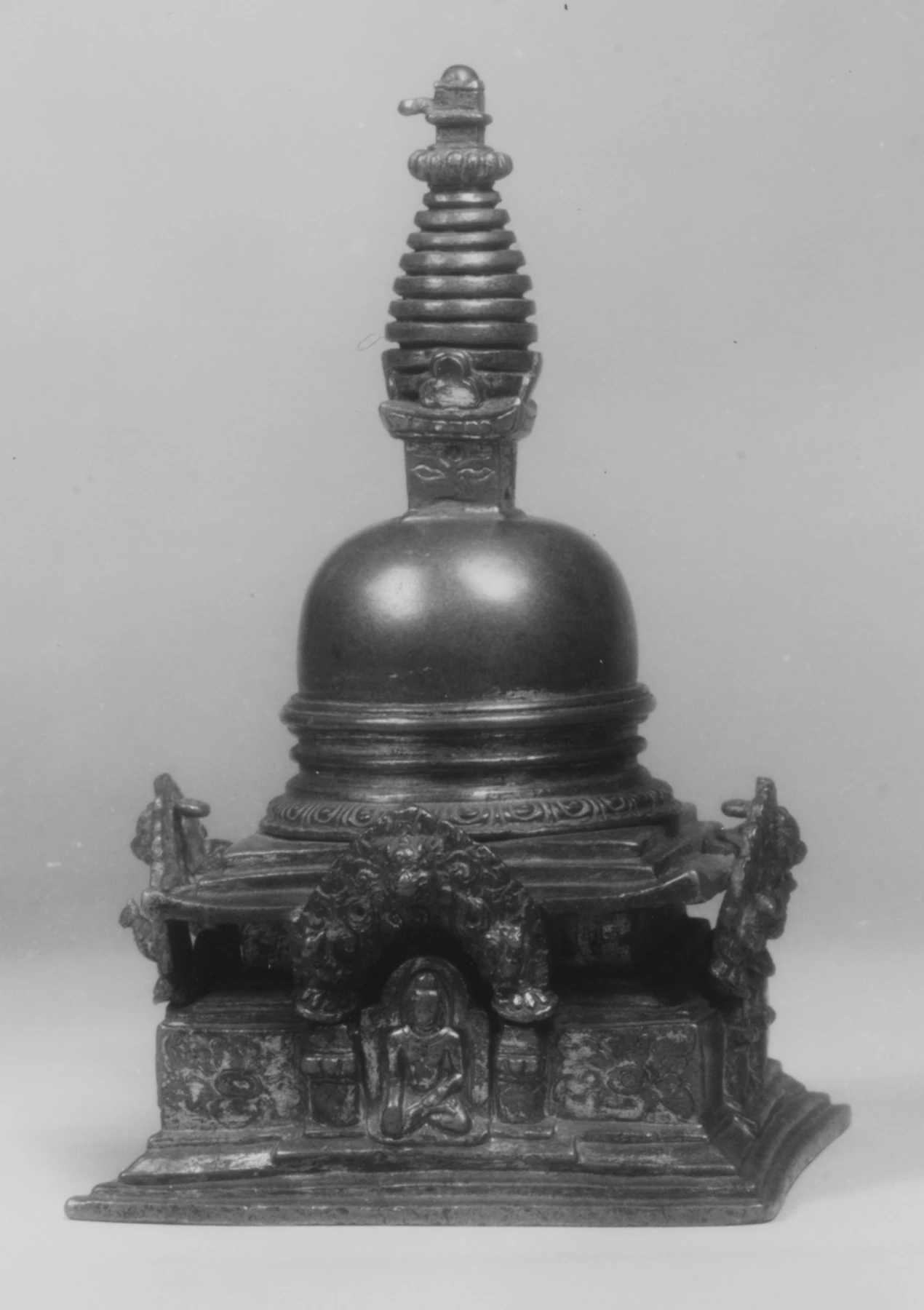
A Nepalese gilt-metal model of a stupa with a domed body, shrine niches and a tall finial.
Model of a Stupa · Nepal (Kathmandu Valley) · ca. 16th century

Sacred architecture

A stūpa in miniature

This sixteenth-century Nepalese model brings the form of a sacred monument into a small object. Stupas are associated with relics, memory and devotion. The Met notes the meditating Buddhas in its shrines and eyes incised on its upper structure. This is a model from Nepal, not a photograph of Sanchi.

Look closelyFollow the form from its base through the dome to the rising finial. What happens when monumental architecture is made small enough to approach closely?

Continue studying ↗

Artist unknown · The Metropolitan Museum of Art · 1985.400.16. Anonymous Gift, 1985. Object / image record ↗ · Public domain / CC0. Resized and converted to WebP; image content unchanged.
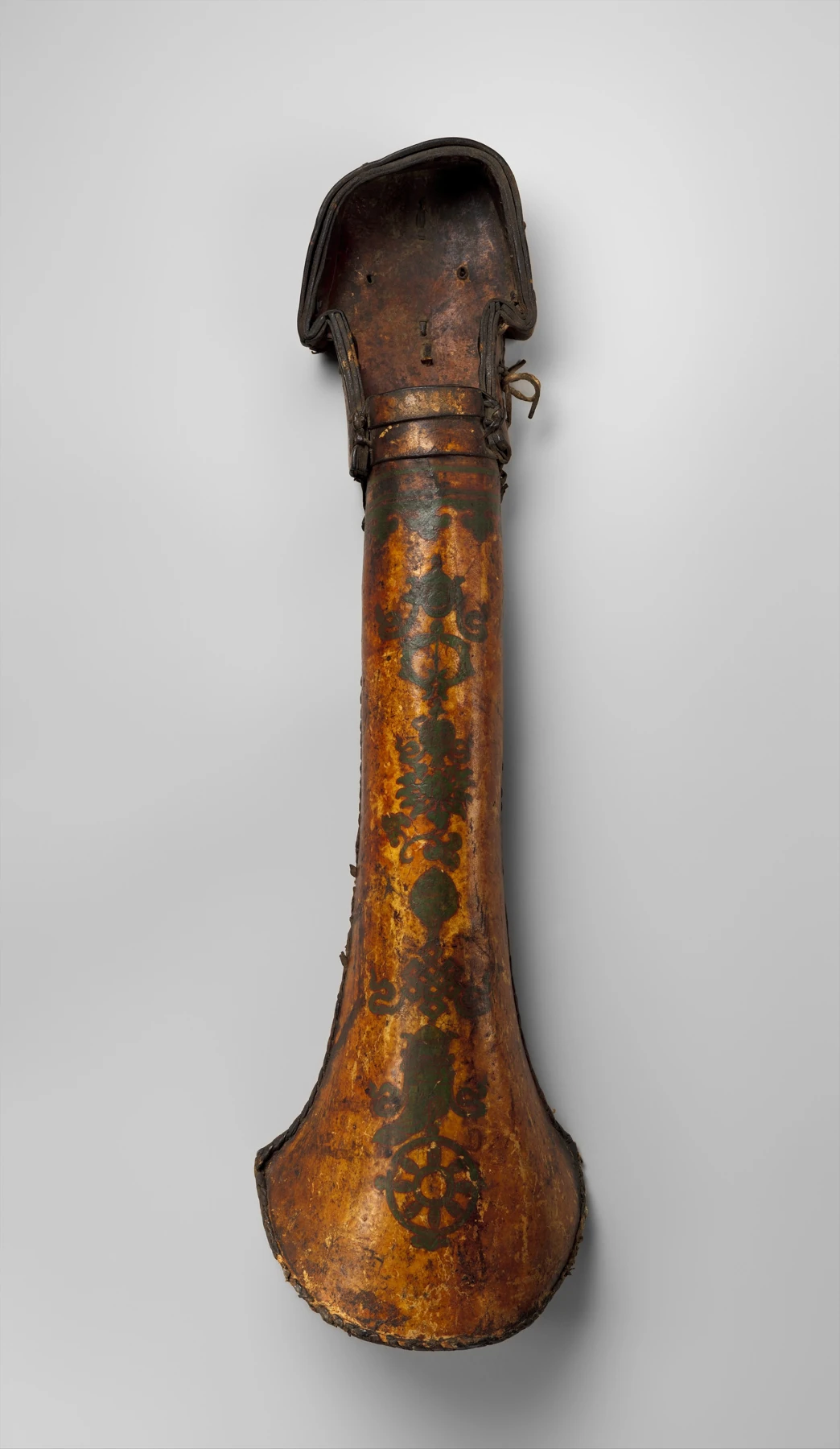
An aged decorated quiver bearing Buddhist auspicious motifs on its long surface.
Quiver Decorated with the Eight Auspicious Symbols · Tibetan or Mongolian · 14th–16th century

Symbols in material culture

Auspicious symbols beyond the shrine

This Tibetan or Mongolian quiver, dated between the fourteenth and sixteenth centuries, carries the Eight Auspicious Symbols. It shows that religious imagery could appear on objects outside a shrine. A historical object can raise questions about protection, status and the complexity of the societies that made it.

Look closelyCompare its worn motifs with the clearer symbols on the sutra cover. Distinguish what you can still recognise from what the museum identifies.

Continue studying ↗

Artist unknown · The Metropolitan Museum of Art · 2014.71. Purchase, Arthur Ochs Sulzberger Bequest, and Rogers Fund, by exchange, 2014. Object / image record ↗ · Public domain / CC0. Resized and converted to WebP; image content unchanged.
04 · Contemporary contemplations

Six images for a slower moment

Original AI-assisted artwork for this library. These are contemporary interpretations with House of Ananda reflection prompts; they are not historical evidence or consecrated ritual images.

A seated Buddha beneath a spreading tree in an emerald and gold dawn landscape.
Contemporary AI-assisted artwork · House of Ananda

Beneath the awakening tree

The spreading tree recalls the traditional story of awakening at Bodh Gaya. The composition places steadiness within a living landscape; its imagined setting should not be treated as a reconstruction of ancient India.

A moment to reflectWhat conditions make patient attention possible for you?

Follow this theme ↗
An ivory lotus opens above a dark emerald pond with gold reflections.
Contemporary AI-assisted artwork · House of Ananda

A lotus above the water

The lotus is widely associated with purity and awakening. Here the contrast between bloom and water invites a reflection on developing wisdom amid ordinary conditions. The picture is contemporary artwork, not a traditional icon with a fixed colour code.

A moment to reflectWhere might care grow within an imperfect situation?

Follow this theme ↗
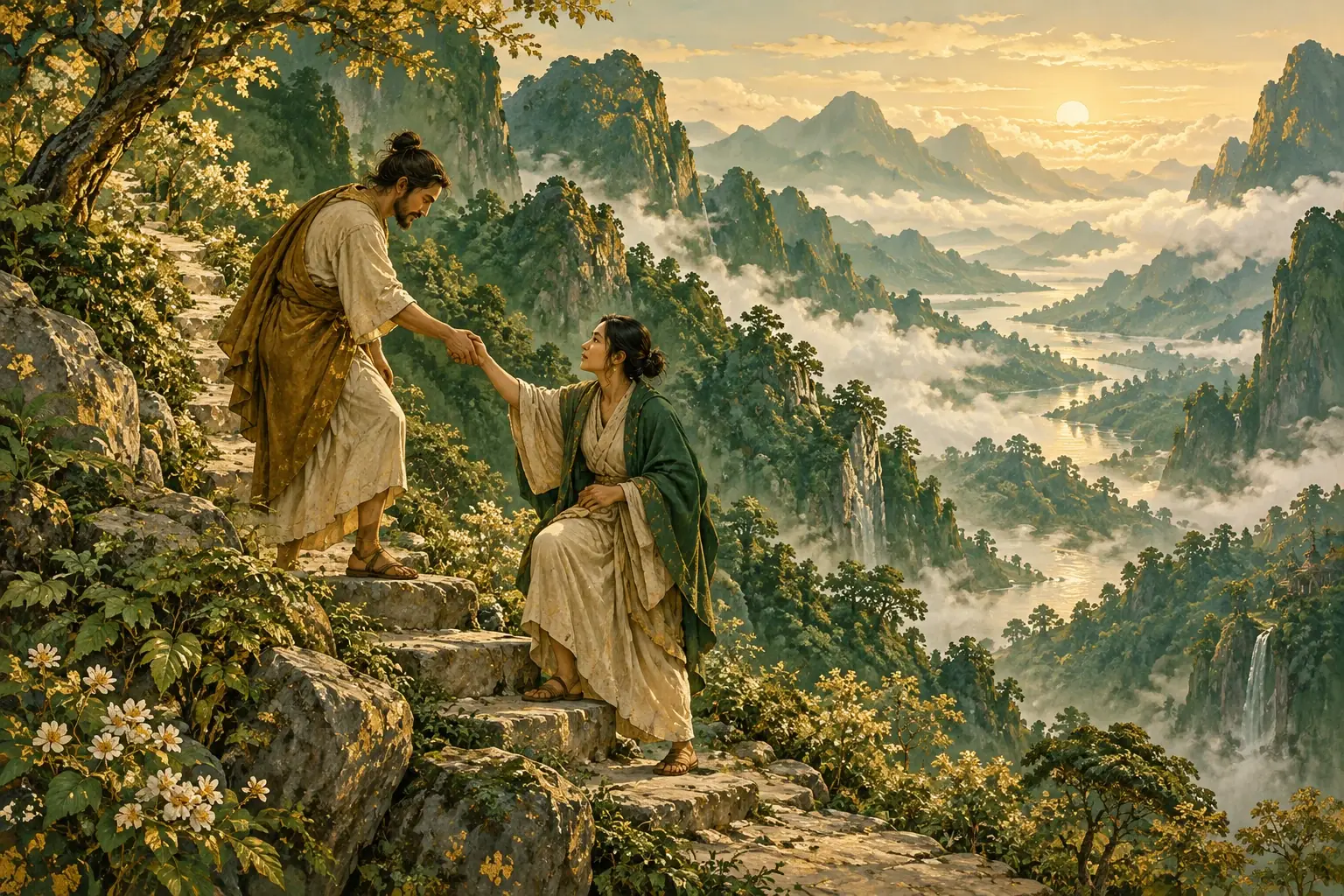
Two robed travellers on a mountain path, one extending a hand to help the other.
Contemporary AI-assisted artwork · House of Ananda

The helping hand

The scene interprets compassion as practical responsiveness. Neither figure represents a named bodhisattva or a recorded Buddhist story. Help becomes meaningful through attention to what another person actually needs.

A moment to reflectWhat would useful help look like today?

Follow this theme ↗
A glowing oil lamp illuminates a blank open manuscript in a quiet monastery-inspired room.
Contemporary AI-assisted artwork · House of Ananda

A lamp for inquiry

Light offers a contemporary metaphor for inquiry and understanding. The unlettered pages do not depict a lost scripture or an authentic manuscript. Study can illuminate experience while experience raises new questions for study.

A moment to reflectWhich question deserves a slower, more attentive reading?

Follow this theme ↗
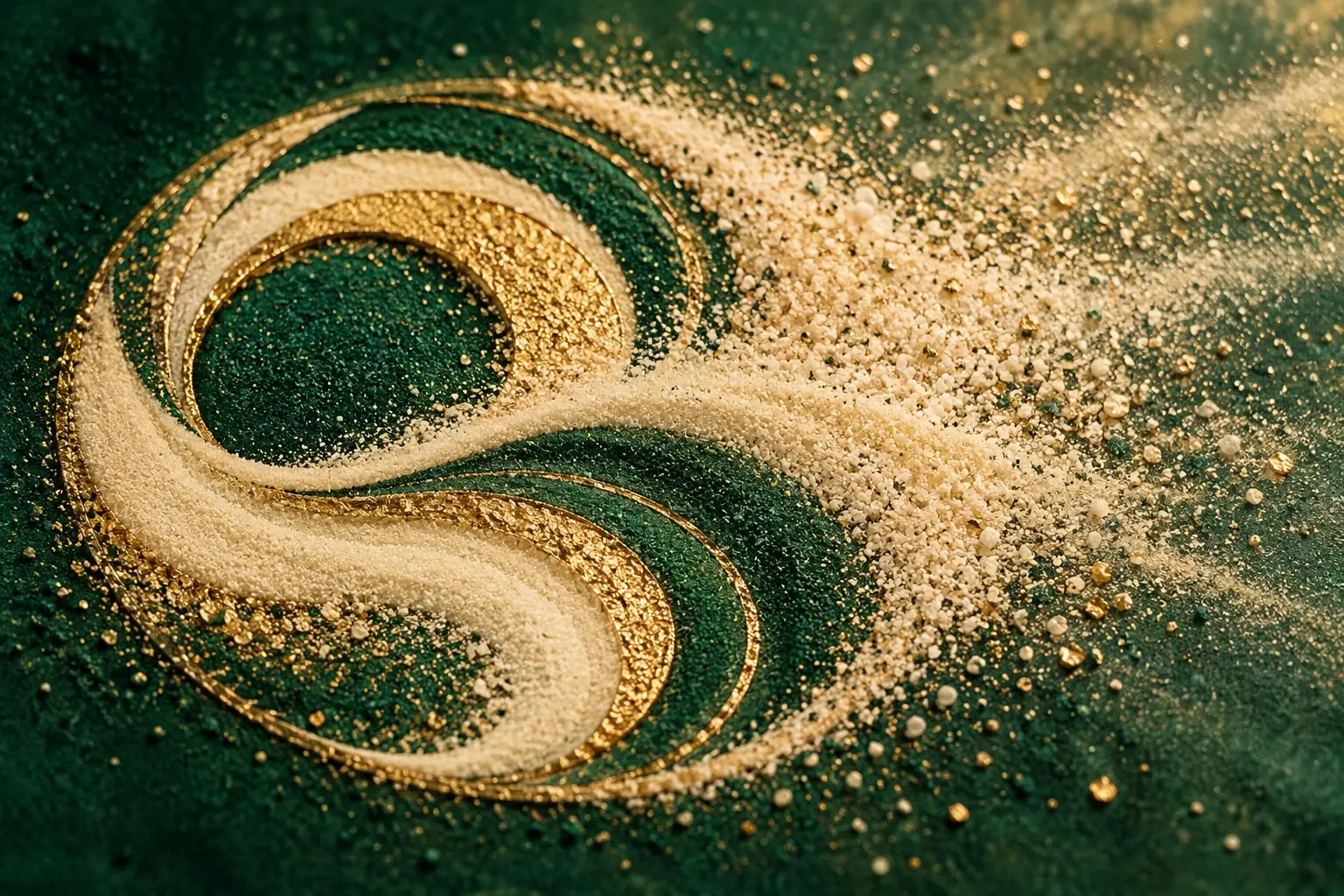
An abstract circular pattern in coloured sand begins to disperse across a pale surface.
Contemporary AI-assisted artwork · House of Ananda

A pattern passing

Loose grains forming and releasing a pattern invite reflection on change. This is an invented artwork, not a Tibetan ritual sand mandala. Authentic mandala construction and dissolution belong to particular communities and practices.

A moment to reflectWhat can you appreciate without asking it to stay the same?

Follow this theme ↗
A person meditates on a supported wooden bench beside a forest stream.
Contemporary AI-assisted artwork · House of Ananda

A place to return

A quiet bench evokes an accessible moment of attention. The setting is imagined and the person is not a named teacher. Meditation can also happen amid ordinary household sounds, without a remote retreat or a perfectly quiet mind.

A moment to reflectWhat is one manageable pause you can make in your day?

Follow this theme ↗

Images with provenance

Credits & further exploration

Reference images keep the creator, collection, source record and reuse licence attached. Museum dates and identifications may be approximate. Our descriptions distinguish documented context from questions offered for personal reflection.

View all historical image and symbol credits

Lotus (Padma)

19 July 2015

Christopher J. Fynn. Object / image record ↗ · CC BY-SA 4.0. Original SVG, unmodified.

Dharma wheel (Khorlo)

2014 (first upload)

Christopher J. Fynn. Object / image record ↗ · CC BY-SA 4.0. Original SVG, unmodified.

Royal parasol (Duk)

24 November 2014

Christopher J. Fynn. Object / image record ↗ · CC BY-SA 4.0. Original SVG, unmodified.

Treasure vase (Bumpa)

24 November 2014

Christopher J. Fynn. Object / image record ↗ · CC BY-SA 4.0. Original SVG, unmodified.

Bo tree leaf

7 May 2020

Kamindamanuraj. Object / image record ↗ · CC BY-SA 4.0. Resized and converted to WebP; image content unchanged.

Bodhisattva Manjushri

China · Yongle period (1403–24)

Artist unknown · The Metropolitan Museum of Art · 2001.59. Object / image record ↗ · Public domain / CC0. Resized and converted to WebP; image content unchanged.
Buddha Shakyamuni

Central Tibet · 12th century

Artist unknown · The Metropolitan Museum of Art · 2012.458. Object / image record ↗ · Public domain / CC0. Resized and converted to WebP; image content unchanged.
Tara, the Buddhist Savior

Nepal, Kathmandu Valley · 14th century

Artist unknown · The Metropolitan Museum of Art · 66.179. Object / image record ↗ · Public domain / CC0. Resized and converted to WebP; image content unchanged.
Amitabha, the Buddha of the Western Pure Land (Sukhavati)

Central Tibet · ca. 1700

Artist unknown · The Metropolitan Museum of Art · 2004.139. Object / image record ↗ · Public domain / CC0. Resized and converted to WebP; image content unchanged.
Bodhisattva Avalokiteshvara (Guanyin)

China · late 10th–early 11th century

Artist unknown · The Metropolitan Museum of Art · 33.116. Object / image record ↗ · Public domain / CC0. Resized and converted to WebP; image content unchanged.
Vajra

Indonesia, Java · ca. 10th century

Artist unknown · The Metropolitan Museum of Art · 1987.142.297. Object / image record ↗ · Public domain / CC0. Resized and converted to WebP; image content unchanged.
Gheṇṭa (prayer bell)

East Java, Indonesia · 11th century

Artist unknown · The Metropolitan Museum of Art · 30.87.4. Object / image record ↗ · Public domain / CC0. Resized and converted to WebP; image content unchanged.

Chakrasamvara Mandala

Nepal · ca. 1100

Artist unknown · The Metropolitan Museum of Art · 1995.233. Object / image record ↗ · Public domain / CC0. Resized and converted to WebP; image content unchanged.
Sutra Cover with Eight Buddhist Treasures

China · 18th century

Artist unknown · The Metropolitan Museum of Art · 2012.559. Purchase, Barbara and William Karatz Gift, in honor of James C. Y. Watt, 2012. Object / image record ↗ · Public domain / CC0. Resized and converted to WebP; image content unchanged.
Quiver Decorated with the Eight Auspicious Symbols

Tibetan or Mongolian · 14th–16th century

Artist unknown · The Metropolitan Museum of Art · 2014.71. Purchase, Arthur Ochs Sulzberger Bequest, and Rogers Fund, by exchange, 2014. Object / image record ↗ · Public domain / CC0. Resized and converted to WebP; image content unchanged.
Model of a Stupa

Nepal (Kathmandu Valley) · ca. 16th century

Artist unknown · The Metropolitan Museum of Art · 1985.400.16. Anonymous Gift, 1985. Object / image record ↗ · Public domain / CC0. Resized and converted to WebP; image content unchanged.
Visit the reading room ↗