
Conditionality
Dependent origination, paṭiccasamuppāda or pratītyasamutpāda, examines the conditioned arising of experience and suffering. It is more precise than the slogan “everything is connected”. Its purpose is to understand how a process is sustained and how its cessation becomes possible.
Visual study
A teaching you can explore
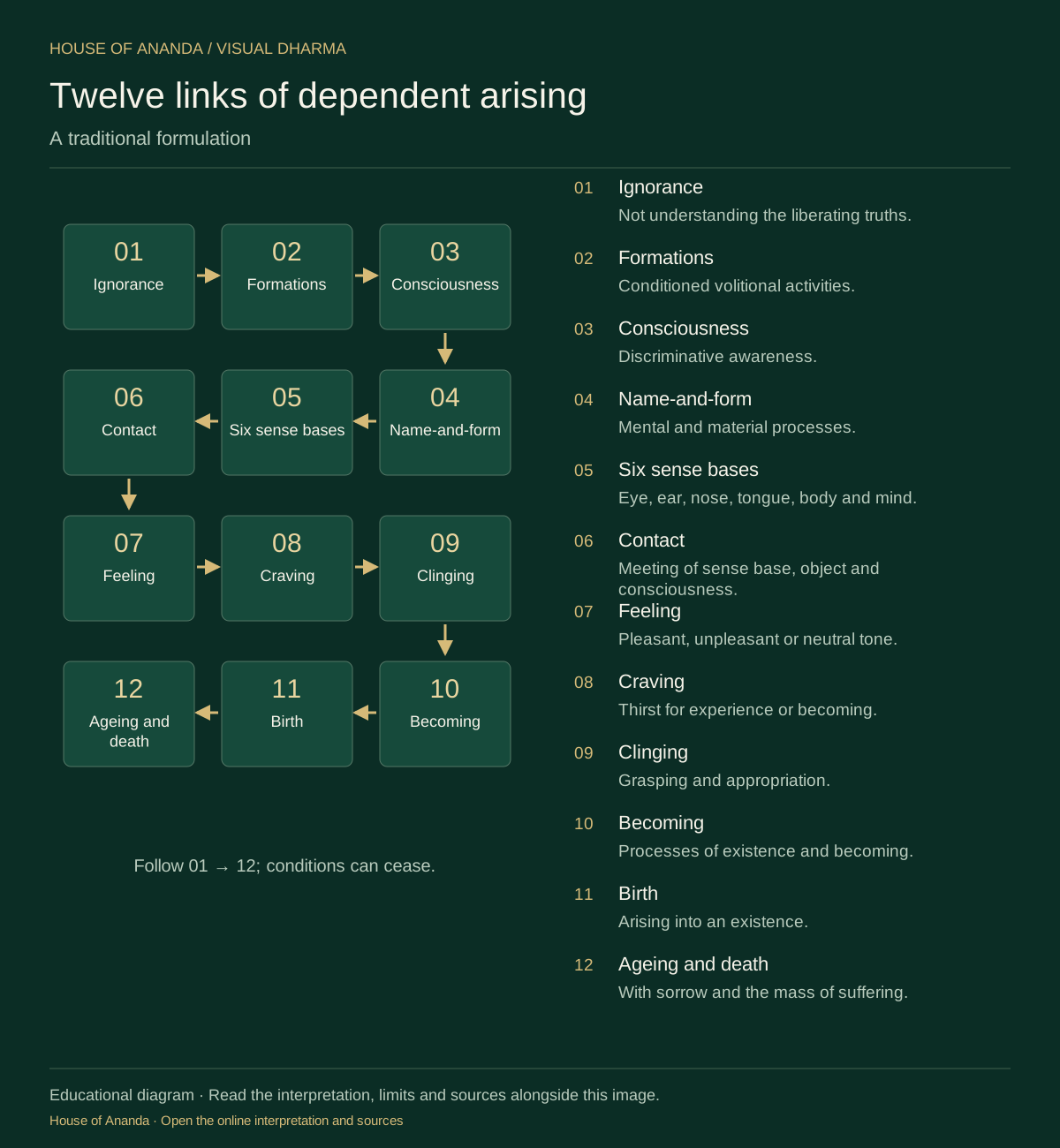
A traditional formulation
Twelve links of dependent arising
The twelve-link account describes the conditioned arising of suffering.
Read the diagram & interpretation
- IgnoranceNot understanding the liberating truths.
- FormationsConditioned volitional activities.
- ConsciousnessDiscriminative awareness.
- Name-and-formMental and material processes.
- Six sense basesEye, ear, nose, tongue, body and mind.
- ContactMeeting of sense base, object and consciousness.
- FeelingPleasant, unpleasant or neutral tone.
- CravingThirst for experience or becoming.
- ClingingGrasping and appropriation.
- BecomingProcesses of existence and becoming.
- BirthArising into an existence.
- Ageing and deathWith sorrow and the mass of suffering.
Follow the numbers in the diagram. Traditional commentaries explain this formulation in different ways, including across lives. Some modern presentations also examine patterns in immediate experience. Neither reading makes this a universal twelve-step timeline for every event.
Keep in mind The teaching also describes cessation when sustaining conditions cease. A useful place for ordinary observation is how feeling can lead into craving.
Sources: SN 12:2 · Dependent Co-arising ↗
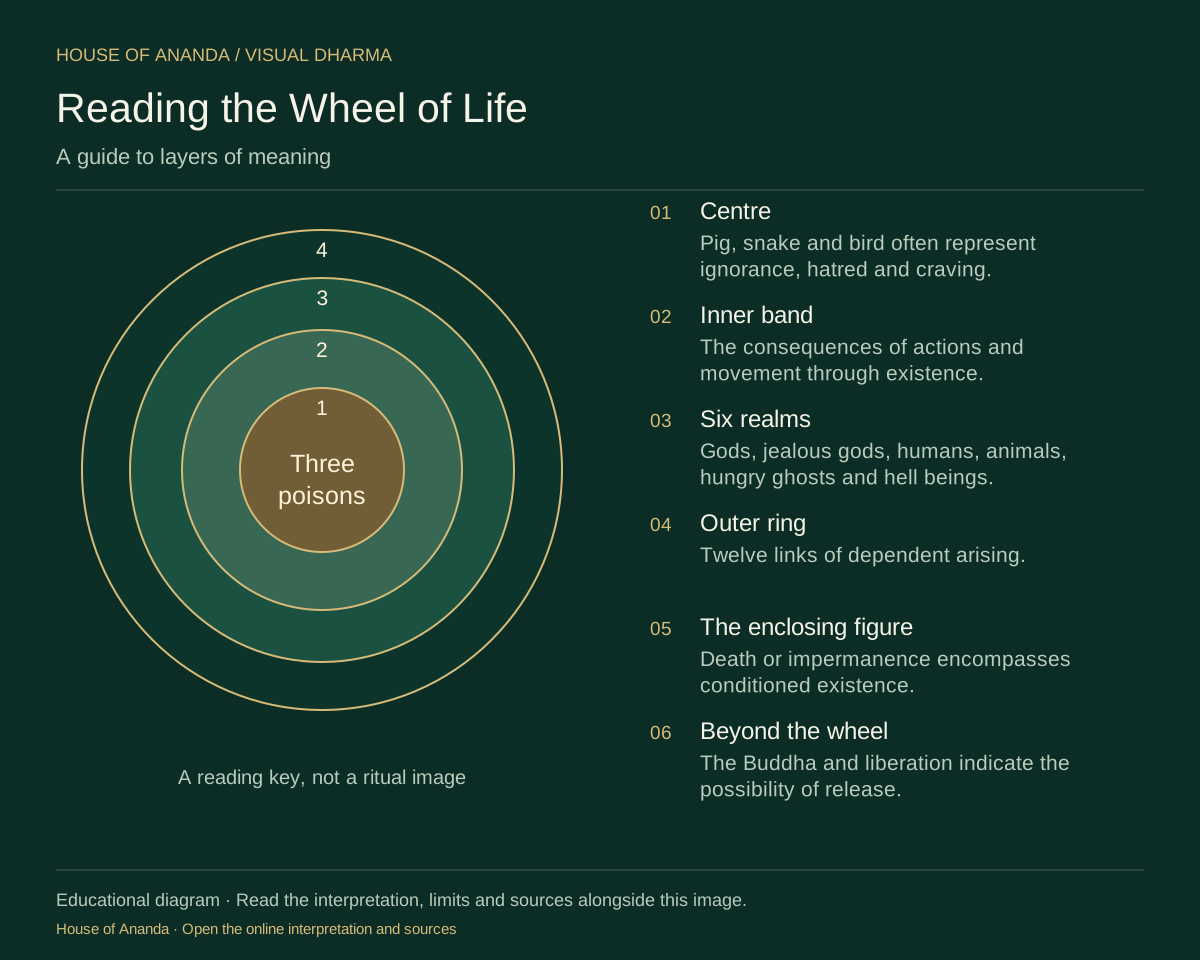
A guide to layers of meaning
Reading the Wheel of Life
A schematic reading key for the bhavacakra found in Tibetan Buddhist art.
Read the diagram & interpretation
- CentrePig, snake and bird often represent ignorance, hatred and craving.
- Inner bandThe consequences of actions and movement through existence.
- Six realmsGods, jealous gods, humans, animals, hungry ghosts and hell beings.
- Outer ringTwelve links of dependent arising.
- The enclosing figureDeath or impermanence encompasses conditioned existence.
- Beyond the wheelThe Buddha and liberation indicate the possibility of release.
Read inward and outward: habits, actions, kinds of existence and sustaining conditions belong to one account of saṃsāra. Traditional cosmological readings take the realms seriously as rebirth destinations; some teachers also use them to illuminate familiar states of mind. Paintings vary.
Keep in mind This labelled graphic is a modern teaching schematic, not a reproduction, a consecrated image or an exhaustive account of a particular painting.
Sources: Rubin Museum · Wheel of Existence ↗
The twelve-link formulation
A familiar sequence names ignorance, formations, consciousness, name-and-form, the six sense bases, contact, feeling, craving, clinging, becoming, birth, and ageing-and-death. Traditional explanations include the continuity of rebirth; different schools also explore how conditioned processes can be observed in experience. A short psychological example does not exhaust the teaching.
Contact, feeling and craving
A practical place to begin is the movement from contact to feeling tone and then to craving. A notification appears, excitement or unease arises, and the hand reaches for the phone. Mindful attention can reveal that sequence and create an opportunity for a more deliberate response.
Changing a condition
The useful question is not only “Why am I like this?” but “What feeds this pattern?” Rest, a clearer agreement, fewer interruptions or a conversation may change the situation. The point is observation and responsible action, not blaming a person for all the conditions around them.
Art & contemplation
Look, learn, reflect

A pattern passing
Loose grains forming and releasing a pattern invite reflection on change. This is an invented artwork, not a Tibetan ritual sand mandala. Authentic mandala construction and dissolution belong to particular communities and practices.
A moment to reflectWhat can you appreciate without asking it to stay the same?
Follow this theme ↗A question to carry with you
Pause and reflect.
Choose one small habit. What happens immediately before it, and which condition could you change?
Sources & further reading
Study notes and examples are original explanations. Follow the links for the source texts and their own contexts.