
1 · Dukkha: understand
Dukkha includes pain and distress, but also the unreliability of trying to make changing experiences provide permanent satisfaction. The first truth asks for understanding. It does not say that pleasure, friendship and beauty are unreal, nor that every moment must feel miserable.
Visual study
A teaching you can explore
Understand · release · realise · cultivate
The Four Noble Truths
A teaching about suffering and freedom, expressed as four truths with four corresponding tasks.
Read the diagram & interpretation
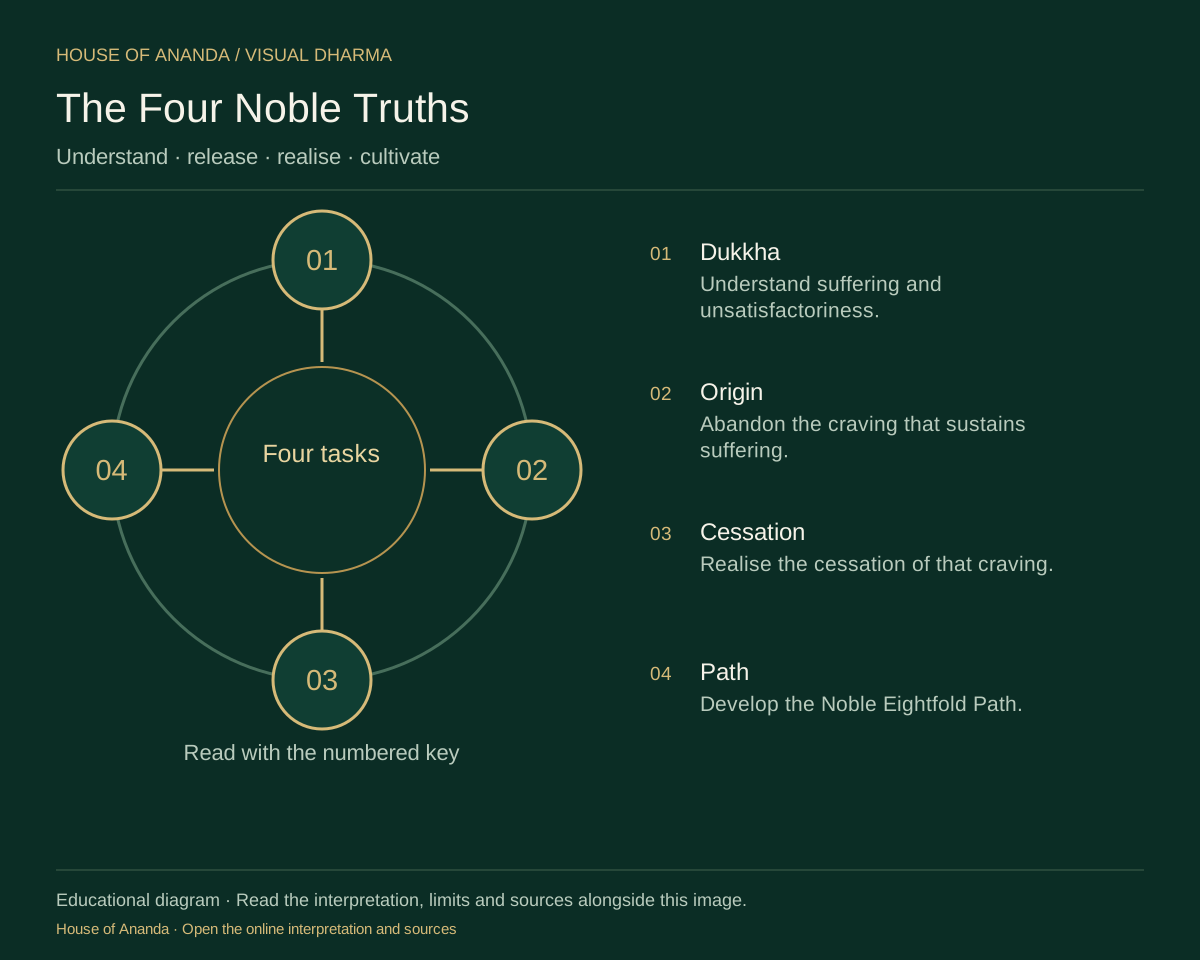
- DukkhaUnderstand suffering and unsatisfactoriness.
- OriginAbandon the craving that sustains suffering.
- CessationRealise the cessation of that craving.
- PathDevelop the Noble Eightfold Path.
Read each truth together with its task. The teaching asks for understanding, letting go, direct realisation and ongoing cultivation; it is more than a list of beliefs. The circular layout here shows their relationship, not a promise of a quick progression.
Keep in mind Dukkha does not mean that every moment of life is miserable. Nor does the teaching blame a person for every painful event.
2 · Origin: abandon
The early formulation identifies craving: the insistence that experience must supply what we want, preserve what we like or eliminate what we dislike. This is not the claim that all wishes are bad. The intention to learn, help someone or practise can support the path.
3 · Cessation: realise
Cessation concerns the ending of craving and the suffering sustained by it. A brief pause in reactivity can help a beginner see why this matters, but it should not be confused with complete liberation.
4 · Path: develop
The Noble Eightfold Path develops understanding, intention, ethical conduct, effort, mindfulness and concentration together. It is a sustained way of life rather than a single insight or a technique used only when upset.
A reflection in ordinary life
Imagine repeatedly checking whether a message has been answered. Notice the discomfort, the demand for immediate reassurance and what happens if you put the phone down briefly. This is a modest observation of a habit, not a complete account of dukkha or a claim that all distress can be solved by changing your attitude.
A question to carry with you
Pause and reflect.
In a manageable difficulty, what is the experience itself, and what extra demand are you adding to it?
Sources & further reading
Study notes and examples are original explanations. Follow the links for the source texts and their own contexts.