
Where the symbol belongs
The usual spelling is yin and yang. These concepts have long histories in Chinese thought, including Daoist and Confucian traditions. They describe relationships and changing tendencies: shade and sunlight, yielding and activity, contraction and expansion. The familiar circular symbol is a taijitu, a diagram associated with the “supreme ultimate”. Neither its vocabulary nor this familiar design originates as an emblem of the historical Buddha.
Visual study
A teaching you can explore
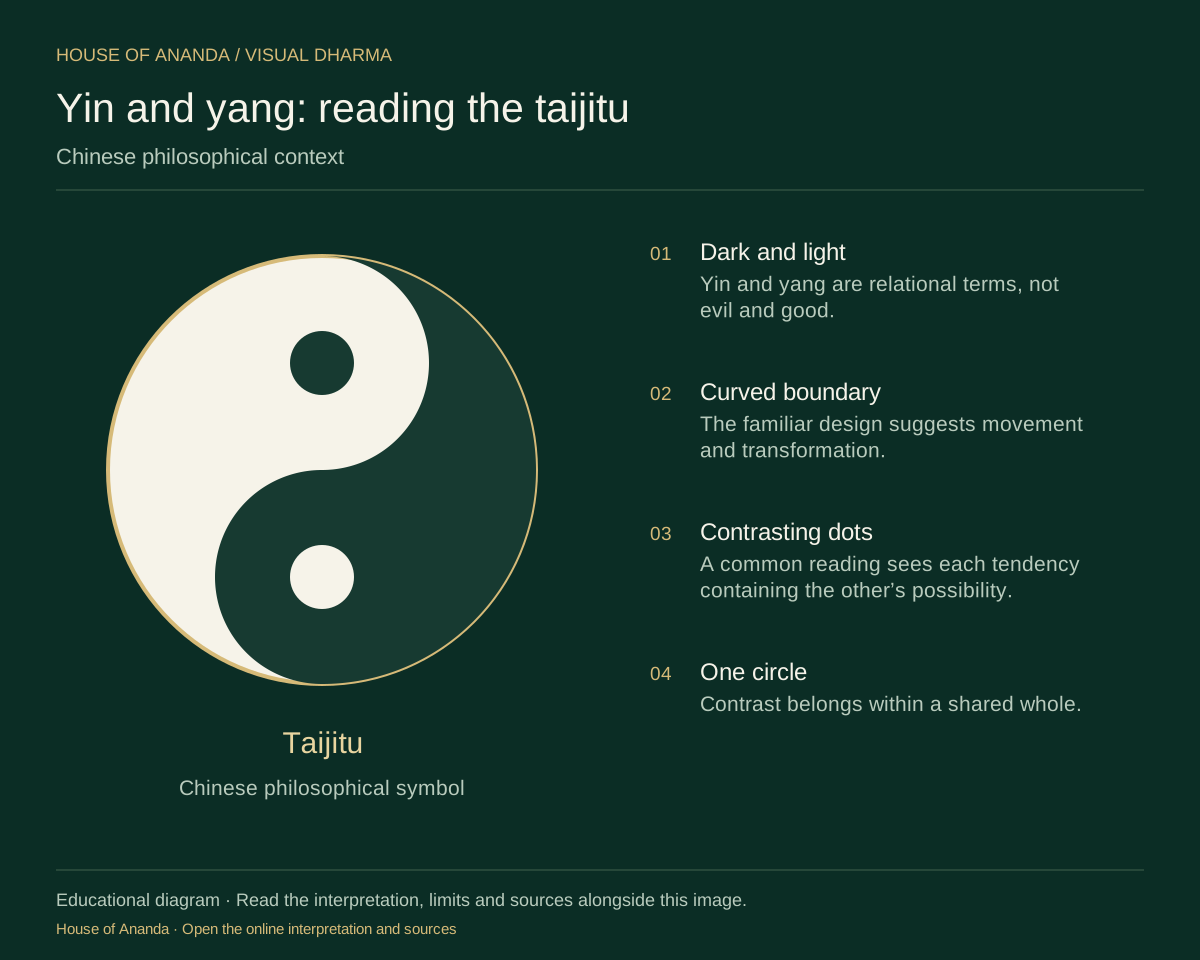
Chinese philosophical context
Yin and yang: reading the taijitu
The familiar dark-and-light diagram invites attention to complementary tendencies and change.
Read the diagram & interpretation
- Dark and lightYin and yang are relational terms, not evil and good.
- Curved boundaryThe familiar design suggests movement and transformation.
- Contrasting dotsA common reading sees each tendency containing the other’s possibility.
- One circleContrast belongs within a shared whole.
Yin and yang are important across Chinese intellectual and cultural traditions, including Daoist and Confucian thought. The familiar taijitu is not a core emblem taught by the historical Buddha. Chinese Buddhism developed in conversation with this wider culture without becoming identical to it.
Keep in mind The diagram is not a scientific measurement, a fixed personality test or a reason to assign rigid roles to women and men.
Sources: Internet Encyclopedia of Philosophy · Yinyang ↗ · Stanford Encyclopedia of Philosophy · Metaphysics in Chinese Philosophy ↗
Reading without turning contrast into conflict
A useful introductory interpretation sees the dark and light shapes as mutually related and changing. The contrasting dots suggest that neither tendency is absolutely isolated. This is a conventional reading of the familiar design, not the only explanation ever given of every taiji diagram. Yin is not evil, and yang is not good; the aim is not to eliminate one side.
- Ask what the terms are relative to: shade on one side of a hill is not an eternal property of the whole hill.
- Consider change over time, rather than imagining balance must always mean a motionless 50:50 split.
- Historical masculine and feminine associations should not be turned into fixed prescriptions for real people.
Its relationship to Buddhism
Buddhism arose in the Indian subcontinent and later developed in China within a rich existing intellectual culture. Chinese Buddhists and their neighbours entered into many forms of conversation and exchange. That history makes comparison interesting, but it does not make yin–yang theory identical to dependent arising, emptiness or the Middle Way.
| Question | Yin and yang | A Buddhist comparison |
|---|---|---|
| What is being explored? | Relational polarities and processes of change in Chinese thought. | Conditions of suffering, experience and liberation in named Buddhist teachings. |
| A useful point of contact | Attention to relationship rather than isolated things. | Dependent arising asks how phenomena depend on conditions. |
| A boundary to preserve | A polarity framework is not a universal Buddhist doctrine. | Emptiness is not simply a balance between two cosmic forces. |
An invitation to compare carefully
Choose an ordinary example, such as activity and rest. Describe how they support one another. Then ask a different question: what intentions, habits and conditions make the activity helpful or harmful? The first question may help you think about complementarity; the second can open a Buddhist ethical inquiry. This paired exercise is an editorial comparison, not an ancient teaching shared verbatim by both traditions.
Art & contemplation
Look, learn, reflect

A lamp for inquiry
Light offers a contemporary metaphor for inquiry and understanding. The unlettered pages do not depict a lost scripture or an authentic manuscript. Study can illuminate experience while experience raises new questions for study.
A moment to reflectWhich question deserves a slower, more attentive reading?
Follow this theme ↗A question to carry with you
Pause and reflect.
When you see a familiar spiritual symbol, do you know its community and history, or mainly the meaning you have given it?
Sources & further reading
Study notes and examples are original explanations. Follow the links for the source texts and their own contexts.