
An image designed to teach
The Wheel of Life, or bhavacakra, is especially familiar in Tibetan Buddhist settings. It gives a visual account of conditioned existence, saṃsāra. A fierce figure encloses the wheel, expressing the reach of death and impermanence. The image is not simply a picture of a frightening deity: its purpose includes showing why liberation matters.
Visual study
A teaching you can explore
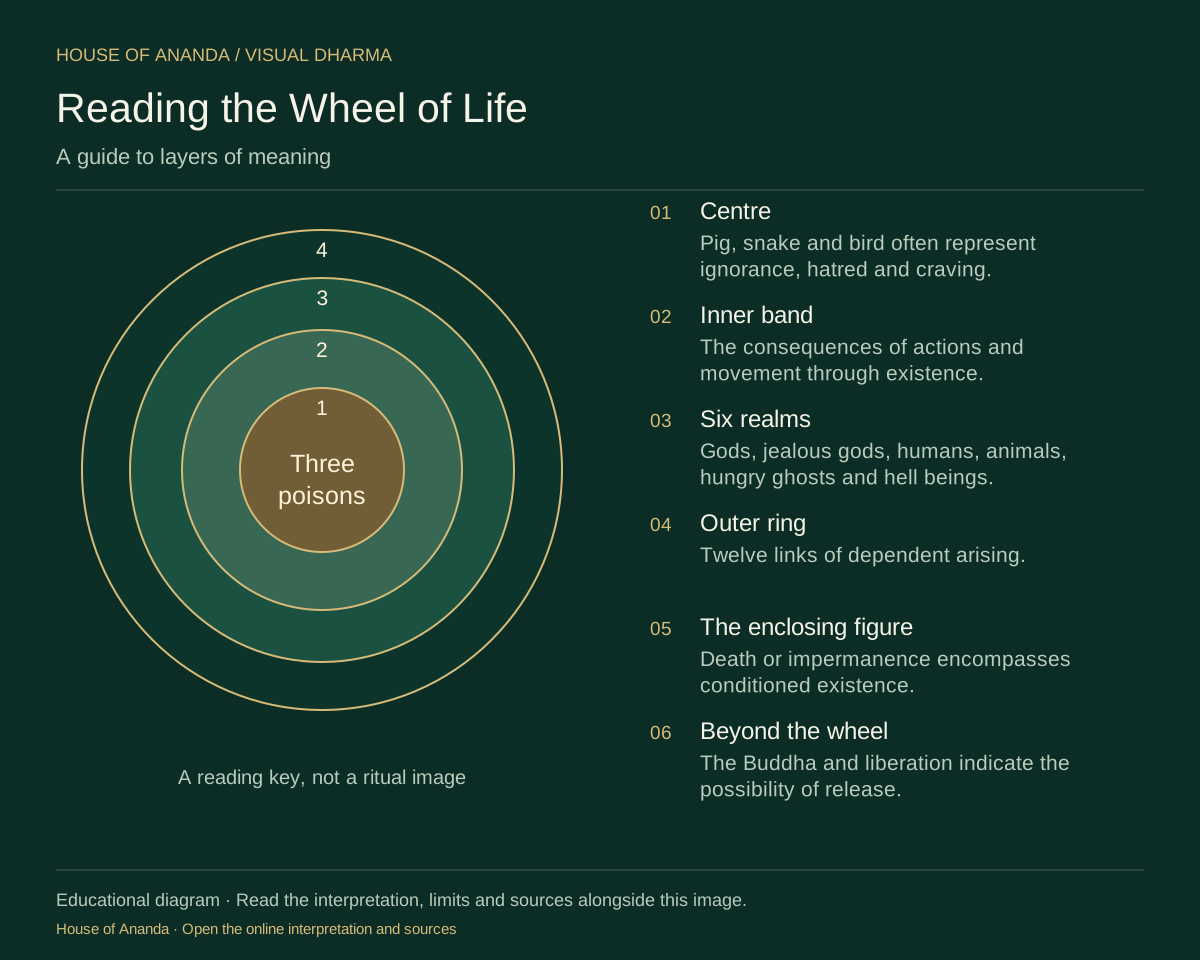
A guide to layers of meaning
Reading the Wheel of Life
A schematic reading key for the bhavacakra found in Tibetan Buddhist art.
Read the diagram & interpretation
- CentrePig, snake and bird often represent ignorance, hatred and craving.
- Inner bandThe consequences of actions and movement through existence.
- Six realmsGods, jealous gods, humans, animals, hungry ghosts and hell beings.
- Outer ringTwelve links of dependent arising.
- The enclosing figureDeath or impermanence encompasses conditioned existence.
- Beyond the wheelThe Buddha and liberation indicate the possibility of release.
Read inward and outward: habits, actions, kinds of existence and sustaining conditions belong to one account of saṃsāra. Traditional cosmological readings take the realms seriously as rebirth destinations; some teachers also use them to illuminate familiar states of mind. Paintings vary.
Keep in mind This labelled graphic is a modern teaching schematic, not a reproduction, a consecrated image or an exhaustive account of a particular painting.
Sources: Rubin Museum · Wheel of Existence ↗
Reading the layers
The centre commonly contains animals associated with ignorance, craving and hatred. Surrounding bands develop the story of action and rebirth, realms of existence and the twelve links of dependent arising. Outside the wheel, a Buddha or another indication of release directs attention beyond the cycle. Individual paintings may organise details differently, so follow the catalogue for the actual work you are studying.
Realms and ways of interpretation
The familiar six-realm arrangement includes gods, jealous gods, human beings, animals, hungry ghosts and hell beings. Traditional accounts understand these as possibilities of rebirth. Some contemporary explanations also use them to reflect on pride, rivalry, vulnerability, insatiability and other experiences. A psychological reading can be illuminating without replacing the cosmological teaching or claiming that every Buddhist gives the same interpretation.
Using the image for inquiry
Pick one layer instead of trying to memorise the entire painting. With the centre, ask what feeds hostility or grasping. With the outer ring, study contact, feeling and craving. Then look for the indication of release. The teaching concerns the possibility of changing conditions, not a verdict that a person is trapped in an unchangeable identity.
Art & contemplation
Look, learn, reflect
A pattern passing
Loose grains forming and releasing a pattern invite reflection on change. This is an invented artwork, not a Tibetan ritual sand mandala. Authentic mandala construction and dissolution belong to particular communities and practices.
A moment to reflectWhat can you appreciate without asking it to stay the same?
Follow this theme ↗A question to carry with you
Pause and reflect.
Where can you notice a habit being reinforced—and what might stop feeding it?
Sources & further reading
Study notes and examples are original explanations. Follow the links for the source texts and their own contexts.