
An image has a history
Ask what is depicted, where it was made, its date and how it was used. Buddhist art can support recollection, devotion, teaching and ritual. A sacred image is more than anonymous wellness decoration.
Visual study
A teaching you can explore
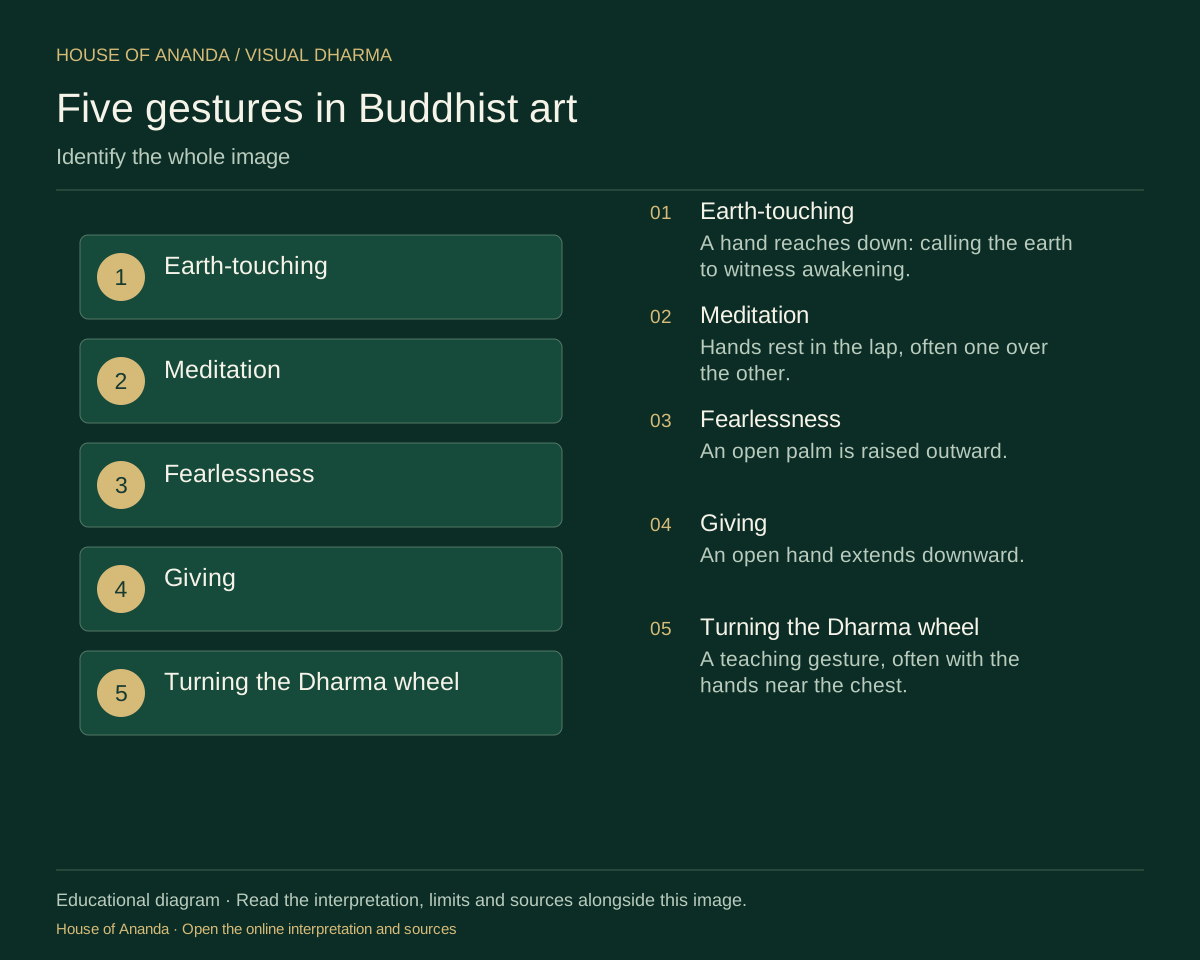
Identify the whole image
Five gestures in Buddhist art
Common hand gestures offer clues to what an image expresses.
Read the diagram & interpretation
- Earth-touchingA hand reaches down: calling the earth to witness awakening.
- MeditationHands rest in the lap, often one over the other.
- FearlessnessAn open palm is raised outward.
- GivingAn open hand extends downward.
- Turning the Dharma wheelA teaching gesture, often with the hands near the chest.
Look at palm direction, hand position and the surrounding story. Similar gestures can differ across regions and periods. A catalogue identification should take precedence over guessing from one feature. The historical sculptures below provide real examples to examine.
Keep in mind A hand position alone cannot reliably identify every figure. This guide describes art and does not teach esoteric ritual hand sequences.
Sources: The Met · Recognizing the Gods ↗ · BuddhaNet · Mudras of the Great Buddha ↗
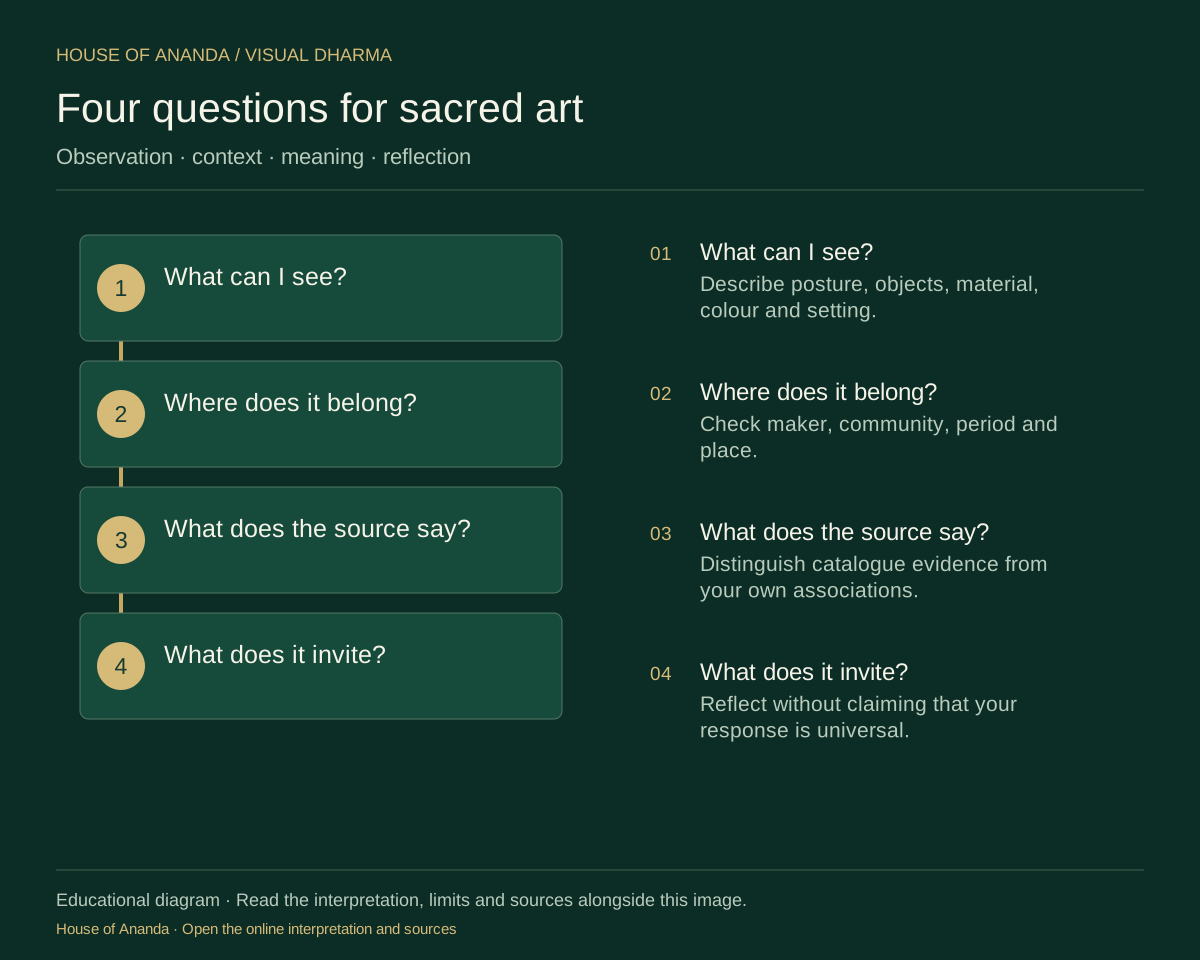
Observation · context · meaning · reflection
Four questions for sacred art
A practical way to make visual study more thoughtful.
Read the diagram & interpretation
- What can I see?Describe posture, objects, material, colour and setting.
- Where does it belong?Check maker, community, period and place.
- What does the source say?Distinguish catalogue evidence from your own associations.
- What does it invite?Reflect without claiming that your response is universal.
Begin with observable detail, then consult reliable context. An image may serve devotion, teaching, ritual, remembrance or several purposes at once. Ask what is known and what is inferred. The maker’s community may understand a detail differently from a modern museum visitor.
Keep in mind These four questions are an original House of Ananda study framework, not a traditional Buddhist list.
Sources: The Metropolitan Museum of Art · Buddhism and Buddhist Art ↗
Hands can tell a story
The Met’s Nalanda sculpture shows the Buddha reaching towards the earth in connection with awakening. Teaching, reassurance and meditation gestures occur elsewhere. Identification depends on the whole image and its context, not just a cropped hand.
Different sacred figures
Śākyamuni, Amitābha and bodhisattvas such as Avalokiteśvara have different roles. Attributes and local conventions help interpretation. Do not assume every seated figure is the same Buddha or that every image shares one symbolic meaning.
Study one object
Choose a museum entry and record title, place, period, material and interpretation. Notice which details support the identification. For a living shrine, also listen to the community’s account of how the image is approached.
Begin with observation
Look before interpreting. Describe the material, posture, hands, clothing, objects, facial expression and surrounding figures. Note what is absent as well as what is present. A plain robe, elaborate crown or lotus seat may matter, but none should be treated as a complete identification in isolation. The four-question infographic offers a repeatable study method.
Buddhas and bodhisattvas
Śākyamuni is the historical Buddha; Amitābha belongs to a different Buddhist devotional and scriptural setting. Avalokiteśvara, known as Guanyin in Chinese, is associated with compassion; Mañjuśrī with wisdom. Tārā has many forms and interpretations. The named examples in this collection are identified through their museum records, not simply through colour, gender or posture.
A work belongs to a place and time
A Chinese sculpture, Nepalese painting and Javanese ritual implement can all illuminate Buddhist history while differing greatly in use and style. Dates are often approximate and artists may be unknown. A museum image gives access to an object, but its catalogue cannot capture everything the work has meant to the communities that have encountered it.
Keep three kinds of image distinct
The library labels historical works, educational diagrams and contemporary AI-assisted interpretations. Historical works have source records and reuse credits. Diagrams simplify a teaching and explain what the simplification leaves out. Contemporary artwork can invite reflection without claiming archaeological accuracy, ritual authority or the status of an inherited icon.
From looking to thoughtful explanation
When sharing an image, name it and its source, describe one visible detail and explain one well-supported association. Keep a personal response separate: “This reminds me of patience” is different from “This figure traditionally represents patience.” Both can belong in a conversation if their status is clear.
Art & contemplation
Look, learn, reflect
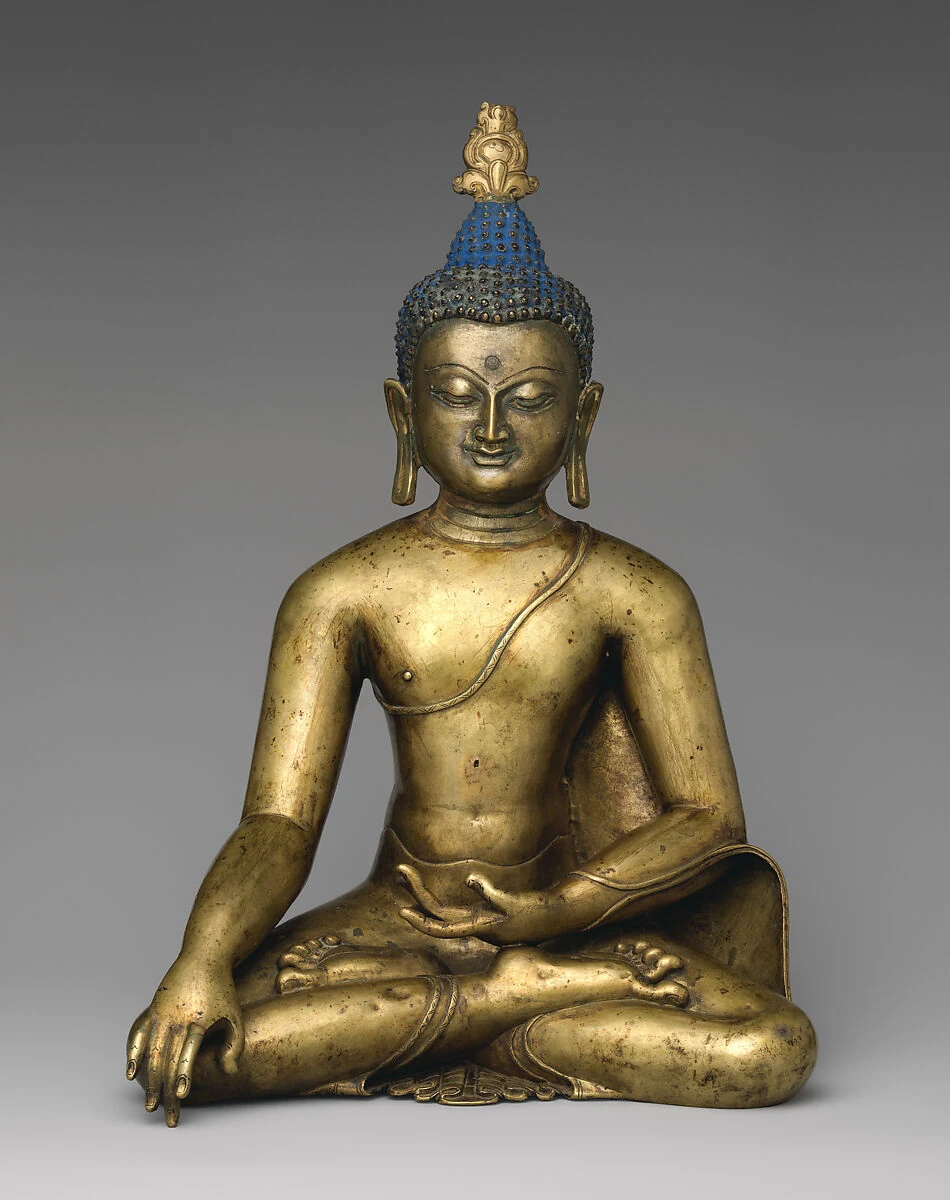
Buddha & gesture
Śākyamuni: the earth as witness
The downward right hand is the earth-touching gesture, associated with the traditional story of awakening. The robe and seated posture help establish the figure’s contemplative setting. This is a twelfth-century Central Tibetan sculpture, rather than a portrait made during the Buddha’s lifetime.
Look closelyCompare the lowered right hand with the left hand in the lap. What story does this difference tell?
Continue studying ↗Artist unknown · The Metropolitan Museum of Art · 2012.458. Object / image record ↗ · Public domain / CC0. Resized and converted to WebP; image content unchanged.
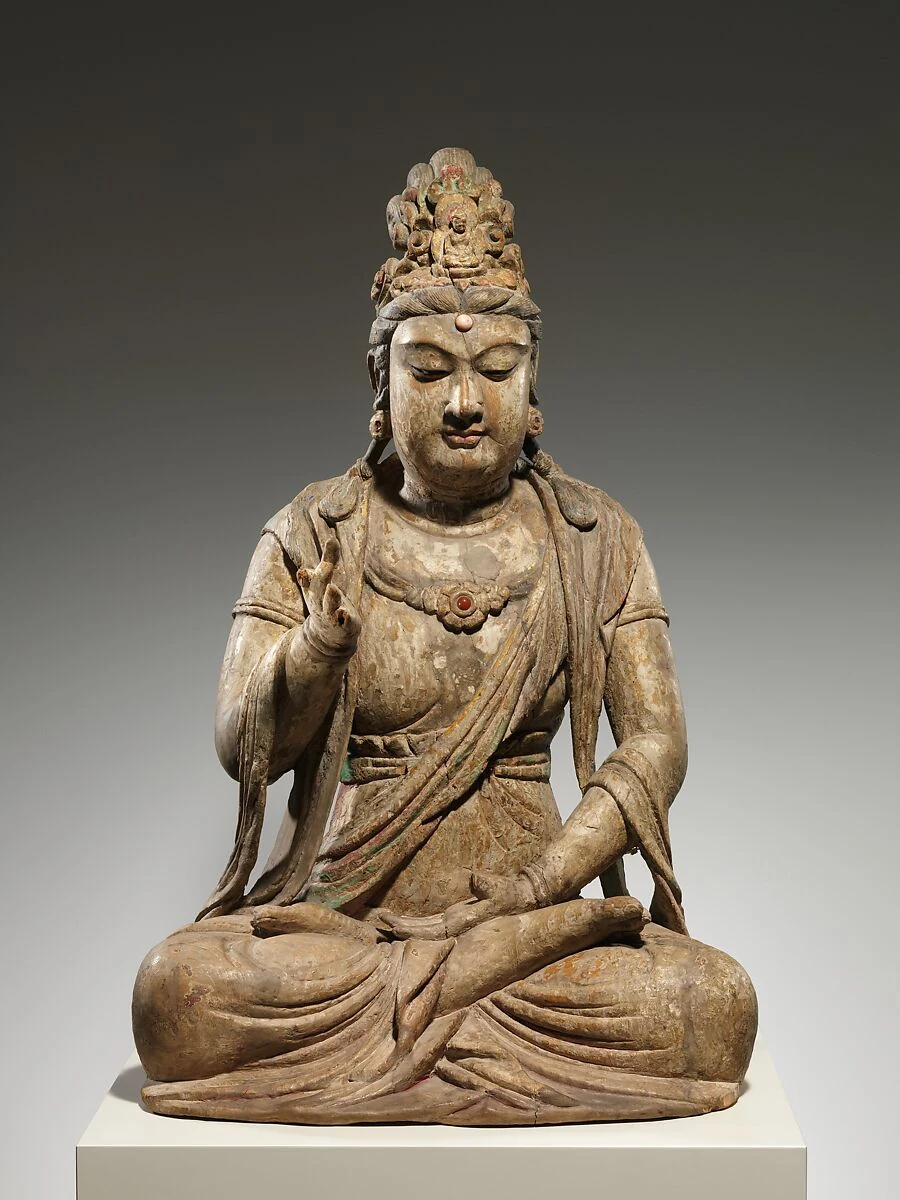
Bodhisattva
Avalokiteśvara / Guanyin: compassion
Avalokiteśvara is associated with compassion; Guanyin is the Chinese name. This Chinese sculpture belongs to a long and varied history of the figure’s representation. Its particular posture should be studied through the object record rather than assumed to be the standard form everywhere.
Look closelyNotice the ornament and headdress. Compare them with the plain robe of the Śākyamuni sculpture.
Continue studying ↗Artist unknown · The Metropolitan Museum of Art · 33.116. Object / image record ↗ · Public domain / CC0. Resized and converted to WebP; image content unchanged.
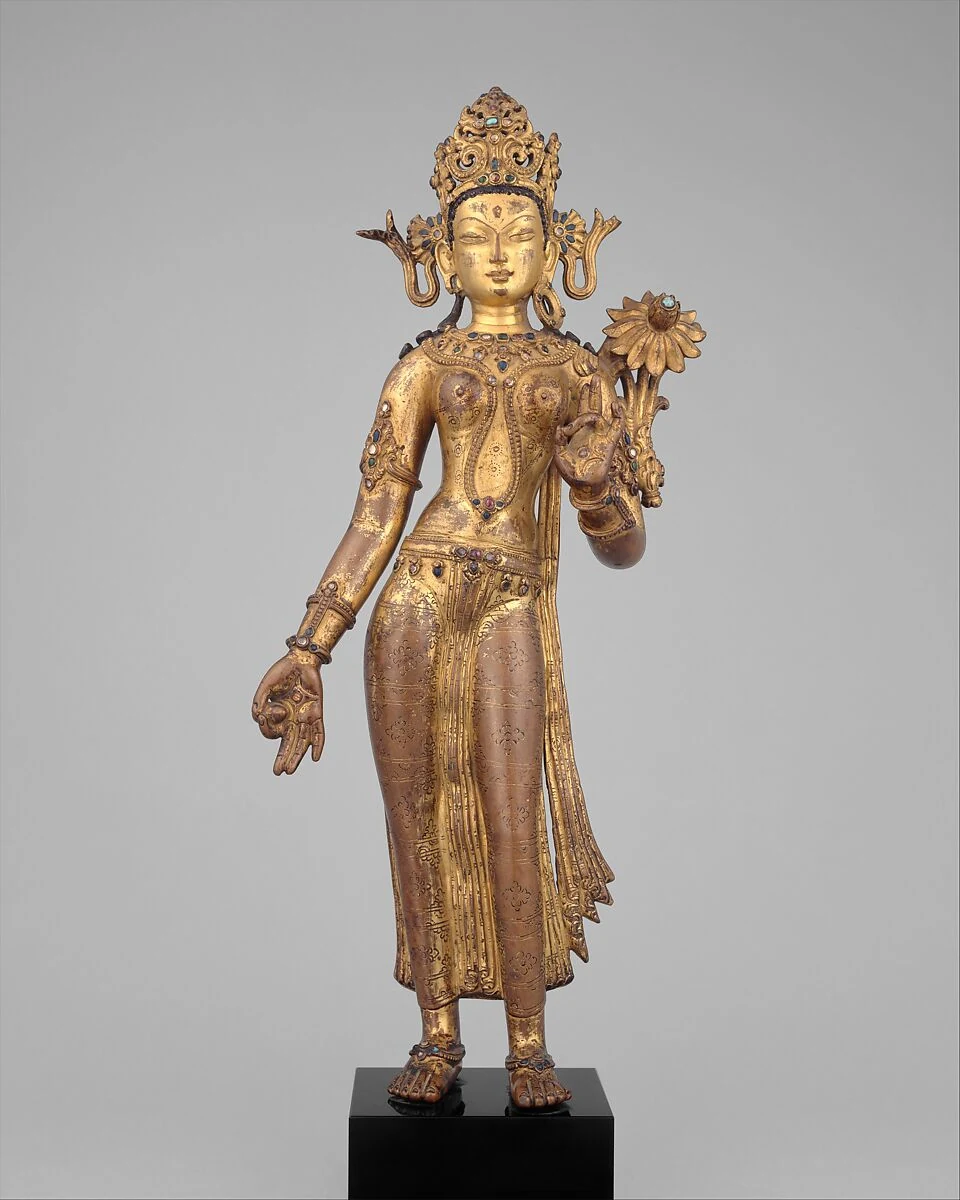
Sacred figure
Tārā: responsive care
The Met identifies this Nepalese figure as probably White Tārā. The lowered hand expresses giving, and the lotus is an important attribute. Tārā has multiple forms, so this example should not be renamed Green Tārā merely because that form is widely familiar.
Look closelyFollow the line from the lower hand to the upper body and the flower. How does the standing posture affect your response?
Continue studying ↗Artist unknown · The Metropolitan Museum of Art · 66.179. Object / image record ↗ · Public domain / CC0. Resized and converted to WebP; image content unchanged.
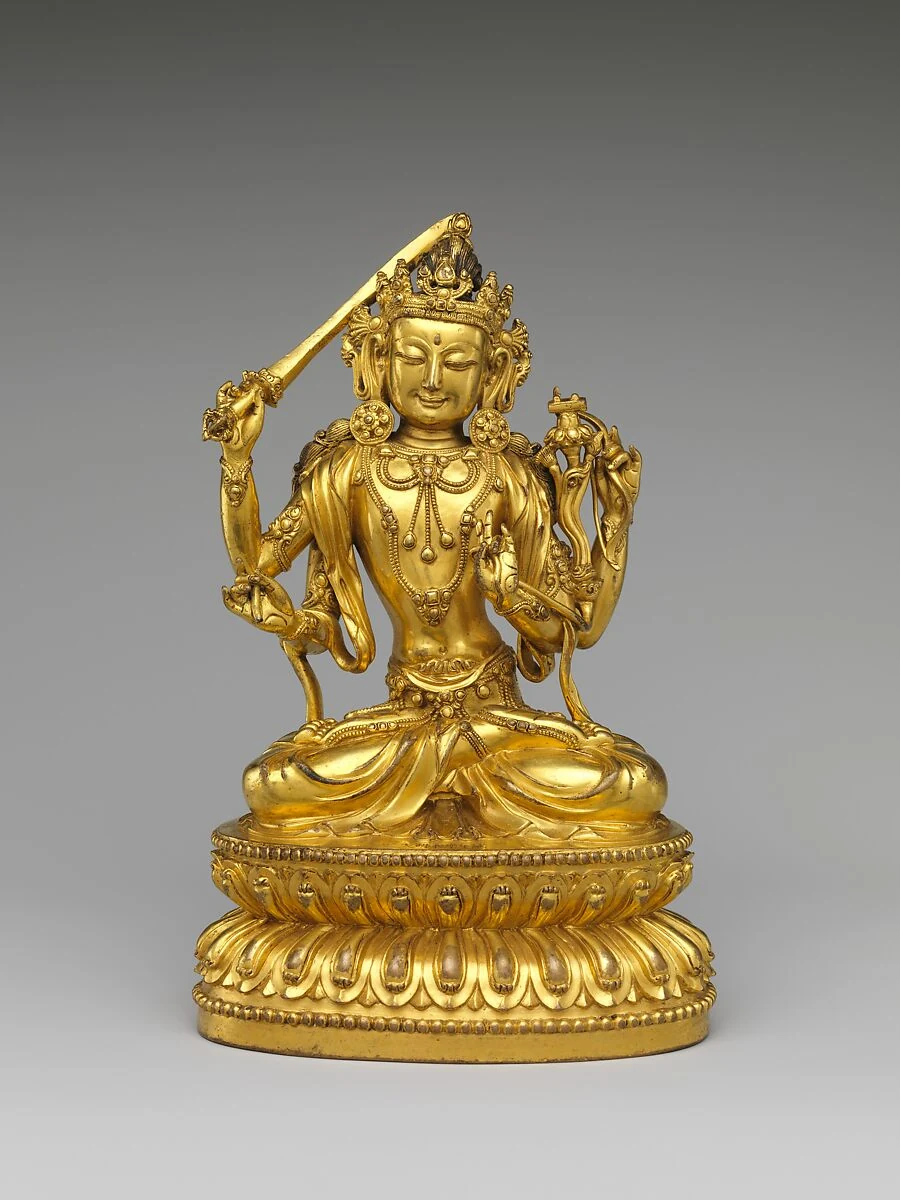
Bodhisattva
Mañjuśrī: the clarity of wisdom
Mañjuśrī is associated with wisdom. In this Chinese image, the sword and book help communicate that identity: the sword is read in relation to cutting through ignorance, while the book points toward wisdom teaching. Several arms allow several attributes to be represented together.
Look closelyFind the attributes before reading them as symbols. Which would be difficult to recognise without a catalogue?
Continue studying ↗Artist unknown · The Metropolitan Museum of Art · 2001.59. Object / image record ↗ · Public domain / CC0. Resized and converted to WebP; image content unchanged.
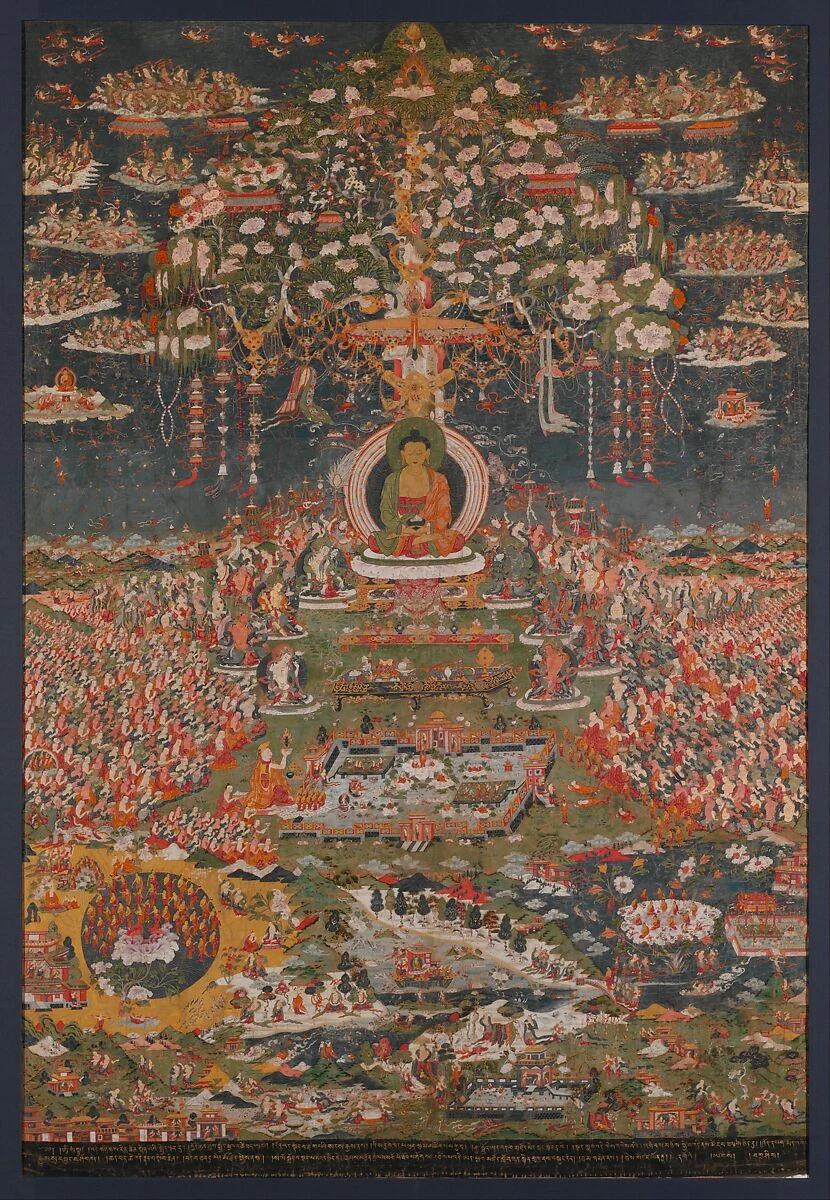
Buddha & sacred landscape
Amitābha and the Pure Land
This Tibetan painting places Amitābha within Sukhāvatī, the Western Pure Land. It is a sacred landscape shaped by Buddhist devotion and imagination, not a map to a physical travel destination. Pure Land teachings and practices have distinct expressions across Buddhist communities.
Look closelyBegin with the central Buddha, then examine how the surrounding figures and landscape direct attention back toward the centre.
Continue studying ↗Artist unknown · The Metropolitan Museum of Art · 2004.139. Object / image record ↗ · Public domain / CC0. Resized and converted to WebP; image content unchanged.
A question to carry with you
Pause and reflect.
Which details tell you who an image represents, and which details remain uncertain? Choose one artwork. Write one observation, one source-supported interpretation and one personal response.
Sources & further reading
Study notes and examples are original explanations. Follow the links for the source texts and their own contexts.