
Empty of what?
In Madhyamaka philosophy, emptiness concerns the absence of intrinsic, independent existence. It does not mean that nothing exists or that actions have no consequences. Things function conventionally while lacking the self-contained essence we may imagine them to possess.
Visual study
A teaching you can explore
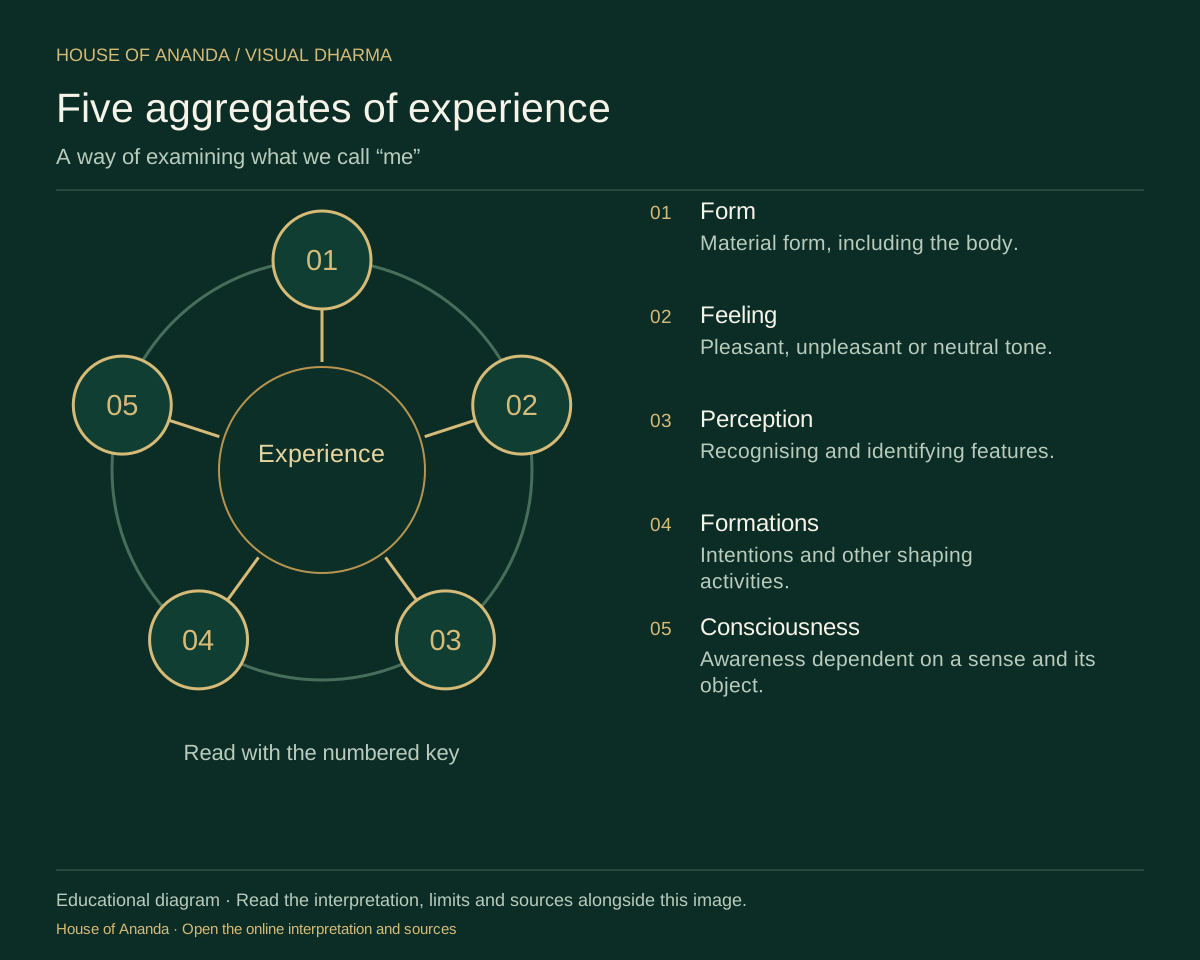
A way of examining what we call “me”
Five aggregates of experience
Five categories help analyse experience without treating it as a fixed possession.
Read the diagram & interpretation
- FormMaterial form, including the body.
- FeelingPleasant, unpleasant or neutral tone.
- PerceptionRecognising and identifying features.
- FormationsIntentions and other shaping activities.
- ConsciousnessAwareness dependent on a sense and its object.
At the sound of a message alert, there may be bodily sensation, pleasant or unpleasant tone, recognition, a wish to respond and auditory awareness. This is an editorial example, not five isolated compartments or a fixed neurological sequence.
Keep in mind Feeling tone is not the same category as the whole complexity of emotion. The aggregate model is a contemplative analysis, not a brain scan.
Sources: SN 22:59 · The Five ↗
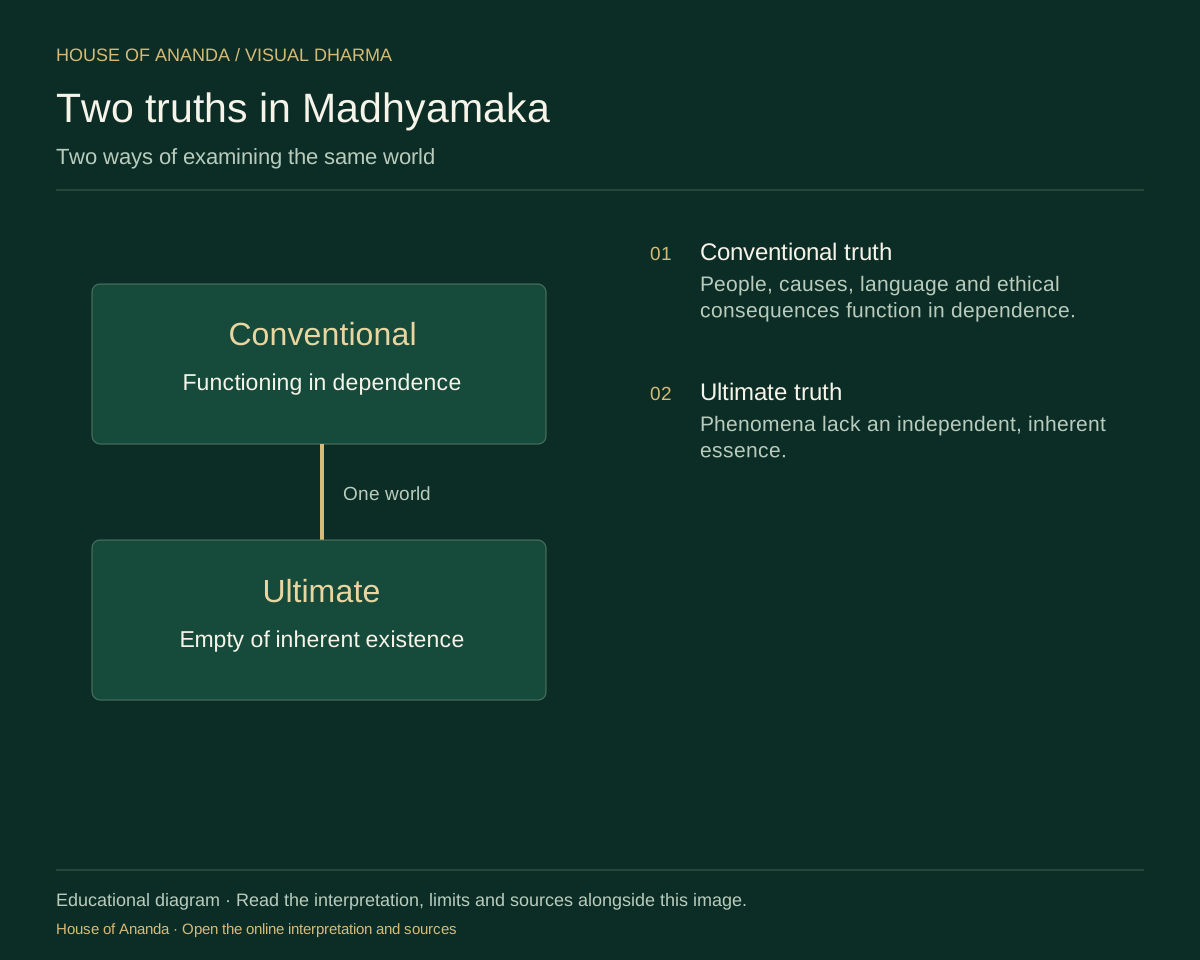
Two ways of examining the same world
Two truths in Madhyamaka
An introductory map of conventional and ultimate truth in a Mahāyāna philosophical tradition.
Read the diagram & interpretation
- Conventional truthPeople, causes, language and ethical consequences function in dependence.
- Ultimate truthPhenomena lack an independent, inherent essence.
The two panels are connected because emptiness does not erase conventional functioning. A person can lack an independent essence and still be someone whose pain matters. This framing follows a Madhyamaka context; Buddhist schools differ on how the two truths are explained.
Keep in mind “Empty” does not mean nonexistent. The panels do not depict two separate worlds or a good reality above a bad one.
A teaching about dependence
Nāgārjuna’s philosophical approach connects emptiness with dependent arising. The aim is to challenge rigid views, including turning emptiness itself into a final substance. Emptiness is not a hidden energy behind the world.
Two truths
Conventional and ultimate truth are distinguished in varied ways across Buddhist schools. At an introductory level, conventional descriptions allow us to speak and act in the world; ultimate analysis examines whether things possess inherent existence. It is misleading to use “ultimate truth” to dismiss someone’s pain or ethical responsibilities.
An everyday learning analogy
Consider a meal: ingredients, labour, weather, transport, cooking and a person eating all matter. The meal is still a useful and meaningful thing to name. This can make dependence more tangible, although an ordinary analogy cannot settle the technical arguments of Buddhist philosophy.
Study slowly
Begin with dependent origination and not-self before treating emptiness as a meditation instruction. Different Mahāyāna traditions explain it with distinct vocabularies. Keep questions open and work with careful translations and qualified teaching.
Art & contemplation
Look, learn, reflect

A pattern passing
Loose grains forming and releasing a pattern invite reflection on change. This is an invented artwork, not a Tibetan ritual sand mandala. Authentic mandala construction and dissolution belong to particular communities and practices.
A moment to reflectWhat can you appreciate without asking it to stay the same?
Follow this theme ↗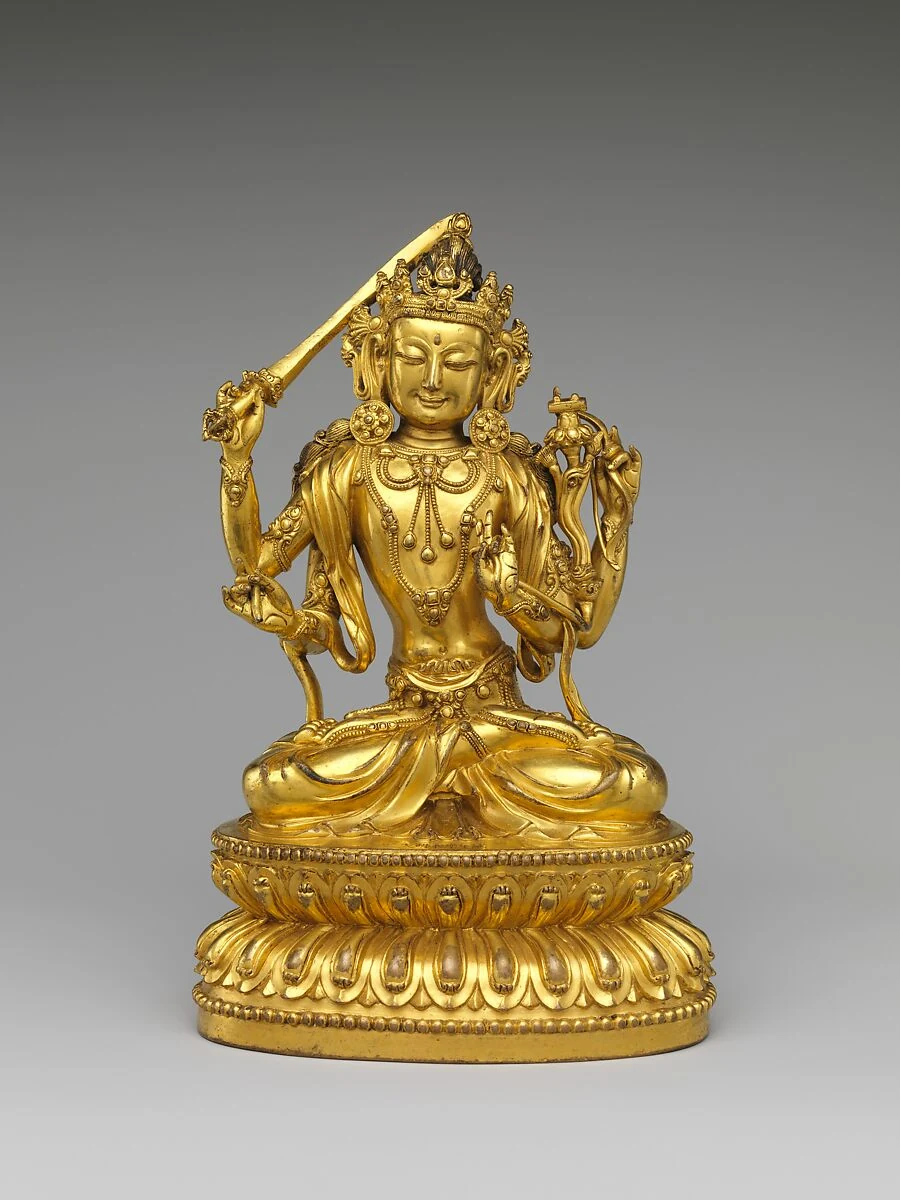
Bodhisattva
Mañjuśrī: the clarity of wisdom
Mañjuśrī is associated with wisdom. In this Chinese image, the sword and book help communicate that identity: the sword is read in relation to cutting through ignorance, while the book points toward wisdom teaching. Several arms allow several attributes to be represented together.
Look closelyFind the attributes before reading them as symbols. Which would be difficult to recognise without a catalogue?
Continue studying ↗Artist unknown · The Metropolitan Museum of Art · 2001.59. Object / image record ↗ · Public domain / CC0. Resized and converted to WebP; image content unchanged.
A question to carry with you
Pause and reflect.
What familiar object becomes less self-contained when you consider the conditions that make it possible?
Sources & further reading
Study notes and examples are original explanations. Follow the links for the source texts and their own contexts.