
A family of auspicious images
The Eight Auspicious Symbols appear together or individually in Himalayan Buddhist art, textiles, architecture and ceremonial settings. Their forms draw on a wider Indian visual heritage, and their ordering and interpretation can differ. The set here follows a common Tibetan Buddhist presentation. These symbols can express wishes for flourishing and the qualities of an awakened life.
Visual study
A teaching you can explore
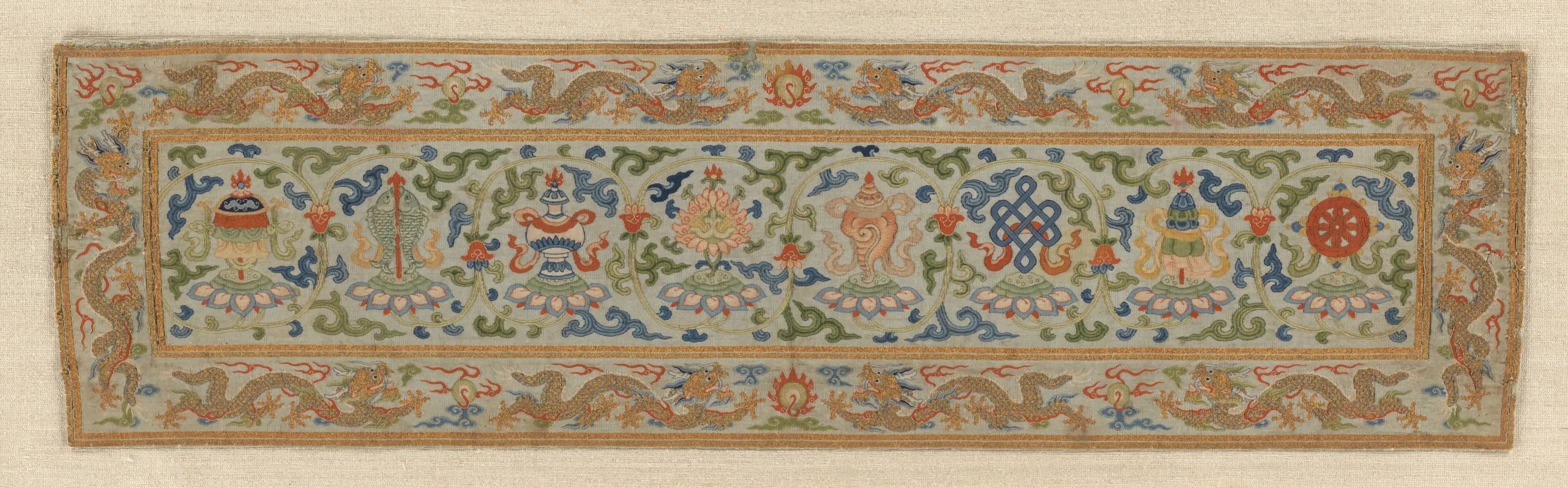
- 1. Parasol
- 2. Two fish
- 3. Treasure vase
- 4. Lotus
- 5. Conch
- 6. Endless knot
- 7. Canopy / banner
- 8. Dharma wheel
Artist unknown · The Metropolitan Museum of Art · 2012.559. Purchase, Barbara and William Karatz Gift, in honor of James C. Y. Watt, 2012. Object / image record ↗ · Public domain / CC0. Resized and converted to WebP; image content unchanged.
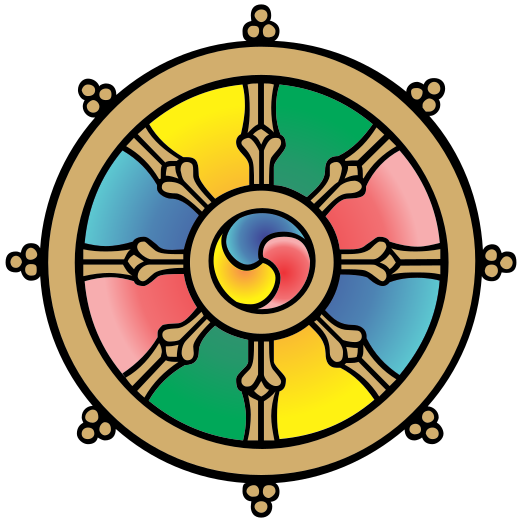
01 · Dharmacakra
Dharma wheel
The wheel represents the Buddha’s teaching. Eight spokes commonly recall the eight factors of the path.
Interpretation & reflection
Look closely. Notice the relationship of hub, spokes and rim: distinct parts make one functioning wheel. The eightfold association is especially useful when the image actually has eight spokes.
A question. Which part of the path needs attention in your daily life?
The Dharma wheel and the Wheel of Life are different images with different teaching functions.
Sources: Norbulingka Institute · The Eight Auspicious Symbols ↗ · Himalayan Art Resources · Eight Auspicious Symbols ↗
Christopher J. Fynn. Object / image record ↗ · CC BY-SA 4.0. Original SVG, unmodified.
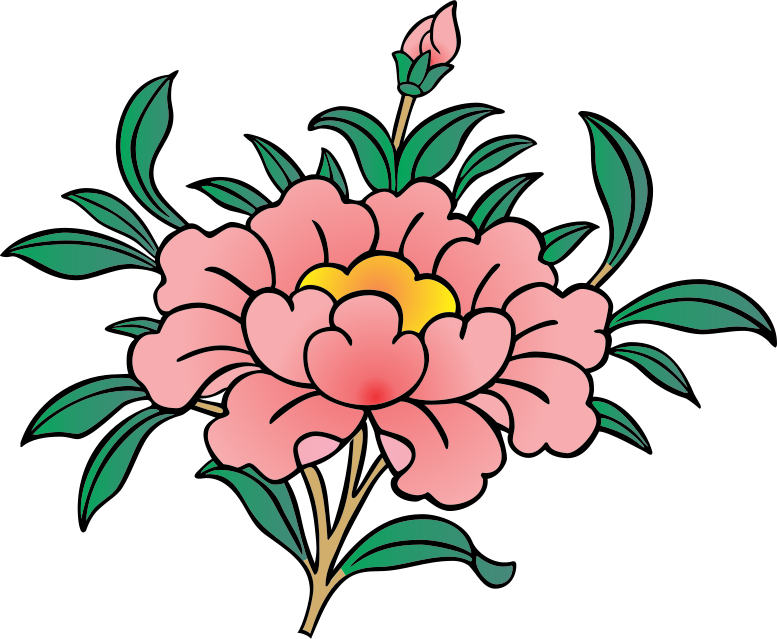
02 · Padma
Lotus
A widespread image of purity and awakening, expressed through a flower associated with water and mud.
Interpretation & reflection
Look closely. Look at bud, open petals, stem and seat. A lotus held by a figure is an attribute within a particular image; a lotus throne can carry another layer of meaning.
A question. What might grow through care within conditions you cannot make perfect?
Colour associations depend on tradition and context; a modern coloured flower is not enough to identify a deity.
Sources: Norbulingka Institute · The Eight Auspicious Symbols ↗ · Himalayan Art Resources · Eight Auspicious Symbols ↗
Christopher J. Fynn. Object / image record ↗ · CC BY-SA 4.0. Original SVG, unmodified.
03 · Śrīvatsa · glorious knot
Endless knot
A continuous interlaced design associated with the Buddha’s inexhaustible wisdom; it can also invite reflection on relationship and continuity.
Interpretation & reflection
Look closely. Trace the interwoven line. Notice how crossing and connection make a pattern without a prominently declared beginning or end.
A question. Which relationships support something you usually think of as your own achievement?
A personal reflection about connection is not a complete explanation of every ritual use of this design.
Sources: Norbulingka Institute · The Eight Auspicious Symbols ↗ · Himalayan Art Resources · Eight Auspicious Symbols ↗
Detail displayed from the historical sutra cover shown above. Open the image to see the whole textile.
Artist unknown · The Metropolitan Museum of Art · 2012.559. Purchase, Barbara and William Karatz Gift, in honor of James C. Y. Watt, 2012. Object / image record ↗ · Public domain / CC0. Resized and converted to WebP; image content unchanged.
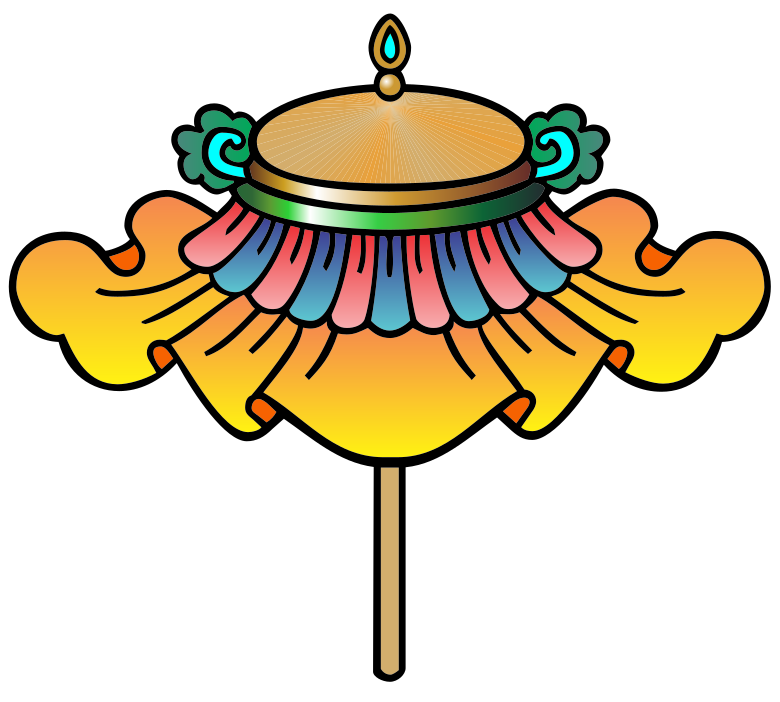
04 · Chatra
Precious parasol
A sign associated with dignity and spiritual protection, drawing on the elevated status of the royal umbrella.
Interpretation & reflection
Look closely. Notice the canopy, handle and hanging ornaments. The canopy’s ordinary ability to provide shade helps make the image of shelter understandable.
A question. What kind of environment helps people feel able to learn and practise?
A symbol of protection is not a guarantee that difficult events cannot happen.
Sources: Norbulingka Institute · The Eight Auspicious Symbols ↗ · Himalayan Art Resources · Eight Auspicious Symbols ↗
Christopher J. Fynn. Object / image record ↗ · CC BY-SA 4.0. Original SVG, unmodified.
05 · Suvarṇamatsya
Two golden fish
The paired fish are auspicious emblems associated with good fortune and freedom.
Interpretation & reflection
Look closely. Observe the two bodies, their orientation and their relationship. Pairing is a visible feature of this symbol; it should not automatically be read as the Chinese yin–yang diagram.
A question. Where does fear make your actions more constrained than they need to be?
The fish appear within a particular family of auspicious symbols. Similar-looking fish in another culture may mean something different.
Sources: Norbulingka Institute · The Eight Auspicious Symbols ↗ · Himalayan Art Resources · Eight Auspicious Symbols ↗
Detail displayed from the historical sutra cover shown above. Open the image to see the whole textile.
Artist unknown · The Metropolitan Museum of Art · 2012.559. Purchase, Barbara and William Karatz Gift, in honor of James C. Y. Watt, 2012. Object / image record ↗ · Public domain / CC0. Resized and converted to WebP; image content unchanged.
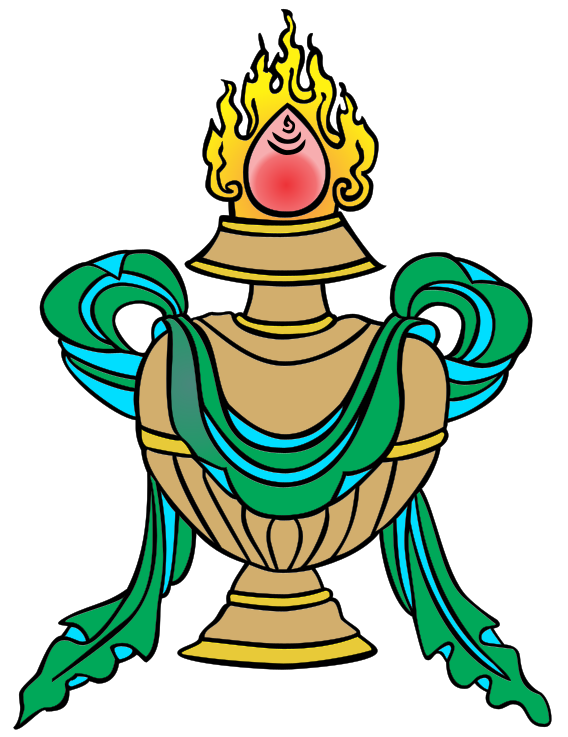
06 · Kalaśa · bumpa
Treasure vase
A symbol of abundance, including material well-being and spiritual riches.
Interpretation & reflection
Look closely. Identify the rounded vessel, its neck, covering and jewel-like details. Its recognisable container form gives the idea of holding something precious a visual presence.
A question. What form of generosity can increase well-being without merely accumulating more possessions?
Its auspicious meaning should not be turned into a promise of wealth from displaying an image.
Sources: Norbulingka Institute · The Eight Auspicious Symbols ↗ · Himalayan Art Resources · Eight Auspicious Symbols ↗
Christopher J. Fynn. Object / image record ↗ · CC BY-SA 4.0. Original SVG, unmodified.
07 · Śaṅkha
Right-turning conch
The conch is associated with the proclamation and spreading of the Buddha’s teaching.
Interpretation & reflection
Look closely. Notice the spiral and its direction. A shell can also be a sounding instrument, making the association with a teaching heard by others especially vivid.
A question. What makes a message worth listening to: its volume, its truthfulness or its usefulness?
This symbol is usually specified as right-turning; mirrored decorative reproductions can lose that distinction.
Sources: Norbulingka Institute · The Eight Auspicious Symbols ↗ · Himalayan Art Resources · Eight Auspicious Symbols ↗
Detail displayed from the historical sutra cover shown above. Open the image to see the whole textile.
Artist unknown · The Metropolitan Museum of Art · 2012.559. Purchase, Barbara and William Karatz Gift, in honor of James C. Y. Watt, 2012. Object / image record ↗ · Public domain / CC0. Resized and converted to WebP; image content unchanged.
08 · Dhvaja
Victory banner
An emblem of the teaching and wisdom overcoming ignorance.
Interpretation & reflection
Look closely. Notice its upright form and stacked or hanging fabric elements. The language of victory is directed toward freedom from affliction, not contempt for another community.
A question. What would it mean to overcome a harmful habit without hating yourself?
Spiritual victory is not a claim that Buddhists should dominate people of other beliefs.
Sources: Norbulingka Institute · The Eight Auspicious Symbols ↗ · Himalayan Art Resources · Eight Auspicious Symbols ↗
Detail displayed from the historical sutra cover shown above. Open the image to see the whole textile.
Artist unknown · The Metropolitan Museum of Art · 2012.559. Purchase, Barbara and William Karatz Gift, in honor of James C. Y. Watt, 2012. Object / image record ↗ · Public domain / CC0. Resized and converted to WebP; image content unchanged.
Eight images, several layers
The short associations below are an entry point. Detailed ritual explanations can assign further correspondences, so avoid treating any single list as a universal decoder.
- Parasol: dignity and spiritual protection.
- Golden fish: good fortune and freedom.
- Treasure vase: abundance, including spiritual riches.
- Lotus: mental and spiritual purity.
- Conch: the spreading or proclamation of the teaching.
- Endless knot: inexhaustible wisdom and connection.
- Victory banner: overcoming ignorance.
- Dharma wheel: the teaching of the Buddha.
From recognition to understanding
Begin by identifying the object. Is the wheel eight-spoked? Does the conch coil to the right? How is the knot woven? Next read the explanation supplied by the artist, temple or collection. A recognisable shape may carry a particular meaning within a particular ceremony. The visual atlas brings the symbols together with individual reading notes and credited source images.
A simple way to study the set
Choose one symbol for a week. Sketch its structure in a notebook, record the source of the meaning you learned, and write a separate personal reflection. Keeping those entries separate helps distinguish historical explanation from the associations that arise for you. If you reproduce an artist’s drawing, retain its credit and reuse licence.
Art & contemplation
Look, learn, reflect
Symbols in material culture
Auspicious symbols beyond the shrine
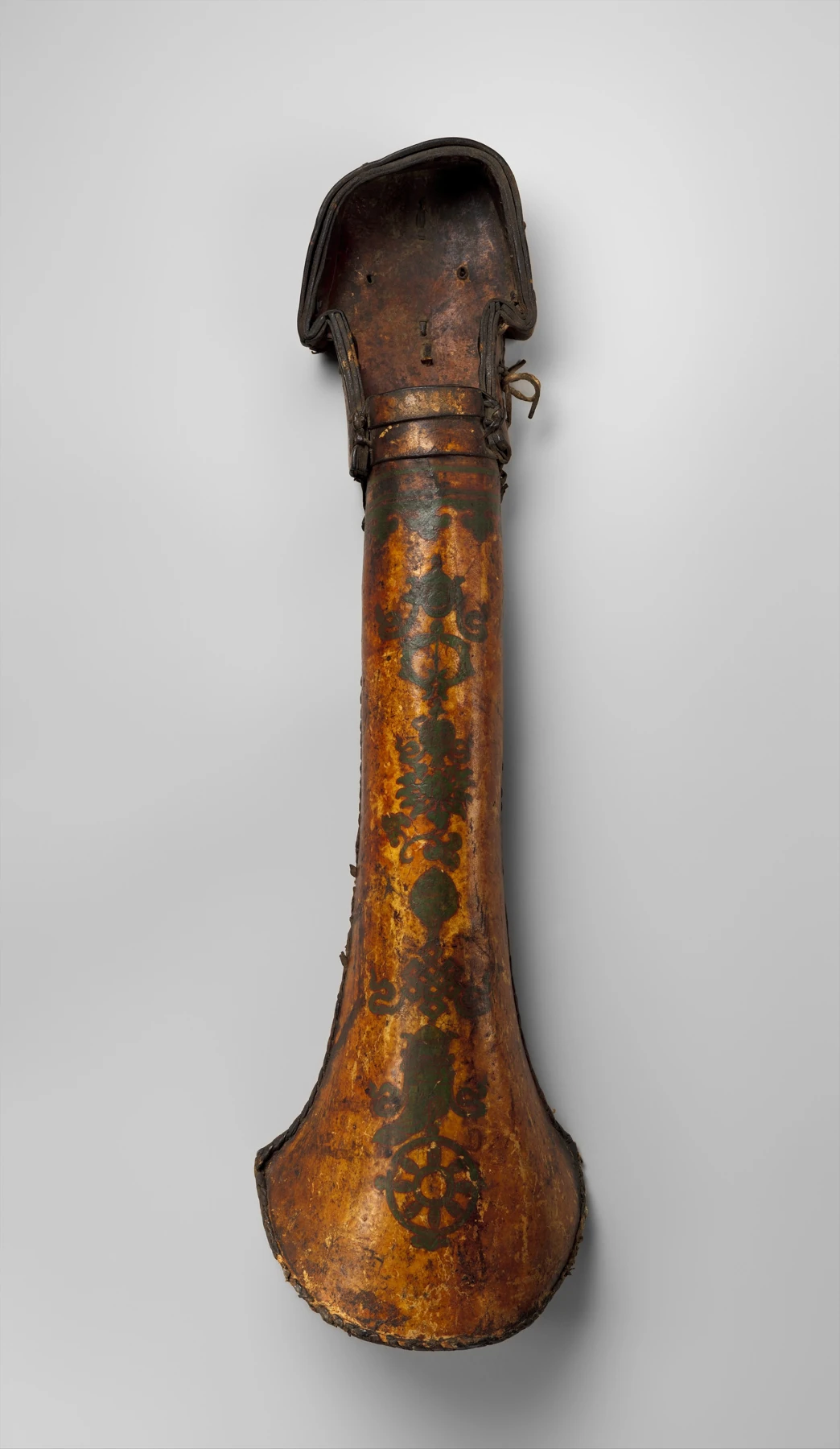
This Tibetan or Mongolian quiver, dated between the fourteenth and sixteenth centuries, carries the Eight Auspicious Symbols. It shows that religious imagery could appear on objects outside a shrine. A historical object can raise questions about protection, status and the complexity of the societies that made it.
Look closelyCompare its worn motifs with the clearer symbols on the sutra cover. Distinguish what you can still recognise from what the museum identifies.
Continue studying ↗Artist unknown · The Metropolitan Museum of Art · 2014.71. Purchase, Arthur Ochs Sulzberger Bequest, and Rogers Fund, by exchange, 2014. Object / image record ↗ · Public domain / CC0. Resized and converted to WebP; image content unchanged.
A question to carry with you
Pause and reflect.
Which symbol draws your attention, and what would you need to learn before explaining it to somebody else?
Sources & further reading
Study notes and examples are original explanations. Follow the links for the source texts and their own contexts.