
Five commitments
The basic lay precepts train in refraining from killing, taking what is not given, sexual misconduct, false speech, and intoxicants that lead to heedlessness. They are commitments to practise, not claims of moral perfection.
Visual study
A teaching you can explore
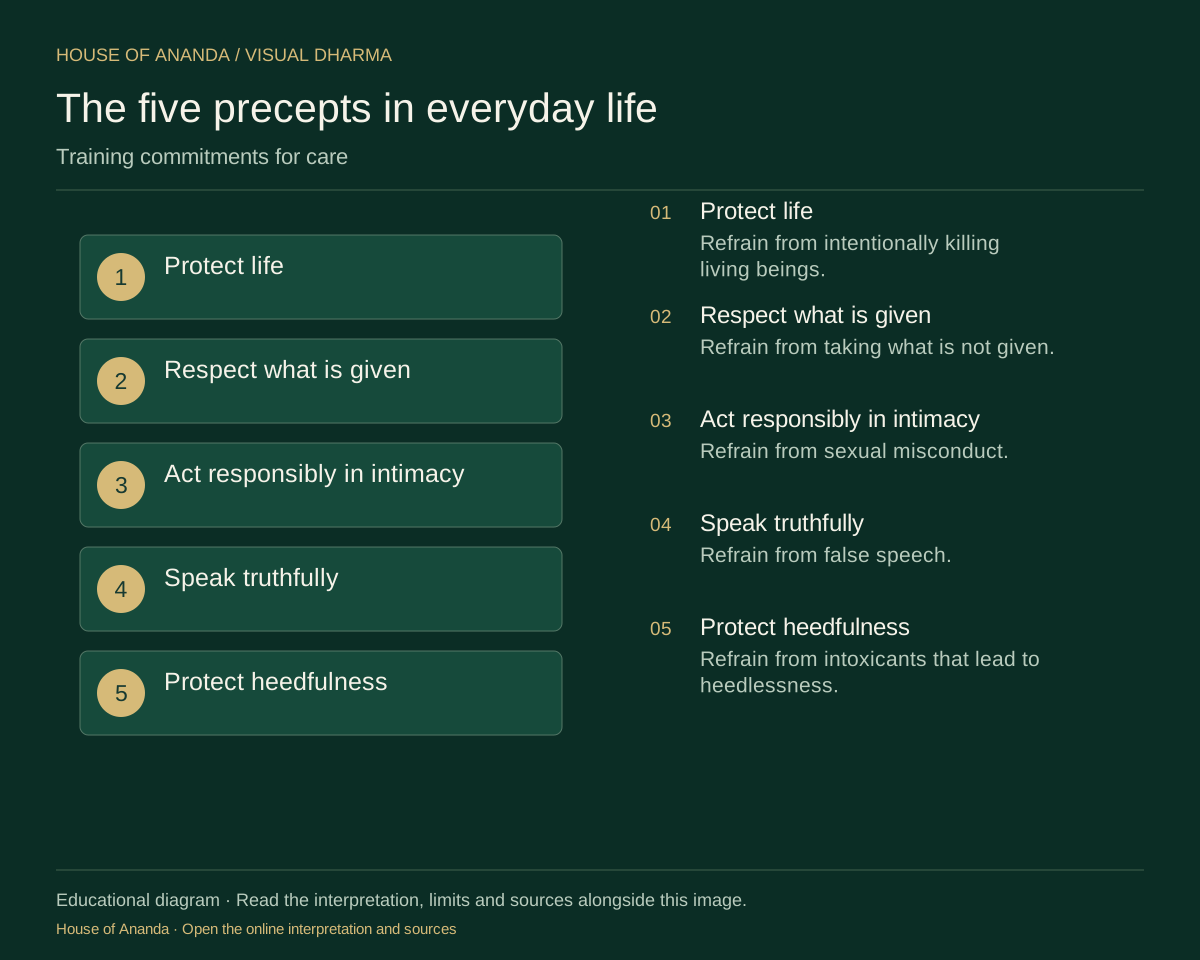
Training commitments for care
The five precepts in everyday life
A common lay ethical framework, paired here with everyday reflection prompts.
Read the diagram & interpretation
- Protect lifeRefrain from intentionally killing living beings.
- Respect what is givenRefrain from taking what is not given.
- Act responsibly in intimacyRefrain from sexual misconduct.
- Speak truthfullyRefrain from false speech.
- Protect heedfulnessRefrain from intoxicants that lead to heedlessness.
Ask how a commitment can become concrete today: a truthful correction, a respectful boundary, care for an animal, returning an item or reconsidering a habit that clouds attention. These examples are reflections, not a replacement for a community’s formulation or explanation of its precepts.
Keep in mind A precept is a training commitment. Compassionate accountability includes recognising harm, making repair where possible and practising again.
Sources: Ṭhānissaro Bhikkhu · The Healing Power of the Precepts ↗ · Plum Village · Five Mindfulness Trainings ↗
Responsibility in relationships
Consider consent, trust, exploitation and the consequences of secrecy. Spiritual labels never remove the need for consent. Ethical reflection includes people affected by a choice, rather than concentrating only on whether the person acting feels pure.
More than avoiding a list
Non-harming can encourage care; not stealing can encourage generosity; truthful speech can encourage repair. Plum Village offers a particular contemporary formulation in its Five Mindfulness Trainings. Name that living tradition rather than treating its wording as universal.
When you fall short
Acknowledge the act, stop repeating harm, make appropriate repair and change the conditions that encouraged it. Accountability is more useful than self-punishment or an instant claim that you have let everything go.
Five commitments for lay practice
Common formulations are undertakings to refrain from harm. Their explanation and ceremonial wording vary across communities.
| Training | An everyday application |
|---|---|
| Refrain from killing | Respect life; consider how choices affect other beings. |
| Refrain from taking what is not given | Respect property, consent, time and fair dealing. |
| Refrain from sexual misconduct | Act with honesty, consent and care; recognise power imbalances. |
| Refrain from false speech | Tell the truth and avoid deliberate deception. |
| Refrain from intoxicants that lead to heedlessness | Protect the clarity needed to act responsibly. |
Practice rather than perfectionism
The precepts support trust and reduce harm. They are not a licence to shame others or to declare yourself spiritually superior. When you fall short, acknowledge what happened, make appropriate repair and consider how to act differently.
Traditional and modern expressions
Plum Village’s Five Mindfulness Trainings develop a contemporary expression of Buddhist ethics, including communication, consumption and relationship. They are valuable to study as a named lineage’s formulation, rather than assuming every Buddhist community uses the same wording.
One commitment made concrete
Choose one area where your intention can become observable: being accurate about a promise, asking before borrowing something, or giving full attention during an important conversation. Keep the commitment small enough to practise and serious enough to matter.
Art & contemplation
Look, learn, reflect

The helping hand
The scene interprets compassion as practical responsiveness. Neither figure represents a named bodhisattva or a recorded Buddhist story. Help becomes meaningful through attention to what another person actually needs.
A moment to reflectWhat would useful help look like today?
Follow this theme ↗A question to carry with you
Pause and reflect.
Choose one precept and one observable action today. Review its effects this evening. What is one action this week that would make another person safer or more able to trust you?
Sources & further reading
Study notes and examples are original explanations. Follow the links for the source texts and their own contexts.