
Anicca / anitya · impermanence
Conditioned things change. A sound ends; a mood shifts; a body ages; a relationship develops. Impermanence is not simply an instruction to enjoy the moment. It invites a careful look at the costs of demanding that changing things remain exactly as we prefer.
Visual study
A teaching you can explore
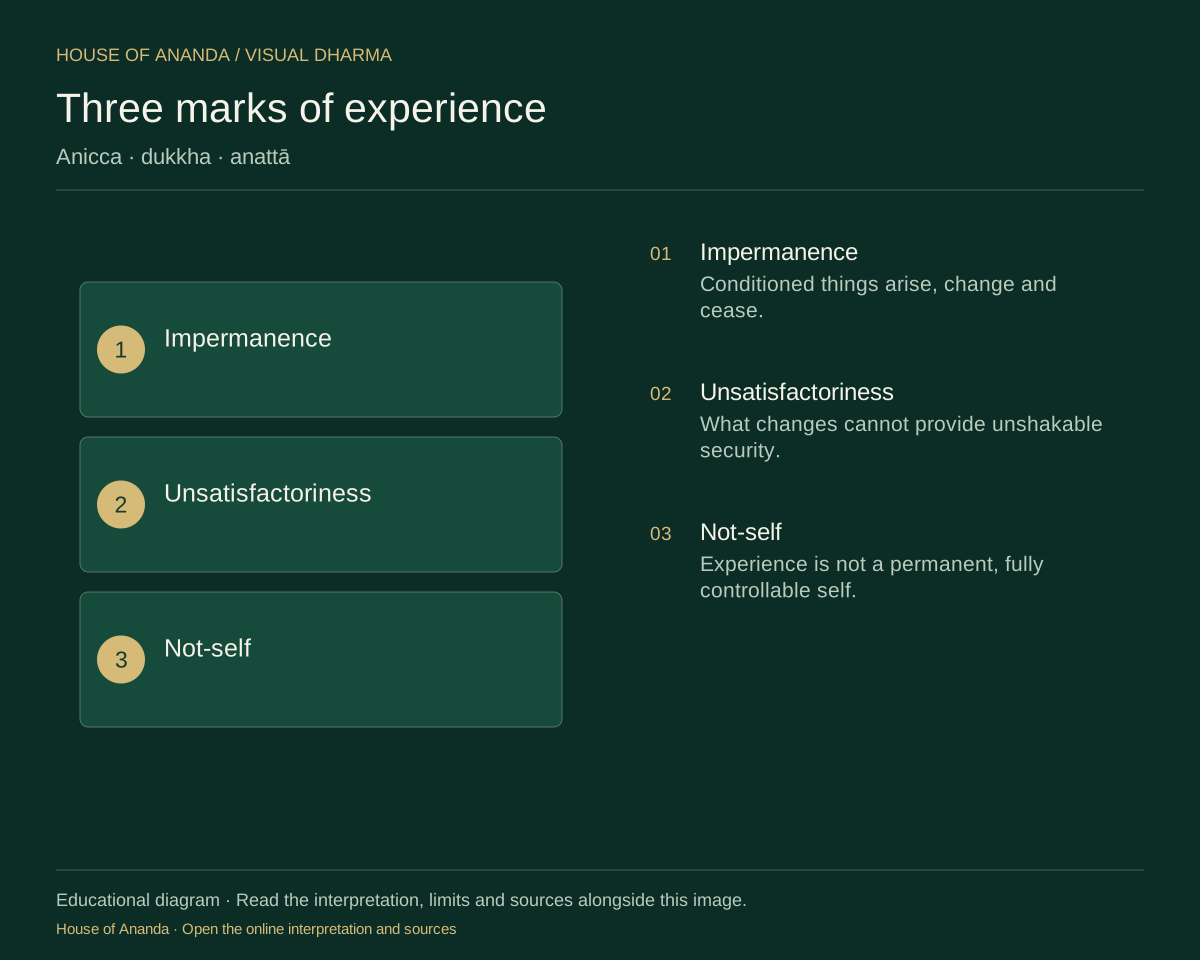
Anicca · dukkha · anattā
Three marks of experience
A framework for examining change, unreliability and the limits of ownership.
Read the diagram & interpretation
- ImpermanenceConditioned things arise, change and cease.
- UnsatisfactorinessWhat changes cannot provide unshakable security.
- Not-selfExperience is not a permanent, fully controllable self.
Consider a sound, a feeling or a plan. Notice its conditions, its change and the limits of your control. This is a starting point for inquiry, not a proof produced by a single exercise. In traditional formulations, impermanence and unsatisfactoriness concern conditioned phenomena; not-self is stated more broadly.
Keep in mind Not-self is not an instruction to deny ordinary identity, responsibility or the reality of another person’s pain.
Sources: Dhammapada · Chapter 20, The Path ↗ · SN 22:59 · The Five ↗
Dukkha / duḥkha · unsatisfactoriness
What changes and cannot be fully controlled cannot provide unshakeable security when clung to. This does not make ordinary happiness worthless. It changes the kind of expectation we place upon it.
Anattā / anātman · not-self
Buddhist teaching questions the identification of changing processes as a permanent, independent self. This is not a statement that people do not matter. Responsibility, care and ordinary personal language continue to have a place. Interpretations differ across Buddhist philosophical schools.
A precise distinction
In a well-known early formulation, conditioned formations are impermanent and dukkha, while all dhammas are not-self. Saying simply “everything is impermanent” can lose this distinction, especially when discussing nirvāṇa. A beginner does not need to resolve every philosophical debate to notice change carefully.
Try a small observation
Listen to a sound from its beginning to its ending. Notice the wish for it to continue or stop. Keep the observation simple. If self-inquiry feels disorienting, return to ordinary surroundings and leave deeper analysis for a supported teaching setting.
Art & contemplation
Look, learn, reflect

A pattern passing
Loose grains forming and releasing a pattern invite reflection on change. This is an invented artwork, not a Tibetan ritual sand mandala. Authentic mandala construction and dissolution belong to particular communities and practices.
A moment to reflectWhat can you appreciate without asking it to stay the same?
Follow this theme ↗A question to carry with you
Pause and reflect.
What is changing right now that you usually describe as fixed?
Sources & further reading
Study notes and examples are original explanations. Follow the links for the source texts and their own contexts.