
A living tradition
Theravāda is especially prominent in Sri Lanka, Thailand, Myanmar, Cambodia and Laos, with communities around the world. It gives central authority to the Pāli canon and honours the historical Buddha. Common features do not make every temple or meditation centre identical.
Visual study
A teaching you can explore
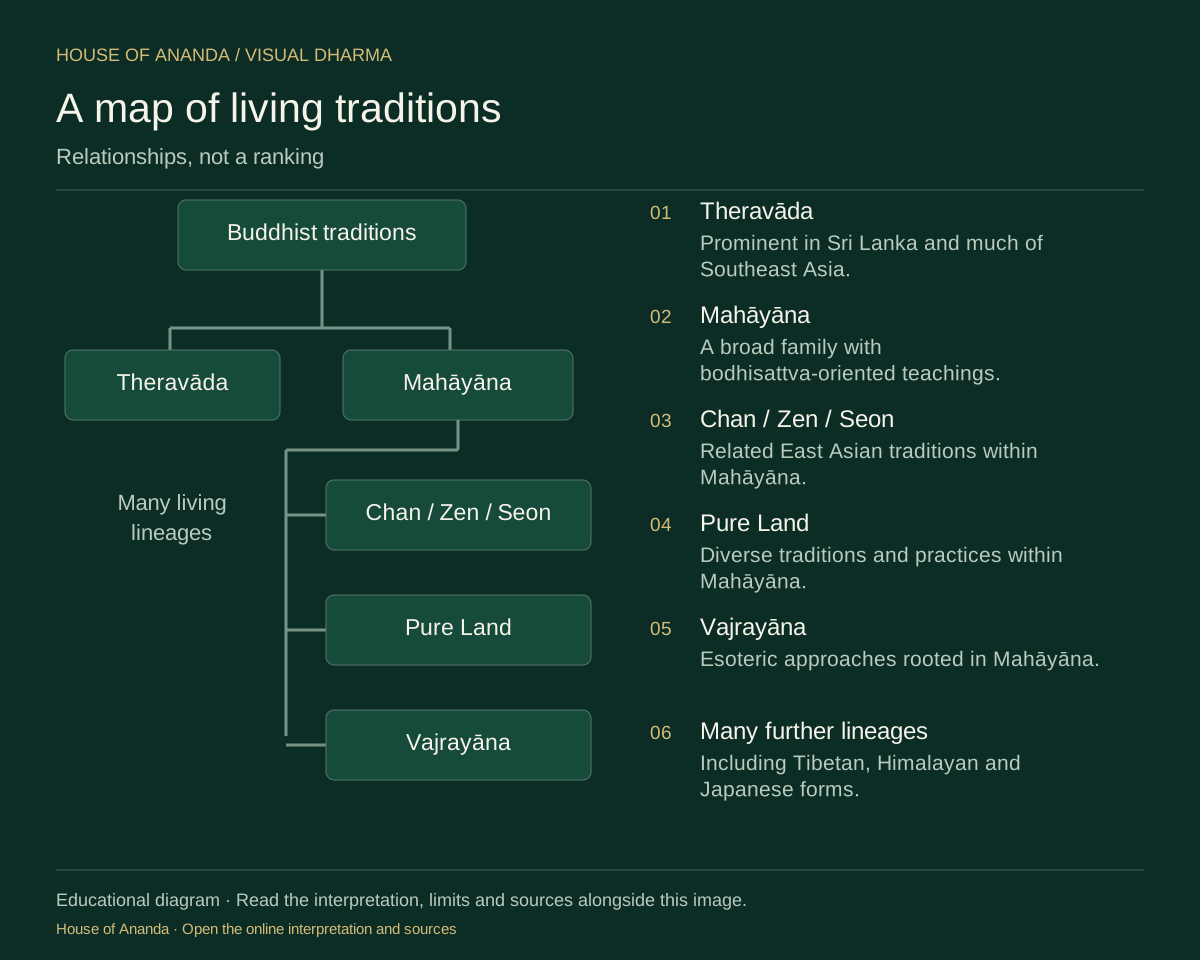
Relationships, not a ranking
A map of living traditions
A simplified orientation to large families and selected lineages.
Read the diagram & interpretation
- TheravādaProminent in Sri Lanka and much of Southeast Asia.
- MahāyānaA broad family with bodhisattva-oriented teachings.
- Chan / Zen / SeonRelated East Asian traditions within Mahāyāna.
- Pure LandDiverse traditions and practices within Mahāyāna.
- VajrayānaEsoteric approaches rooted in Mahāyāna.
- Many further lineagesIncluding Tibetan, Himalayan and Japanese forms.
Read the branches as broad relationships. Zen and Pure Land are not always separate memberships: practices can coexist. Vajrayāna is not a wholly independent third religion beside Mahāyāna; it develops within a Mahāyāna setting. Communities now live throughout the world.
Keep in mind This is a study map, not a complete historical family tree. Geographic associations are neither exclusive nor fixed.
Sources: Study Buddhism · Types of Buddhism ↗ · Stanford Encyclopedia of Philosophy · Japanese Zen ↗
The arahant ideal
An arahant is a liberated practitioner whose defilements have ended. This ideal must not be caricatured as selfishness: generosity, ethical conduct and care for others are integral to Theravāda life.
More than an insight retreat
Monastic discipline, offerings, chanting, festivals and lay support sit alongside meditation. Forest, scholarly and urban communities may emphasise different activities. A modern residential vipassanā course gives one particular doorway into a much larger religious world.
Visit thoughtfully
Read the centre’s own explanation before attending. Ask whether the event is a public teaching, devotional ceremony or formal retreat. Follow the hosts’ advice about clothing, seating, offerings and interaction with monastics. Local guidance is more useful than an internet rule applied everywhere.
Texts and communities
Theravāda, often translated as “teaching of the elders”, is strongly associated with Sri Lanka, Thailand, Myanmar, Cambodia and Laos, as well as global communities. Its textual heritage centres on the Pāli Tipiṭaka and a large commentarial tradition. It should not be described as an unchanged photograph of the Buddha’s own time.
More than retreat meditation
Lay generosity, precepts, chanting, merit-making, festivals and support of monastic life are central in many communities. Forest traditions, scholastic institutions and modern lay meditation movements have different emphases. A single silent retreat cannot represent all of this diversity.
Wisdom and liberation
The path is often explained through generosity, ethical conduct and cultivation, or through ethics, concentration and wisdom. Arahantship is a major formulation of liberation. This emphasis does not imply that Theravāda practitioners lack compassion or concern for other beings.
Where to begin reading
Read a short discourse with its introduction before taking an isolated sentence as the whole teaching. Compare translations when a term seems strange. Dhamma/Dharma, nibbāna/nirvāṇa and kamma/karma are useful Pāli/Sanskrit pairs to recognise.
A first community visit
Ask whether a session is suitable for visitors, how offerings work, and what etiquette applies. Observe rather than assume. Some events are primarily devotional or communal; others are explicitly introductory meditation classes.
Art & contemplation
Look, learn, reflect

A lamp for inquiry
Light offers a contemporary metaphor for inquiry and understanding. The unlettered pages do not depict a lost scripture or an authentic manuscript. Study can illuminate experience while experience raises new questions for study.
A moment to reflectWhich question deserves a slower, more attentive reading?
Follow this theme ↗A question to carry with you
Pause and reflect.
For a practice labelled Theravāda, can you identify its teacher, community and textual background? Which aspects of Buddhist community life have you overlooked by focusing only on meditation?
Sources & further reading
Study notes and examples are original explanations. Follow the links for the source texts and their own contexts.