
Buddha
Buddha refers to the awakened teacher and, in different traditions, to wider understandings of awakening and Buddhahood. Remembering the Buddha can express gratitude, confidence and a commitment to the path. It does not require treating every Buddhist image as a creator god.
Visual study
A teaching you can explore
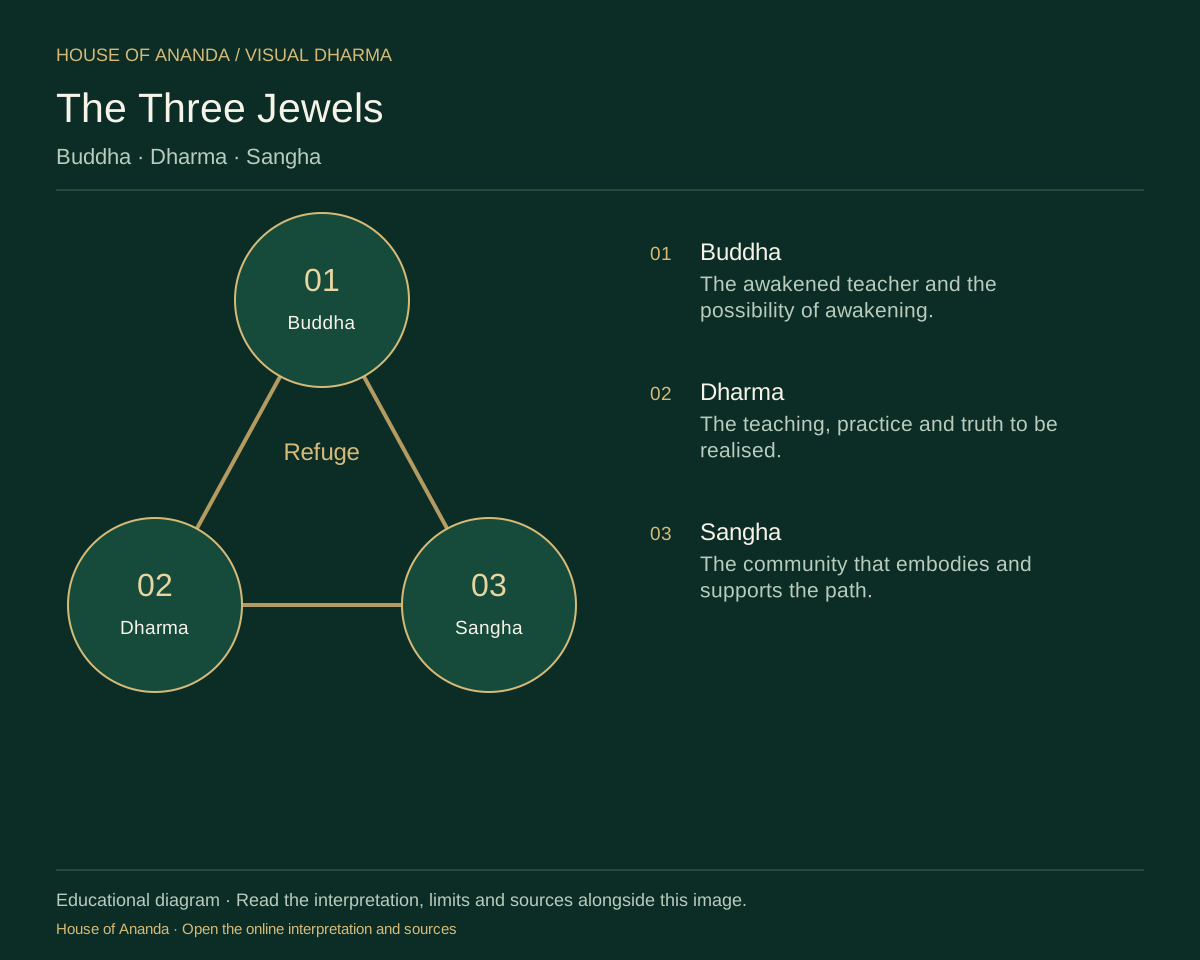
Buddha · Dharma · Sangha
The Three Jewels
Three interrelated points of orientation in Buddhist life.
Read the diagram & interpretation
- BuddhaThe awakened teacher and the possibility of awakening.
- DharmaThe teaching, practice and truth to be realised.
- SanghaThe community that embodies and supports the path.
The triangle places teacher, teaching and community in relationship. Refuge is a lived orientation, and formal taking of refuge has particular forms in different Buddhist communities. “Sangha” may mean the monastic community, the noble community or, in some modern settings, a wider practice community.
Keep in mind Reading a diagram does not confer religious refuge or community membership.
Sources: Khuddakapāṭha 1 · Going for Refuge ↗
Dharma / Dhamma
Dharma is the teaching and the path of practice, as well as a term with other meanings in Buddhist thought. A teaching becomes more than an idea when it changes how we speak, act and understand experience. The Sanskrit form Dharma and the Pāli form Dhamma reflect different textual languages.
Sangha / Saṅgha
Sangha can refer to the monastic community, the noble community of those with realisation, or, in some modern contexts, a broader practice community. These uses are related but not identical. A friendly group is valuable; it should also have clear ethical expectations and accountability.
Taking refuge
In many communities, taking refuge is a formal expression of Buddhist commitment, often made with a teacher and repeated in practice. Learning about it is different from participating in a ceremony. If you are considering refuge, ask the community what the words, responsibilities and accompanying precepts mean.
Art & contemplation
Look, learn, reflect
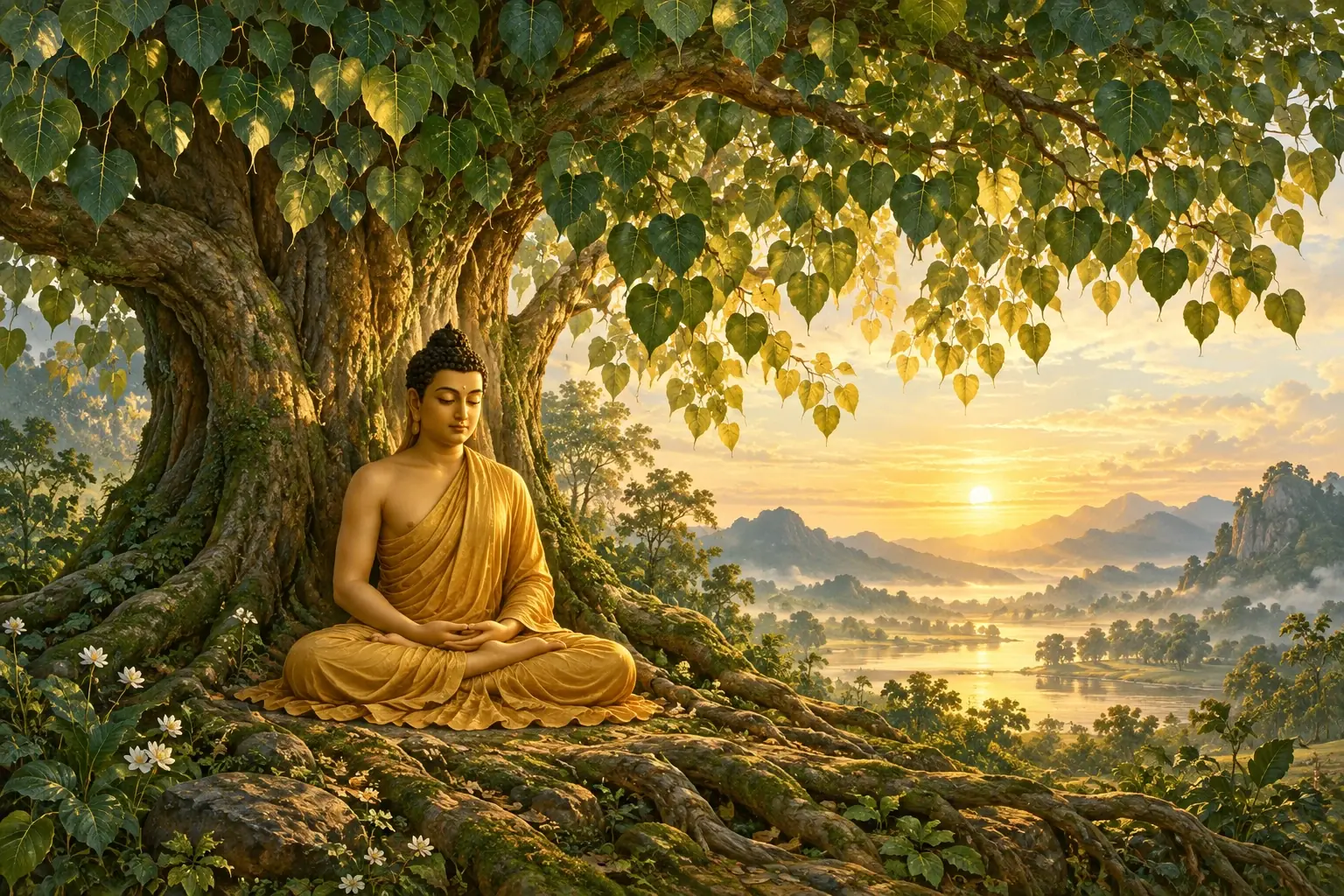
Beneath the awakening tree
The spreading tree recalls the traditional story of awakening at Bodh Gaya. The composition places steadiness within a living landscape; its imagined setting should not be treated as a reconstruction of ancient India.
A moment to reflectWhat conditions make patient attention possible for you?
Follow this theme ↗A question to carry with you
Pause and reflect.
Where do you currently turn for guidance, and what would make that guidance trustworthy?
Sources & further reading
Study notes and examples are original explanations. Follow the links for the source texts and their own contexts.