
Five aspects of experience
The aggregates are an analytical framework, not five organs, layers of a soul or a modern brain model. In Pāli they are khandhas; in Sanskrit, skandhas.
| Aggregate | A working explanation |
|---|---|
| Form · rūpa | Material form, including the body. |
| Feeling · vedanā | The pleasant, unpleasant or neutral tone of experience. |
| Perception · saññā / saṃjñā | Recognition and identification, such as recognising a sound as a voice. |
| Formations · saṅkhāra / saṃskāra | Volitional and other mental formations; the term has a wider range in other contexts. |
| Consciousness · viññāṇa / vijñāna | Awareness associated with an object and a sense domain. |
Visual study
A teaching you can explore
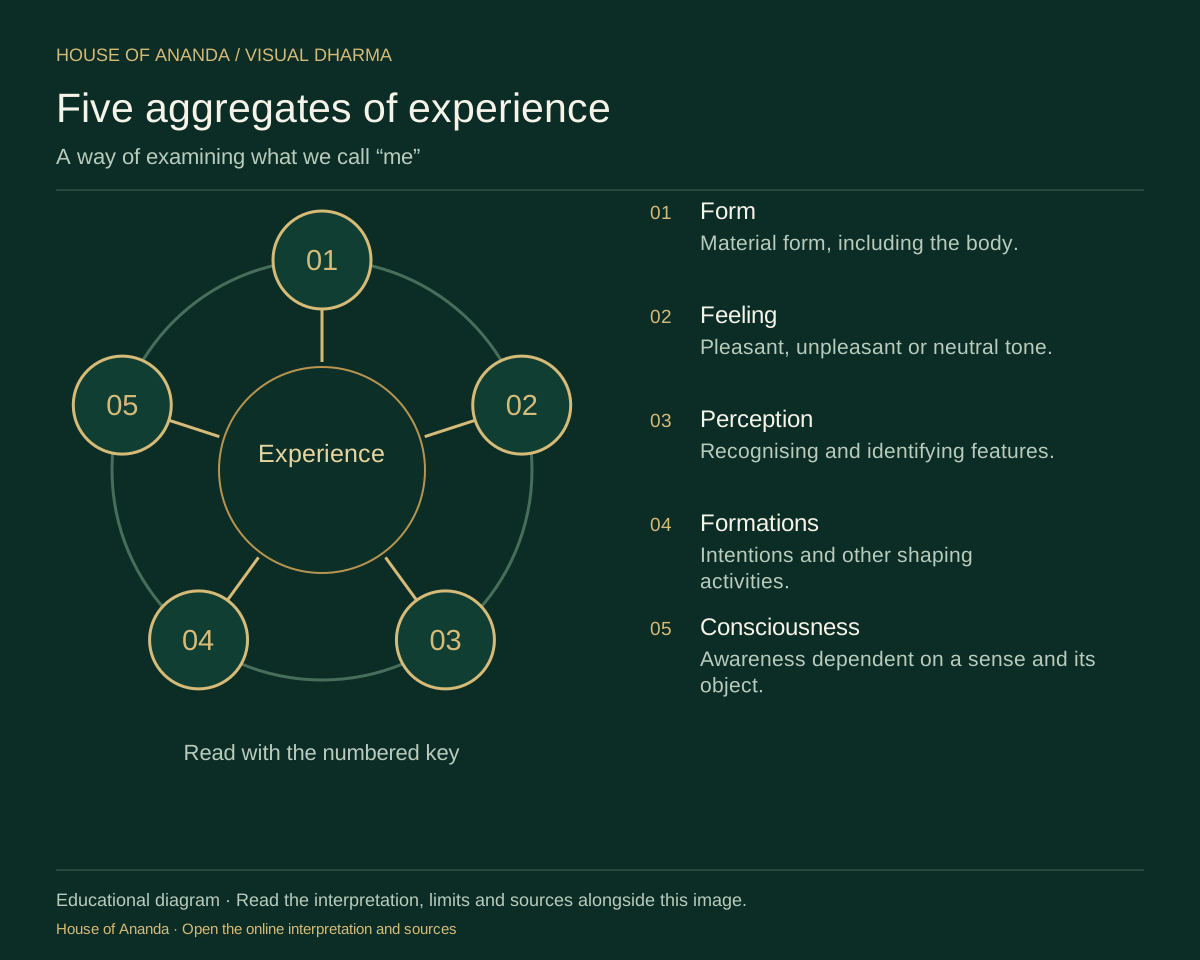
A way of examining what we call “me”
Five aggregates of experience
Five categories help analyse experience without treating it as a fixed possession.
Read the diagram & interpretation
- FormMaterial form, including the body.
- FeelingPleasant, unpleasant or neutral tone.
- PerceptionRecognising and identifying features.
- FormationsIntentions and other shaping activities.
- ConsciousnessAwareness dependent on a sense and its object.
At the sound of a message alert, there may be bodily sensation, pleasant or unpleasant tone, recognition, a wish to respond and auditory awareness. This is an editorial example, not five isolated compartments or a fixed neurological sequence.
Keep in mind Feeling tone is not the same category as the whole complexity of emotion. The aggregate model is a contemplative analysis, not a brain scan.
Sources: SN 22:59 · The Five ↗
Feeling is not the whole emotion
Here “feeling” means hedonic tone: pleasant, unpleasant or neutral. A complex emotion such as jealousy includes perception, thoughts, bodily responses and intentions as well. Keeping this technical use in mind makes the teaching easier to read.
An everyday example
You hear your name: there is an audible event, recognition, perhaps a pleasant or unpleasant tone, a developing interpretation and an urge to answer. This example is a learning aid, not a claim that experience arrives in five tidy consecutive packets.
Why investigate them?
The early not-self teaching asks whether these changing, vulnerable processes can be held as an enduring self. For a beginner, the practical invitation is to loosen an absolute statement such as “I am an angry person” into a more careful observation of what is occurring now.
Art & contemplation
Look, learn, reflect

A pattern passing
Loose grains forming and releasing a pattern invite reflection on change. This is an invented artwork, not a Tibetan ritual sand mandala. Authentic mandala construction and dissolution belong to particular communities and practices.
A moment to reflectWhat can you appreciate without asking it to stay the same?
Follow this theme ↗A question to carry with you
Pause and reflect.
Can you distinguish an unpleasant feeling tone from the story that quickly follows it?
Sources & further reading
Study notes and examples are original explanations. Follow the links for the source texts and their own contexts.