
The five hindrances
Sensual desire, ill will, sloth and torpor, restlessness and remorse, and doubt can obstruct collected attention. These describe conditions to investigate, not five defective kinds of people. Sleepiness may also mean you need sleep.
Visual study
A teaching you can explore
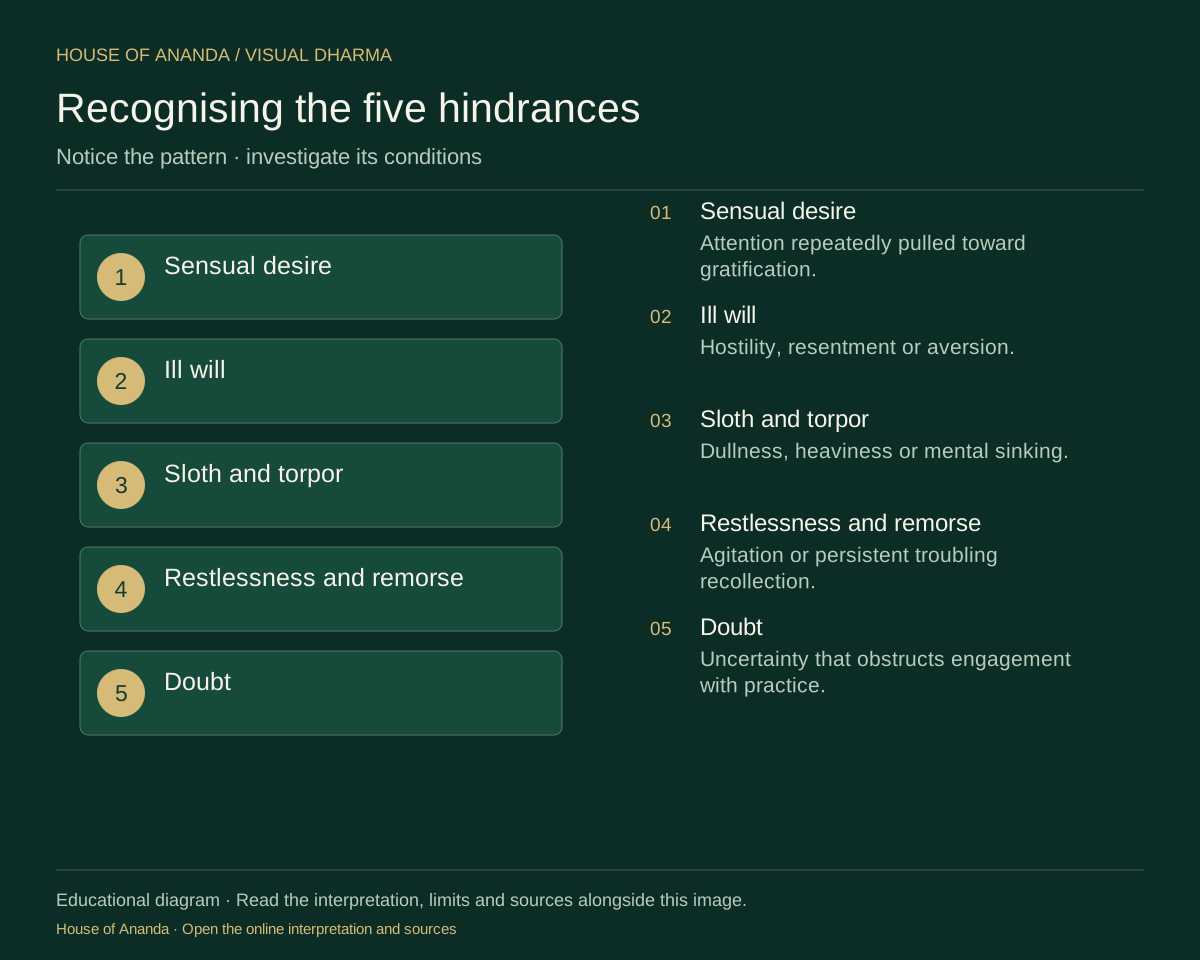
Notice the pattern · investigate its conditions
Recognising the five hindrances
Traditional obstacles to steadiness and understanding are patterns to recognise, not permanent identities.
Read the diagram & interpretation
- Sensual desireAttention repeatedly pulled toward gratification.
- Ill willHostility, resentment or aversion.
- Sloth and torporDullness, heaviness or mental sinking.
- Restlessness and remorseAgitation or persistent troubling recollection.
- DoubtUncertainty that obstructs engagement with practice.
Naming a pattern can create room for a wiser response. Ask what is feeding it: exhaustion, conflict, stimulation, unrealistic effort or a question that needs an answer? The traditional account of nourishment and its removal invites attention to conditions.
Keep in mind Ordinary fatigue may need rest, and honest inquiry is not a moral failure. This framework is not a diagnosis.
The seven factors
Mindfulness, investigation, energy, joy or rapture, tranquillity, concentration and equanimity are the awakening factors. More effort is not always the answer to agitation; more relaxation is not always the answer to dullness.
Make a gentle adjustment
If repeatedly falling asleep, open the eyes, change posture or take a short walk. If agitated, shorten the session and attend to contact with the ground. If confused, record a question for a teacher rather than treating doubt as failure.
Learn the pattern
Note time of day, sleep, task pressure and the instruction used. Observing the conditions can help you choose a better setting. Avoid turning these lists into a performance score or forcing yourself through distress.
What gets in the way?
The five hindrances describe patterns of mind, not moral defects or medical diagnoses. Their arising can become a subject of investigation.
| Hindrance | An everyday recognition | A gentle response to explore |
|---|---|---|
| Sensual desire | Repeatedly chasing the next pleasant object. | Notice the pull and return to the chosen task. |
| Ill will | Rehearsing blame or pushing experience away. | Soften the immediate reaction; consider goodwill and a wise boundary. |
| Sloth and torpor | Dullness, heaviness or fading alertness. | Check whether you need rest; adjust posture or take a short walk. |
| Restlessness and remorse | Agitation or looping over what happened. | Simplify the task; repair an action where appropriate. |
| Doubt | Uncertainty that prevents beginning or continuing. | Clarify the instruction and ask a trustworthy teacher. |
Conditions, not character
Instead of “I am bad at meditation”, ask what is present and what is feeding it. Lack of sleep, overstimulation or an unresolved disagreement may be relevant. A Buddhist category should not be used to dismiss illness, depression or another condition that needs appropriate care.
Balance the effort
More force is not always the answer. An agitated mind may benefit from steadiness; a dull mind may need interest or movement. The source text explores how attention can nourish or weaken particular qualities. A teacher can help when a repeated difficulty is confusing.
Art & contemplation
Look, learn, reflect

A place to return
A quiet bench evokes an accessible moment of attention. The setting is imagined and the person is not a named teacher. Meditation can also happen amid ordinary household sounds, without a remote retreat or a perfectly quiet mind.
A moment to reflectWhat is one manageable pause you can make in your day?
Follow this theme ↗A question to carry with you
Pause and reflect.
Which condition most often interrupts practice? Name one gentle adjustment. Which pattern is present today, and what small change in conditions might help?
Sources & further reading
Study notes and examples are original explanations. Follow the links for the source texts and their own contexts.