
A path with many expressions
Buddhism takes its name from the Buddha, “the awakened one”. Its communities explore suffering and its causes, cultivate ethical conduct and meditation, and seek liberation. It is a living religion as well as a rich philosophical tradition. Ritual, devotion, generosity, festivals and the relationship between laypeople and monastics matter alongside formal meditation.
Visual study
A teaching you can explore
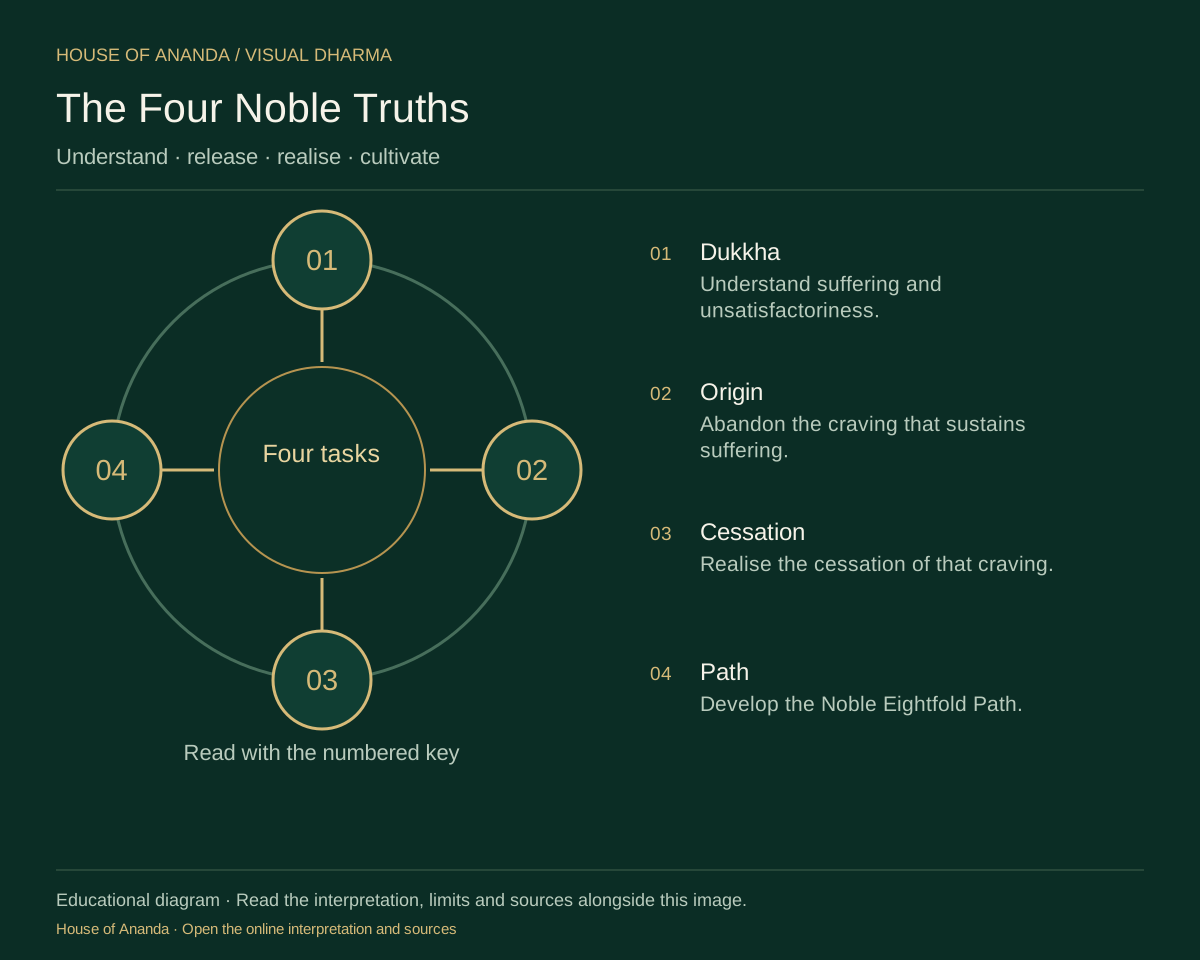
Understand · release · realise · cultivate
The Four Noble Truths
A teaching about suffering and freedom, expressed as four truths with four corresponding tasks.
Read the diagram & interpretation
- DukkhaUnderstand suffering and unsatisfactoriness.
- OriginAbandon the craving that sustains suffering.
- CessationRealise the cessation of that craving.
- PathDevelop the Noble Eightfold Path.
Read each truth together with its task. The teaching asks for understanding, letting go, direct realisation and ongoing cultivation; it is more than a list of beliefs. The circular layout here shows their relationship, not a promise of a quick progression.
Keep in mind Dukkha does not mean that every moment of life is miserable. Nor does the teaching blame a person for every painful event.
Three useful starting questions
You do not need to settle every metaphysical question before learning. Start by asking what a teaching says, where it comes from and how its community puts it into practice. A Pāli discourse, a Japanese Zen instruction and a Tibetan commentary may approach a shared concern using quite different language.
- What tends to increase greed, hostility or confusion in my day?
- What helps me respond with care and clear understanding?
- Which teacher, text or tradition is this explanation drawing upon?
Learning without pretending to know
“Buddhist” does not mean permanently calm, free from difficult feelings or detached from other people. A beginner can read, ask questions and visit an open teaching without claiming a religious identity. Formal refuge, vows and initiations have specific meanings; a website exercise does not confer them.
A sensible order
Read the Buddha’s life, the Four Noble Truths and the Eightfold Path. Then explore the five precepts and one brief practice. Return to the tradition guides once you have a few questions of your own. Understanding grows through repeated study and relationship, rather than collecting many techniques at once.
Art & contemplation
Look, learn, reflect
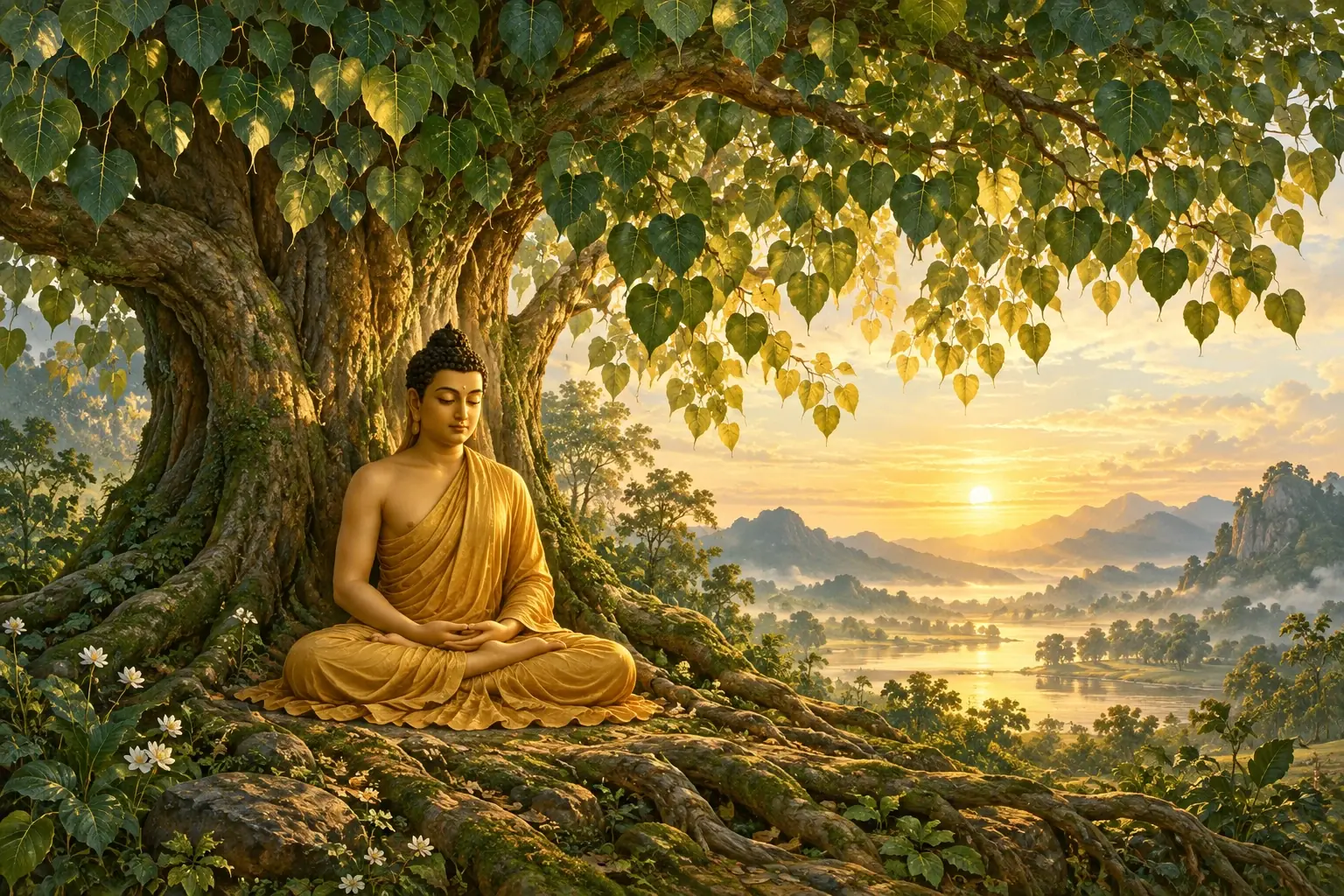
Beneath the awakening tree
The spreading tree recalls the traditional story of awakening at Bodh Gaya. The composition places steadiness within a living landscape; its imagined setting should not be treated as a reconstruction of ancient India.
A moment to reflectWhat conditions make patient attention possible for you?
Follow this theme ↗A question to carry with you
Pause and reflect.
What brought you here: curiosity, a practical difficulty, an interest in history, or a wish to explore a spiritual path?
Sources & further reading
Study notes and examples are original explanations. Follow the links for the source texts and their own contexts.