
No single Buddhist Bible
Pāli, Chinese and Tibetan canons preserve overlapping and distinct literature. Suttas or sūtras are discourses; Vinaya concerns monastic discipline; Abhidhamma or Abhidharma analyses teaching systematically. Commentaries and manuals form further layers.
Visual study
A teaching you can explore
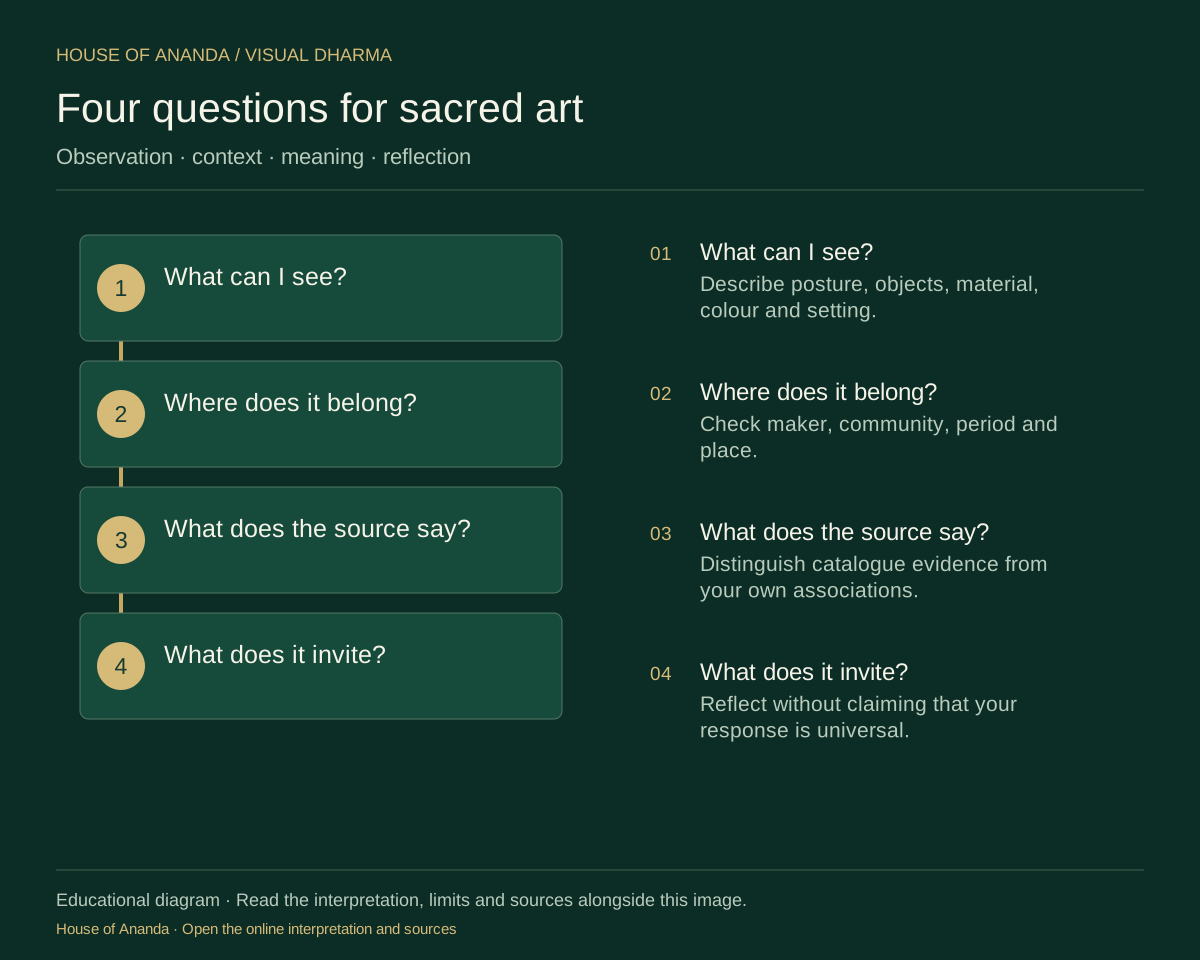
Observation · context · meaning · reflection
Four questions for sacred art
A practical way to make visual study more thoughtful.
Read the diagram & interpretation
- What can I see?Describe posture, objects, material, colour and setting.
- Where does it belong?Check maker, community, period and place.
- What does the source say?Distinguish catalogue evidence from your own associations.
- What does it invite?Reflect without claiming that your response is universal.
Begin with observable detail, then consult reliable context. An image may serve devotion, teaching, ritual, remembrance or several purposes at once. Ask what is known and what is inferred. The maker’s community may understand a detail differently from a modern museum visitor.
Keep in mind These four questions are an original House of Ananda study framework, not a traditional Buddhist list.
Sources: The Metropolitan Museum of Art · Buddhism and Buddhist Art ↗
Locate the passage
SN identifies the Saṃyutta Nikāya, MN the Majjhima Nikāya, and AN the Aṅguttara Nikāya. Tibetan catalogue references such as Toh 21 use another system. Record the collection, title and translator rather than citing a quotation without a location.
Build a small reading shelf
Begin with the Four Noble Truths discourse, a Dhammapada chapter and teaching from a named living tradition. Later, read the Heart Sūtra with its introduction. A compressed wisdom text is not a beginner instruction sheet.
Translation interprets
Suffering and stress, concentration and immersion, not-self and non-self reflect choices. Compare complete passages instead of selecting an attractive sentence. Keep the text, translator note and your own response separate.
Different collections
Buddhist texts survive in several major canonical traditions. The Pāli Tipiṭaka, Chinese Buddhist canon and Tibetan Kangyur and Tengyur are not identical collections. Sutta and sūtra are related terms used in different languages; commentaries explain and develop the teachings in particular traditions.
A first reading list
Read a short passage with its context. These are starting points, not a ranking of scriptures.
| Text or collection | Why begin here? |
|---|---|
| SN 56:11 | The Four Noble Truths and the Middle Way. |
| SN 45:8 | A concise analysis of the Eightfold Path. |
| Karaṇīya Mettā Sutta | Goodwill alongside ethical qualities. |
| MN 118 | The wider framework of mindfulness of breathing. |
| Heart Sūtra | A brief but demanding Mahāyāna text on emptiness; use a commentary. |
| Pure Land sūtras | An introduction to Amitābha and devotional paths. |
| Dhammapada | A collection of verses; read complete chapters rather than unattributed quotations. |
Three translation libraries
Dhamma talks provides translations from the Pāli canon; BDK America publishes translations from the Chinese Buddhist canon; 84000 translates the Tibetan Buddhist canon. Their editorial introductions and glossaries are often as useful to a beginner as the main text.
A method for reading
Write down the text’s name, translator and reference number. Ask who is speaking, to whom, and in what setting. Distinguish a scripture from a later explanation and from your own response. When a sentence seems surprising, compare translations or ask a teacher rather than immediately turning it into a social-media quote.
Art & contemplation
Look, learn, reflect

A lamp for inquiry
Light offers a contemporary metaphor for inquiry and understanding. The unlettered pages do not depict a lost scripture or an authentic manuscript. Study can illuminate experience while experience raises new questions for study.
A moment to reflectWhich question deserves a slower, more attentive reading?
Follow this theme ↗A question to carry with you
Pause and reflect.
For your next reading, note its reference, translator, tradition and one remaining question. Read one short discourse twice. What becomes clearer when you know its audience and purpose?
Sources & further reading
Study notes and examples are original explanations. Follow the links for the source texts and their own contexts.