
A distinctive approach
Vajrayāna develops within Mahāyāna and gives important roles to mantra, maṇḍala, visualisation and transmitted ritual. Tibetan Buddhism includes these methods alongside ethics, philosophy and many other forms of meditation. Vajrayāna also has histories outside Tibet, including Japanese esoteric traditions.
Visual study
A teaching you can explore
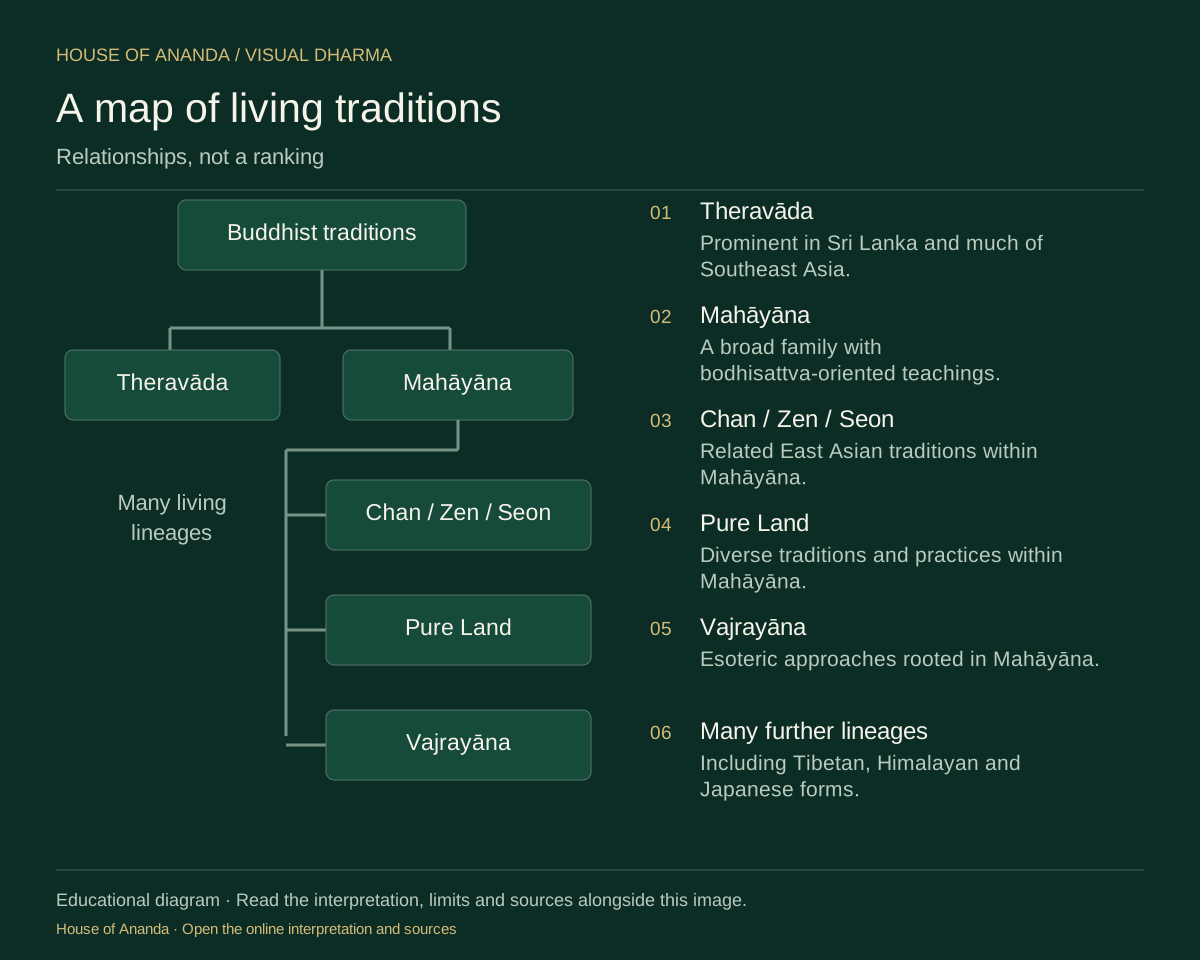
Relationships, not a ranking
A map of living traditions
A simplified orientation to large families and selected lineages.
Read the diagram & interpretation
- TheravādaProminent in Sri Lanka and much of Southeast Asia.
- MahāyānaA broad family with bodhisattva-oriented teachings.
- Chan / Zen / SeonRelated East Asian traditions within Mahāyāna.
- Pure LandDiverse traditions and practices within Mahāyāna.
- VajrayānaEsoteric approaches rooted in Mahāyāna.
- Many further lineagesIncluding Tibetan, Himalayan and Japanese forms.
Read the branches as broad relationships. Zen and Pure Land are not always separate memberships: practices can coexist. Vajrayāna is not a wholly independent third religion beside Mahāyāna; it develops within a Mahāyāna setting. Communities now live throughout the world.
Keep in mind This is a study map, not a complete historical family tree. Geographic associations are neither exclusive nor fixed.
Sources: Study Buddhism · Types of Buddhism ↗ · Stanford Encyclopedia of Philosophy · Japanese Zen ↗
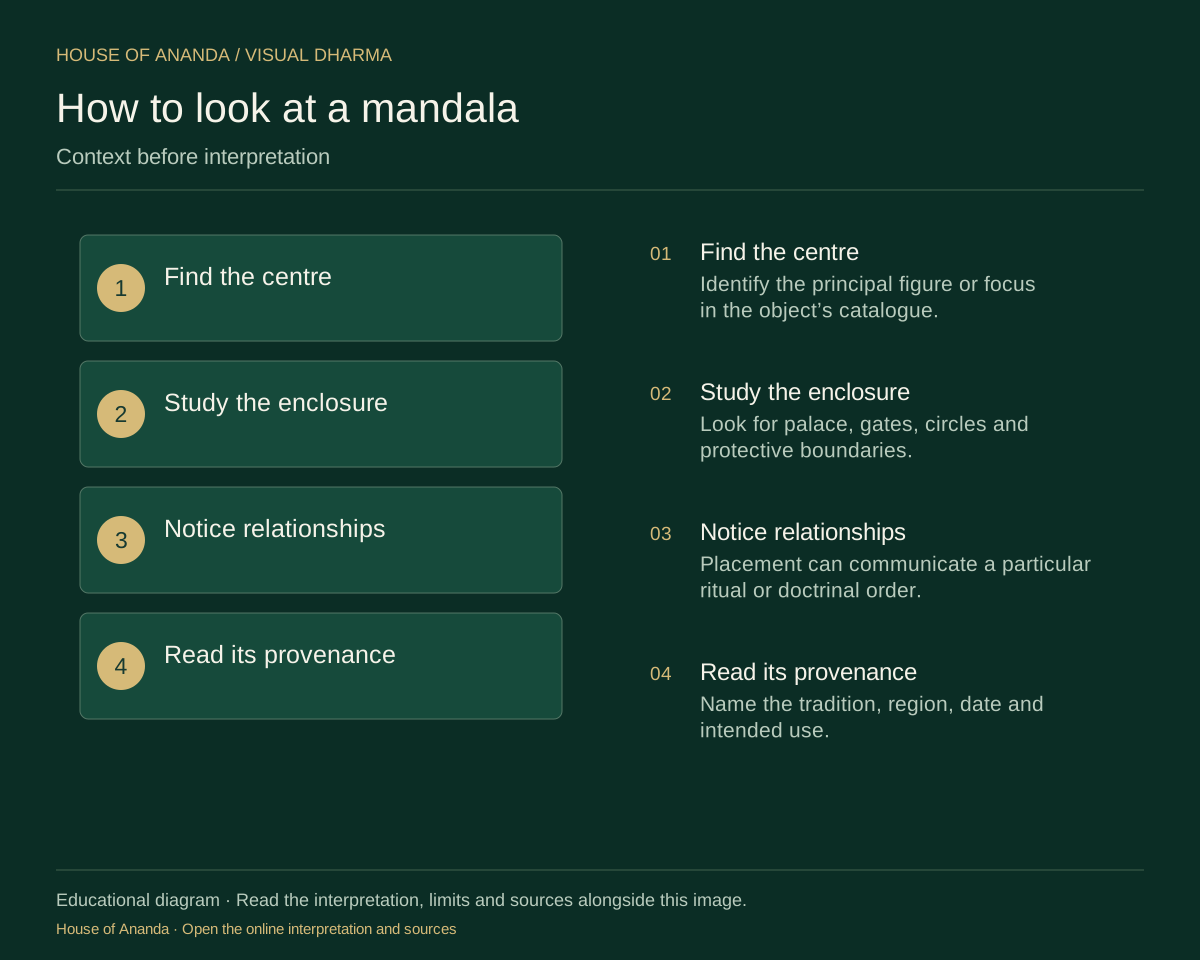
Context before interpretation
How to look at a mandala
A viewing guide for a sacred arrangement, not a universal symbolic decoder.
Read the diagram & interpretation
- Find the centreIdentify the principal figure or focus in the object’s catalogue.
- Study the enclosureLook for palace, gates, circles and protective boundaries.
- Notice relationshipsPlacement can communicate a particular ritual or doctrinal order.
- Read its provenanceName the tradition, region, date and intended use.
Mandalas have different structures and functions. The Nepalese Chakrasamvara mandala in this collection represents a specific sacred assembly; its figures cannot be replaced with a generic explanation about balance. A contemporary radial pattern may be beautiful without having this ritual identity.
Keep in mind This is an art-reading sequence. It is not an initiation or an instruction to perform a restricted visualisation.
Sources: The Met · Chakrasamvara Mandala ↗ · Study Buddhism · What Is Tantra? ↗
Transmission matters
Some practices require empowerment, instruction and continuing guidance. A description of a deity or maṇḍala is not permission to undertake its full ritual. This library offers public orientation and study, not restricted sādhana manuals.
Images in context
Buddhas, bodhisattvas and wrathful forms operate within precise doctrinal and ritual settings. They are not interchangeable energies or personality types. Learn the name, tradition and function of a particular image before comparing it with another system.
A considered first encounter
Attend an explicitly introductory teaching on compassion, ethics or the stages of the path. Ask what commitments accompany any offered ceremony. Understand the teacher’s community and accountability before undertaking vows. Reverence and informed consent can coexist.
Within the Mahāyāna world
Vajrayāna refers to esoteric Buddhist approaches rooted in Mahāyāna aims. It is strongly associated with Tibetan and Himalayan Buddhism, but esoteric Buddhist traditions also exist elsewhere, including Japanese Shingon. Tibetan Buddhism itself includes extensive study, ethics and non-tantric meditation.
Methods with a context
Mantra, mandala, visualisation and ritual work within particular understandings of compassion, emptiness and awakening. A deity in Buddhist tantric practice should not automatically be interpreted as a creator god. The meaning of an image or practice depends on its teaching context.
Empowerment and commitments
Many practices require empowerment, transmission and guidance from an appropriately qualified teacher, and may involve vows or continuing commitments. Reading instructions online is not equivalent to receiving these. Requirements vary by practice and lineage; ask the responsible teacher directly.
What an introduction can offer
Public teachings on compassion, ethics and foundational philosophy can be appropriate starting points. This guide explains the landscape; it does not supply self-initiation, advanced deity-yoga instructions or subtle-body techniques.
Discernment remains essential
Respect for a teacher does not remove the need for consent, boundaries or accountability. Take time to understand a community, its commitments and its complaint procedures before entering a close teaching relationship.
Art & contemplation
Look, learn, reflect
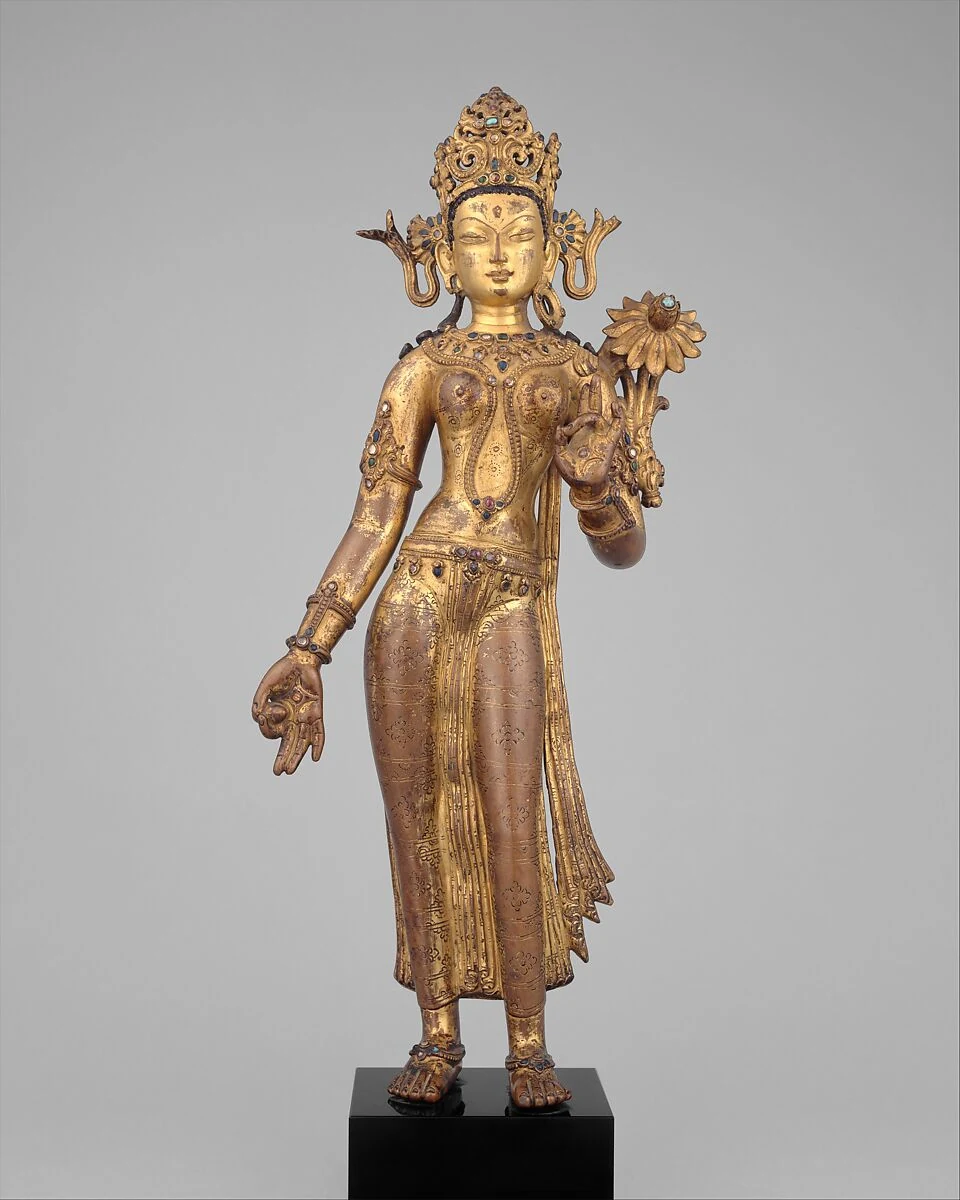
Sacred figure
Tārā: responsive care
The Met identifies this Nepalese figure as probably White Tārā. The lowered hand expresses giving, and the lotus is an important attribute. Tārā has multiple forms, so this example should not be renamed Green Tārā merely because that form is widely familiar.
Look closelyFollow the line from the lower hand to the upper body and the flower. How does the standing posture affect your response?
Continue studying ↗Artist unknown · The Metropolitan Museum of Art · 66.179. Object / image record ↗ · Public domain / CC0. Resized and converted to WebP; image content unchanged.
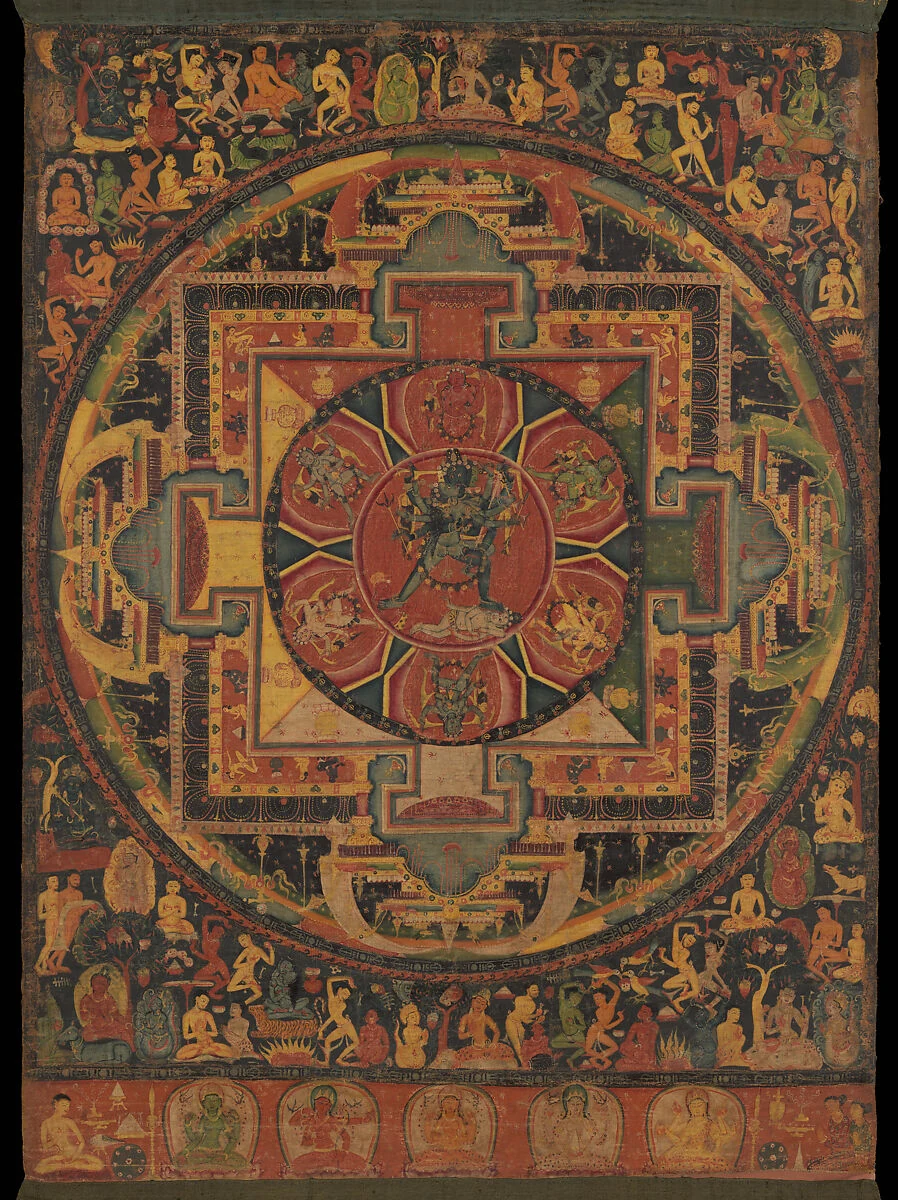
Ritual painting
A mandala as sacred arrangement
This Nepalese painting, dated around 1100, depicts Chakrasamvara and Vajravarahi within a specific tantric assembly. Its placement of figures communicates a particular sacred order. It offers a historical example against which to distinguish modern ornamental circular patterns.
Look closelyLook for centre, surrounding assembly and outer registers. Use the museum explanation before assigning meanings to individual figures.
Continue studying ↗Artist unknown · The Metropolitan Museum of Art · 1995.233. Object / image record ↗ · Public domain / CC0. Resized and converted to WebP; image content unchanged.
A question to carry with you
Pause and reflect.
Can you distinguish an introduction, public recitation and a practice requiring initiation? Before learning a method, what would you need to know about its purpose, preparation and commitments?
Sources & further reading
Study notes and examples are original explanations. Follow the links for the source texts and their own contexts.