
A shared landscape
Buddhist, Jain and Brahmanical communities developed disciplines of conduct, meditation and liberation in overlapping South Asian worlds. Shared vocabulary does not make the teachings identical. Buddhism is not a style of modern posture yoga.
Visual study
A teaching you can explore
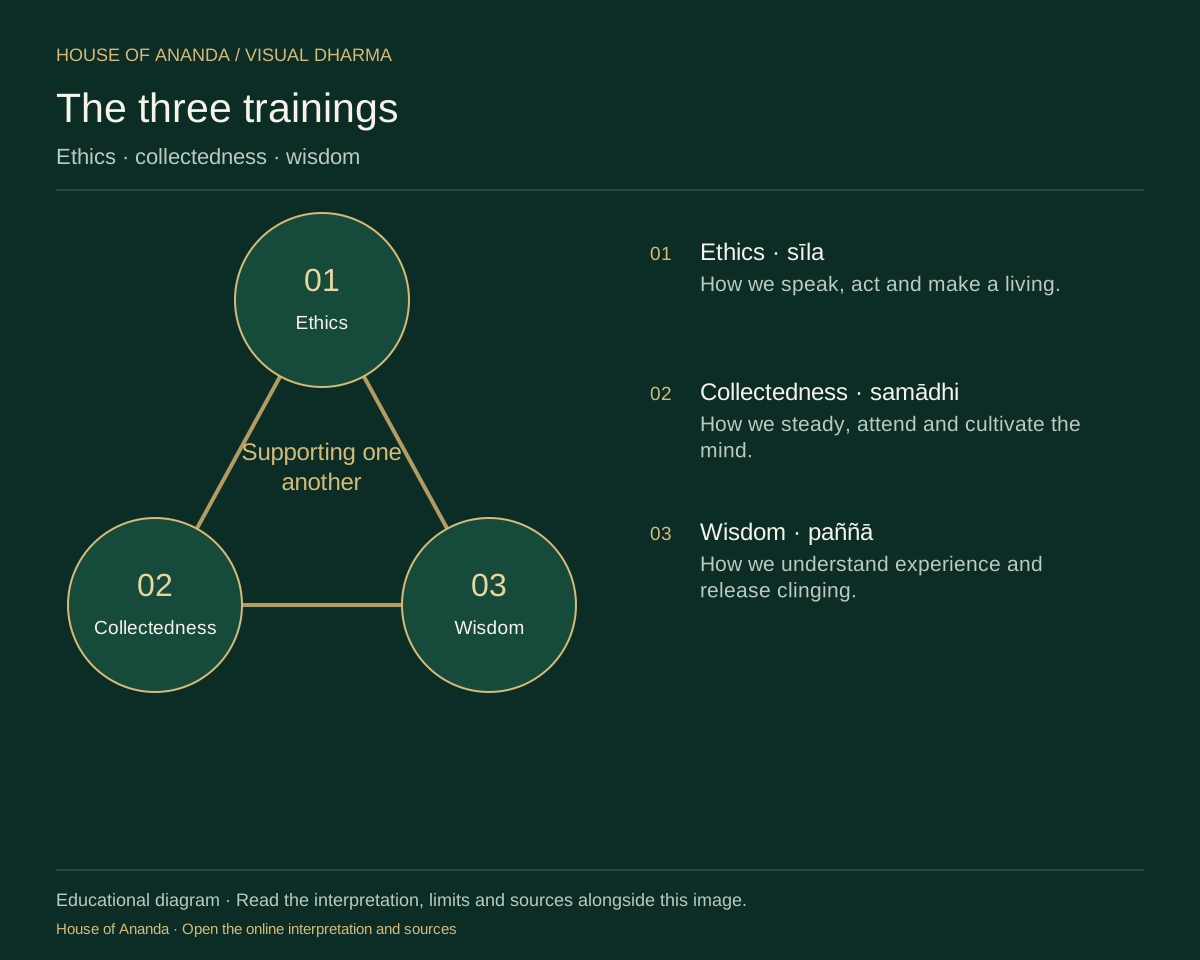
Ethics · collectedness · wisdom
The three trainings
The path can be understood through three areas of training that strengthen each other.
Read the diagram & interpretation
- Ethics · sīlaHow we speak, act and make a living.
- Collectedness · samādhiHow we steady, attend and cultivate the mind.
- Wisdom · paññāHow we understand experience and release clinging.
Ethical choices can reduce remorse; steadiness can support observation; understanding can deepen care. The connecting lines indicate reciprocal support. The Eightfold Path gives a more detailed account of these three trainings.
Keep in mind Meditation is one part of a wider path that also concerns relationships and conduct.
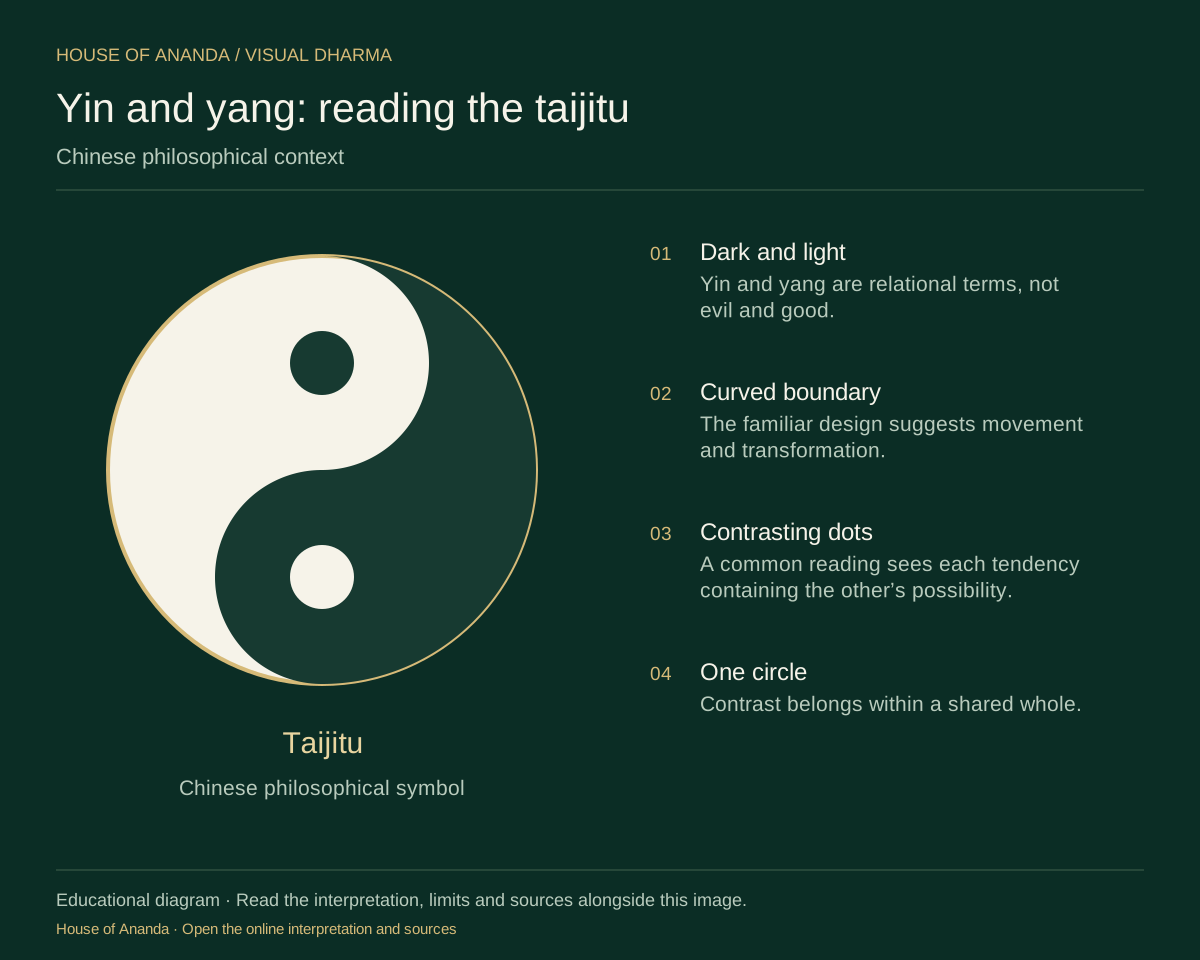
Chinese philosophical context
Yin and yang: reading the taijitu
The familiar dark-and-light diagram invites attention to complementary tendencies and change.
Read the diagram & interpretation
- Dark and lightYin and yang are relational terms, not evil and good.
- Curved boundaryThe familiar design suggests movement and transformation.
- Contrasting dotsA common reading sees each tendency containing the other’s possibility.
- One circleContrast belongs within a shared whole.
Yin and yang are important across Chinese intellectual and cultural traditions, including Daoist and Confucian thought. The familiar taijitu is not a core emblem taught by the historical Buddha. Chinese Buddhism developed in conversation with this wider culture without becoming identical to it.
Keep in mind The diagram is not a scientific measurement, a fixed personality test or a reason to assign rigid roles to women and men.
Sources: Internet Encyclopedia of Philosophy · Yinyang ↗ · Stanford Encyclopedia of Philosophy · Metaphysics in Chinese Philosophy ↗
The question of self
Classical Pātañjala Yoga distinguishes puruṣa, the conscious seer, from prakṛti. Buddhist analysis of not-self challenges identification of changing experience with a permanent self. These differences deserve to remain visible.
Compare precisely
The Buddhist Eightfold Path and Patañjali’s eight limbs are different lists with distinct doctrinal settings. Breath awareness is not automatically prāṇāyāma. A Buddhist maṇḍala is not interchangeable with every Hindu chakra diagram.
When teaching a mixed class
Name the sources and describe your adaptations. Do not call an original mixed sequence an unchanged ancient Buddhist practice. Participants can appreciate connections without accepting that every tradition teaches the same metaphysics.
Compare one question at a time
“Yoga” covers many religious, philosophical and modern physical practices. Compare a named tradition with another named tradition, rather than all Buddhism with all yoga.
| Question | Buddhist contexts | Yoga contexts |
|---|---|---|
| Self | Not-self is central, interpreted differently across schools. | Classical Yoga distinguishes puruṣa from prakṛti; many Vedāntic approaches affirm ātman. |
| Liberation | Nirvāṇa and Buddhahood have different formulations across traditions. | Kaivalya, mokṣa and other aims depend on the school. |
| Ethics | Precepts, compassion and the Eightfold Path. | Yamas, niyamas and other tradition-specific disciplines. |
| Meditation | Mindfulness, concentration, insight, devotion and other methods. | Dhyāna and samādhi have distinct meanings in particular systems. |
| Body and breath | Posture and breathing may support contemplation; tantric systems have their own methods. | Āsana, prāṇāyāma and subtle-body practices vary widely across yoga traditions. |
Useful points of dialogue
Both worlds ask how habits, attention and conduct shape experience. Historical contact includes debate as well as borrowing. A shared Sanskrit word may carry a different meaning in another text. The Buddhist Eightfold Path and Patañjali’s eight limbs should not be matched as though they were the same list.
Teaching with clear attribution
If a yoga class includes a goodwill reflection, name it as an adaptation inspired by Buddhist mettā. If teaching a tradition-specific practice, explain its source and stay within your training. A modern combination can be useful without claiming it is an ancient unified system.
Art & contemplation
Look, learn, reflect

A place to return
A quiet bench evokes an accessible moment of attention. The setting is imagined and the person is not a named teacher. Meditation can also happen amid ordinary household sounds, without a remote retreat or a perfectly quiet mind.
A moment to reflectWhat is one manageable pause you can make in your day?
Follow this theme ↗A question to carry with you
Pause and reflect.
Choose one shared word, such as dhyāna. How does its role change in two named traditions? Which similarities are practical, which are historical, and where do the philosophical aims remain different?
Sources & further reading
Study notes and examples are original explanations. Follow the links for the source texts and their own contexts.