Sahasrāra · crown
The seventh centre in the familiar seven-chakra teaching model. Its name evokes a thousandfold lotus. Chakra systems differ across traditions; seven is not the only historical arrangement.
 House of AnandaMovement · Stillness · Wisdom · Journey
The subtle body · 07
सहस्रार
A thousand petals. Room for silence.
The crown lotus offers a contemplative image of connection and awareness. Explore your class notes through symbolism, a simple sitting practice and music that leaves space to listen.
Hand gesture · Meditation · stillness
Dhyāna means meditation. This gesture appears across meditation traditions and is used here as a crown-themed companion, not an exclusive Sahasrāra assignment.
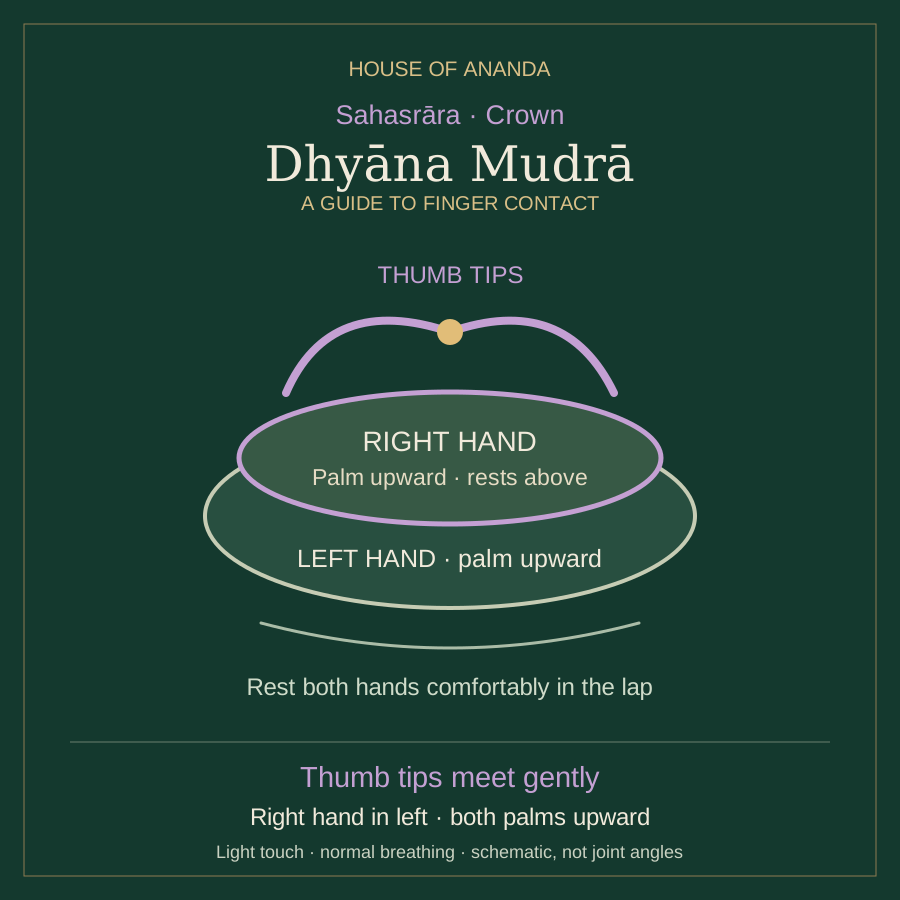
Thumb tips meet gently. Touch with the fingertips, not the nails.
Right hand rests in the left; both palms face upward.
Let the cupped hands rest in your lap. Bring the thumb tips together without lifting or tensing the shoulders.
Use a light touch and normal breathing. Never force a finger straight or press through pain; resting the hands open is a suitable alternative. These are gestures for contemplation, not a way to diagnose or treat illness.
Arhanta Yoga · Dhyāna hand form and pairing ↗. Chakra–mudra pairings vary by lineage and teacher. Therapeutic claims made by teaching sources are not adopted here.
In some yoga teachings the crown lotus represents spiritual fulfilment, liberation and the relationship between individual awareness and a greater whole. These are philosophical and religious meanings; they are not medical measurements or sensations that every practitioner must have.
Your notes give violet, space and silence. Yoga in Daily Life describes all-colour light, a supreme spiritual principle and Oṃ. Both examples show why a classroom chart needs its lineage context rather than being treated as a universal specification.
For one tradition’s interpretation: Yoga in Daily Life: Sahasrāra. Its spiritual account is cited for symbolism, not as evidence for physiological claims.
The notebook’s central practice cue
Let ordinary sounds, thoughts and sensations be present. You can return to the support of the seat or the feeling of the feet whenever attention wanders. Nothing needs to rise through the head, and no special experience is required.
Shorten the practice whenever you wish. Avoid forcing concentration at the crown, breath retention or inverted postures to “activate” a gland.
The notes name silence, not a seed mantra. Some traditions use Oṃ for Sahasrāra. If it belongs in your practice, sound a gentle Oṃ on one comfortable exhalation, moving from an easy o sound to a soft m. Then resume normal breathing. Repeat silently or omit it entirely.
There is no prescribed pitch or count here. The music below is not a vocal model. Explore Oṃ and japa →
Meditation can sometimes bring discomfort or distress. Stop if you feel unsettled, dizzy or disoriented; seek support for persistent symptoms. NCCIH: meditation evidence and safety.
No frequency is written in this photograph
This collection uses the modern crown association already discussed in the House’s frequency guide. It is an editorial musical choice, not a number from your notes or an established ancient tuning instruction.
| Term | What it means on this page |
|---|---|
| Silence | The practice cue in the notebook; silence is not a specific audible frequency. |
| 963 Hz | A selected tone in the music: 963 cycles per second, alongside other frequencies. |
| 481.5 Hz | Exactly one octave below 963 Hz, offered as an alternative sound. |
| Oṃ | A sacred syllable that can be voiced at many pitches or repeated mentally. |
There is no established evidence that 963 Hz uniquely opens the crown chakra, activates the pituitary or repairs the nervous system. This is music for optional reflection, not a treatment or a diagnostic test. Neither option is a binaural-beat programme.
Read the frequency comparison and research →The listening room
Original House of Ananda music · 12 pieces · 60 minutes
Twelve five-minute ambient compositions with soft pads, a central tone and sparse bell-like pulses. Each has different pacing and harmonies. These are instrumentals, without recorded chanting.
Choose a piece to prepare it on your device. Playback and a WAV download become available when it is ready. The lower option offers a different listening texture; neither pitch is a treatment.
Tracks advance where your browser allows; preparation creates a short pause. Keep this page open while preparing audio. Start at low volume. Headphones are optional. Silence is always an equally valid choice.
Listen to one piece at a comfortable volume. Pause the player before it ends if you want silence afterwards. Notice the room and your contact with the chair or floor. Longer listening is not a stronger dose; avoid inward-focused practice while driving.
The seventh centre in the familiar seven-chakra teaching model. Its name evokes a thousandfold lotus. Chakra systems differ across traditions; seven is not the only historical arrangement.
An image of expansive or fully unfolding awareness. It is spiritual symbolism, not a count of brain structures or a physical flower inside the head.
The notebook’s colour, used throughout this lesson. Other teachings describe white or light containing all colours; violet is not a universal historical rule.
The clearest practice cue in the notes. Silence means giving sound and thought room to come and go, rather than forcing the mind to become blank.
Preserved as a classroom association. Some lineages place Sahasrāra beyond the five gross elements or describe a supreme spiritual principle. It should not simply be equated with physical empty space.
The line beneath pituitary appears to read “master gland”. That is a familiar endocrine nickname. Associating a chakra with a gland is a teaching correspondence, not an established anatomical identity.
The abbreviation is expanded correctly, but the control claim needs correction. The CNS is the brain and spinal cord. The pituitary influences other glands through hormones; it is not the controller of the whole CNS.
Endocrine signalling
A small gland at the base of the brain.
HormonesInfluence growth and the activity of other glands.
Central nervous system
These two structures make up the CNS. The pituitary is not its overall controller.
“Master gland” is shorthand for the pituitary’s endocrine role. It does not establish a physical crown chakra or show that sound can regulate hormones. A spiritual body map and a medical anatomy diagram answer different kinds of questions.
Anatomy references: MedlinePlus: the pituitary gland and NCI: definition of the CNS. Continue to the anatomy library →