The two-petalled lotus
Its paired form is interpreted differently across lineages. It can provide a contemplative image of relationship or complementarity without implying a literal structure in the brain.
 House of AnandaMovement · Stillness · Wisdom · Journey
The subtle body · 06
आज्ञा
Attention, insight and the freedom to question.
A study of the two-petalled brow lotus, Oṃ and your notes on discernment. Explore the symbolism without needing to produce visions or extraordinary experiences.
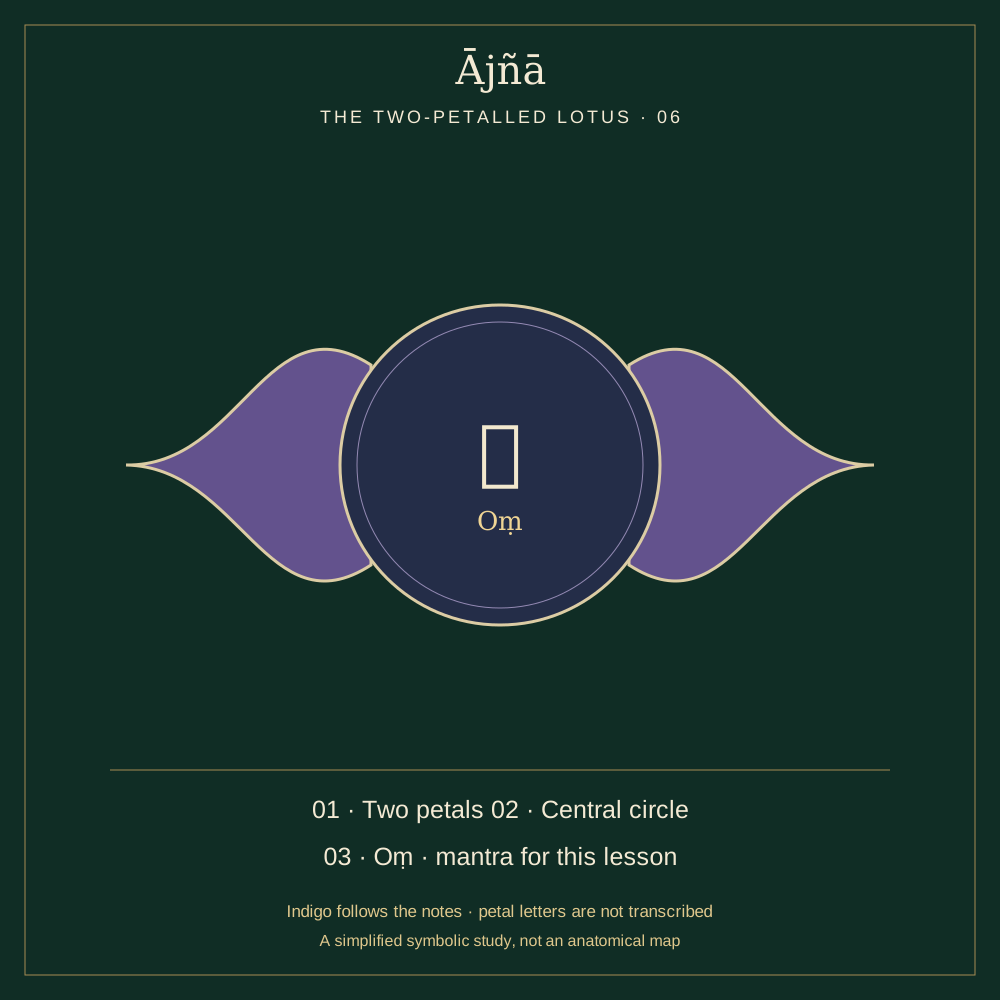
Its paired form is interpreted differently across lineages. It can provide a contemplative image of relationship or complementarity without implying a literal structure in the brain.
Some traditional depictions include a liṅga and other symbolic forms. This study keeps the central circle simple rather than treating a quick classroom drawing as a complete yantra.
“Third eye” names a spiritual symbol. It is not an anatomical organ, a claim about opening the pineal gland or a reason to press on the forehead.
Indigo follows the notebook. White occurs in other teaching systems, showing why one colour chart should not be presented as the sole historical account.
Traditional two-petalled imagery, Oṃ, brow location and lineage context: Yoga in Daily Life’s Agya lesson. These are spiritual teachings, not evidence of anatomical or paranormal mechanisms.
Oṃ · ॐ · also written OM or AUM
Oṃ is a sacred syllable used across several Indian spiritual traditions. In this lesson it accompanies Ājñā; it is not simply another word for intuition, nor a sentence promising knowledge of the future.
In a gentle introduction, allow an easy o sound to move into a soft m resonance. AUM expresses a traditional analysis into a, u and m; spoken and sung delivery differs across schools. There is no need to force three equally long sounds or extend the breath.
Repeat silently if preferred. Neither sound nor silence requires a particular pitch, closed eyes or a fixed gaze at the brow.
Do not cross or strain the eyes, press the forehead, hold the breath or stare at bright lights. Stop if you feel dizzy, anxious, disoriented or uncomfortable. Simple external listening is an alternative.
No fixed count is required; 108 repetitions are a traditional japa option, not a dose. Explore Oṃ, japa and mala beads →
Hand gesture · Attention · discernment
This is a contemporary pairing for focused attention. You do not need to lift the hands to your forehead or strain the eyes upward.
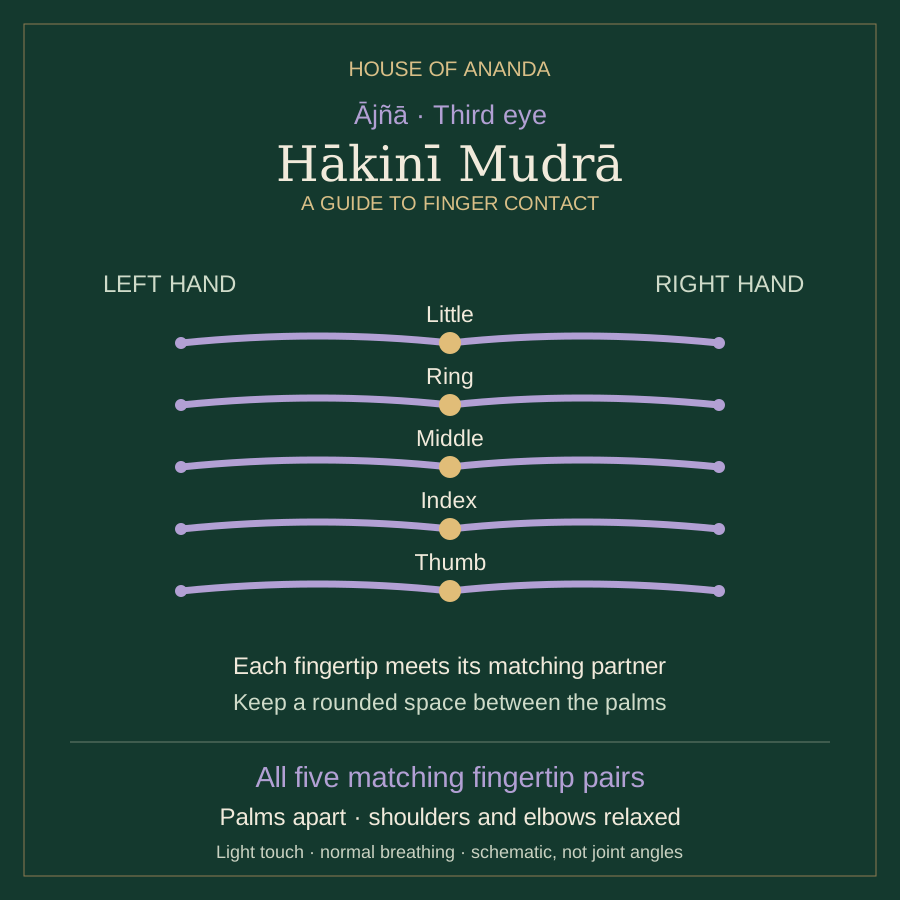
All five matching fingertip pairs. Touch with the fingertips, not the nails.
Keep the palms apart, as though holding a small ball.
Bring the fingertips of the left hand to the matching fingertips of the right. Hold comfortably in front of the torso with the elbows relaxed.
Use a light touch and normal breathing. Never force a finger straight or press through pain; resting the hands open is a suitable alternative. These are gestures for contemplation, not a way to diagnose or treat illness.
Arhanta Yoga · Hākinī hand form and pairing ↗. Chakra–mudra pairings vary by lineage and teacher. Therapeutic claims made by teaching sources are not adopted here.
No frequency is specified in the Ājñā notes
The photograph contains no Ājñā frequency or note name. House of Ananda has chosen a 440 Hz centre tone, A4 in standard concert tuning, to create the matching listening feature. It is not attributed to the teacher or presented as an ancient OM frequency.
| Label | Meaning here |
|---|---|
| Oṃ | A sacred syllable, voiced at many pitches or repeated silently |
| 440 Hz · A4 | The chosen central tone in this original collection |
| 220 Hz · A3 | An octave below; still not a required chanting pitch |
| Ājñā theme | An intention to reflect and practise attention, not an acoustic diagnosis |
Pitch relationships: UNSW’s note-frequency guide.
Music may be personally meaningful, but there is no established evidence that 440 Hz uniquely opens Ājñā or produces telepathy, clairvoyance or reliable predictions. The recording includes other frequencies and is not a binaural-beat protocol. It contains no recorded OM chant.
You do not need to match 440 Hz. Use your own range and stop if sound or inward attention feels unpleasant.
The listening room
Original House of Ananda audio · 12 tracks · 60 minutes
Twelve ambient sound studies with a continuous 440 Hz tone, layered harmonic pads and gentle bell-like pulses. Each five-minute piece has its own spacing and harmonic palette. These are synthesised instrumentals, with no recorded Oṃ chant.
Tracks advance automatically where your browser permits. Use the player to pause, seek and adjust volume. Begin quietly; headphones are optional.
Original digital compositions: a mathematically specified 440 Hz component plus other frequencies. MP3 encoding, playback equipment and room acoustics affect the sound you hear. The music is not a treatment or a test of chakra activity.
Listen quietly for a minute, optionally repeat Oṃ on a few easy exhalations, then rest. If an idea arises, write it down as an idea—not a revelation that demands action. Ask what evidence might support or change it.
One track is enough. Headphones are optional; longer listening is not a stronger dose. Do not practise inward-focused listening while driving.
Ājñā is commonly associated with command or instruction; Agya is a familiar alternative spelling. The brow region is a contemplative location, not a literal extra eye.
The notebook clearly shows a two-sided lotus around a central circle. The letters inside the petals are unclear, so the diagram does not reproduce them as a confident transcription.
Indigo follows the notes and a modern colour convention; some traditions depict this chakra as white. Oṃ is the associated mantra in this lesson, though mantra assignments can vary by lineage.
The wisdom or discernment sheath also appears on the throat-chakra page. This is not a contradiction that needs an invented correction: classroom associations can overlap and are not a universal one-to-one system.
The notebook lists space here, while many accounts associate Ājñā with mind or a level beyond the five gross elements. The page preserves the note while distinguishing that difference.
These are recorded as topics in the notes, not demonstrated abilities. Intuition can be explored as an impression to examine; it should not be treated as proof of what another person thinks or as paranormal knowledge.
In a contemplative reading these concern insight and self-direction. They are not permission to control others or evidence of messages from an external authority.
The last word appears to be manas, commonly referring to mind in Indian philosophical vocabulary. The handwriting is tentative; mental clarity is not a measurable test of chakra opening.
Continue with the five-kośa study to explore discernment without collapsing separate philosophical models into one diagram.
A strong feeling may reflect experience, expectation or emotion. Treat it as something to examine. Ask others directly rather than assuming you know their thoughts; check consequential decisions against reliable information.
Visions or unusual sensations are not goals or proof of progress. If meditation brings distress or disrupts sleep or daily life, pause and seek appropriate support. No one needs to pursue an “awakening” to benefit from ordinary reflective practice.
Evidence and possible adverse experiences in meditation: NCCIH’s meditation and mindfulness review. Chakra practice is not a substitute for healthcare.