The ten-petalled lotus
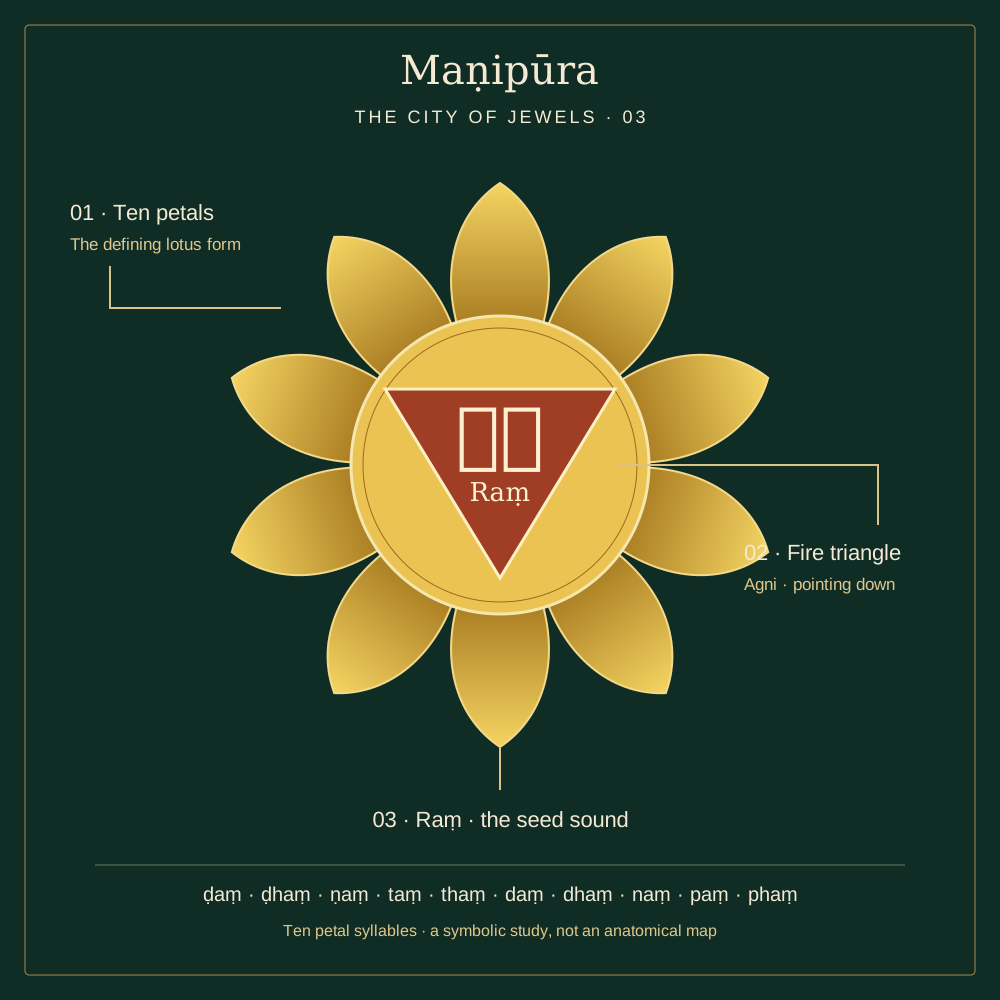
The petals carry ḍaṃ, ḍhaṃ, ṇaṃ, taṃ, thaṃ, daṃ, dhaṃ, naṃ, paṃ and phaṃ. The dots below some letters distinguish Sanskrit sounds that English spellings often blur. These are separate from the central Raṃ.
 House of AnandaMovement · Stillness · Wisdom · Journey
The subtle body · 03
मणिपूर
The city of jewels. A study in fire and clarity.
Explore the solar plexus chakra through your class notes: ten petals, the fire element, Raṃ, Samāna and the intention to act with steadiness rather than force.
Reading the symbol
The petals carry ḍaṃ, ḍhaṃ, ṇaṃ, taṃ, thaṃ, daṃ, dhaṃ, naṃ, paṃ and phaṃ. The dots below some letters distinguish Sanskrit sounds that English spellings often blur. These are separate from the central Raṃ.
A red, downward-pointing triangle commonly marks the fire region in Maṇipūra imagery. Interpret a symbol within its specific diagram: triangle meanings are not identical across all yantras.
Raṃ is the associated bīja mantra. Sound is a focus for contemplation; a fixed pitch in hertz is not part of the syllable’s written meaning.
The ram accompanies fire symbolism in some depictions. It can support reflection on purposeful action without reducing people to a chakra-based personality type.
Traditional lotus, fire and mantra descriptions: Sivananda’s Kundalini Yoga. Yellow, ram and downward triangle: Yoga in Daily Life. These are sources for spiritual teachings, not validation of their medical or supernatural claims.
Raṃ · रं · commonly written RAM
Bīja means seed: a compact sacred syllable used in mantra practice. Raṃ is not a literal sentence meaning “I am strong” or “I am confident”. Such affirmations may be contemporary companions, but they are not translations.
The written form combines र (ra, with a short a) and the dot marking a nasal sound, anusvāra. In a gentle classroom approach, make a light r, allow an easy vowel, then a soft nasal resonance. The English cue “rum” is approximate; pronunciation varies with tradition.
There is no need to force a rolled r, prolong the breath or push the voice into the abdomen. The seed Raṃ is also distinct from the divine name Rāma, although they may look similar in simplified English spelling.
Silent repetition is an alternative. No breath retention, forceful “fire breathing”, abdominal locks or squeezing is required. Stop if you feel dizzy, breathless, tense or distressed.
Let the sound support attention, then choose one manageable action that matters to you. Sensations of warmth or vibration can occur during sound practice, but they do not demonstrate that a chakra has opened.
A mala can support japa, and 108 is a familiar traditional count. It is not a medical dose or a requirement for this introduction. A few comfortable repetitions are enough to explore.
Explore japa and mala beads →Hand gesture · Agency · clear intention
Rudra is one of several gestures used in modern solar-plexus practice. It is different from Agni Mudra, in which the ring finger folds toward the palm under the thumb.
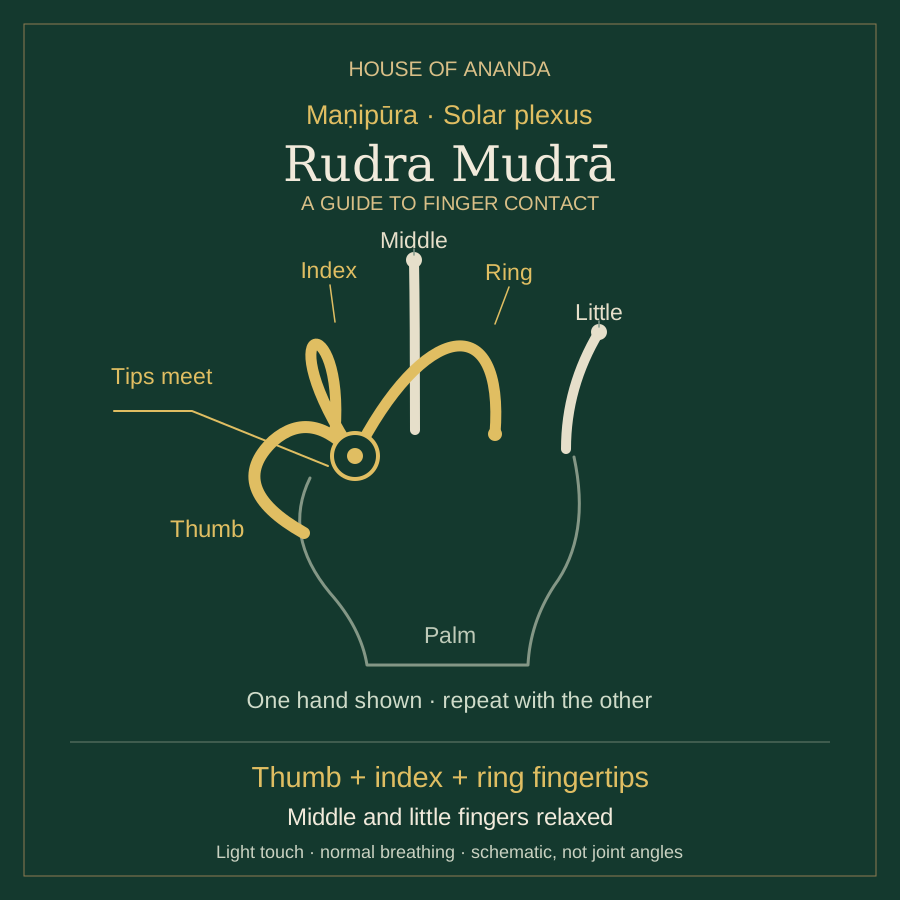
Thumb + index + ring fingertips. Touch with the fingertips, not the nails.
Middle and little fingers softly extended.
Form the three-tip contact on each hand. Let the forearms rest, rather than holding the shoulders up.
Use a light touch and normal breathing. Never force a finger straight or press through pain; resting the hands open is a suitable alternative. These are gestures for contemplation, not a way to diagnose or treat illness.
Tummee · Rudra hand position ↗. Chakra–mudra pairings vary by lineage and teacher. Therapeutic claims made by teaching sources are not adopted here.
Compare all seven chakra frequencies, traditional mantras and the research →
From the notebook · 575 Hz — E sound
Your notes record 575 Hz and what appears to be E. We retain 575 Hz as the musical starting point for this page, while clarifying that it is not E in standard A4 = 440 Hz tuning.
| Sound | Frequency | Relationship |
|---|---|---|
| E4 | 329.63 Hz | E above middle C |
| Classroom frequency | 575 Hz | About 36.7 cents below D5 |
| D5 | 587.33 Hz | Nearest standard note |
| E5 | 659.26 Hz | One octave above E4 |
Calculated using UNSW’s note-frequency equations. E may be a separate chakra-chart association rather than the measured pitch; the photograph does not specify a tuning system.
A 575 Hz tone repeats 575 times per second. It does not specify volume, rhythm or spiritual meaning. Music built around it still contains other frequencies, including harmonics and accompanying notes.
There is no established evidence that this frequency uniquely opens Maṇipūra, improves digestion or treats fatigue, hormonal conditions or low confidence. It is a creative listening choice—not a health prescription.
A song in E, a continuous 575 Hz drone, an A4 tuning reference and a binaural beat describe different things. This collection uses a central tone with harmonic accompaniment, not a binaural-beat protocol. Raṃ can be chanted at many pitches or repeated silently.
The listening room
Original House of Ananda audio · 12 tracks · 60 minutes
Twelve ambient sound studies with a continuous 575 Hz tone, layered harmonic pads and gentle bell-like pulses. Each five-minute piece has its own spacing and harmonic palette. These are synthesised instrumentals, with no recorded Raṃ chant.
Tracks advance automatically where your browser permits. Use the player to pause, seek and adjust volume. Begin quietly; headphones are optional.
Original digital compositions: a mathematically specified 575 Hz component plus other frequencies. MP3 encoding, playback equipment and room acoustics affect the sound you hear. The music is not a treatment or a test of chakra activity.
One track is enough; longer listening is not a stronger dose. Headphones are optional. Pause or stop if sound is uncomfortable, and do not practise inward-focused listening while driving.
Notebook study · Maṇipūra
Maṇi means jewel; pūra refers to a city or place. ‘City of jewels’ is a common translation. The notebook’s solar phrase is a poetic association, not the literal translation of the name.
Solar plexus chakra is a common modern name; many yogic descriptions place Maṇipūra at the navel region. The anatomical solar plexus is a network of nerves, not a visible chakra. Subtle-body and anatomical maps should not be treated as identical.
The ten-petalled lotus is a defining feature. Yellow follows these notes and many modern charts; older descriptions also give the petals a dark, rain-cloud colour. Neither colour scheme is universal.
The vital or energy sheath in the five-kośa model is associated with prāṇa and its functions. It is not simply oxygen, electrical activity or calories. The notebook’s Maṇipūra correspondence is a teaching connection, not a universal one-chakra-to-one-sheath rule.
Samāna is the balancing or assimilating aspect of prāṇa in yogic teaching, associated with the navel and digestion. It is a traditional explanatory model, not a substitute for digestive anatomy or a medical diagnosis.
Fire is the element; sight and the eyes are sensory correspondences, while the feet or legs represent locomotion in traditional organ-of-action charts. These are symbolic relationships, not evidence that Maṇipūra controls vision or leg function.
The animal ram is associated with the fire symbolism. It is distinct from Raṃ, the Sanskrit seed syllable: their resemblance in English spelling does not make them the same word.
These themes can invite reflection on agency, sustainable effort and clear decisions. Fatigue, low confidence or digestive symptoms are not proof of a blocked chakra, and spiritual practice need not become a demand to feel powerful.
For the traditional Samāna association, see the “Five Pranas” table in Kundalini Yoga. Continue with the five kośas lesson and anatomy collection to keep the philosophical and physical models distinct.
Practice with perspective
“Fire” need not mean a strenuous session, forceful breathwork or ignoring tiredness. Rest, ordinary breathing and a short reflective practice can sit alongside movement. Adapt yoga to your circumstances rather than trying to produce a particular sensation.
Digestive discomfort, persistent fatigue or other symptoms deserve appropriate healthcare; they should not be diagnosed as a blocked chakra. This page is educational and contemplative, not treatment advice. See NCCIH’s guidance on yoga evidence and safety.