The lotus
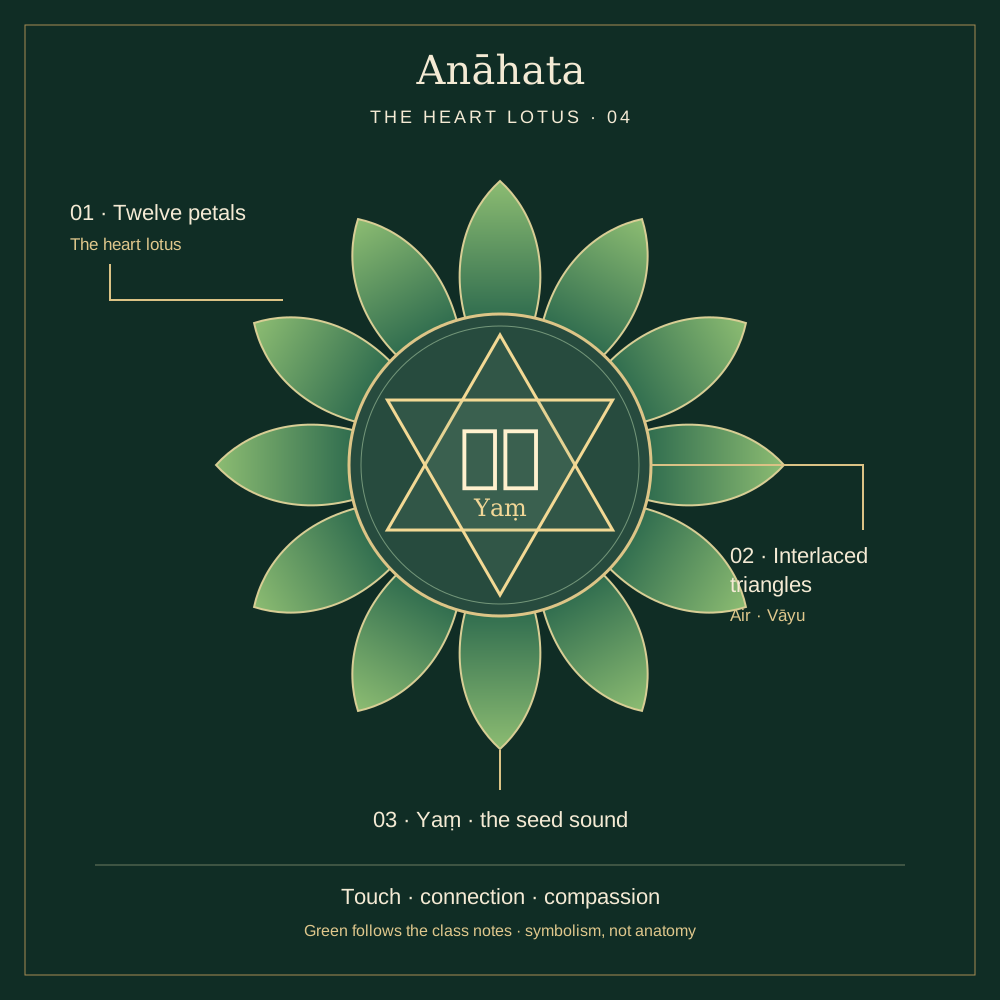
Twelve petals distinguish this chakra. Different teaching traditions interpret them through qualities or mental tendencies; one list should not be treated as a universal personality test.
 House of AnandaMovement · Stillness · Wisdom · Journey
The subtle body · 04
अनाहत
A place for kindness, connection and room to breathe.
A companion to the root, sacral and solar plexus studies: explore the twelve-petalled heart lotus, Yaṃ and your notes on air, touch, love and the bliss sheath.
Reading the symbol
Twelve petals distinguish this chakra. Different teaching traditions interpret them through qualities or mental tendencies; one list should not be treated as a universal personality test.
One triangle points upward and one downward. Their meeting is often read as a relationship between consciousness and nature, or complementary principles—not an anatomical structure.
Air offers an image of movement and spaciousness. For a simple contemporary reflection, notice an ordinary breath without making it deeper or trying to generate energy.
A single sacred syllable provides a focus. Its use in mantra practice is distinct from music theory and from the English word “yam”.
Twelve petals, interlaced triangles, air, mantra and antelope: Yoga in Daily Life’s Anāhata teaching. These are spiritual associations; supernatural promises in traditional accounts are not adopted as factual outcomes here.
The name is commonly translated as “unstruck”, associated with the contemplative idea of sound not produced by two things striking together. It does not mean that a person cannot be hurt, nor that grief indicates spiritual failure. See the Anāhata overview and its references.
Yaṃ · यं · commonly written YAM
Bīja means seed. Yaṃ is a compact sacred sound, not a literal sentence such as “I am loved”. A personal affirmation may accompany practice, but it is not the mantra’s translation.
The written form combines य (ya, with a short a) and a dot marking a nasal sound, anusvāra. Begin with a light y sound, allow an easy vowel and finish with gentle nasal resonance. A soft “yum” is only an approximate English classroom cue; pronunciation and sustained endings vary by tradition.
Use your natural vocal range. There is no need to match the music, create a strong chest vibration or extend the exhalation to its limit.
No breath retention, forceful breathing, chest stretching or squeezing is needed. Stop if dizzy, breathless or distressed. Silent repetition or simply listening are alternatives.
A gentle practice need not produce warmth, joy or forgiveness. Numbness, sadness and ordinary distraction are not evidence that your heart is closed. Keep the exercise brief and optional.
A mala may help with japa; 108 is a traditional count in many practices, not a dose. This introduction does not require it.
Explore japa and mala beads →A tentative reading of “mudrā — prāṇa”
Prāṇa is the yogic concept of vital force. It is not simply oxygen, and it is not a measured electrical field around the heart. A mudrā is a gesture or seal used within practice; the note may refer specifically to Prāṇa Mudrā.
A commonly taught hand form lightly brings the thumb, ring fingertip and little fingertip together, with the index and middle fingers comfortably extended. Rest the hands with support and avoid pressing or forcing the joints. Relaxed hands on the thighs are an equally suitable option for this listening practice.
Use it briefly as an attentional gesture, not as a way to treat heart symptoms or “charge” the body. The note does not establish that this is a uniquely Anāhata mudrā.
Example of this hand form in a yoga teaching context: Bamboo Garden Yoga’s mudrā guide. Therapeutic claims are not adopted here. For the broader philosophical model, continue with the five kośas lesson.
Hand gesture · Vitality · gentle attention
This illustrates the Prāṇa Mudrā already discussed in the Anāhata notes. The notebook’s wording is uncertain, and this is not a uniquely heart-chakra gesture.
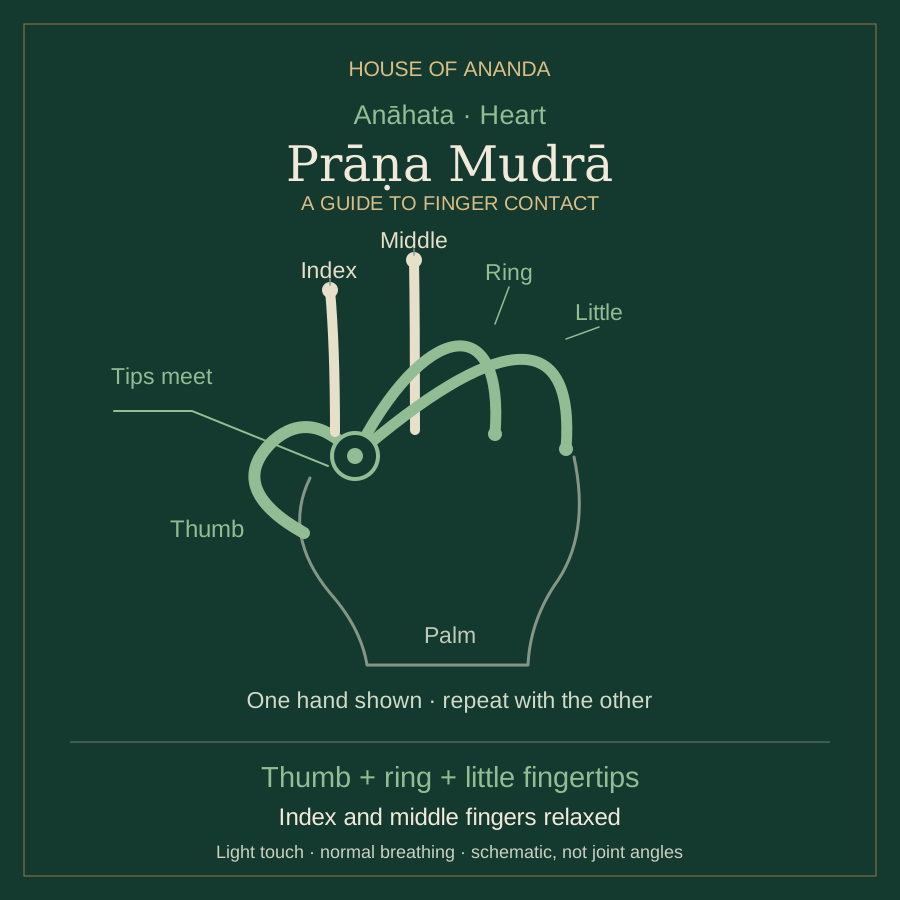
Thumb + ring + little fingertips. Touch with the fingertips, not the nails.
Index and middle fingers softly extended.
Use both hands independently, supported on the thighs. Touch lightly; do not squeeze the fingertips together.
Use a light touch and normal breathing. Never force a finger straight or press through pain; resting the hands open is a suitable alternative. These are gestures for contemplation, not a way to diagnose or treat illness.
Bamboo Garden Yoga · Prāṇa hand form ↗. Chakra–mudra pairings vary by lineage and teacher. Therapeutic claims made by teaching sources are not adopted here.
Compare all seven chakra frequencies, traditional mantras and the research →
A musical choice · not a frequency from the notebook
The uploaded page contains no frequency or musical-note value. To provide the same listening features as the previous chakra pages, House of Ananda has chosen a 349.23 Hz centre tone, approximately F4 in standard tuning. This is an editorial composition choice, not a claim about your teacher’s instructions or an ancient prescription.
| Label | What it means here |
|---|---|
| Yaṃ | A mantra syllable that may be voiced at different pitches or repeated silently. |
| 349.23 Hz | The chosen central tonal component in these instrumentals. |
| F4 | Approximately 349.228 Hz in twelve-tone equal temperament with A4 = 440 Hz. |
| Music around F | A musical relationship among notes, not a claim that the entire recording contains one frequency. |
| Heart-chakra theme | A contemplative intention, not an acoustic diagnosis or treatment. |
Pitch calculation: UNSW’s note-frequency equations. An octave below F4 is F3, about 174.61 Hz; you may chant in any comfortable range instead of matching either.
“Opening” can describe a spiritual intention to cultivate care and receptivity. There is no established evidence that a particular frequency uniquely opens Anāhata, repairs the heart or resolves grief and relationship difficulties. A meaningful listening experience does not need that claim.
These tracks are ambient instrumentals with harmonics and soft pulses, not pure-tone recordings or a binaural-beat protocol. Headphones are optional, and the recording contains no spoken or sung YAM.
The listening room
Original House of Ananda audio · 12 tracks · 60 minutes
Twelve ambient sound studies with a continuous 349.23 Hz tone, layered harmonic pads and gentle bell-like pulses. Each five-minute piece has its own spacing and harmonic palette. These are synthesised instrumentals, with no recorded Yaṃ chant.
Tracks advance automatically where your browser permits. Use the player to pause, seek and adjust volume. Begin quietly; headphones are optional.
Original digital compositions: a mathematically specified 349.23 Hz component plus other frequencies. MP3 encoding, playback equipment and room acoustics affect the sound you hear. The music is not a treatment or a test of chakra activity.
Stop or pause whenever you wish. Longer listening is not a stronger dose. Avoid inward-focused practice while driving, and discontinue sound that feels uncomfortable.
Notebook study · Anāhata
The notes describe the fourth chakra and its twelve-petalled lotus. The heart region is a contemplative location in a subtle-body map, not a separate anatomical organ.
Green follows the class notes and a widespread modern rainbow-colour convention. Other traditions use different colours; Yoga in Daily Life, for example, describes light blue. The page preserves your classroom palette without presenting it as universal.
Yaṃ is the associated seed sound. It can be voiced at a comfortable pitch or repeated silently; its identity is not determined by a single frequency.
This appears to refer to ānandamaya kośa, the bliss sheath in the five-kośa model. The notebook connects it with Anāhata; that is a teaching correspondence, not a universal one-to-one map. It does not mean a practitioner should feel happy all the time.
The line may name Prāṇa Mudrā, or list mudrā and prāṇa as separate points. Both are discussed below, but the photograph alone does not settle the teacher’s intended connection.
Air is the element. Touch and skin are sensory correspondences, while hands represent grasping or action in traditional charts. These symbolic links do not establish control over skin conditions, nerve function or physical touch responses.
The antelope is a traditional animal association, often interpreted as alertness or sensitivity. It is a symbol rather than a label for someone’s personality.
The final word appears to be attachment, though the handwriting is not fully clear. The reflection section explores these themes without promising that thoughts alone produce events or that love requires abandoning boundaries.
These are expanded study notes rather than a verbatim transcript. The mudrā/prāṇa line and the final word remain uncertain. Compare the five-kośa model with the anatomy collection without treating their categories as interchangeable.
Love, kindness & attachment
Compassion does not require agreement, continued contact, forgiveness on demand or tolerating harm. Consent and mutual respect belong alongside kindness.
Wanting connection is human. A useful reflection is whether care has become an attempt to control an outcome or another person. Non-attachment need not mean emotional numbness or abandoning relationships.
The notes can inspire an intention followed by practical action: reach out respectfully, listen, rest or honour a boundary. Thoughts and music cannot guarantee another person’s love, and hardship is not evidence that someone failed to manifest correctly.
The philosophical bliss sheath should not become pressure to be positive. Grief and difficult feelings can coexist with a meaningful spiritual life. If inward attention feels overwhelming, stop and return to ordinary surroundings or seek support.
Do not interpret chest pain, breathlessness or persistent distress as a blocked chakra. Seek appropriate medical care for physical symptoms; urgent symptoms need urgent help. This page offers educational and contemplative material, not treatment. Read NCCIH’s yoga evidence and safety guidance.