House of AnandaMovement · Stillness · Wisdom · Journey

Chakras · चक्र

Seven centres.
Many traditions.

Explore the familiar seven-chakra map as a contemplative language for body, breath, attention and meaning—beautifully, carefully and without confusing spiritual symbolism with medical anatomy.

Meet the seven centres ↓
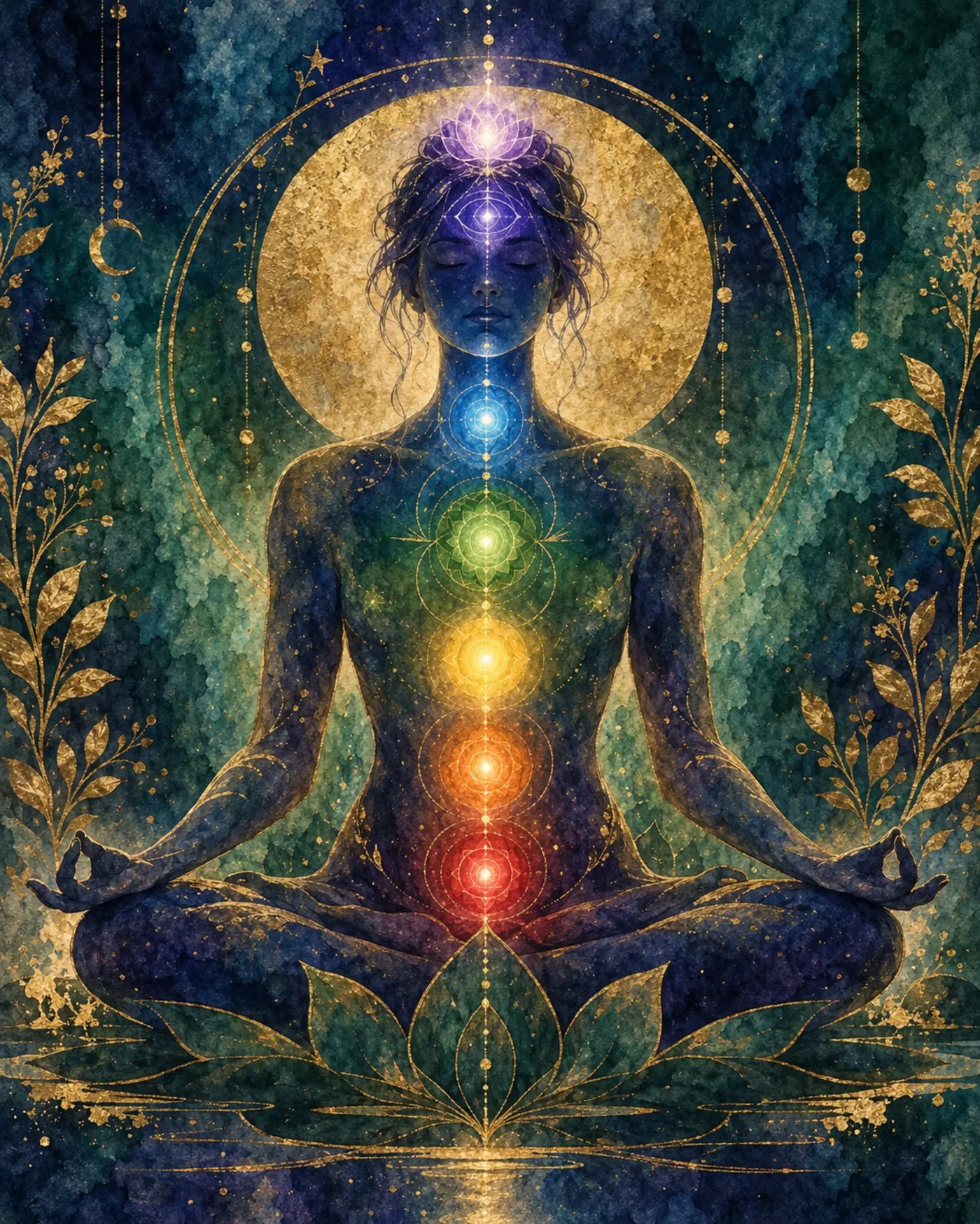
Original watercolor illustration of a seated figure with seven luminous chakra centres in red, orange, yellow, green, blue, indigo and violet
Original House of Ananda artwork · the familiar modern seven-centre map

Beyond the familiar seven

Bindu.
The moon centre.

Explore Bindu Visarga through original moonlit imagery, two downloadable diagrams and a gentle three-minute contemplation.

Understand the traditional nectar teaching, how Bindu differs from the brow and crown, and where spiritual symbolism meets the limits of evidence.

Explore Bindu and its illustrated maps →

Hands as a focus

Seven mudra
infographics.

Sound · tradition · evidence

Chakra frequencies,
with context.

Compare the seven commonly used Solfeggio frequencies, from 396 to 963 Hz, alongside traditional seed mantras.

Understand why different charts use different numbers, what 345 Hz means in the classroom notes and what research supports.

Read the chakra frequency research →

Begin with context

A map of the
subtle body.

In several Indian traditions, chakras are described within a subtle body: a contemplative and ritual body of channels, energies, sounds and symbols.

They are not physical organs, glands or structures visible through dissection or medical imaging. Treating them as reflective or spiritual frameworks respects both their religious history and the boundaries of contemporary anatomy.

There is no single chakra system shared unchanged by every school of yoga, Hinduism or Buddhism.

A concise history

Older than the rainbow.
Richer than a chart.

The popular seven colours are useful visual cues, but the history contains many maps, lineages and symbolic languages.

01

Not one fixed map

Cakra means ‘wheel’ or ‘disc’. Hindu and Buddhist tantric traditions developed several subtle-body maps with different numbers, positions, symbols and purposes.

02

Tantric practice

Chakras became important within medieval tantric systems of mantra, visualisation, ritual and subtle-body yoga. These practices belonged to particular texts and lineages rather than one universal system.

03

The familiar seven

The now-famous ascending set—from Mūlādhāra to Sahasrāra—draws strongly on a six-centre model crowned by the thousand-petalled lotus, transmitted to English readers through works including The Serpent Power.

04

The rainbow is modern

The neat red-to-violet spectrum and many personality-based ‘blocked chakra’ descriptions are largely modern syntheses. They can support reflection, but should not be mistaken for a single unchanged ancient doctrine.

The familiar ascending map

Root to crown.

Colours and psychological themes below reflect influential modern teaching. Sanskrit meanings, elements and seed sounds preserve connections to older tantric sources while acknowledging that associations vary.

Base of the torso

Mūlādhāra

मूलाधार

Root support
Colour
Red
Element
Earth
Seed sound
Laṃ

Traditionally associated with foundation, steadiness and the earth element. Modern interpretations often use it to reflect on safety, belonging and basic needs.

Explore Mūlādhāra & its symbol →
Lower abdomen and pelvis

Svādhiṣṭhāna

स्वाधिष्ठान

One’s own abode
Colour
Orange
Element
Water
Seed sound
Vaṃ

Linked in influential tantric maps with water, movement and generative energy. Contemporary teaching commonly explores creativity, feeling and relationship here.

Explore Svādhiṣṭhāna, VAM & 465 Hz music →
Navel region

Maṇipūra

मणिपूर

City of jewels
Colour
Yellow
Element
Fire
Seed sound
Raṃ

Associated with fire, digestion and transformation. Modern chakra language often connects this centre with agency, confidence and the ability to act.

Explore Maṇipūra, RAM & 575 Hz music →
Heart region

Anāhata

अनाहत

Unstruck
Colour
Green
Element
Air
Seed sound
Yaṃ

Anāhata means ‘unstruck’, evoking a sound that arises without two things colliding. It is associated with air and, in modern reflection, love, compassion and balance.

Explore Anāhata, YAM & heart-centred music →
Throat region

Viśuddha

विशुद्ध

Purification
Colour
Blue
Element
Space
Seed sound
Haṃ

Traditionally related to space and purification. Modern teaching frequently treats the throat as a place to contemplate truthful expression and equally truthful listening.

Explore Viśuddha, HAM & music →
Between the brows

Ājñā

आज्ञा

Command or perception
Colour
Indigo
Element
Mind and subtle perception
Seed sound
Haṃ · Kṣaṃ

A centre of inward attention, discernment and meditative perception. Its two petals are traditionally linked with haṃ and kṣaṃ; Oṃ is also widely used in modern practice.

Explore Ājñā, OM & music →
At or above the crown

Sahasrāra

सहस्रार

Thousand-petalled
Colour
Violet or white
Element
Beyond the elements
Seed sound
Silence · Oṃ varies by lineage

Often presented as the crown centre—or as a state beyond the six embodied chakras. It can symbolise expanded awareness, spiritual freedom and relation to what is greater than the individual self.

Explore Sahasrāra, silence & music →
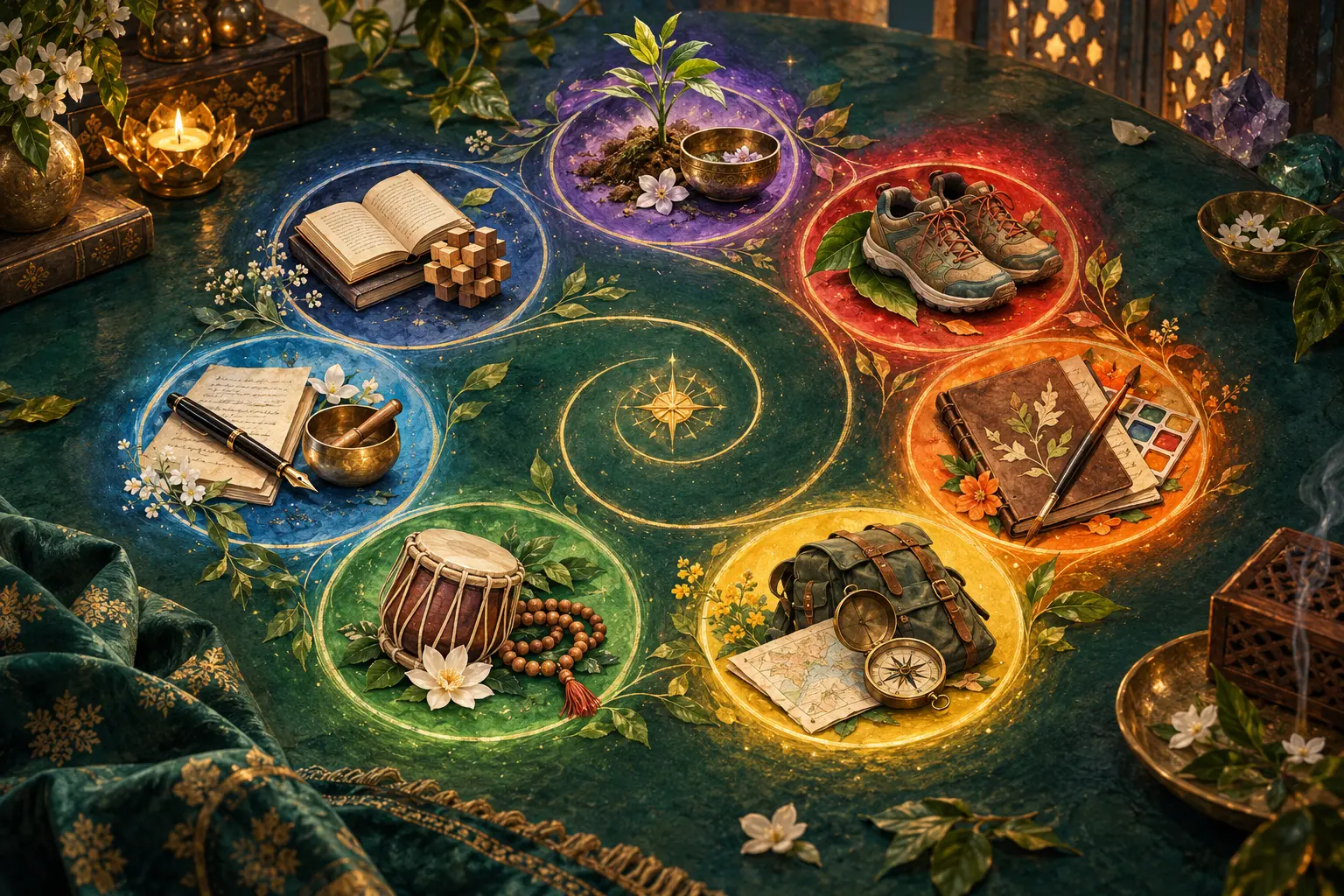
Seven circles of everyday practices including walking, creativity, travel, music, writing, reading and caring for a young plant
Original House of Ananda artwork · ordinary activities as doorways into attention

Everyday life & the seven centres

Practice can look
like living.

Hobbies are not wasted time. They can interrupt the narrow cycle of work, responsibility and scrolling, restore curiosity and remind us that a worthwhile life also includes pleasure, friendship, learning and service.

The associations below are a contemporary House of Ananda reflection inspired by the chakra themes—not a classical prescription. Choose what genuinely nourishes you rather than attempting to complete another perfect list.

01
Mūlādhāra

Ground the body

Choose hobbies that return attention to rhythm, strength and the physical world.

  • Walking outdoors
  • Cooking whole foods
  • Yoga
  • Cycling
02
Svādhiṣṭhāna

Make and feel

Create without needing the result to be useful, impressive or shared.

  • Journalling
  • Painting
  • Gentle self-massage
  • Yoga nidrā
03
Maṇipūra

Practise courage

Meet manageable challenge and develop confidence through preparation and repetition.

  • Public speaking
  • Adventure activities
  • Solo travel
  • Martial arts
04
Anāhata

Connect with others

Let enjoyment become a place of companionship, generosity and shared presence.

  • Attending kīrtan
  • Book clubs
  • Game nights
  • Dance classes
05
Viśuddha

Find expression

Develop a form through which your own voice can become clearer and more honest.

  • Podcasting
  • Writing
  • Singing
  • Thoughtful affirmations
06
Ājñā

Cultivate insight

Choose practices that train attention, curiosity and the ability to see beyond first impressions.

  • Reading
  • Learning languages
  • Meditation
  • Solving puzzles
07
Sahasrāra

Serve beyond self

Give time to something larger than individual achievement or entertainment.

  • Volunteering
  • Caring for animals
  • Supporting charity
  • Planting trees

A seven-day contemplation

One centre.
Ten quiet minutes.

This is a reflective programme, not a promise to diagnose, unblock or heal the body.

  1. 01

    Arrive. Choose a stable, comfortable seat and feel the support beneath you.

  2. 02

    Locate attention. Bring gentle awareness to the day’s traditional region without searching for a special sensation.

  3. 03

    Add one symbol. Use the colour, element or seed sound as a focus—not as a medical intervention.

  4. 04

    Move or breathe. Explore the suggested posture for three to five easy breaths, with no forced retention.

  5. 05

    Reflect and close. Consider the question, write one sentence if useful, then rest in silence.

Practice with discernment

Symbol is not diagnosis.

Language such as ‘open’, ‘closed’ or ‘blocked’ can be a metaphor for reflection; it cannot establish the cause of anxiety, pain, fatigue or illness. Seek qualified healthcare support for symptoms that are severe, persistent or concerning.

Intense breath retention, bandha, forceful kuṇḍalinī methods and prolonged sensory practices can be destabilising. Learn advanced methods from an appropriately experienced teacher, especially if you have cardiovascular, respiratory, neurological or mental-health concerns.

Continue with gentle meditation →Compare contemporary anatomy →
Study sourcesṢaṭ-cakra-nirūpaṇa in The Serpent Power ↗Springer · Chakras reference entry ↗Internet Encyclopedia of Philosophy · Yoga ↗NCCIH · Yoga safety ↗