Four petals
The root lotus
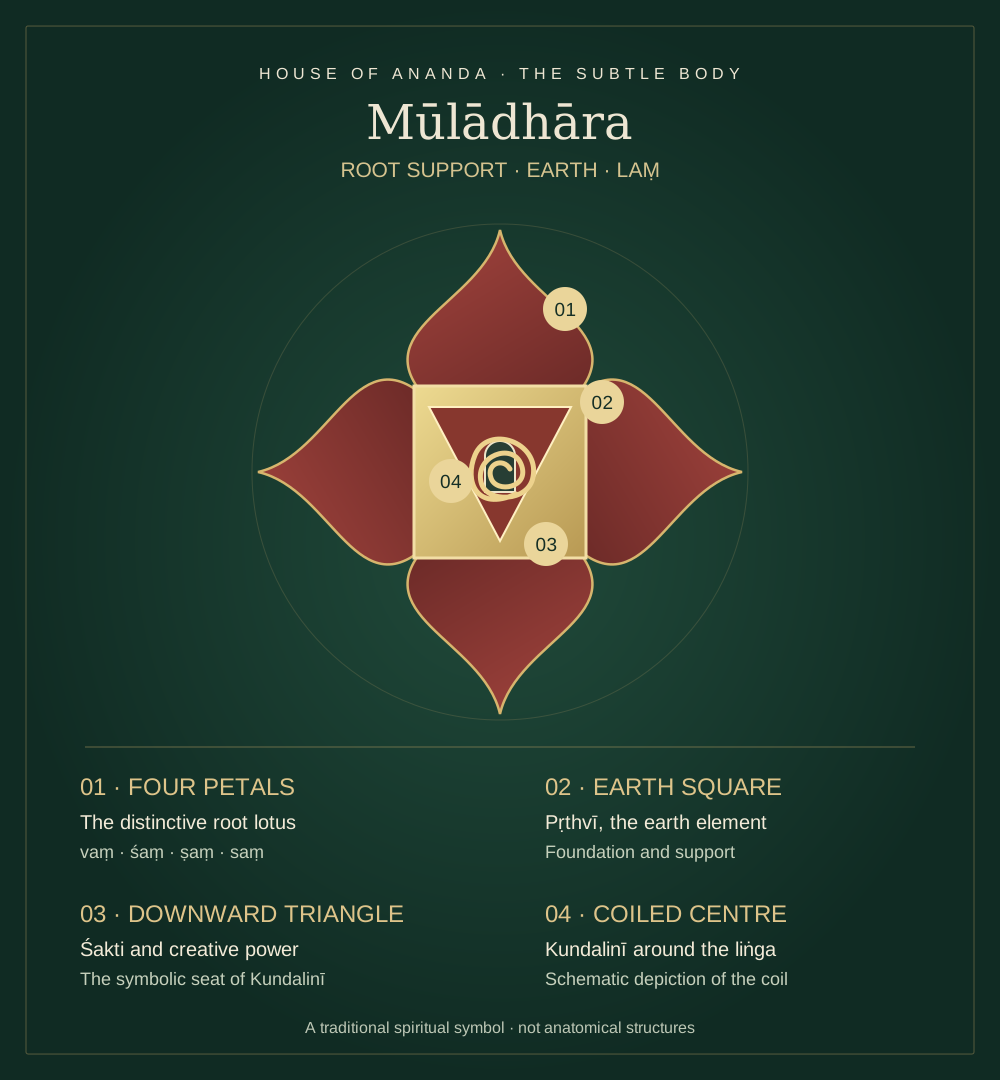
The four-petalled lotus is a defining feature of Mūlādhāra. Traditional depictions place the syllables vaṃ, śaṃ, ṣaṃ and saṃ on its petals. Interpretations of what the petals represent differ between teachers and texts.
 House of AnandaMovement · Stillness · Wisdom · Journey
The subtle body · 01
मूलाधार
The root. The foundation. The place of support.
Begin with the symbol: four petals, a square of earth, a downward triangle and a coiled centre. Together they form a contemplative map of Mūlādhāra, often called the root chakra.
Reading the symbol
The root lotus
The four-petalled lotus is a defining feature of Mūlādhāra. Traditional depictions place the syllables vaṃ, śaṃ, ṣaṃ and saṃ on its petals. Interpretations of what the petals represent differ between teachers and texts.
Pṛthvī · earth
The yellow square represents the earth element: the most solid of the five elements in this symbolic system. It offers an image of foundation and support.
Śakti · creative power
The inverted triangle is associated with the yoni and creative divine power. Within Mūlādhāra imagery it frames the seat of Kundalinī. It is more specific than a general symbol for ‘grounding’.
Kundalinī & the liṅga
Kundalinī is traditionally represented as a serpent coiled three-and-a-half times around the Svayambhū liṅga. This expresses latent spiritual power; it is not a literal snake or anatomical structure.
Traditional associations: Swami Sivananda, Kundalini Yoga; Mūlādhāra iconography overview.
Name & location
Mūla means root; ādhāra means support or foundation. The name is commonly translated as “root support”. “Mooladhara” is another familiar spelling.
Traditional descriptions associate it with the perineal region at the base of the torso. “Base of the spine” is a common shorthand. This belongs to a subtle-body map used in spiritual practice, rather than to a diagram of nerves, organs or glands.
Laṃ · लं · A closer listening
Laṃ is the bīja mantra associated with Mūlādhāra and the earth element. Bīja means “seed”: a compact sacred sound used as a focus in mantra practice. It does not translate into a sentence such as “I am safe”. Such affirmations are modern companions to practice, not literal translations of Laṃ.
The consonant l with its inherent short a vowel.
The dot marks a nasal sound; its realisation depends on the chanting tradition.
One seed syllable, distinct from the four petal syllables.
Begin with a light l sound, letting the tongue touch behind the upper front teeth. Allow the vowel to sound easily, then finish with a gentle nasal resonance. In many contemporary classes this is taught as a soft “lum” ending in a hum; that English cue is only approximate. It is not the English word “lamb”, and there is no final b.
The transliteration Laṃ uses a short a. A teacher may sustain the vowel during chanting, and some teaching materials write LAM or LĀM. Follow the pronunciation taught within your chosen tradition rather than forcing one English approximation.
For the traditional seed-mantra association, see Sivananda’s Kundalini Yoga. Spoken and sung delivery varies by lineage; the practice below is a gentle contemporary introduction.
An optional two-minute introduction
Keep the breath moving without retention or pelvic-floor squeezing. Silent repetition is an alternative. If you become dizzy, breathless or uncomfortable, stop and return to normal breathing.
In spiritual practice, Laṃ may be used to contemplate earth, steadiness and Mūlādhāra. In an everyday practice, returning attention to a repeated sound can give the mind a simple point of focus. Feeling vibration is not proof that a chakra has opened.
No fixed count is required for this introductory exercise. A mala may be used to count repetitions in japa; 108 is a traditional count in many practices, not a medical dose or a requirement for benefit. Begin briefly and comfortably.
Read about japa and mala beads →There is no established single frequency in hertz that makes Laṃ “correct”, and no established evidence that Laṃ specifically repairs tissues or treats a blocked chakra. A comfortable pitch is sufficient for this introduction.
Hand gesture · Earth · steadiness
Pṛthvī means earth. This is a contemporary chakra-meditation pairing with the earth-associated root centre.
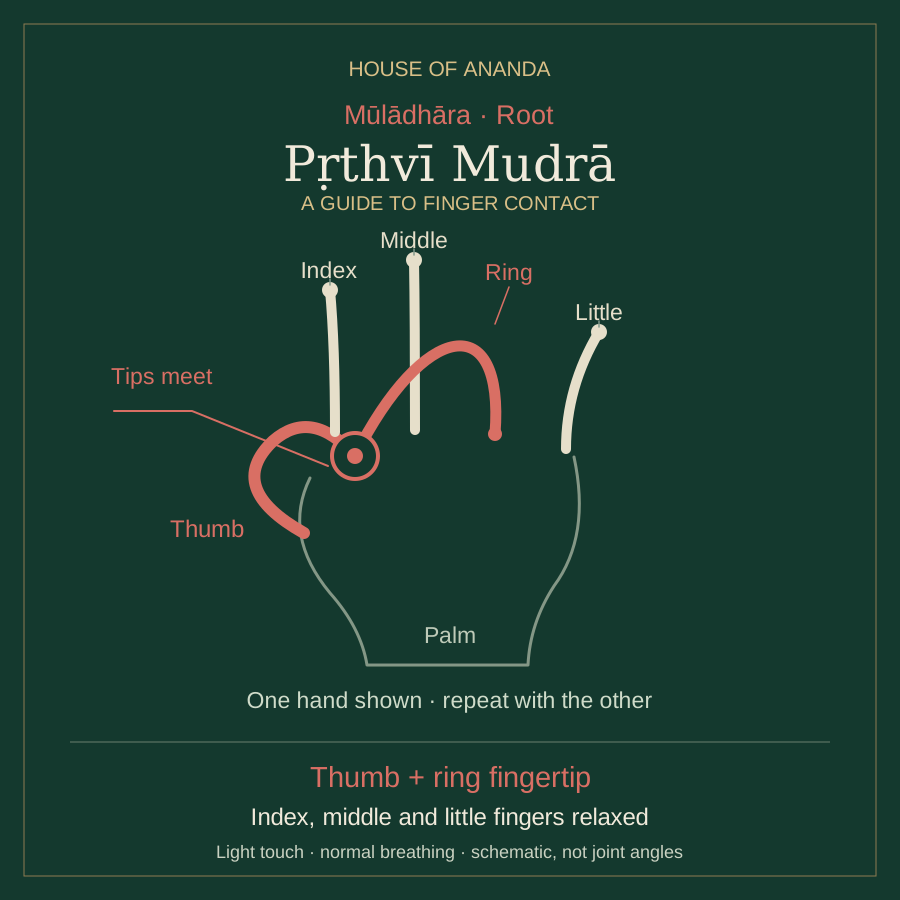
Thumb + ring fingertip. Touch with the fingertips, not the nails.
Index, middle and little fingers softly extended.
Make the gesture with each hand. Rest the hands on the thighs, with the palms comfortably upward.
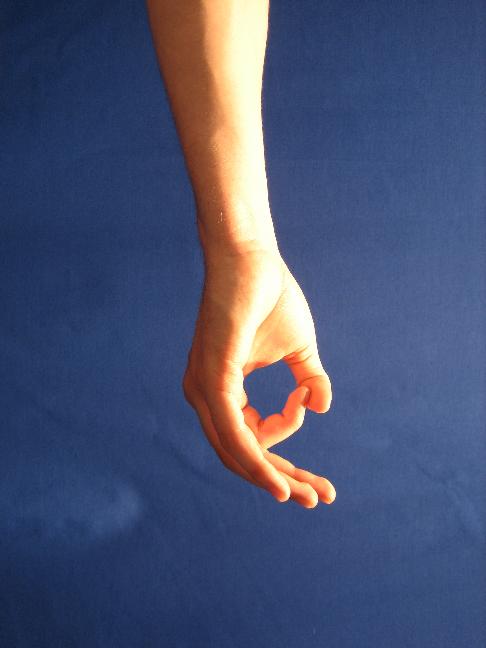
A photographic example of thumb–ring contact. The other fingers overlap in this view.
Subcommandante / Davin7 · CC BY-SA 3.0. Image unchanged.
Use a light touch and normal breathing. Never force a finger straight or press through pain; resting the hands open is a suitable alternative. These are gestures for contemplation, not a way to diagnose or treat illness.
Arhanta Yoga · hand position and contemporary pairing ↗. Chakra–mudra pairings vary by lineage and teacher. Therapeutic claims made by teaching sources are not adopted here.
Compare all seven chakra frequencies, traditional mantras and the research →
From the notebook · Laṃ — 345 Hz — C
Your note records “LAM – 345 Hz” and a circled “C”. We preserve that as a classroom note, while separating three different ideas: a sacred syllable, a measurable sound frequency and a musical note name.
The mantra can be spoken, sung or repeated silently. When sung, it has a changing pitch and a spectrum of overtones shaped by the voice. Its traditional association with Mūlādhāra does not assign every singer one required frequency.
A 345 Hz tone oscillates 345 times each second. That number describes an acoustic property, not the volume, tempo, mantra meaning or a measured chakra state. A whole musical recording contains many frequencies even when it is built around a 345 Hz drone.
| Sound | Frequency | What it tells us |
|---|---|---|
| Middle C · C4 | 261.63 Hz | The usual middle C in standard tuning. |
| Your note | 345 Hz | Approximately 22 cents below F4, not C in this tuning. |
| F4 | 349.23 Hz | The nearest standard equal-tempered note. |
| C5 | 523.25 Hz | The C one octave above middle C. |
Values calculated using UNSW’s note-frequency equations. “C” may be a separate chakra-chart association in the class, or a transcription issue; the photograph alone cannot establish the teacher’s intended tuning system.
“Opening” can express a spiritual intention: attending to steadiness, embodiment and connection with the ground. It is not an established measurable outcome of listening to 345 Hz. There is no established evidence for a unique root-chakra-opening effect at this frequency. A meaningful or calming experience does not need that claim to be valuable.
Modern recordings may use other numbers, including 396 Hz, for root-chakra themes. Those labels reflect different contemporary approaches; they are not interchangeable with 345 Hz, and a title alone does not verify a recording’s acoustic content.
The listening room
Original House of Ananda audio · 12 tracks · 60 minutes
Twelve ambient sound studies with a continuous 345 Hz tone, layered harmonic pads and gentle bell-like pulses. Each five-minute piece has its own spacing and harmonic palette. These are synthesised instrumentals, with no recorded Laṃ chant.
Tracks advance automatically where your browser permits. Use the player to pause, seek and adjust volume. Begin quietly; headphones are optional.
Original digital compositions: a mathematically specified 345 Hz component plus other frequencies. MP3 encoding, playback equipment and room acoustics affect the sound you hear. The music is not a treatment or a test of chakra activity.
You can stop after one track. Longer listening is an option, not a stronger dose. Avoid straining the breath or voice; stop if sound or chanting feels uncomfortable.
From your notes · 14 September 2026
The notebook connects the red root lotus with earth, the physical body and an elephant with seven trunks. These associations bring together chakra symbolism, the kośa model and Ayurvedic tissue theory. They are related teaching frameworks, not interchangeable anatomical systems.
Anna means food; annamaya means made of or sustained by food; kośa means sheath. Annamaya Kośa is the physical, food-supported layer in the five-kośa model: the body that eats, moves, rests and changes.
Your class links this embodied layer with the root chakra. This is a useful teaching association rather than a universal one-to-one assignment of five kośas to seven chakras.
Bihar School of Yoga · The Koshas ↗Some depictions include an elephant beneath the seed syllable. In the teaching of Swami Maheshwarananda, its seven trunks can represent the body’s seven basic constituents, alongside other symbolic sets of seven. Your notes emphasise the seven tissues, or sapta dhātus.
This is symbolic imagery: interpretations differ among texts and schools. The seven trunks do not refer to seven literal structures in an elephant or the human body.
Chakras and Kundalini · Mūlādhāra ↗The spellings below are standardised from the handwriting. The English terms are approximate teaching equivalents within Ayurveda, rather than exact matches to modern histology.
| Sanskrit | Common English equivalent | Reading the note |
|---|---|---|
| Rasa | Nourishing fluid; often compared with plasma and lymph | “Plasma” is useful shorthand, but does not exhaust the Ayurvedic concept. |
| Rakta | Blood | The blood tissue category. |
| Māṃsa | Muscle / flesh | The muscle entry is Māṃsa, not “Mada”. |
| Meda / Medas | Fat / adipose tissue | Distinct from Māṃsa. |
| Asthi | Bone | Connects with the skeletal-system note. |
| Majjā | Marrow | Often taught as bone marrow; broader interpretations vary. |
| Śukra | Reproductive tissue / generative principle | A traditional category, not a direct synonym for every reproductive organ. |
Compare the overview of Ayurvedic dhātus and continue in the Ayurveda library. This classification is not a claim that chanting creates, repairs or transforms these tissues.
These sensory and bodily correspondences appear in Maheshwarananda’s teaching chart; they should be read as traditional correspondences, not medical mechanisms.
Tradition & interpretation
Chakra systems developed in different tantric traditions; there is no single map shared by every school of yoga. The four-petalled root lotus, earth element, seed sound and Kundalinī imagery belong to established teachings. Modern language about security, belonging and emotional grounding offers a later reflective interpretation.
Neither the diagram nor a feeling of being “blocked” can diagnose illness. Here, the symbol is an invitation to study and contemplation.
From the classroom
The board was headed “Chakra” and “moola dhara”. Its four petals, central square and inverted triangle clearly identify the subject. The small coiled shape most likely represents Kundalinī around the liṅga; that detail is an interpretation of the sketch, not a confirmed transcription of the teacher’s explanation.
The illustration above develops those visible shapes into a labelled study aid. It does not treat the ambiguous centre as a clearly written Laṃ symbol.
A moment of reflection
Notice the contact of your feet or seat with the surface beneath you. Let your breathing remain easy. Consider one practical source of support in your life: a person, a place, a habit or a moment of rest.
This is a contemporary reflection, not a Kundalinī-awakening technique.
Explore gentle meditation →A traditional teaching source for the root centre, petal sounds, seed mantra and Kundalinī symbolism. Spiritual claims should be read in their religious context.
The Serpent Power · Ṣaṭ-cakra-nirūpaṇa ↗A historical English translation and commentary on an influential tantric chakra text.
