Japa is the intentional repetition of a mantra, sacred name, prayer or sound. The Sanskrit verbal root jap carries the sense of murmuring or reciting in a low voice.
Japa belongs to many Hindu and yogic worlds rather than one uniform method. It may be devotional, contemplative, ritual or initiatory. The mantra can be voiced, whispered or held mentally; some lineages formally distinguish these modes and value them differently.
The mālā does not make repetition meaningful by itself. It gives the hands a rhythm and frees the mind from numerical counting, so attention can remain with sound, intention and remembrance.
One sound. One bead. One return.
Japa may be audible, whispered or inward; the posture should remain steady and easeful.
The mantra in this practice
Oṃ · A–U–M
Oṃ is a sacred syllable with layered meanings across Hindu, Buddhist and Jain traditions. Here it is approached within Hindu and yogic mantra practice—not as a generic relaxation sound detached from its religious histories.
The Māṇḍūkya Upaniṣad makes Oṃ the focus of a concise contemplation on the whole of experience. Its analysis relates A–U–M to modes of consciousness and also attends to what lies beyond the sounded syllable. Other texts, schools and teachers interpret Oṃ through their own philosophies and devotional commitments.
During this practice, let A open, U carry the resonance and M close softly. Do not force length or volume. The silence after the sound is part of the listening.
9 September notebook · IMG_1850–1852
One syllable. Four contemplative pointers.
Developing the consciousness sketch within its Upaniṣadic context.
A · U · M
A · waking
Jāgrat: outwardly directed experience.
U · dreaming
Svapna: the dream world.
M · deep sleep
Suṣupti: dreamless sleep.
Turīya · “the fourth”
The Upaniṣad’s pointer beyond these three conditions, not merely another sleep stage.
Read the diagram with care
The notebook labels awake, dreaming and sleeping as conscious, subconscious and unconscious. That is a classroom simplification; these modern psychological terms do not map exactly onto the Māṇḍūkya’s philosophical categories.
The mark for turīya sits near “samādhi”. Their relationship depends on the school: do not define both simply as sleep, blankness or loss of consciousness. Nor should the page’s word “trinity” be assumed to name Brahmā, Viṣṇu and Śiva here; this particular diagram concerns experience.
The following spread links A, U and M with navel, heart and third-eye regions. These are contemplative associations from the lesson, not anatomical locations of consciousness or a universal resonance map.
A full japa mālā commonly contains 108 counting beads and one additional guru or meru bead. Materials, knots, tassels and rules of handling vary between regions, communities, deities and lineages.
108
Counting beads, each receiving one repetition
+1
Guru or meru bead, marking the threshold of a round
1 round
A complete circuit without crossing the guru bead
A rudrākṣa-style mālā with a larger guru bead and tassel. Mālās may also be made from tulasī, sandalwood, seeds, stone or other materials.
From Daniel’s Japa lesson notes
Three dimensions. One complete round.
The notes record 108 as a symbolic portrait of mental, physical and spiritual existence. This interpretation is preserved as a teaching received in Daniel’s training; it is not presented as the single origin of every 108-bead mālā.
3mental+5physical+100spiritual=108one round
03 · mental qualities
The three guṇas.
In Sāṃkhya and many Hindu philosophical contexts, sattva, rajas and tamas describe interacting qualities of manifest nature. They are not personality labels or moral verdicts.
01
Sattva
clarity · harmony · luminosity
02
Rajas
activity · movement · restlessness
03
Tamas
inertia · heaviness · obscuration
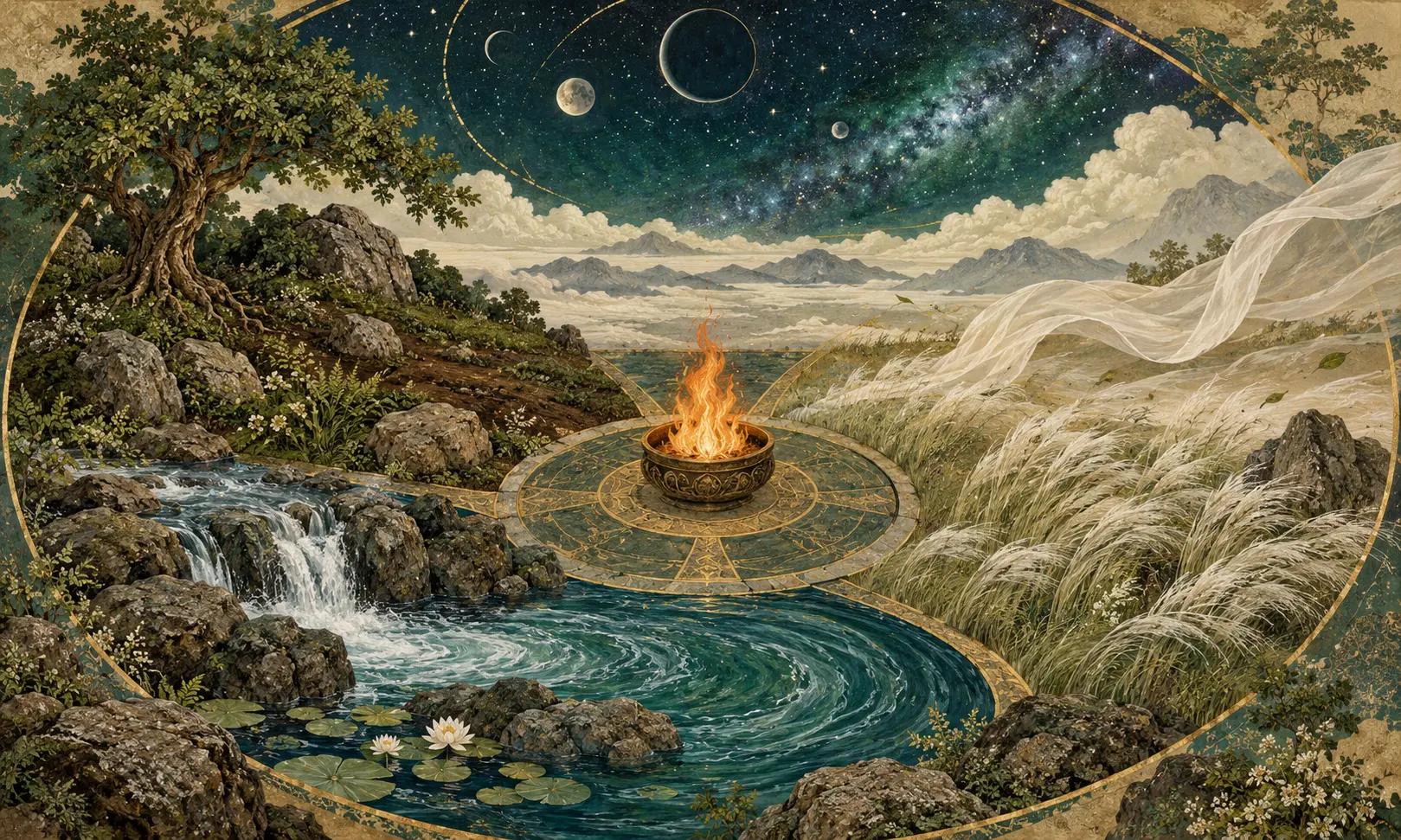
An artistic meditation on the five great elements—not a scientific diagram of matter.
05 · physical elements
The five mahābhūtas.
Indian philosophical and medical traditions describe five “great elements.” Their meanings and relationships vary by system; they should not be confused with the elements of modern chemistry.
01
Earth
Pṛthivī
form · solidity · support
02
Water
Āpas
fluidity · cohesion · adaptation
03
Fire
Agni / Tejas
heat · transformation · illumination
04
Air
Vāyu
movement · touch · circulation
05
Space
Ākāśa
openness · resonance · room for experience
100 · spiritual elements
From the individual toward the universal.
Daniel’s notes place the remaining one hundred within the spiritual dimension and connect them with ego, individual soul and universal soul. IMG_1842 repeats this teaching. The notebook gives the symbolic total but does not identify a named classical list of one hundred items.
For that reason, House of Ananda preserves the teaching without presenting it as a universally standard Hindu taxonomy. Different schools understand ego, self, soul, consciousness and ultimate reality in importantly different ways.
In the lesson’s symbolic arithmetic, mental, physical and spiritual existence meet in the 108 repetitions of one complete mālā.
A gentle guided round
How to practise with Oṃ and beads.
Allow approximately 12–25 minutes. Shorter rounds using 27 or 54 beads may also be used when that is consistent with the tradition being followed.
01
Prepare
Sit in a position that allows steadiness without strain. Let the breath settle naturally; no special breathing ratio is required.
02
Begin beside the guru bead
Find the larger guru or meru bead. Start with the first counting bead beside it rather than counting the guru bead itself.
03
Repeat Oṃ once
Voice Oṃ gently, whisper it, or repeat it inwardly. Hear the whole sound rather than rushing to the next bead.
04
Move one bead
After one repetition, draw the next bead toward you. Many Hindu lineages use the thumb and middle finger, but customs differ.
05
Complete the circle
Continue for 108 repetitions. If attention wanders, return to the sound and the bead without criticism.
06
Turn, do not cross
On reaching the guru bead, pause. If beginning another round, turn the mālā and travel back in the opposite direction.
07
Rest in silence
Place the mālā down and remain still for a few moments. Notice the quiet, sensation and quality of attention left by the practice.
Daniel’s mantra notebook · IMG_1847 · expanded 17 September 2026
Sa · Ta · Na · Ma
Four sounds, a sequence of finger touches, and a movement from voice towards silence and back.
Meaning and context
This four-sound practice is commonly called Kirtan Kriya in modern Kundalini Yoga teaching. The notebook links it to Sat Nām: sat, truth or true being; nām, name or identity. “Truth is my identity” is a common practice rendering, not a word-for-word translation of each of the four syllables.
This is a distinct mantra practice within the broader world of repetition. It does not require a mālā and is not another name for Oṃ japa. Your earlier notes on the 108 beads remain above in their original context.
Sound and touch
In a common Kirtan Kriya form, lightly meet each fingertip with the thumb on both hands as its sound is repeated. Keep hands relaxed. Finger movement may be reduced or omitted if uncomfortable; this is an accessibility adaptation.
Sa
Index finger + thumb
Ta
Middle finger + thumb
Na
Ring finger + thumb
Ma
Little finger + thumb
The five phases in your notes
Aloud5
Whisper5
Mental10
Whisper5
Aloud5
The handwritten 5–5–10–5–5 pattern totals 30 units, with twice as much time or counting assigned to the silent middle. The photograph does not explicitly label the units, so it has not been turned into a compulsory 30-minute routine.
For comparison, the Alzheimer’s Research & Prevention Foundation documents a 12-minute form: 2 minutes voiced, 2 whispered, 4 silent, 2 whispered and 2 voiced. This is a separate published version, not a correction to what your teacher wrote.
A gentle introduction
Choose a comfortable seat or chair. Say the four sounds quietly for a few repetitions while allowing normal breathing. Notice the transition from one fingertip to the next. Pause, listen, and stop when ready; you do not need to complete a timed round to become familiar with the pattern.
Keep the voice easy, without prolonged breath holds. Open the eyes or return to ordinary activity if inward attention feels unsettling.
Keep the claims proportionate
The gesture and sound provide supports for attention. Their presence does not establish a treatment for memory loss, dementia, hormonal problems or a neurological condition. A teaching organisation’s instructions explain its method; they do not by themselves prove a medical benefit.
Study notes: Daniel Fewtrell · Edited 17 September 2026 · No named teacher review recorded.
Practice with respect
Sound is not a performance.
Begin quietly and keep the breath free. Stop vocal repetition if it causes strain, breathlessness, dizziness or agitation; continue mentally or rest if that feels steadier.
Some mantras are public and widely shared; others are transmitted through initiation or a teacher relationship. Follow the guidance of the lineage in which a mantra was received.
Oṃ carries sacred meanings. Participation should be voluntary, and people should not be pressured to chant language or theology that conflicts with their beliefs.
Study beyond this page
Texts, context and living guidance.
The historical references support the broader account of Oṃ and japa. The 3 + 5 + 100 interpretation is explicitly attributed to Daniel’s handwritten Japa lesson notes.