Sixteen sound-bearing petals
The vowel association gives sound a central place in the symbol. Spellings and arrangements vary across diagrams; the petal vowels are distinct from the central Haṃ.
 House of AnandaMovement · Stillness · Wisdom · Journey
The subtle body · 05
विशुद्ध
Space to listen. Room to speak.
The throat-chakra study brings together sixteen petals, Haṃ, the space element and your notes on expression, hearing and discernment.
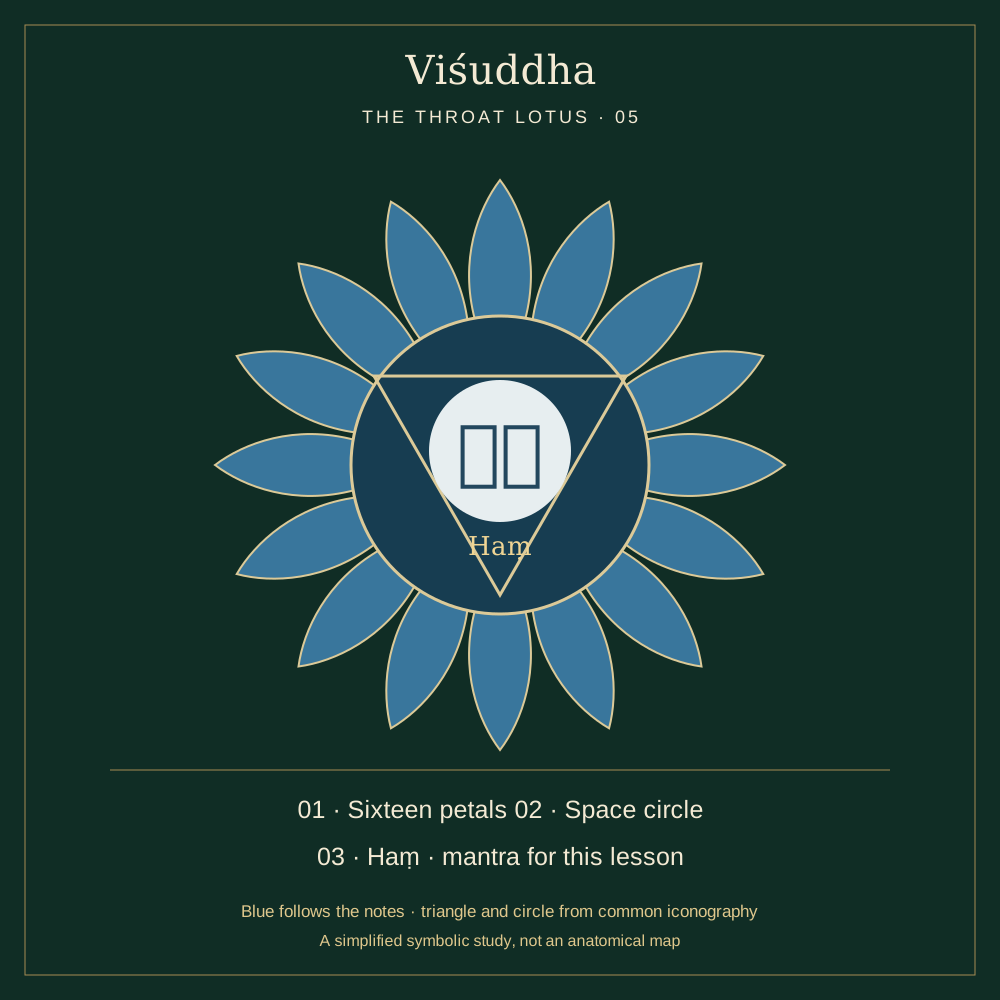
The vowel association gives sound a central place in the symbol. Spellings and arrangements vary across diagrams; the petal vowels are distinct from the central Haṃ.
The circular space region sits within a triangle in common depictions. Ākāśa belongs to a philosophical element system; it is not a physical substance that sound recordings can cleanse.
An accompanying animal symbol in traditional teaching. Here its presence is explained in words rather than mistaken for anatomical information.
A contemporary reflection is to make room for both: speaking clearly and allowing another person to finish. Silence can be a choice rather than a failure to express yourself.
Traditional correspondences: Yoga in Daily Life. Diagram context: Viśuddha iconography overview. Spiritual and supernatural claims in these sources are not adopted as medical facts.
Haṃ · हं · commonly HAM
Bīja means seed: a compact sacred sound used as a focus. Haṃ does not literally translate as “I speak my truth”. That is a modern affirmation, not the mantra’s meaning.
The written form combines ह (ha, with a short a) and the nasal marker anusvāra. Begin with a light h, allow the vowel easily and finish with gentle nasal resonance. “Hum” is only an approximate English cue; follow your teacher’s tradition without forcing the voice.
Haṃ can be spoken, sung or repeated silently. It does not require 745 Hz, a long exhalation or vibration at a particular location.
No breath retention, neck lock or forceful breathing is needed. Stop with pain, hoarseness, dizziness or breathlessness. Resting the voice or repeating silently is always an option.
A mala and 108 repetitions may belong to a japa tradition, but they are not a dose or requirement here. Read about japa →
Hand gesture · Space · listening
Ākāśa means space. The pairing follows the throat centre’s space symbolism; it is not a treatment for voice or thyroid conditions.
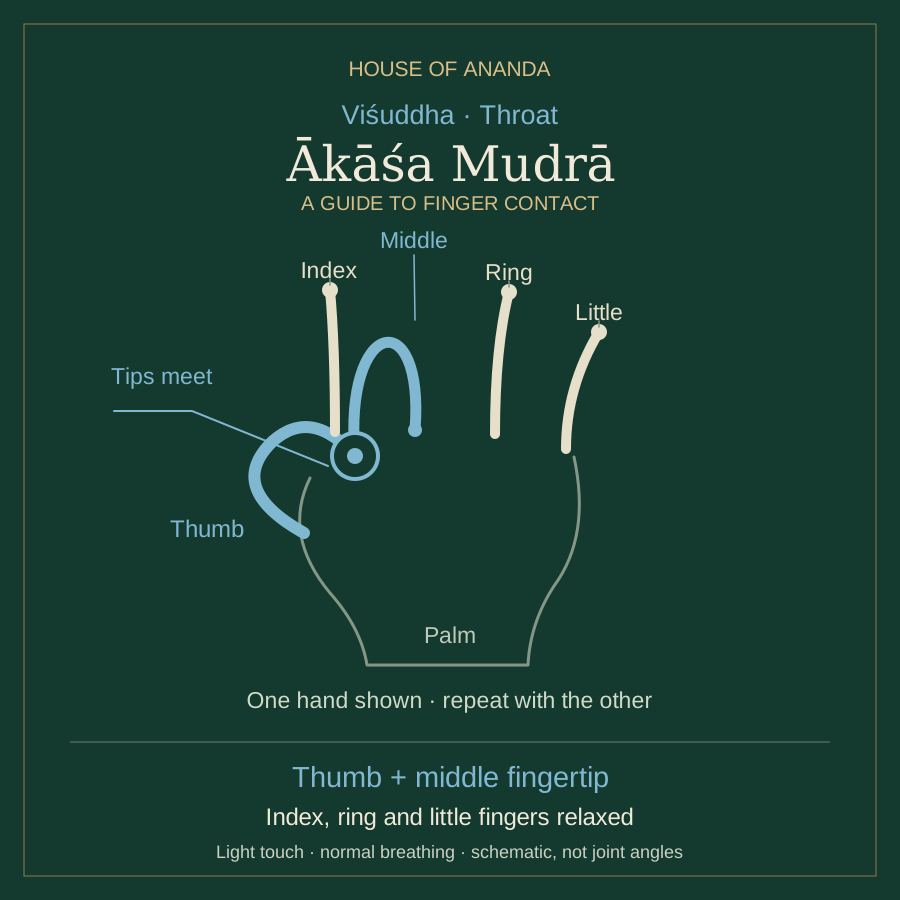
Thumb + middle fingertip. Touch with the fingertips, not the nails.
Index, ring and little fingers softly extended.
Form the gesture with each hand and let the hands rest low. Keep the jaw and throat easy.
Use a light touch and normal breathing. Never force a finger straight or press through pain; resting the hands open is a suitable alternative. These are gestures for contemplation, not a way to diagnose or treat illness.
Arhanta Yoga · Ākāśa hand form and pairing ↗. Chakra–mudra pairings vary by lineage and teacher. Therapeutic claims made by teaching sources are not adopted here.
Tentative notebook reading · 745 Hz — G
The handwritten value appears to be 745 Hz. This collection uses that provisional reading, not a claim that the teacher’s intended tuning is known. In standard twelve-tone equal temperament with A4 = 440 Hz, 745 Hz is nearer F♯5 than G.
| Sound | Frequency | Meaning |
|---|---|---|
| G4 | 392.00 Hz | G above middle C |
| F♯5 | 739.99 Hz | Nearest standard note to 745 Hz |
| Notebook reading | 745 Hz | About 11.7 cents above F♯5 |
| G5 | 783.99 Hz | G one octave above G4 |
Calculated using UNSW’s note-frequency equations. G may refer to a separate chakra-chart convention.
There is no established evidence that 745 Hz uniquely opens the throat chakra, treats thyroid conditions or repairs the voice. It describes an acoustic component, not a spiritual diagnosis. A song in G, a 745 Hz drone and a binaural beat are different things.
The instrumentals below combine the central tone with other pitches. They contain no Haṃ recording and are not a binaural-beat protocol. Use your own vocal range or simply listen.
The listening room
Original House of Ananda audio · 12 tracks · 60 minutes
Twelve ambient sound studies with a continuous 745 Hz tone, layered harmonic pads and gentle bell-like pulses. Each five-minute piece has its own spacing and harmonic palette. These are synthesised instrumentals, with no recorded Haṃ chant.
Tracks advance automatically where your browser permits. Use the player to pause, seek and adjust volume. Begin quietly; headphones are optional.
Original digital compositions: a mathematically specified 745 Hz component plus other frequencies. MP3 encoding, playback equipment and room acoustics affect the sound you hear. The music is not a treatment or a test of chakra activity.
Begin quietly. Listen for a minute, optionally sound Haṃ on a few easy exhalations, then return to silence. Ask: “What needs to be said clearly—and what needs to be heard?” One track is enough; a longer session is not a stronger dose.
Headphones are optional. Stop if the sound is uncomfortable; do not practise inward-focused listening while driving.
Both names occur in yoga teaching, with an association of purification or purity. Here purification is a spiritual theme, not a claim of detoxifying organs. The throat region is a contemplative location, not an anatomical chakra.
Sixteen petals define the lotus; their letters are commonly associated with sixteen Sanskrit vowel sounds. Blue follows the notes and modern charts. Other lineages use different colours, including purple.
Haṃ is the seed mantra. Vijñānamaya kośa is the wisdom or discernment sheath; linking it specifically to this chakra is a classroom correspondence, not a universal mapping. The same term appears in the Ājñā notes.
The handwriting appears to read Udāna, an upward-oriented aspect of prāṇa associated with the throat in yogic teaching. Prāṇa is not simply air, oxygen or a measurable electrical current.
Ākāśa, often translated as space or ether, is the traditional element. Hearing and the ears are sensory correspondences; speech and the mouth refer to expression. These do not establish control over hearing, swallowing or speech disorders.
The white elephant is a traditional symbol. It is not a literal feature of the body or a personality classification.
This appears to mention strength or power, but the full wording is unclear. It is not expanded into a specific claim. A clearer photograph or the teacher’s explanation would be needed for a faithful transcription.
The frequency appears to be 745 Hz. This reading is tentative; the music uses that value provisionally. The note-name discrepancy is explained below rather than silently corrected.
Persistent throat, swallowing, voice or hearing symptoms deserve appropriate healthcare rather than a chakra diagnosis. This is educational material, not treatment. See NCCIH’s yoga safety guidance.