Six petals
The lotus carries six syllables: baṃ, bhaṃ, maṃ, yaṃ, raṃ and laṃ. They are distinct from Vaṃ, the central seed sound.
 House of AnandaMovement · Stillness · Wisdom · Journey
The subtle body · 02
स्वाधिष्ठान
Water, feeling & the freedom to create.
A companion to Mūlādhāra: explore the six-petalled sacral lotus, the seed sound Vaṃ and a listening practice inspired by the philosophy notes of 15 September 2026.
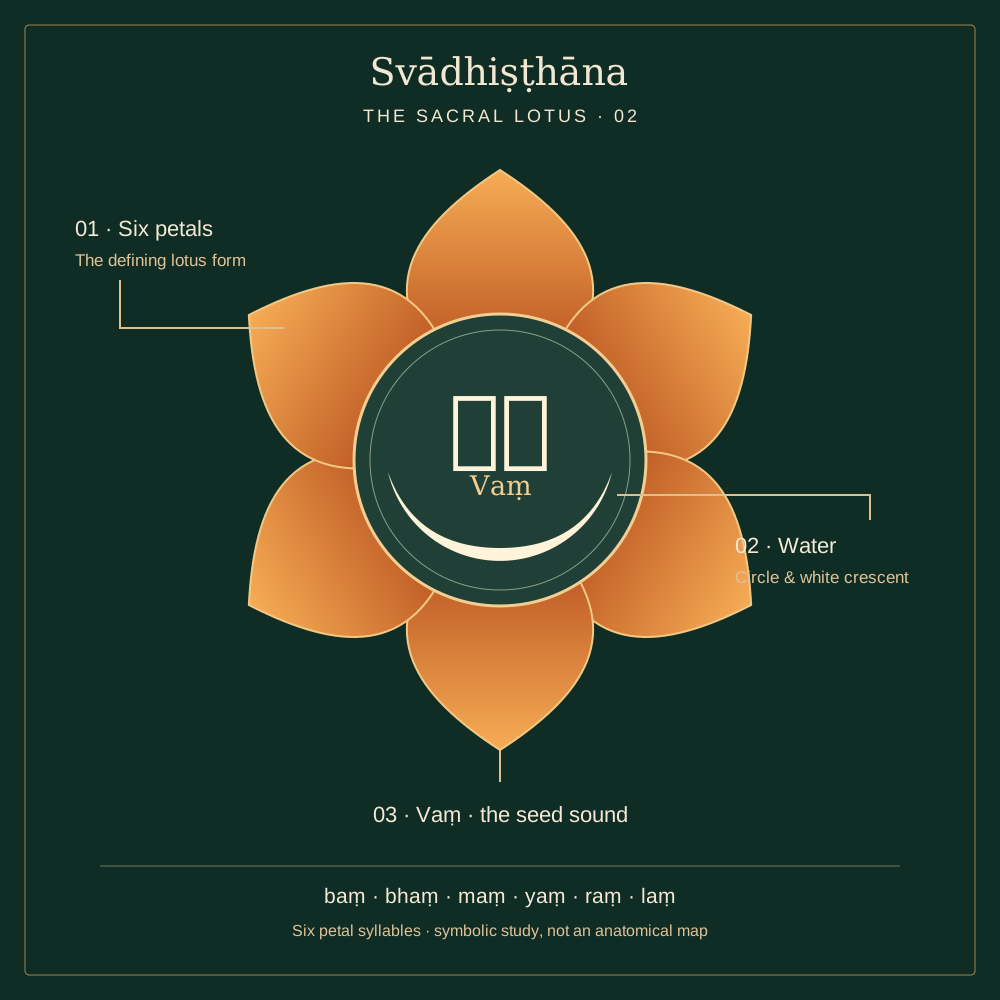
Reading the symbol
The lotus carries six syllables: baṃ, bhaṃ, maṃ, yaṃ, raṃ and laṃ. They are distinct from Vaṃ, the central seed sound.
The circle and white crescent refer to water in this symbolic vocabulary. Fluidity is a contemporary contemplative theme, not a measurement of energy.
The compact mantra gives attention a sound to return to. Traditional mantra practice is more than assigning a modern musical frequency to a syllable.
The orange palette matches the notes and modern seven-colour charts. Chakra imagery and associated deities differ across lineages.
Traditional lotus, crescent and mantra associations: Swami Sivananda, Kundalini Yoga, “Svadhishthana Chakra”. Makara iconography: Svadhishthana overview. These sources describe spiritual traditions; their supernatural and medical claims are not adopted here.
Vaṃ · वं · commonly written VAM
Bīja means seed. Vaṃ is a sacred seed syllable associated with this chakra and the water element, not a sentence meaning “I am creative”. An affirmation can accompany practice, but it is not the mantra’s literal translation.
The letter व carries the short vowel a; the dot marks a nasal sound (anusvāra). Sanskrit v can be softer than an English v, with a quality between English v and w. A soft “vum” is only an approximate classroom cue; pronunciation and the sustained ending vary with tradition.
Use your comfortable speaking or singing range. There is no need to reach 465 Hz, make the vowel last, or feel vibration in one particular part of the body.
No breath retention, forceful breathing or pelvic-floor squeezing is needed. Stop if you feel dizzy, breathless or distressed. A fixed repetition count is not a dose, and a strong sensation is not proof of chakra opening.
Hand gesture · Water · openness
Also written Varun Mudra. The water symbolism offers a contemplative connection with the sacral centre; it does not change the body’s hydration.
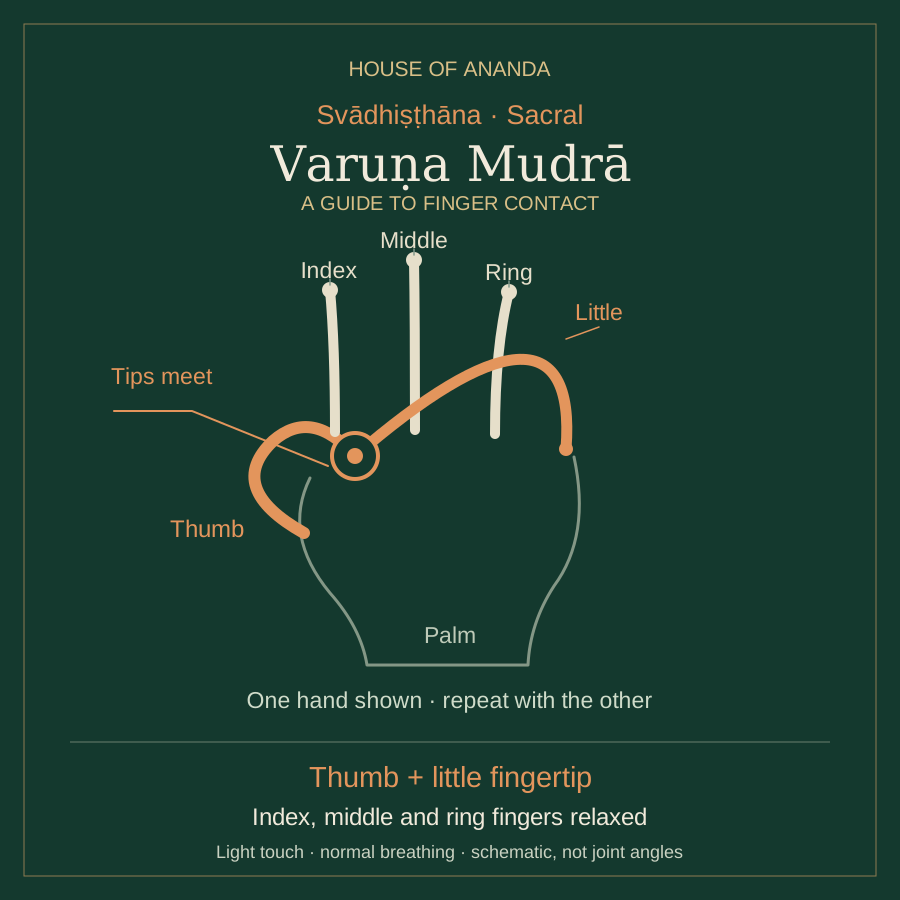
Thumb + little fingertip. Touch with the fingertips, not the nails.
Index, middle and ring fingers softly extended.
Form it separately with each hand and support the wrists on your thighs.
Use a light touch and normal breathing. Never force a finger straight or press through pain; resting the hands open is a suitable alternative. These are gestures for contemplation, not a way to diagnose or treat illness.
Arhanta Yoga · hand position and contemporary pairing ↗. Chakra–mudra pairings vary by lineage and teacher. Therapeutic claims made by teaching sources are not adopted here.
Compare all seven chakra frequencies, traditional mantras and the research →
Notebook clarification · VAM — 465 Hz — D
The photograph clearly records 465 Hz and D. These are preserved as classroom notes, but they do not describe the same pitch in standard A4 = 440 Hz tuning. The music below uses 465 Hz as a creative choice, not a traditionally required VAM frequency.
| Sound | Frequency | Relationship |
|---|---|---|
| D4 | 293.66 Hz | D above middle C |
| Classroom frequency | 465 Hz | About 4.3 cents below B♭4 |
| B♭4 / A♯4 | 466.16 Hz | Nearest standard note |
| D5 | 587.33 Hz | One octave above D4 |
Calculated from UNSW’s musical-note frequency equations. “D” may refer to a separate chakra-chart convention; the image does not establish the teacher’s intended tuning.
A tone repeating 465 times per second. It describes frequency, not loudness, tempo or emotional effect. The playlist layers this tone with other pitches, so it is not pure 465 Hz throughout its spectrum.
“Opening” can name a spiritual intention, but there is no established evidence that 465 Hz uniquely opens a chakra or treats reproductive, hormonal or emotional conditions. This is optional music for contemplation, not a treatment.
A drone, a song in D, an instrument tuned to A4 = 432 Hz and a binaural beat are different things. These tracks are ambient instrumentals, not binaural-beat sessions; headphones are optional.
The listening room
Original House of Ananda audio · 12 tracks · 60 minutes
Twelve ambient sound studies with a continuous 465 Hz tone, layered harmonic pads and gentle bell-like pulses. Each five-minute piece has its own spacing and harmonic palette. These are synthesised instrumentals, with no recorded Vaṃ chant.
Tracks advance automatically where your browser permits. Use the player to pause, seek and adjust volume. Begin quietly; headphones are optional.
Original digital compositions: a mathematically specified 465 Hz component plus other frequencies. MP3 encoding, playback equipment and room acoustics affect the sound you hear. The music is not a treatment or a test of chakra activity.
Start quietly. Listen for a minute, then optionally repeat Vaṃ on a few easy exhalations at your own pitch. Let the voice become silent and listen again. Finish by noticing your surroundings. You do not need to complete the hour; longer listening is not a stronger dose.
Keep the volume comfortable and stop if the sound feels unpleasant. Do not practise inward-focused listening while driving or doing tasks that require attention.
From the notebook · 15 September 2026
The following expands the legible points without treating every classroom correspondence as universal. The word after “water” appears to be Apāna; this reading remains tentative.
Svādhiṣṭhāna is commonly understood as one’s own abode or dwelling place. Sacral chakra is its familiar modern name; the pelvic region is a contemplative location, not a separate anatomical organ.
Six petals are traditional. Orange follows the classroom’s modern colour scheme; older descriptions also use vermilion or red.
Water is the associated element. Taste and the tongue appear in traditional correspondence charts: this is symbolism, not a claim that the chakra controls taste physiology.
The handwriting appears to say Apāna: the downward-moving vital current in yogic teaching. Its assignment to a particular chakra varies; it should not be equated with a measurable flow of air or fluid.
The mental sheath concerns mind, sensory impressions and emotional experience in the five-kośa model. Linking it specifically to this chakra is a teaching correspondence, not a universal one-to-one map.
These are symbolic associations in many sacral-chakra teachings. Sexuality may be explored through consent, boundaries and self-respect; libido, fertility or pelvic symptoms cannot diagnose a blocked chakra.
Often described as the makara, a mythic aquatic creature sometimes represented as crocodile-like. It belongs to the water symbolism rather than being an anatomical feature.
The notes pair stability with physical and mental creativity. A useful reflection is how enough support allows movement and expression. These are prompts, not personality tests or promises of transformation.
Kośa context: the five kośas study lesson. General practice safety: NCCIH’s yoga guidance. Physical or persistent emotional symptoms deserve appropriate care, not a chakra-based diagnosis.