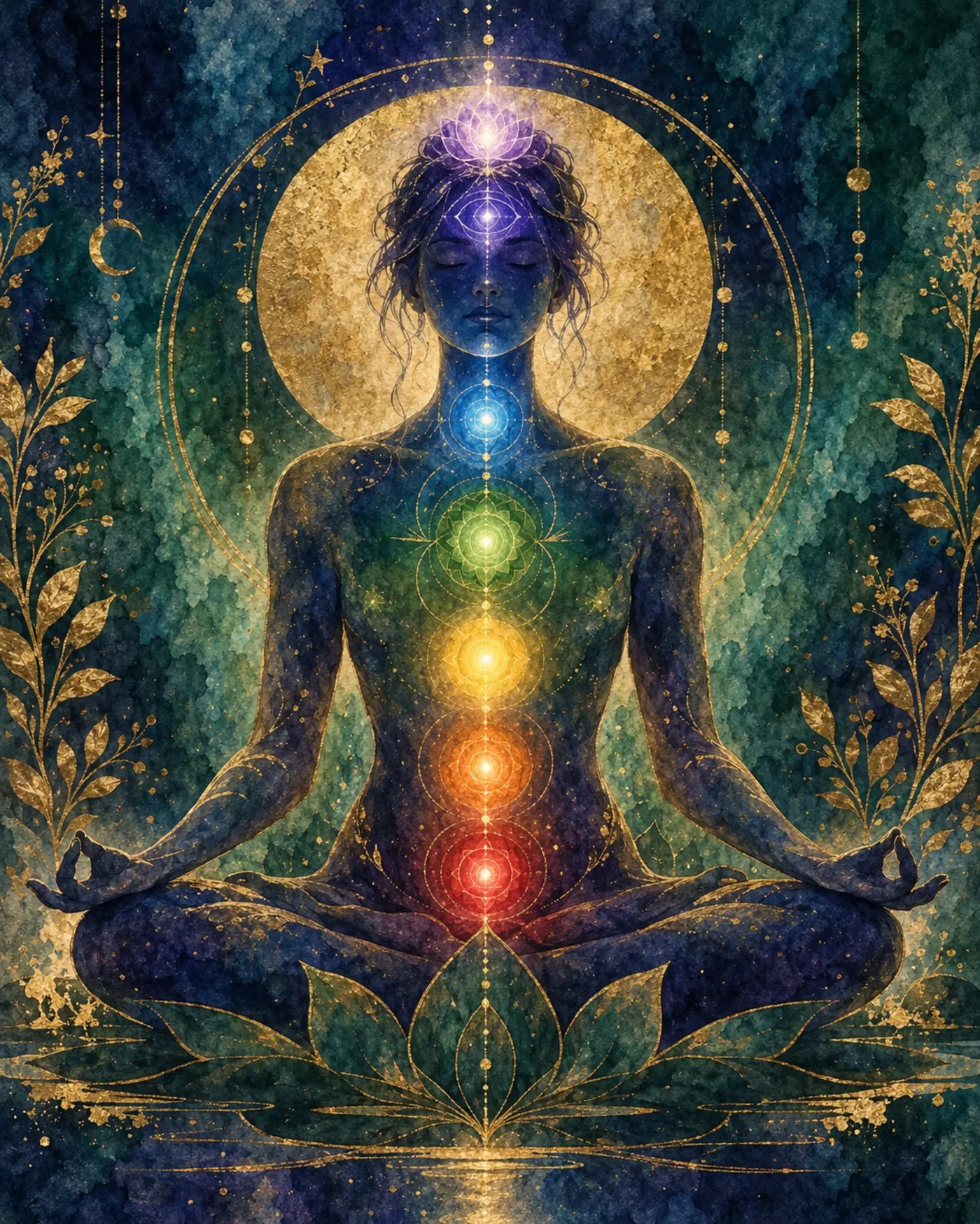
Seven tones commonly used in modern chakra meditation, with the mantras and research behind the chart.
Research has not established a measurable “natural frequency” for each chakra. The numbers below describe a modern sound-meditation convention; the themes offer a focus for contemplation.
The familiar modern seven-centre map.
A comparison for study
From root to crown
The Solfeggio assignments and the seed mantras come from separate systems. A mantra does not have to be chanted at the frequency listed beside it.
Common modern associations — not measured chakra frequencies
The OM entry follows the cited Satyananda practice. Other chakra descriptions include different syllables and petal letters; the crown has no single universally prescribed mantra.
Understanding the differences
Why do charts use different numbers?
The modern Solfeggio system
The specific frequency set was popularised in the late twentieth century. Its name borrows from solfège, the musical teaching system, but that does not establish these numbers as ancient Indian chakra tunings.
Some sound-bowl systems associate the chakras with C, D, E, F, G, A and B. Their frequencies depend on tuning and octave. One maker labels a 260 Hz C bowl for the root and a 345 Hz F bowl for the heart. That is the maker’s convention, not evidence of a biological correspondence.
A frequency, a key and a tuning reference are different things. A 345 Hz tone has 345 cycles per second. “Music in C” describes a key; “A4 = 432 Hz” specifies a tuning reference. A musical recording contains many frequencies, even when built around one drone. See the UNSW explanation of notes and frequencies.
The throat listening study uses a tentative 745 Hz notebook reading, not the 741 Hz Solfeggio assignment. The Ājñā collection uses 440 Hz as an editorial musical choice because its notes specify no frequency.
Reading the evidence
What does research support?
Music and wellbeing
Music-based interventions can help with stress and some aspects of sleep and anxiety. This broader evidence does not establish that particular tones open particular chakras.
A 2018 study examined “528 Hz music” in nine participants and reported changes in stress-related measures. It did not measure chakra activation. Its small sample cannot establish a unique healing effect of 528 Hz.