
A collection with context
The Pāli Dhammapada contains 423 verses in 26 chapters and belongs to the Khuddaka Nikāya. Related verse collections exist in other Buddhist languages. Its compact style makes it widely read and easily detached from its setting.
Visual study
A teaching you can explore
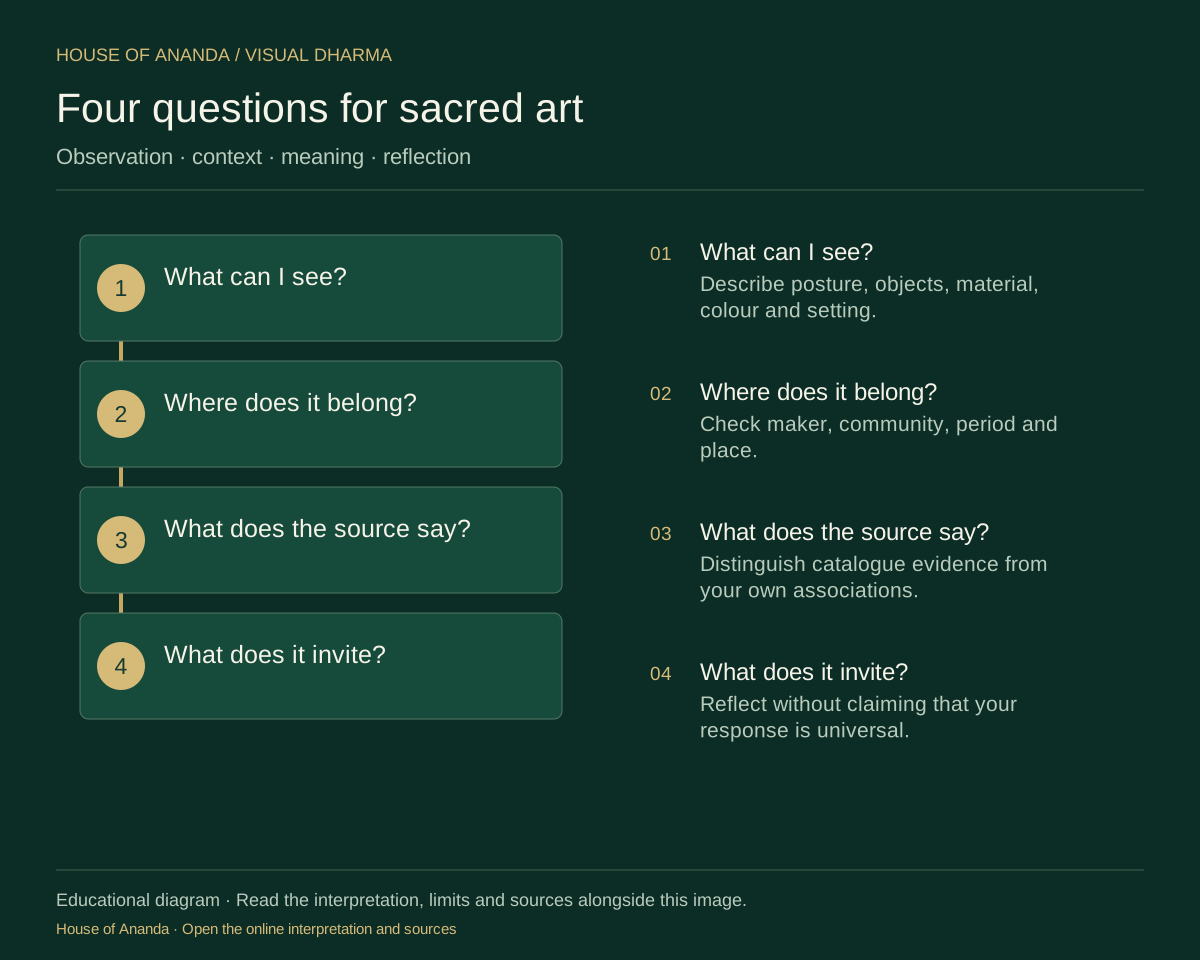
Observation · context · meaning · reflection
Four questions for sacred art
A practical way to make visual study more thoughtful.
Read the diagram & interpretation
- What can I see?Describe posture, objects, material, colour and setting.
- Where does it belong?Check maker, community, period and place.
- What does the source say?Distinguish catalogue evidence from your own associations.
- What does it invite?Reflect without claiming that your response is universal.
Begin with observable detail, then consult reliable context. An image may serve devotion, teaching, ritual, remembrance or several purposes at once. Ask what is known and what is inferred. The maker’s community may understand a detail differently from a modern museum visitor.
Keep in mind These four questions are an original House of Ananda study framework, not a traditional Buddhist list.
Sources: The Metropolitan Museum of Art · Buddhism and Buddhist Art ↗
Follow a theme
Attention, conduct, anger, friendship, ageing and the path recur. Begin with a chapter, not a social-media quotation. A verse may concern renunciant discipline or liberation rather than general advice about personal success.
Read three times
First read the chapter. Then select a verse and compare another translation. Finally describe in your own words what conduct it encourages. Label that paraphrase as yours instead of attributing it directly to the Buddha.
Try an action
If a passage concerns anger, find one ordinary moment to pause before replying. Do not demand instant emotional transformation. Return to the verse afterwards and ask whether experience changes your interpretation.
Art & contemplation
Look, learn, reflect

A lamp for inquiry
Light offers a contemporary metaphor for inquiry and understanding. The unlettered pages do not depict a lost scripture or an authentic manuscript. Study can illuminate experience while experience raises new questions for study.
A moment to reflectWhich question deserves a slower, more attentive reading?
Follow this theme ↗A question to carry with you
Pause and reflect.
Which verse do you want to understand? Record its number as well as its theme.
Sources & further reading
Study notes and examples are original explanations. Follow the links for the source texts and their own contexts.