
Practice in the world
Engaged Buddhism brings Buddhist practice to social concerns. Thích Nhất Hạnh is a central modern voice. Buddhist communities have contributed to peace work, prison programmes, hospice care and environmental action. It is a diverse field, not a single new denomination.
Visual study
A teaching you can explore
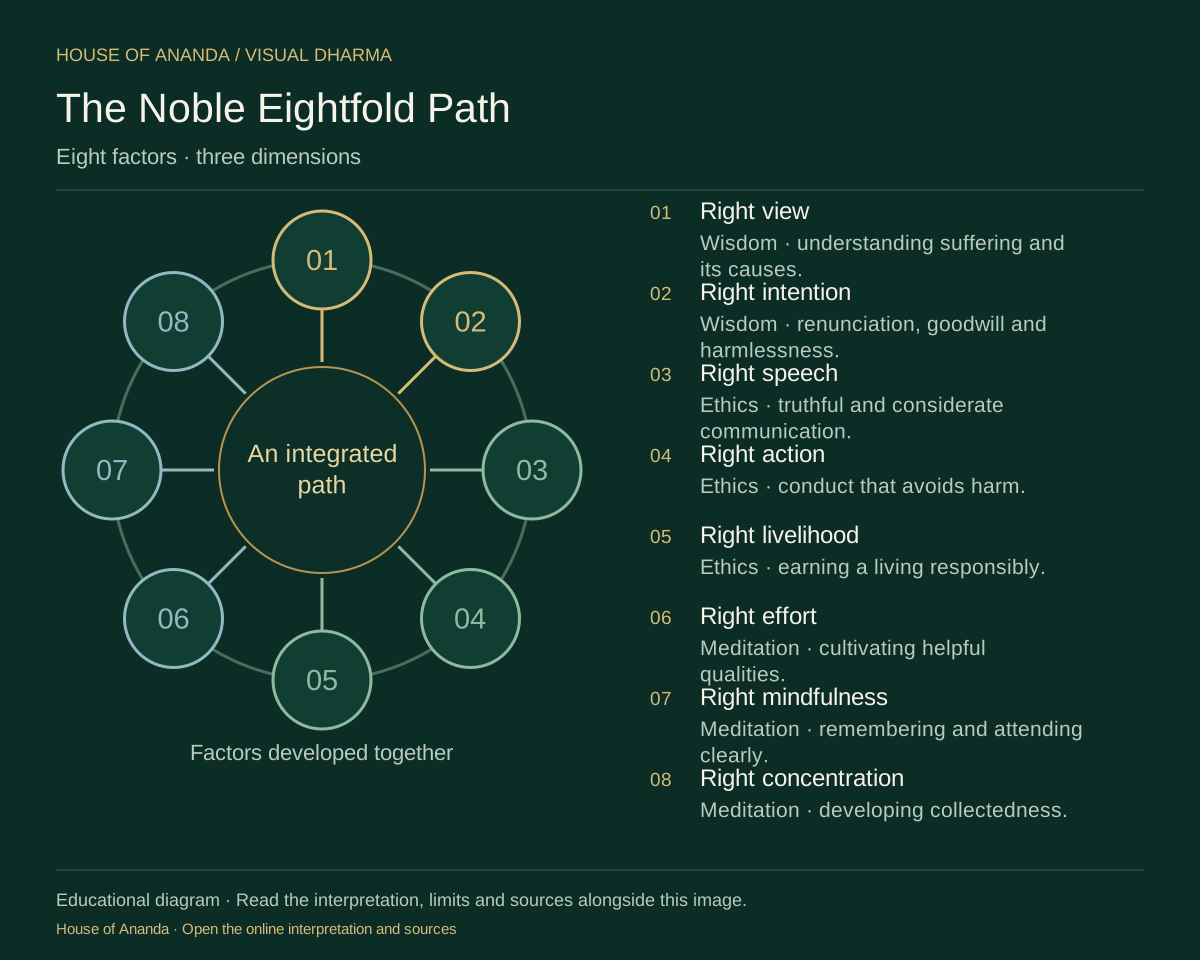
Eight factors · three dimensions
The Noble Eightfold Path
Eight mutually supporting factors develop understanding, ethical conduct and the mind.
Read the diagram & interpretation
- Right viewWisdom · understanding suffering and its causes.
- Right intentionWisdom · renunciation, goodwill and harmlessness.
- Right speechEthics · truthful and considerate communication.
- Right actionEthics · conduct that avoids harm.
- Right livelihoodEthics · earning a living responsibly.
- Right effortMeditation · cultivating helpful qualities.
- Right mindfulnessMeditation · remembering and attending clearly.
- Right concentrationMeditation · developing collectedness.
The gold, green and slate segments mark wisdom, ethics and meditation. Begin anywhere your life gives you an opportunity, while returning to the whole path. “Right” refers to what supports awakening, rather than a demand for personal perfection.
Keep in mind These are eight factors to develop together, not eight levels that must each be finished before the next.
Sources: SN 45:8 · An Analysis of the Path ↗ · Bhikkhu Bodhi · The Noble Eightfold Path ↗
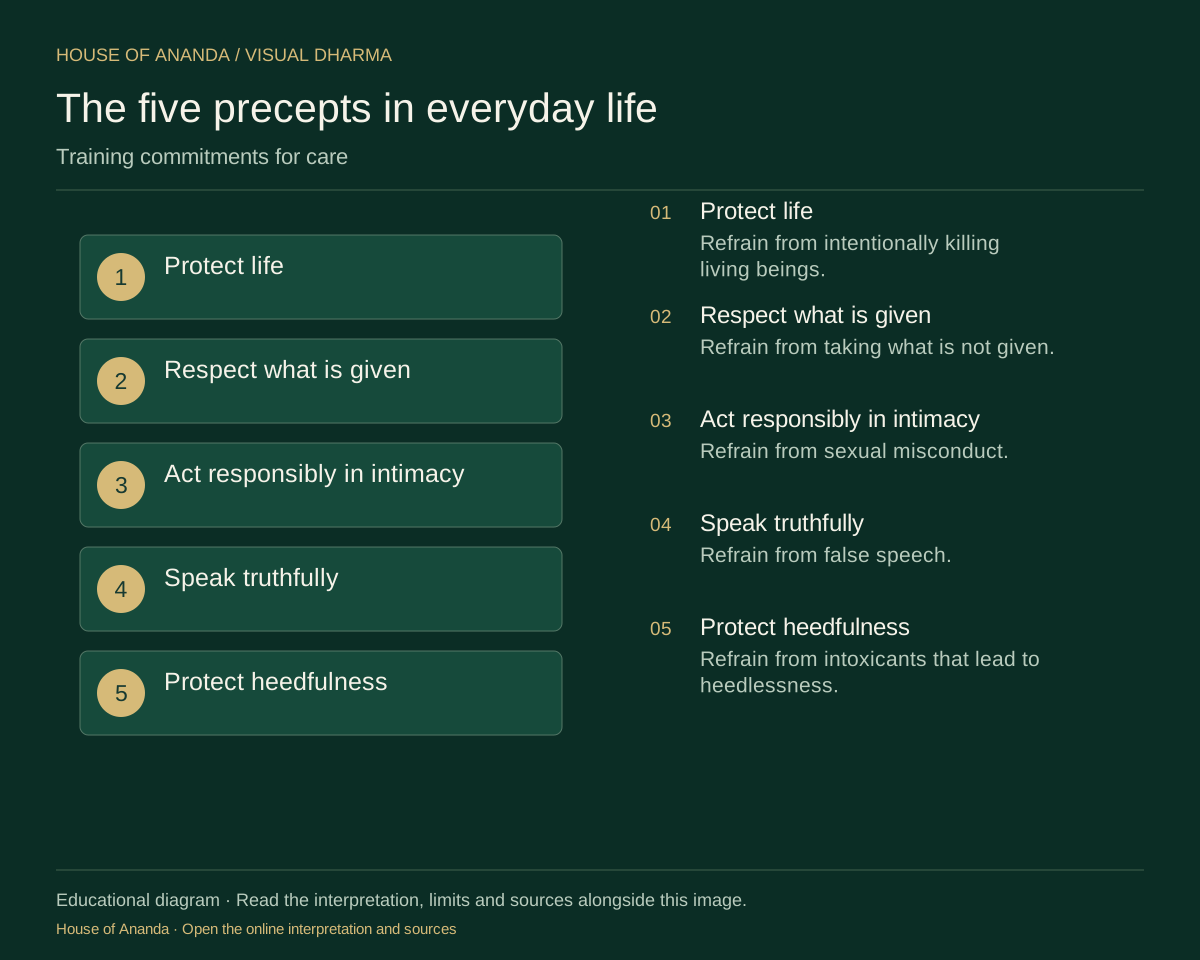
Training commitments for care
The five precepts in everyday life
A common lay ethical framework, paired here with everyday reflection prompts.
Read the diagram & interpretation
- Protect lifeRefrain from intentionally killing living beings.
- Respect what is givenRefrain from taking what is not given.
- Act responsibly in intimacyRefrain from sexual misconduct.
- Speak truthfullyRefrain from false speech.
- Protect heedfulnessRefrain from intoxicants that lead to heedlessness.
Ask how a commitment can become concrete today: a truthful correction, a respectful boundary, care for an animal, returning an item or reconsidering a habit that clouds attention. These examples are reflections, not a replacement for a community’s formulation or explanation of its precepts.
Keep in mind A precept is a training commitment. Compassionate accountability includes recognising harm, making repair where possible and practising again.
Sources: Ṭhānissaro Bhikkhu · The Healing Power of the Precepts ↗ · Plum Village · Five Mindfulness Trainings ↗
Conditions are also social
A person can learn to respond differently while still needing fair treatment, secure housing or protection from violence. Contemplation need not ask people to become comfortable with preventable injustice. Inner cultivation and practical change can support each other.
Service that listens
Ask what an affected community actually wants. Goodwill does not automatically provide expertise. Help might mean a dependable administrative task, a donation, translation or sustained volunteering rather than a dramatic gesture.
A sustainable rhythm
Choose a responsibility you can fulfil. Combine reflection with clear boundaries, shared work and rest. Treat disagreement as a reason to listen and investigate, not proof that only your own position is compassionate.
Art & contemplation
Look, learn, reflect

The helping hand
The scene interprets compassion as practical responsiveness. Neither figure represents a named bodhisattva or a recorded Buddhist story. Help becomes meaningful through attention to what another person actually needs.
A moment to reflectWhat would useful help look like today?
Follow this theme ↗A question to carry with you
Pause and reflect.
Name a local need, an organisation already working on it and one realistic contribution.
Sources & further reading
Study notes and examples are original explanations. Follow the links for the source texts and their own contexts.