
Context and intention
An original daily-life exercise informed by MN 58. It is not a rule that difficult truths should never be spoken.
Visual study
A teaching you can explore
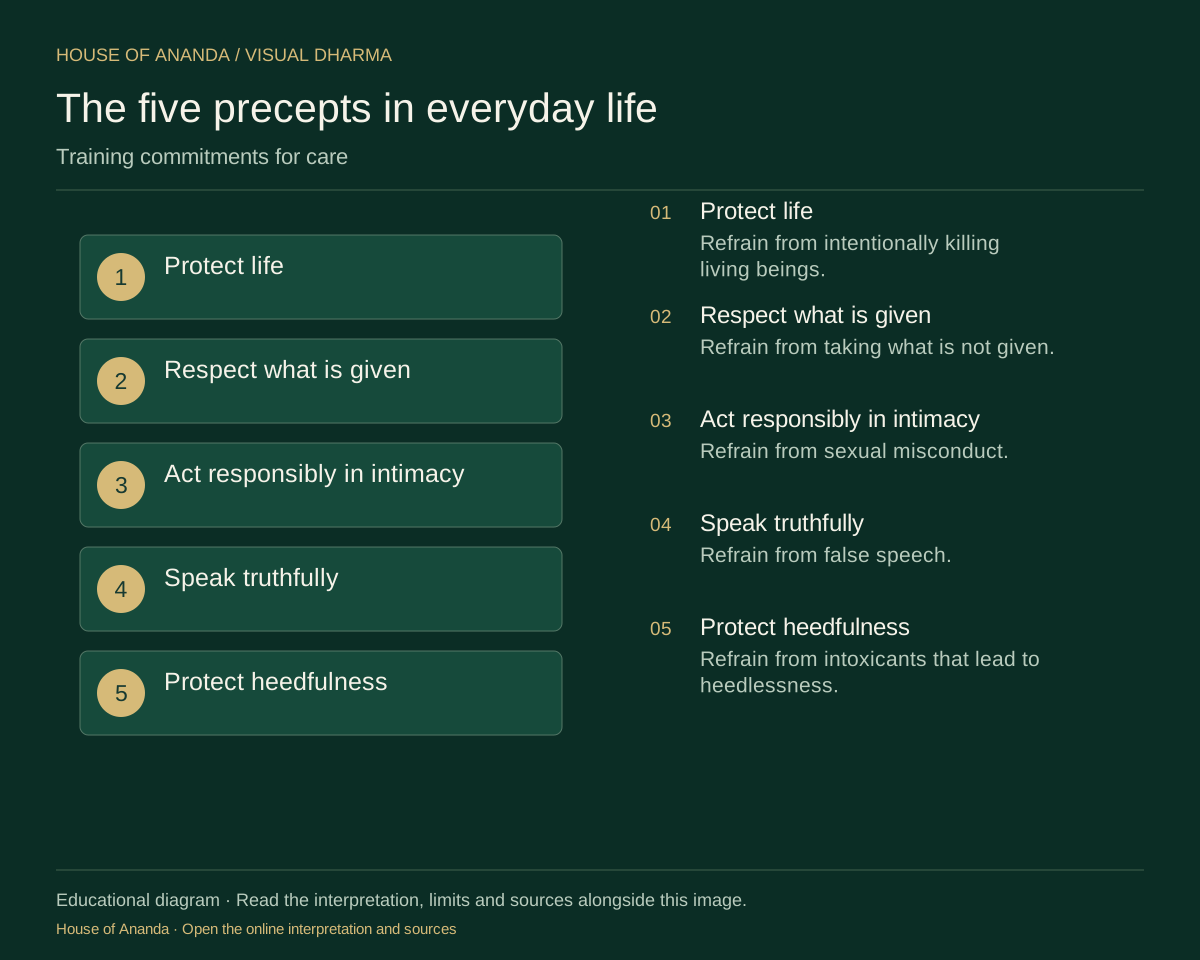
Training commitments for care
The five precepts in everyday life
A common lay ethical framework, paired here with everyday reflection prompts.
Read the diagram & interpretation
- Protect lifeRefrain from intentionally killing living beings.
- Respect what is givenRefrain from taking what is not given.
- Act responsibly in intimacyRefrain from sexual misconduct.
- Speak truthfullyRefrain from false speech.
- Protect heedfulnessRefrain from intoxicants that lead to heedlessness.
Ask how a commitment can become concrete today: a truthful correction, a respectful boundary, care for an animal, returning an item or reconsidering a habit that clouds attention. These examples are reflections, not a replacement for a community’s formulation or explanation of its precepts.
Keep in mind A precept is a training commitment. Compassionate accountability includes recognising harm, making repair where possible and practising again.
Sources: Ṭhānissaro Bhikkhu · The Healing Power of the Precepts ↗ · Plum Village · Five Mindfulness Trainings ↗
Before you begin
Choose a short, comfortable session. You can keep your eyes open, use a chair, adjust position or stop. If inward attention becomes unsettling, orient to the room and ordinary activity. These educational exercises do not promise treatment, attainment or a particular emotional result.
Choose a message · 1 minute
Think of a non-urgent conversation or draft reply. Avoid doing the exercise while driving or in a situation needing immediate action.
Check accuracy · 1 minute
Separate what you know from what you assume. Remove an exaggeration if present.
Check purpose · 1 minute
What do you hope the words will accomplish? Is the aim to clarify, protect, repair or merely punish?
Check timing and tone · 1 minute
Would another time or medium help? Firm, necessary speech can still be respectful. Silence is not always the kindest response.
Act · 1 minute
Revise, speak or postpone with a clear intention. Listen to the response instead of treating your preparation as proof that you are right.
After the practice
What did the conversation reveal that you could not know in advance?
Art & contemplation
Look, learn, reflect

The helping hand
The scene interprets compassion as practical responsiveness. Neither figure represents a named bodhisattva or a recorded Buddhist story. Help becomes meaningful through attention to what another person actually needs.
A moment to reflectWhat would useful help look like today?
Follow this theme ↗A question to carry with you
Pause and reflect.
What did the conversation reveal that you could not know in advance?
Sources & further reading
Study notes and examples are original explanations. Follow the links for the source texts and their own contexts.