
Karma is action
Karma, or kamma in Pāli, is centrally connected with intentional action of body, speech and mind. An intention can shape what we do and the habits we strengthen. The results of action are discussed with terms such as vipāka. Karma is not simply another word for any event that happens.
Visual study
A teaching you can explore
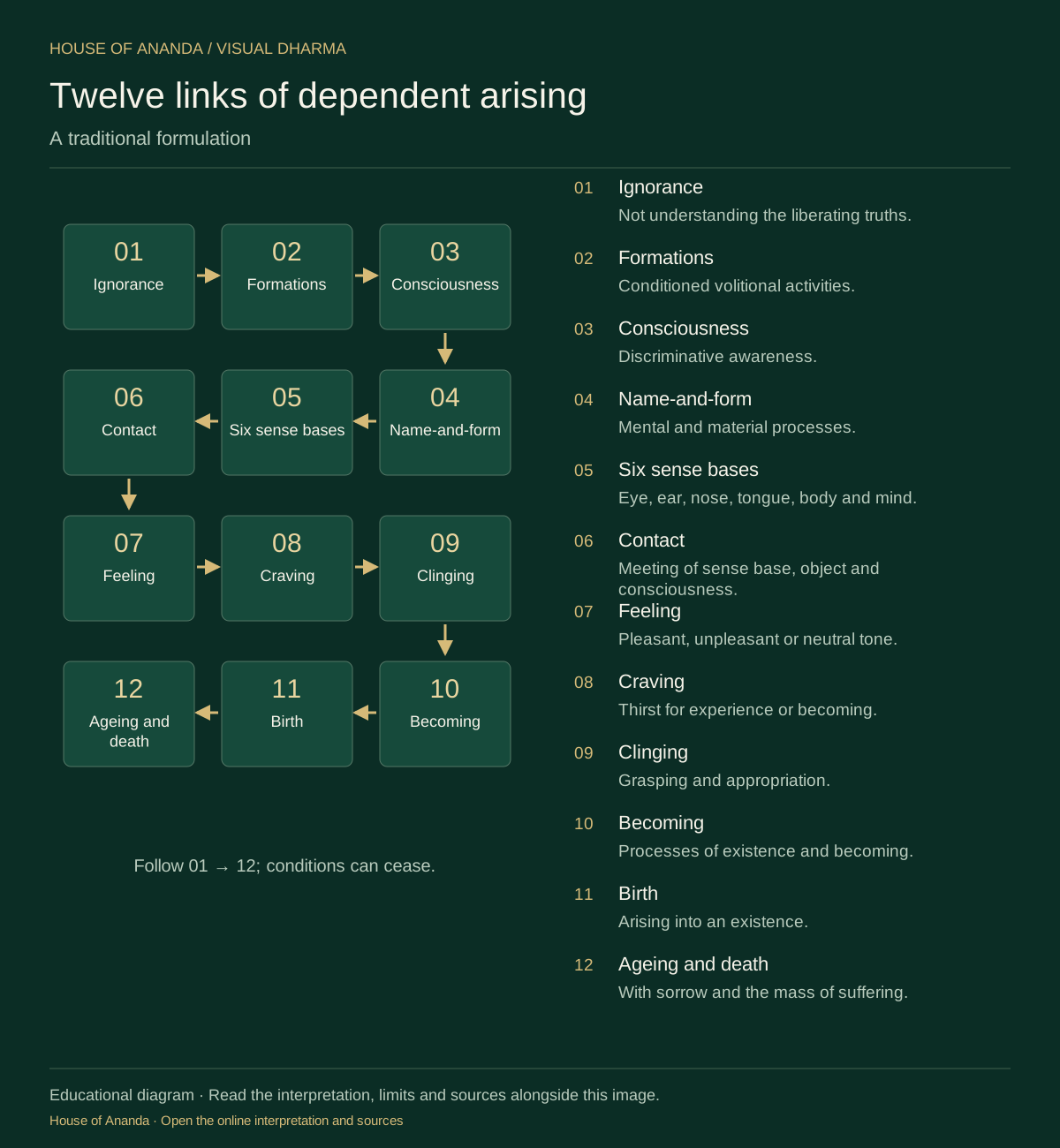
A traditional formulation
Twelve links of dependent arising
The twelve-link account describes the conditioned arising of suffering.
Read the diagram & interpretation
- IgnoranceNot understanding the liberating truths.
- FormationsConditioned volitional activities.
- ConsciousnessDiscriminative awareness.
- Name-and-formMental and material processes.
- Six sense basesEye, ear, nose, tongue, body and mind.
- ContactMeeting of sense base, object and consciousness.
- FeelingPleasant, unpleasant or neutral tone.
- CravingThirst for experience or becoming.
- ClingingGrasping and appropriation.
- BecomingProcesses of existence and becoming.
- BirthArising into an existence.
- Ageing and deathWith sorrow and the mass of suffering.
Follow the numbers in the diagram. Traditional commentaries explain this formulation in different ways, including across lives. Some modern presentations also examine patterns in immediate experience. Neither reading makes this a universal twelve-step timeline for every event.
Keep in mind The teaching also describes cessation when sustaining conditions cease. A useful place for ordinary observation is how feeling can lead into craving.
Sources: SN 12:2 · Dependent Co-arising ↗
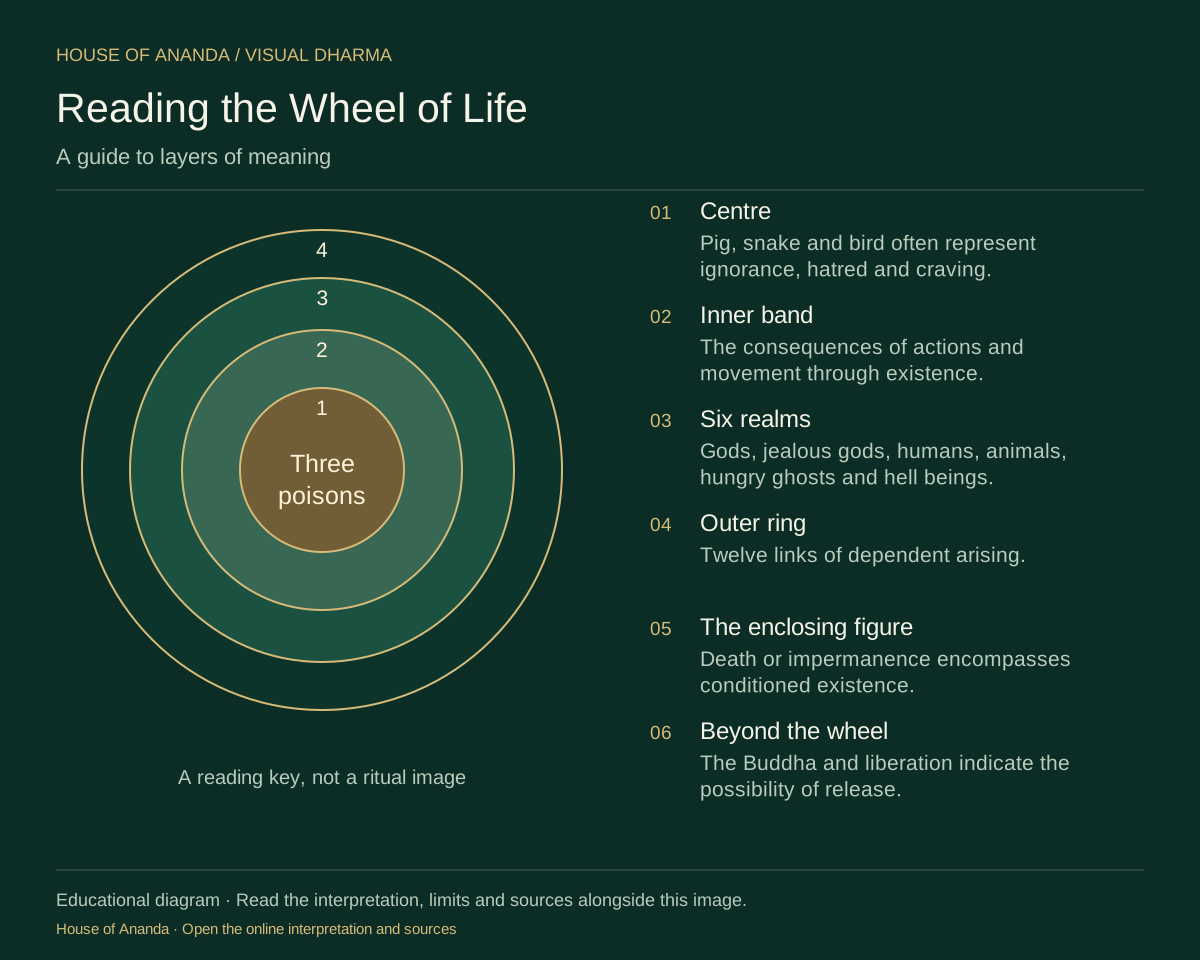
A guide to layers of meaning
Reading the Wheel of Life
A schematic reading key for the bhavacakra found in Tibetan Buddhist art.
Read the diagram & interpretation
- CentrePig, snake and bird often represent ignorance, hatred and craving.
- Inner bandThe consequences of actions and movement through existence.
- Six realmsGods, jealous gods, humans, animals, hungry ghosts and hell beings.
- Outer ringTwelve links of dependent arising.
- The enclosing figureDeath or impermanence encompasses conditioned existence.
- Beyond the wheelThe Buddha and liberation indicate the possibility of release.
Read inward and outward: habits, actions, kinds of existence and sustaining conditions belong to one account of saṃsāra. Traditional cosmological readings take the realms seriously as rebirth destinations; some teachers also use them to illuminate familiar states of mind. Paintings vary.
Keep in mind This labelled graphic is a modern teaching schematic, not a reproduction, a consecrated image or an exhaustive account of a particular painting.
Sources: Rubin Museum · Wheel of Existence ↗
Not a cosmic scorecard
Buddhist explanations of causation are complex. It is misleading to claim that a particular illness, poverty or injustice proves bad conduct in a previous life. Such claims exceed what an observer can know and can become an excuse for withholding help. A useful response to suffering begins with compassion and practical support.
Rebirth in traditional Buddhism
Rebirth is an important teaching across traditional Buddhist communities. It concerns continuity without an unchanging soul passing intact from body to body. Philosophical accounts differ. Modern secular interpretations sometimes bracket or reinterpret rebirth; identify that approach honestly rather than presenting it as the only Buddhist view.
Working with intention today
Before an action, ask what is moving it. During the action, notice its effect. Afterwards, reflect on what you can learn or repair. An apology and a changed behaviour are more useful than endless self-condemnation. Responsibility includes the possibility of learning.
A question to carry with you
Pause and reflect.
Think of a recent conversation. What was your intention, what effect did it have, and what would you change?
Sources & further reading
Study notes and examples are original explanations. Follow the links for the source texts and their own contexts.