
The direction of the path
Nirvāṇa, or nibbāna, names liberation in Buddhist teaching. It is associated with the extinguishing of greed, hatred and delusion and release from the cycle of suffering and rebirth. “Awakening” points towards transformative understanding; different traditions describe the path and its culmination in different ways.
Visual study
A teaching you can explore
Understand · release · realise · cultivate
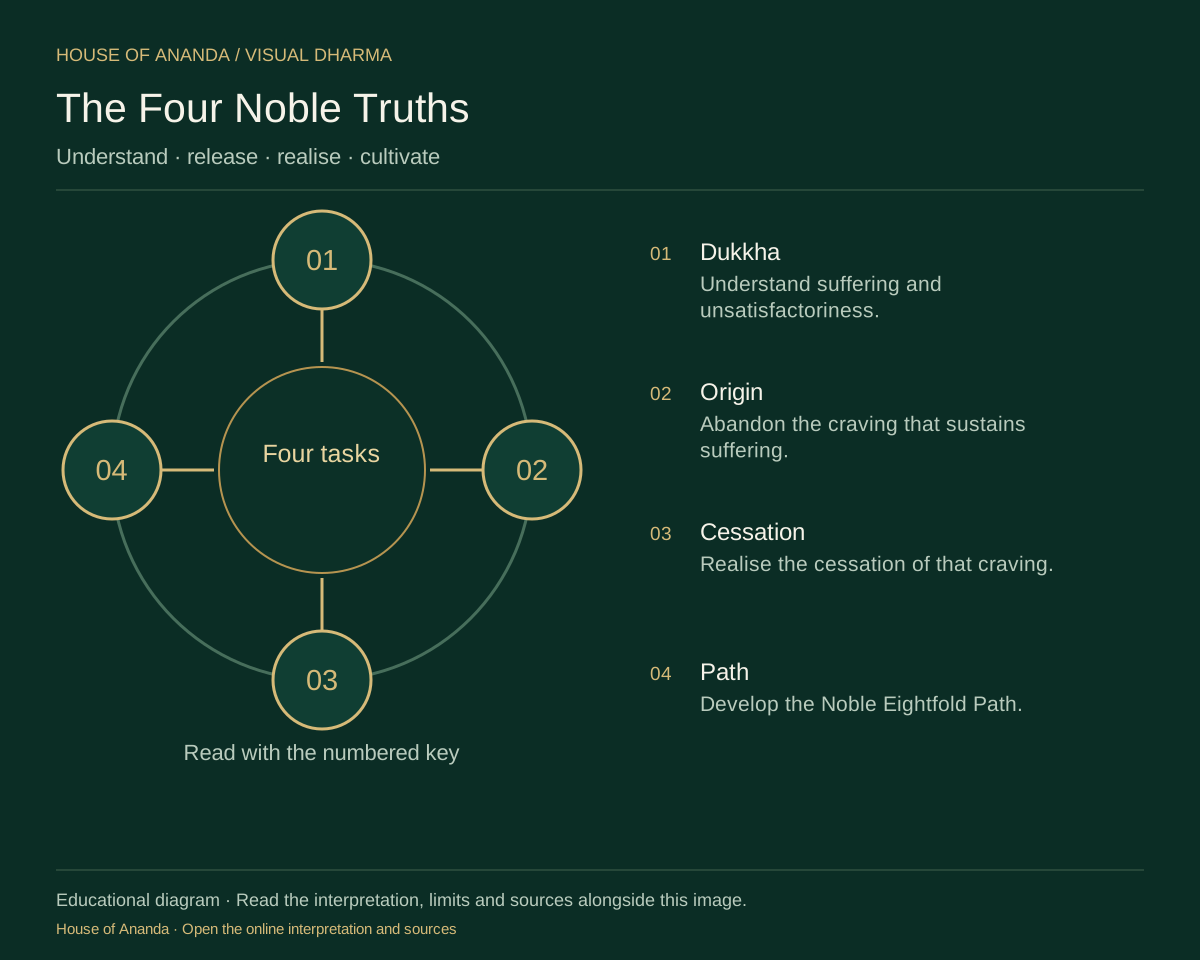
The Four Noble Truths
A teaching about suffering and freedom, expressed as four truths with four corresponding tasks.
Read the diagram & interpretation
- DukkhaUnderstand suffering and unsatisfactoriness.
- OriginAbandon the craving that sustains suffering.
- CessationRealise the cessation of that craving.
- PathDevelop the Noble Eightfold Path.
Read each truth together with its task. The teaching asks for understanding, letting go, direct realisation and ongoing cultivation; it is more than a list of beliefs. The circular layout here shows their relationship, not a promise of a quick progression.
Keep in mind Dukkha does not mean that every moment of life is miserable. Nor does the teaching blame a person for every painful event.
Anicca · dukkha · anattā
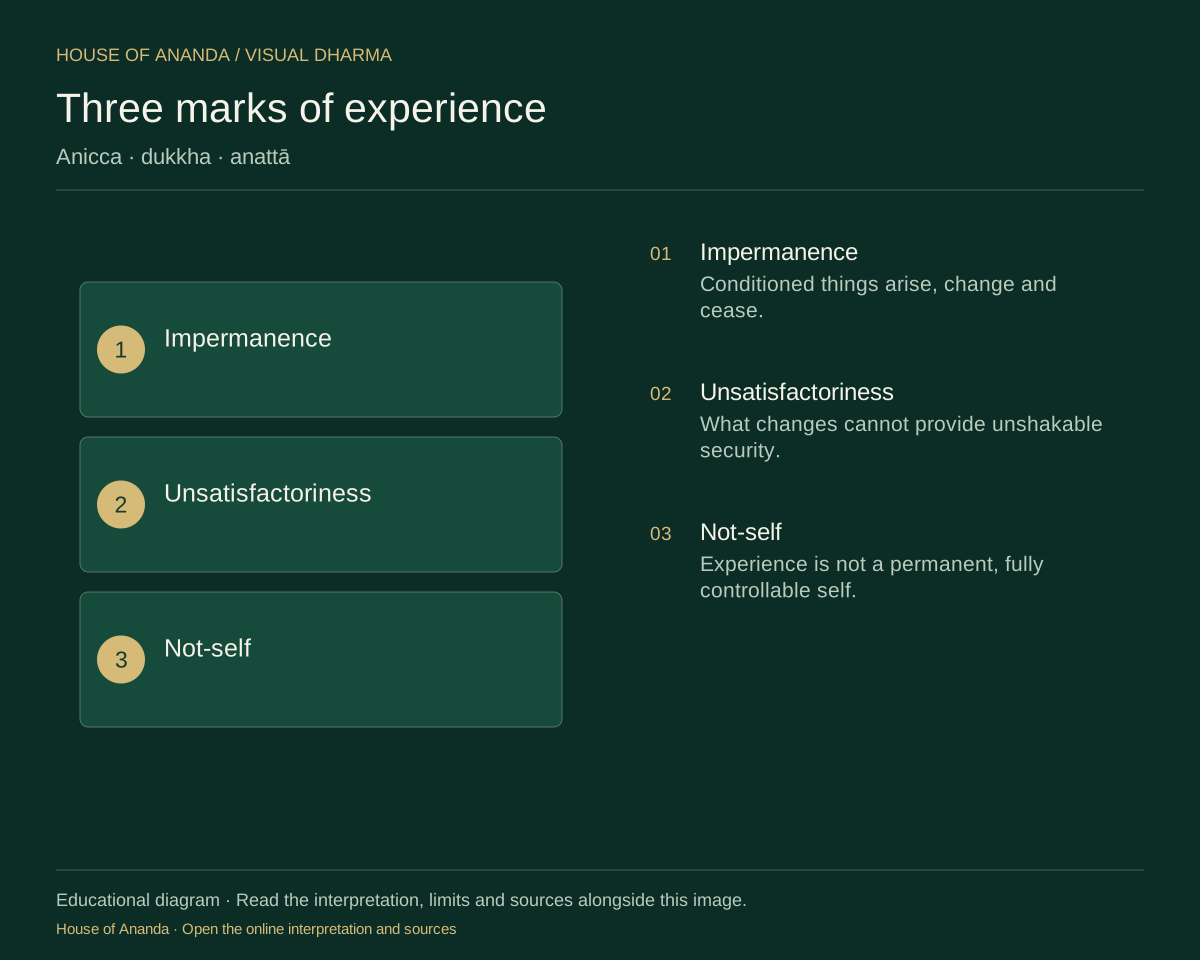
Three marks of experience
A framework for examining change, unreliability and the limits of ownership.
Read the diagram & interpretation
- ImpermanenceConditioned things arise, change and cease.
- UnsatisfactorinessWhat changes cannot provide unshakable security.
- Not-selfExperience is not a permanent, fully controllable self.
Consider a sound, a feeling or a plan. Notice its conditions, its change and the limits of your control. This is a starting point for inquiry, not a proof produced by a single exercise. In traditional formulations, impermanence and unsatisfactoriness concern conditioned phenomena; not-self is stated more broadly.
Keep in mind Not-self is not an instruction to deny ordinary identity, responsibility or the reality of another person’s pain.
Sources: Dhammapada · Chapter 20, The Path ↗ · SN 22:59 · The Five ↗
Not a mood to manufacture
A peaceful afternoon, concentrated meditation or inspiring retreat can be valuable without being liberation. Chasing a dramatic state can itself become another form of grasping. The longer question is how practice changes understanding and conduct.
Different descriptions, careful listening
Theravāda discussions often distinguish arahantship and Buddhahood. Mahāyāna gives central importance to complete Buddhahood and the bodhisattva path. These are not rankings of the kindness of present-day practitioners. Read each account within its own doctrinal setting.
Parinirvāṇa
The Buddha’s final passing is traditionally called parinirvāṇa. It should not be casually equated with a permanent soul entering heaven or merging into a universal self. Buddhist texts often resist the categories people try to impose on the liberated state.
Art & contemplation
Look, learn, reflect

A pattern passing
Loose grains forming and releasing a pattern invite reflection on change. This is an invented artwork, not a Tibetan ritual sand mandala. Authentic mandala construction and dissolution belong to particular communities and practices.
A moment to reflectWhat can you appreciate without asking it to stay the same?
Follow this theme ↗A question to carry with you
Pause and reflect.
When you say you want peace, do you mean a pleasant state, fewer difficulties, or a different relationship with experience?
Sources & further reading
Study notes and examples are original explanations. Follow the links for the source texts and their own contexts.