
Six qualities
A common Mahāyāna list of pāramitās names generosity, ethical discipline, patience, joyful effort, concentration and wisdom. Other texts and traditions use different lists. Bodhicitta gives cultivation an orientation towards awakening for the welfare of beings.
Visual study
A teaching you can explore
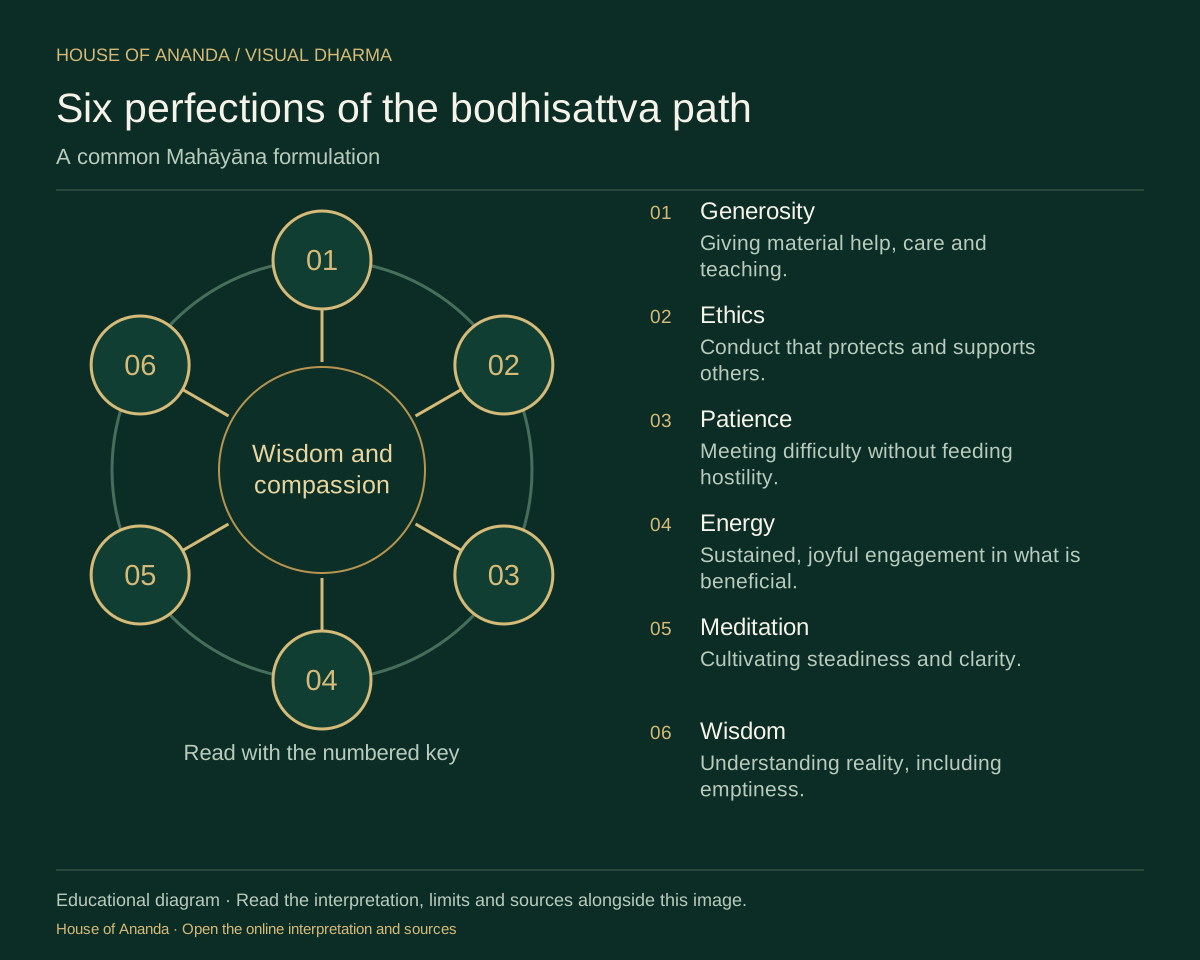
A common Mahāyāna formulation
Six perfections of the bodhisattva path
Six far-reaching qualities connect insight with the work of benefiting beings.
Read the diagram & interpretation
- GenerosityGiving material help, care and teaching.
- EthicsConduct that protects and supports others.
- PatienceMeeting difficulty without feeding hostility.
- EnergySustained, joyful engagement in what is beneficial.
- MeditationCultivating steadiness and clarity.
- WisdomUnderstanding reality, including emptiness.
The circular form emphasises their interdependence. Giving can require patience; ethical action can require courage; wisdom informs how help is offered. Traditions also teach expanded lists, including ten perfections. This sixfold map is not a complete account of every bodhisattva curriculum.
Keep in mind Patience does not mean submitting to abuse, and generosity can include a careful assessment of what is actually helpful.
Sources: Study Buddhism · Six Perfections ↗
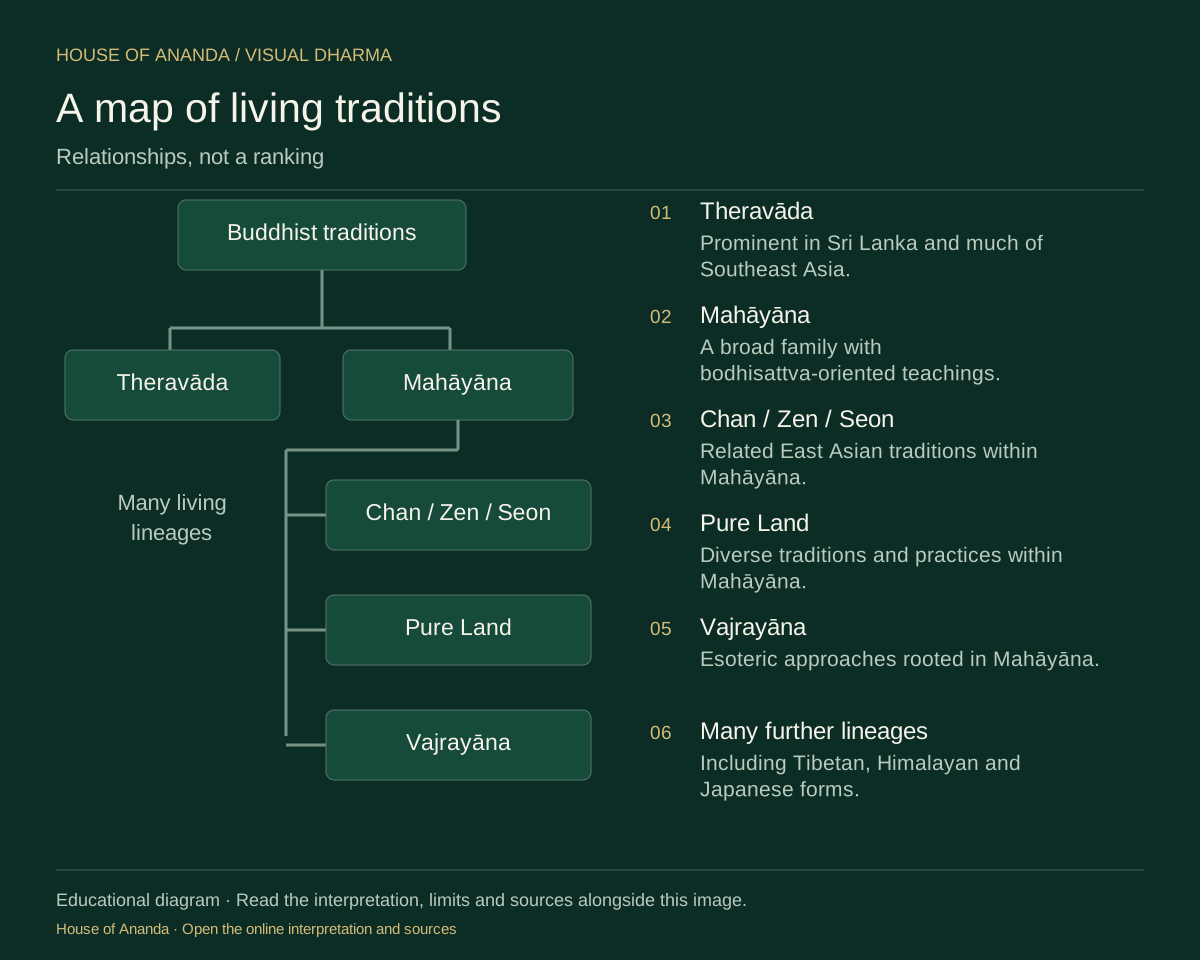
Relationships, not a ranking
A map of living traditions
A simplified orientation to large families and selected lineages.
Read the diagram & interpretation
- TheravādaProminent in Sri Lanka and much of Southeast Asia.
- MahāyānaA broad family with bodhisattva-oriented teachings.
- Chan / Zen / SeonRelated East Asian traditions within Mahāyāna.
- Pure LandDiverse traditions and practices within Mahāyāna.
- VajrayānaEsoteric approaches rooted in Mahāyāna.
- Many further lineagesIncluding Tibetan, Himalayan and Japanese forms.
Read the branches as broad relationships. Zen and Pure Land are not always separate memberships: practices can coexist. Vajrayāna is not a wholly independent third religion beside Mahāyāna; it develops within a Mahāyāna setting. Communities now live throughout the world.
Keep in mind This is a study map, not a complete historical family tree. Geographic associations are neither exclusive nor fixed.
Sources: Study Buddhism · Types of Buddhism ↗ · Stanford Encyclopedia of Philosophy · Japanese Zen ↗
Cultivate them together
Generosity needs wisdom about what helps. Patience needs ethics so it does not become acceptance of abuse. Effort needs discernment so it does not become compulsive striving. Meditation should support a responsible life.
An original example
At a community meal, generosity offers your time; ethics includes reliability; patience meets delays; effort sustains work; attention notices needs; wisdom asks whether your decisions serve those present. This is an everyday illustration, not a canonical definition of the perfections.
Vows need context
An introduction is not the same as undertaking bodhisattva vows. Learn from a community that explains commitments and provides continuing guidance. Ordinary responsibility matters more than collecting impressive spiritual titles.
Art & contemplation
Look, learn, reflect

The helping hand
The scene interprets compassion as practical responsiveness. Neither figure represents a named bodhisattva or a recorded Buddhist story. Help becomes meaningful through attention to what another person actually needs.
A moment to reflectWhat would useful help look like today?
Follow this theme ↗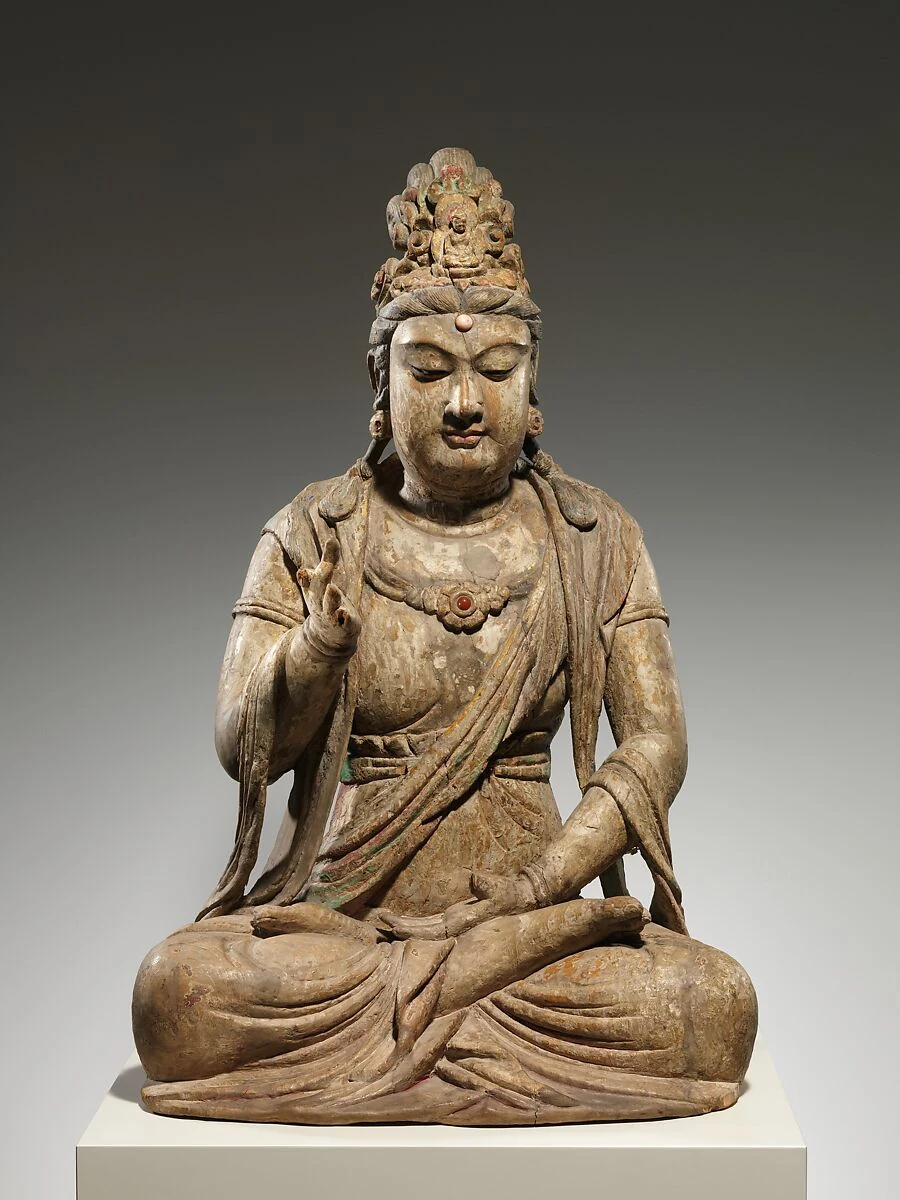
Bodhisattva
Avalokiteśvara / Guanyin: compassion
Avalokiteśvara is associated with compassion; Guanyin is the Chinese name. This Chinese sculpture belongs to a long and varied history of the figure’s representation. Its particular posture should be studied through the object record rather than assumed to be the standard form everywhere.
Look closelyNotice the ornament and headdress. Compare them with the plain robe of the Śākyamuni sculpture.
Continue studying ↗Artist unknown · The Metropolitan Museum of Art · 33.116. Object / image record ↗ · Public domain / CC0. Resized and converted to WebP; image content unchanged.
Bodhisattva
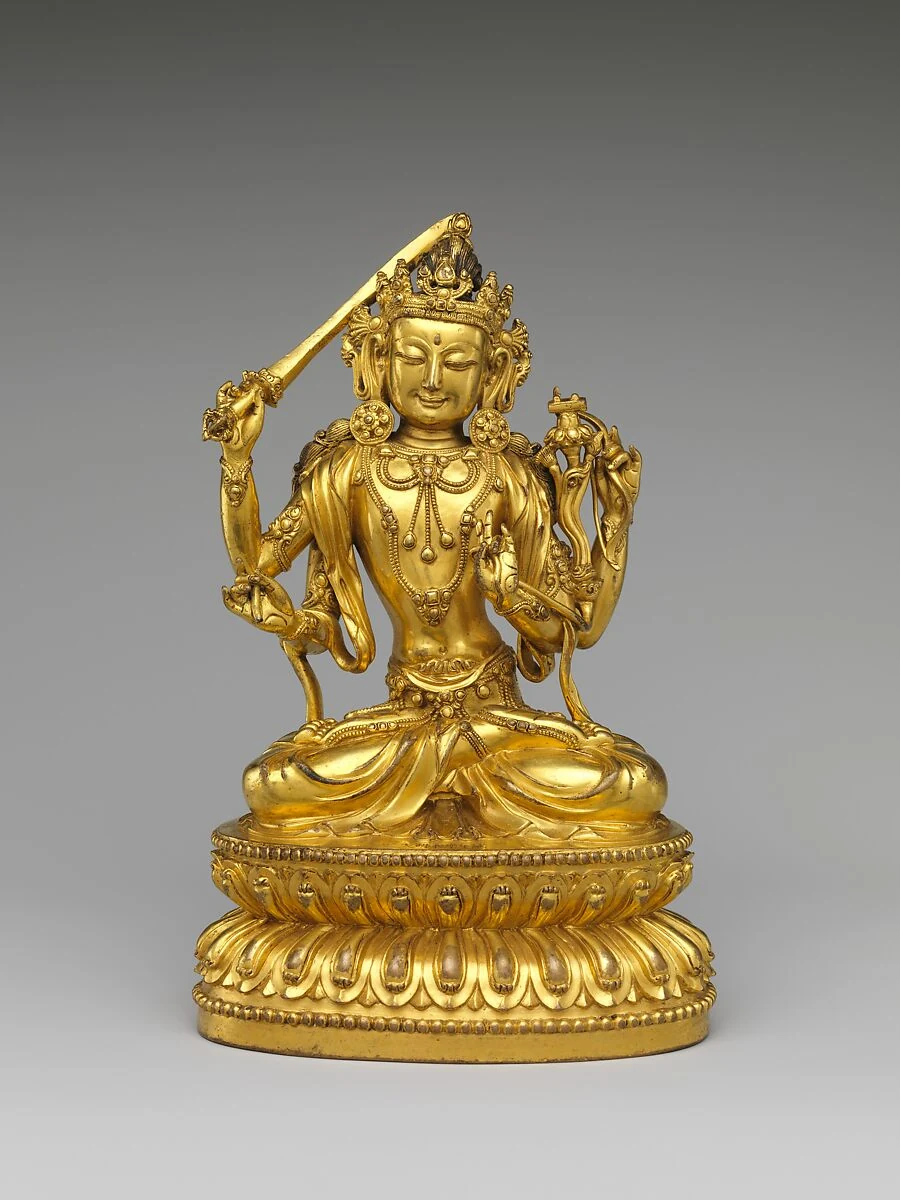
Mañjuśrī: the clarity of wisdom
Mañjuśrī is associated with wisdom. In this Chinese image, the sword and book help communicate that identity: the sword is read in relation to cutting through ignorance, while the book points toward wisdom teaching. Several arms allow several attributes to be represented together.
Look closelyFind the attributes before reading them as symbols. Which would be difficult to recognise without a catalogue?
Continue studying ↗Artist unknown · The Metropolitan Museum of Art · 2001.59. Object / image record ↗ · Public domain / CC0. Resized and converted to WebP; image content unchanged.
A question to carry with you
Pause and reflect.
Choose one helpful action and consider how all six qualities might improve it.
Sources & further reading
Study notes and examples are original explanations. Follow the links for the source texts and their own contexts.