The bindu
The small luminous point illustrates the name’s meaning. It offers a simple visual focus for reflection, without requiring a particular sensation.
 House of AnandaMovement · Stillness · Wisdom · Journey

The moon centre · बिन्दु
A lesser-known centre in some subtle-body traditions, where the imagery of moonlight, nectar and inward attention meets.
Explore the teaching01 · Begin with meaning
Bindu means a point, dot or drop. Bindu Visarga is commonly placed near the upper back of the head in teachings that include it.
It is distinct from the brow centre, Ājñā, and the crown, Sahasrāra. Its presence reminds us that the familiar seven-chakra chart is only one way of describing the subtle body.
This guide draws mainly on Maheshwarananda’s modern teaching, alongside historical context. Details belong to their traditions; they are not a universal anatomical map.
Read the lineage description ↗Point or drop
Near the hair whorl
Cooling, luminous imagery
No universal eighth chakra
Reading the Bindu symbol
The crescent is the central symbol in this study. Its silver light recalls Bindu’s lunar associations and the traditional imagery of amṛta.
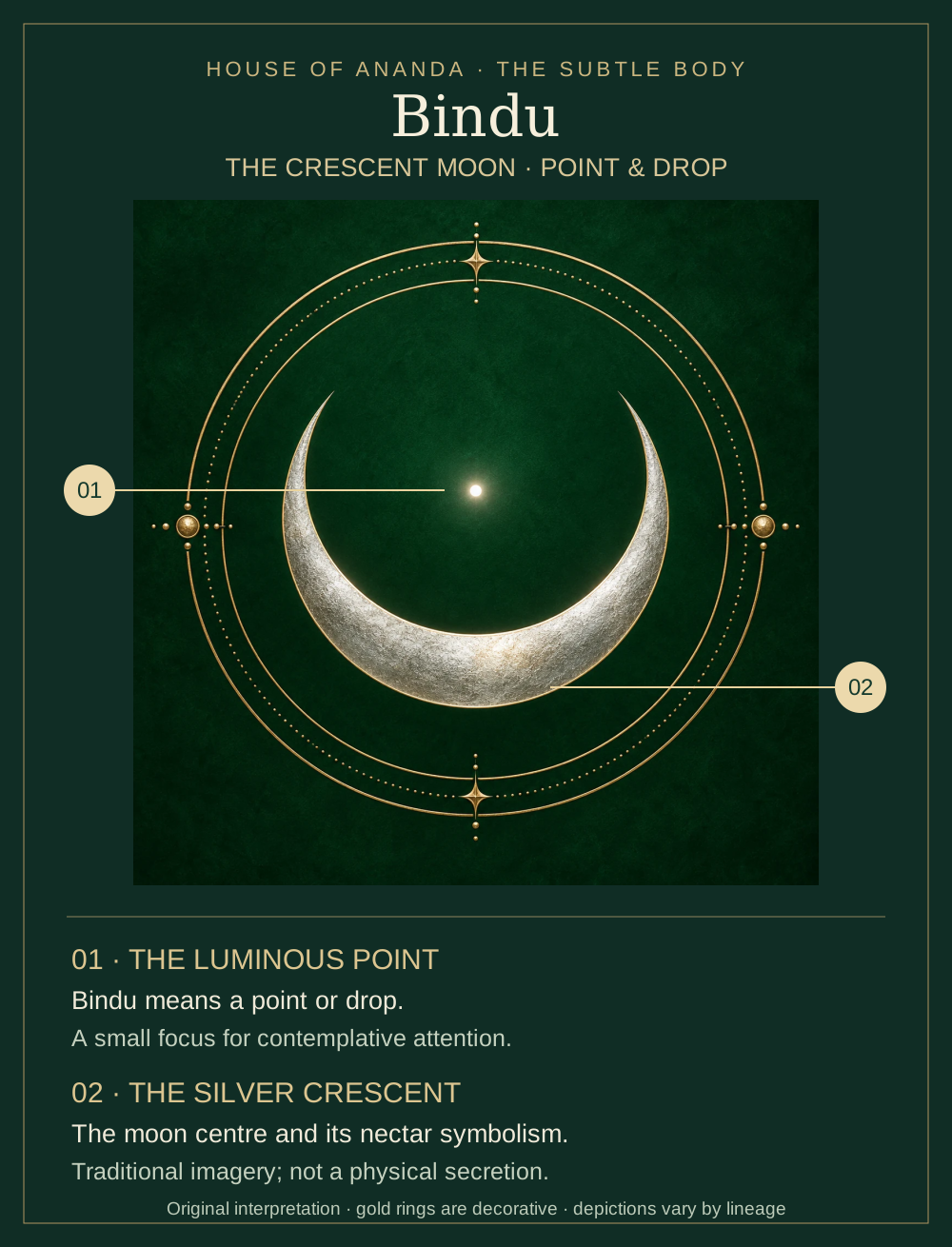
The small luminous point illustrates the name’s meaning. It offers a simple visual focus for reflection, without requiring a particular sensation.
The silver crescent expresses the lunar symbolism described in Bindu teachings. The related nectar story belongs to traditional subtle-body accounts.
This upward-facing crescent and point form our artistic interpretation. The gold rings are decorative; their number has no assigned traditional meaning. Depictions differ between lineages.
02 · Two illustrated guides
These diagrams explain a traditional model. They do not depict glands, nerves or a measurable fluid pathway.
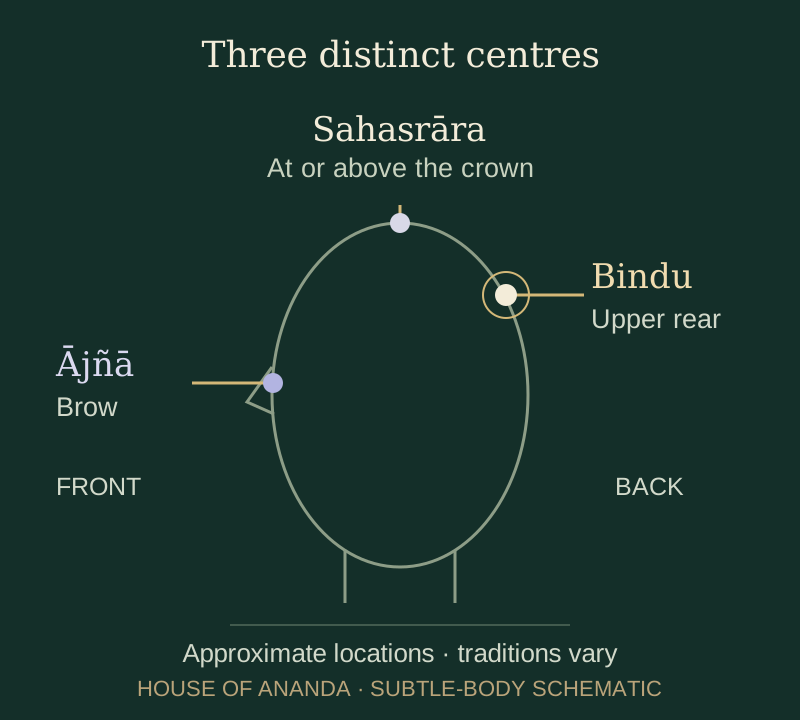
A schematic orientation guide, not a medical illustration. Bindu’s location is approximate and tradition-dependent.
Download infographic ↓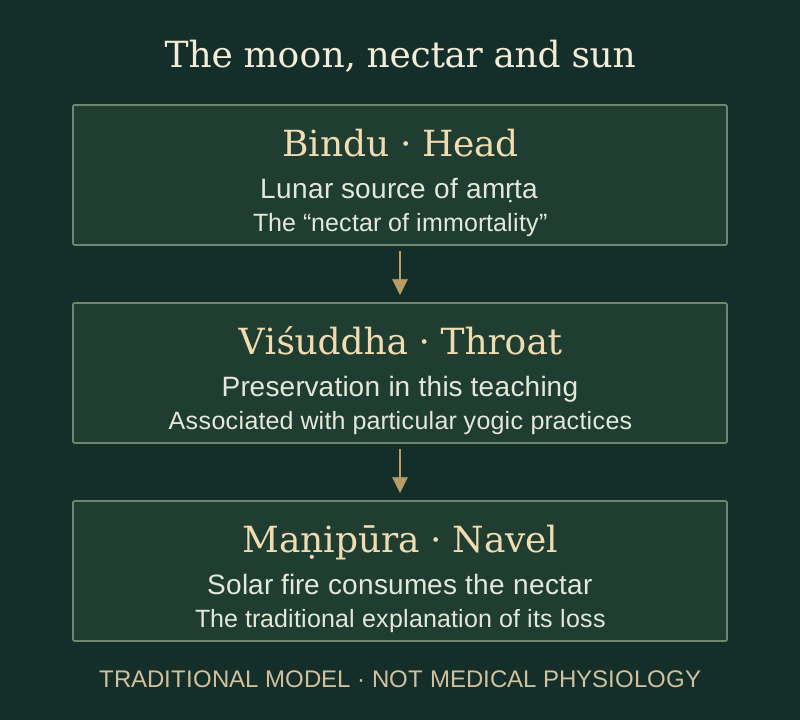
In this account, amṛta descends from the head and is consumed by navel fire. Certain practices are said to preserve it at the throat.
Download infographic ↓Teaching source: Chakras.net · Bindu and amṛta ↗

03 · A word with more than one life
In medieval haṭha yoga, bindu often refers to a vital essence, sometimes associated with reproductive fluid. Preserving or redirecting it was one purpose of particular mudrās and breath practices.
A passage about “retaining bindu” therefore does not automatically describe meditation on a point at the back of the head. Read the term in its own text and context.
The language of the moon and amṛta—the nectar of immortality—belongs to these wider accounts of transformation and liberation.
Explore the historical context ↗04 · Symbol, sound & lineage
“I am Shiva”: a statement of identification with divine consciousness. Yoga in Daily Life associates this mantra with Bindu.
Related teachings use Oṃ, amṛtam and the Mahāmṛtyuñjaya mantra. There is no one Bindu mantra required by every school.
No established traditional or scientifically validated Bindu frequency was identified in the sources reviewed. Choose music for listening, without treating a number as a healing prescription.
Compare Yoga in Daily Life and Chakras.net. Continue to our chakra-frequency guide or the mantra library.
Yoga in Daily Life describes a transparent, colourless centre and depicts a lotus with 23 petals. Silver moonlight is also used in visualisation. These details identify a teaching tradition; they are not fixed features shared by every chakra system.

The Bindu listening room
Twelve original five-minute ambient pieces, plus three spoken practice guides. Choose a quiet place and begin at a low volume. Headphones are optional.
Original instrumentals · 60 minutes
Soft harmonic layers and bell-like pulses, with different musical pitches and pacing across the collection. These are synthesised compositions, without recorded chanting or a claimed Bindu frequency.
01 · Crescent Arrival
Use the player to pause, seek and adjust volume. Tracks continue where your browser permits.
Spoken sound guides · approximately three minutes each
English cues use your device’s available voice, with quiet spaces between stages. This is a synthetic spoken guide, not a recorded teacher or mantra chant. Keep the page open and screen unlocked.
A gentle visualisation with natural breathing.
Sit comfortably and feel the support beneath you. Let the breath move naturally. Soften your gaze or close your eyes if comfortable. There is nothing to hold or force.
Imagine a small silver crescent moon near the upper back of your head. Let the image remain light and optional. If visualisation does not suit you, simply notice the contact of your feet with the floor.
Let the image dissolve. Listen to the sounds around you. Feel your hands and feet. Gradually open your eyes and return to the room in your own time.
05 · A gentle contemplation
A short House of Ananda adaptation inspired by moon visualisation. Explore attention; there is no need to “activate” anything.
Sit comfortably, with support if helpful. Let your eyes close or your gaze soften. Notice the seat beneath you and breathe naturally.
If comfortable, imagine a small point of cool moonlight near the upper back of your head. Let it be a gentle image. No pressure, breath-holding or special sensation is needed.
Release the image. Notice the room, feel your hands and feet, and open your eyes. If the visualisation is uncomfortable, simply stay with the contact of your feet on the floor.
Inspired by moon-centred meditation teachings. This gentle adaptation is not a traditional initiation or treatment.
06 · Tradition & evidence
A spiritual practice can have meaning without its symbolic explanation being established physiology.
Moon symbolism, nectar, clarity and spiritual renewal. Some sources also claim rejuvenation or links with the pineal gland and hypothalamus.
The sources reviewed do not establish a physical Bindu organ, an immortality secretion, age reversal or a Bindu-specific treatment for illness. Research on yoga’s broader benefits does not prove those mechanisms.
Study further
Research compiled 17 September 2026. Lineage sources document spiritual teachings; they do not independently validate health claims.