
A journey of language
The Sanskrit dhyāna is connected through Chinese Chán to Japanese Zen; Korean Seon and Vietnamese Thiền are related traditions. They are not simply synonyms for minimalist design or a quiet mood. Their histories include monasteries, precepts, liturgy, texts and teacher–student relationships.
Visual study
A teaching you can explore
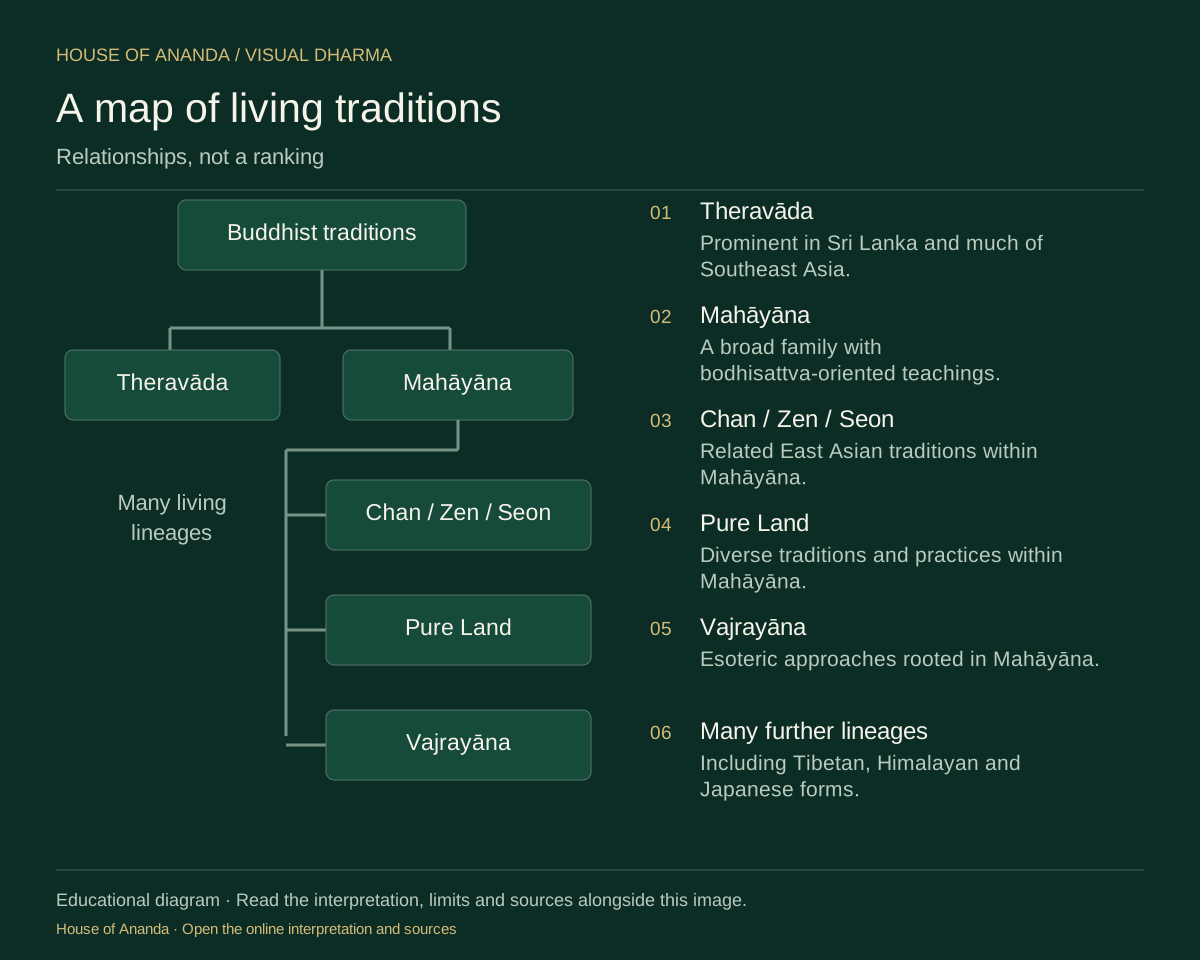
Relationships, not a ranking
A map of living traditions
A simplified orientation to large families and selected lineages.
Read the diagram & interpretation
- TheravādaProminent in Sri Lanka and much of Southeast Asia.
- MahāyānaA broad family with bodhisattva-oriented teachings.
- Chan / Zen / SeonRelated East Asian traditions within Mahāyāna.
- Pure LandDiverse traditions and practices within Mahāyāna.
- VajrayānaEsoteric approaches rooted in Mahāyāna.
- Many further lineagesIncluding Tibetan, Himalayan and Japanese forms.
Read the branches as broad relationships. Zen and Pure Land are not always separate memberships: practices can coexist. Vajrayāna is not a wholly independent third religion beside Mahāyāna; it develops within a Mahāyāna setting. Communities now live throughout the world.
Keep in mind This is a study map, not a complete historical family tree. Geographic associations are neither exclusive nor fixed.
Sources: Study Buddhism · Types of Buddhism ↗ · Stanford Encyclopedia of Philosophy · Japanese Zen ↗
Zazen and different approaches
Zazen means seated meditation in Japanese. Sōtō teaching is particularly associated with shikantaza, often translated as “just sitting”. Rinzai is known for kōan training, among other practices. These distinctions are useful but do not capture the full diversity of either school.
Not a puzzle competition
A kōan belongs within a specific practice and teaching relationship. Treating it as a clever riddle misses that setting. Similarly, “just sitting” is not merely doing nothing; it is approached through embodied discipline and appropriate instruction.
Learning the form
A temple or centre may teach posture, bowing, walking and chanting together. Follow that community’s guidance while communicating access needs. A chair or adapted position can be discussed; discomfort should not be turned into a contest.
Everyday awareness
Some modern Zen communities, including Plum Village, emphasise mindful walking, eating, communication and collective practice. Name the lineage when using its teaching, rather than treating one modern presentation as the whole of Zen.
Art & contemplation
Look, learn, reflect

A place to return
A quiet bench evokes an accessible moment of attention. The setting is imagined and the person is not a named teacher. Meditation can also happen amid ordinary household sounds, without a remote retreat or a perfectly quiet mind.
A moment to reflectWhat is one manageable pause you can make in your day?
Follow this theme ↗A question to carry with you
Pause and reflect.
What do you expect a meditation practice to give you, and how might that expectation shape the way you sit?
Sources & further reading
Study notes and examples are original explanations. Follow the links for the source texts and their own contexts.