
Listen to women’s words
The Therīgāthā preserves verses attributed to early Buddhist nuns, expressing hardship, renunciation, insight and liberation. Read individual poems and translator notes rather than treating every woman’s experience as identical.
Visual study
A teaching you can explore
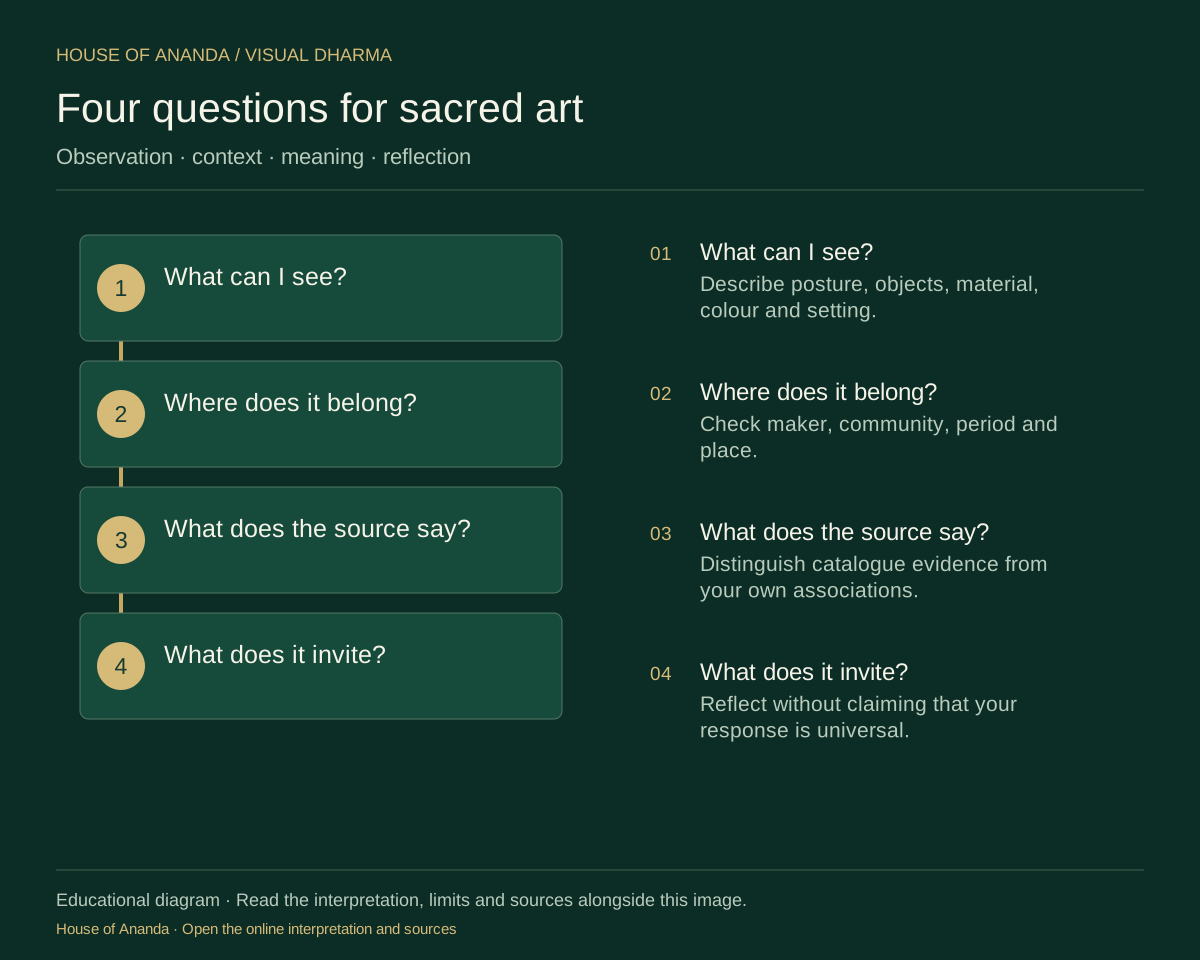
Observation · context · meaning · reflection
Four questions for sacred art
A practical way to make visual study more thoughtful.
Read the diagram & interpretation
- What can I see?Describe posture, objects, material, colour and setting.
- Where does it belong?Check maker, community, period and place.
- What does the source say?Distinguish catalogue evidence from your own associations.
- What does it invite?Reflect without claiming that your response is universal.
Begin with observable detail, then consult reliable context. An image may serve devotion, teaching, ritual, remembrance or several purposes at once. Ask what is known and what is inferred. The maker’s community may understand a detail differently from a modern museum visitor.
Keep in mind These four questions are an original House of Ananda study framework, not a traditional Buddhist list.
Sources: The Metropolitan Museum of Art · Buddhism and Buddhist Art ↗
Institutions and opportunity
Women have participated as nuns, lay supporters, teachers, scholars and ritual specialists. Ordination lineages and access to training differ by region and school. One temple’s arrangements cannot describe all Buddhist history.
Ask whose voice is heard
Notice whose work is translated and whose remains less visible. A balanced reading list includes first-person accounts, not only descriptions of women by others. Modern leadership developments deserve their own historical setting.
A reading exercise
Choose a Therīgāthā poem and identify what freedom its speaker describes. Then read a contemporary woman teacher in a named lineage. Similarities may illuminate, but leave room for different social circumstances.
Art & contemplation
Look, learn, reflect

A lamp for inquiry
Light offers a contemporary metaphor for inquiry and understanding. The unlettered pages do not depict a lost scripture or an authentic manuscript. Study can illuminate experience while experience raises new questions for study.
A moment to reflectWhich question deserves a slower, more attentive reading?
Follow this theme ↗A question to carry with you
Pause and reflect.
Whose voice is missing from your current picture of Buddhist practice?
Sources & further reading
Study notes and examples are original explanations. Follow the links for the source texts and their own contexts.