 House of AnandaMovement · Stillness · Wisdom · Journey
Lesson 12 of 14 · Yoga & anatomy
The spine, discs & back care
Understand the structure. Choose movement with care.
Spinal curves, vertebrae, discs and nerves; the difference between spondylitis and spondylosis; and context for the notebook’s yoga and injury-care list.
01 · Study
A column with curves
The spine supports the trunk and protects neural structures while allowing movement. Cervical and lumbar curves are lordotic; thoracic and sacral curves are kyphotic. These words can describe normal curves. “Hyper” means increased and “hypo” means reduced.
A straighter-looking neck is not, on its own, a diagnosis of ankylosing spondylitis. A photograph or posture check cannot establish the cause of pain.
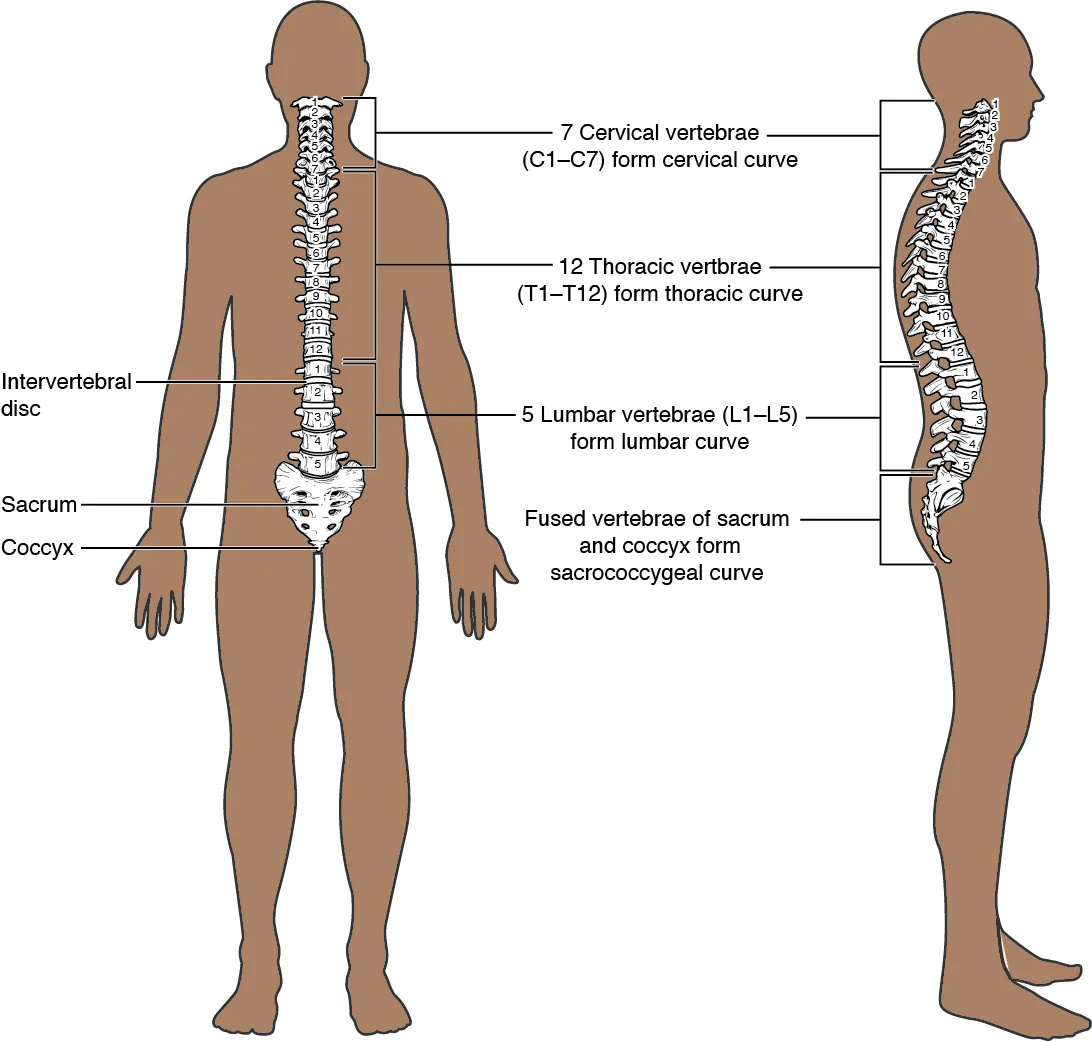
Further reading: OpenStax · Vertebral column ↗
02 · Study
Reading the vertebra sketch
The two kinds of opening are easy to confuse: the vertebral canal runs along the spine; intervertebral foramina are exits at the sides.
| Notebook label | What it identifies |
|---|---|
| Vertebral body | The main weight-bearing part. |
| Vertebral foramen | The opening within a vertebra; successive openings form the vertebral canal. |
| Spinous process | The projection towards the back. |
| Transverse processes | Side projections for attachments. |
| Intervertebral foramina | Side openings between vertebrae through which spinal nerves exit. |
| Spinal cord | Nervous tissue within the canal; it is not the canal itself. |
Further reading: OpenStax · Vertebral column ↗
03 · Study
Disc, ring and centre
The nucleus pulposus belongs to an intervertebral disc. It is not a cell nucleus and is not a general structure of the brain or eyes. This corrects the notebook’s mixed use of “nucleus”.
| Structure | Study meaning |
|---|---|
| Annulus fibrosus | The disc’s fibrous outer ring. |
| Nucleus pulposus | Its softer, gel-like central material. |
Further reading: OpenStax · Vertebral column ↗
04 · Study
Similar words, different conditions
The class lists pain, swelling, heat and redness as signs of inflammation. Those are general teaching signs, not a reliable checklist for diagnosing inflammation deep within the spine.
| Term | Meaning and distinction |
|---|---|
| Spondylitis | Inflammation involving the spine. Ankylosing spondylitis is a form of axial spondyloarthritis; it is not simply loss of the neck’s curve. |
| Spondylosis | Degenerative changes of the spine. Cervical spondylosis concerns the neck; many people have changes without symptoms. |
| Disc bulge / herniation | Related descriptions of disc displacement. “Slipped disc” is a common, imprecise name. A clinician interprets imaging alongside symptoms. |
| Annular fissure / tear | A disruption within the outer disc ring; it is not automatically the same thing as a symptomatic herniation. |
| Spinal stenosis | Narrowing of the canal or nerve-exit spaces; symptoms depend on the structures involved. |
| Radicular pain | Pain associated with irritation of a nerve root, potentially travelling into a limb. Not every spreading pain is radicular pain. |
Further reading: NHS · Slipped disc ↗ · NIAMS · Spinal stenosis ↗ · NHS · Cervical spondylosis ↗ · NHS · Ankylosing spondylitis ↗
05 · Study
The yoga list: a study menu, not a treatment sequence
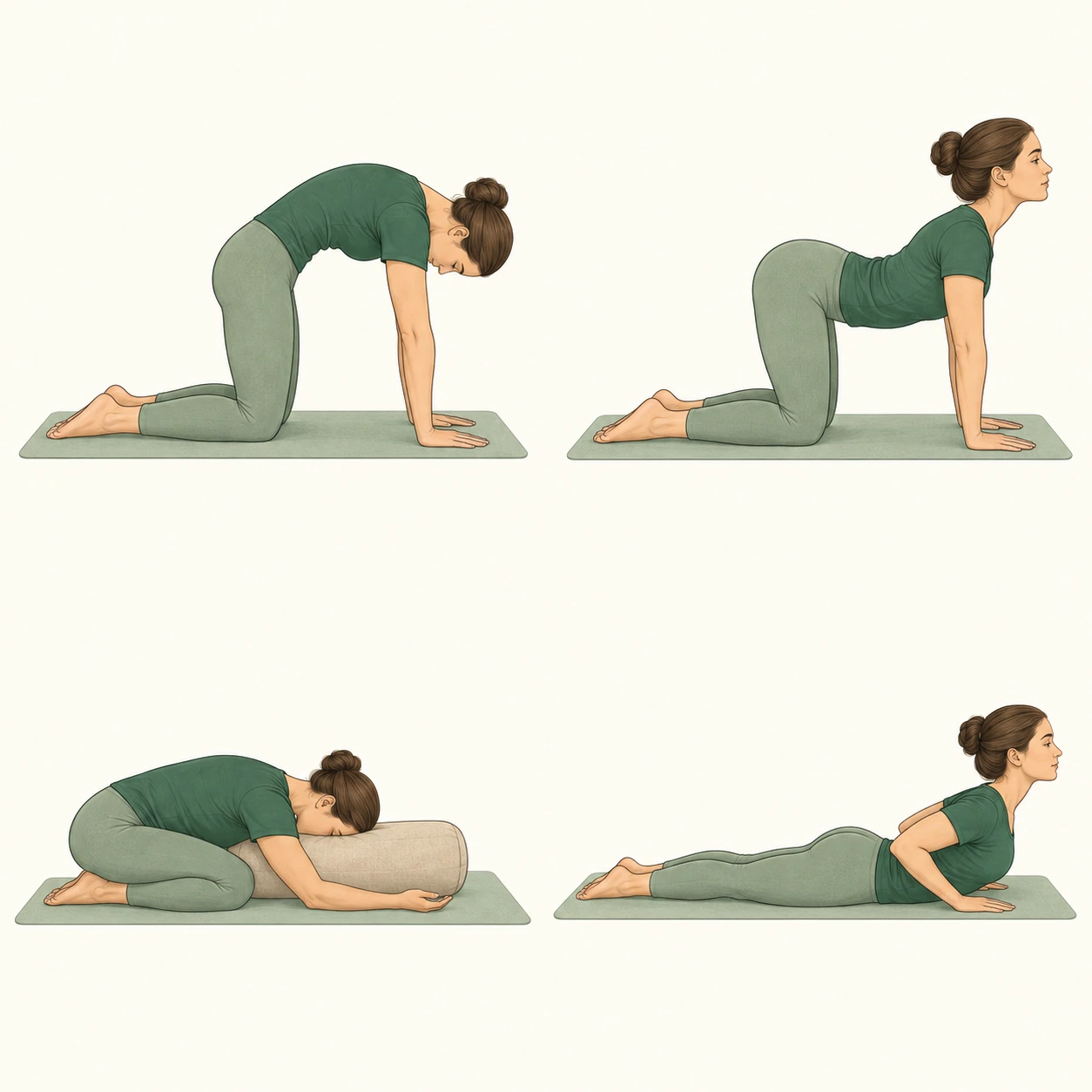
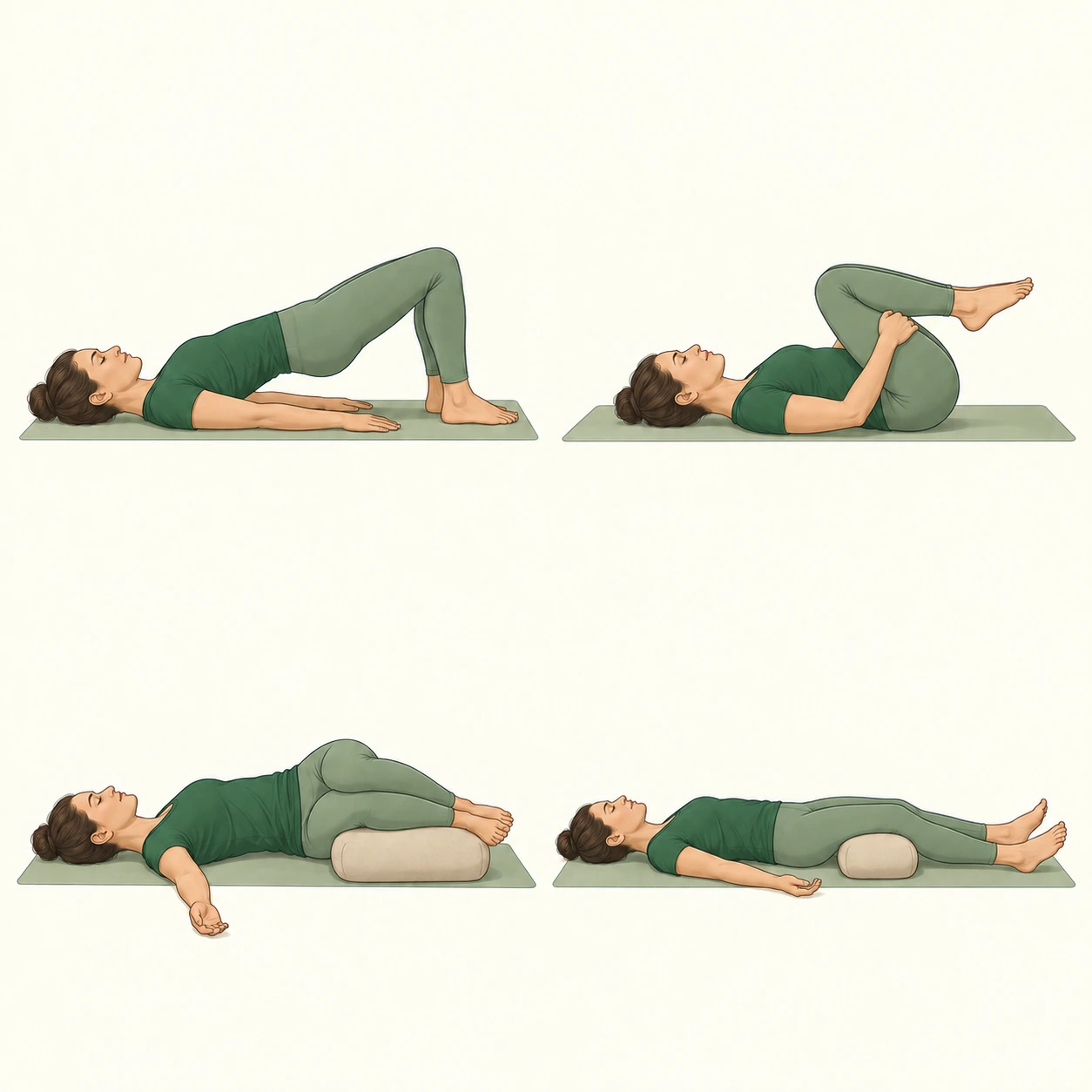
These names come from the page headed “yogic treatment”. They span standing, folding, twisting and backbending. They are not interchangeable remedies for a disc problem, and completing the list is not a recovery target.
| Name in standardised form | English name / reading | How to approach the note |
|---|---|---|
| Tāḍāsana; Tiryaka Tāḍāsana | Palm-tree / standing reach; swaying palm tree | The palm-tree name is used in some haṭha schools; elsewhere Tāḍāsana is Mountain. Side bending is an additional action. |
| Bhujaṅgāsana | Cobra | A backbend; its depth should be individually chosen. |
| Dhanurāsana; Śalabhāsana | Bow; Locust | More demanding extension; not a default starting point for back pain. |
| Mārkaṭāsana | Supine twist, as labelled in the notes | Versions vary; do not force the knees or shoulders towards the floor. |
| Śaśāṅkāsana / Śaśāṅka-related spelling | Likely a kneeling forward-rest posture | The word is uncertain. Bālāsana (Child’s Pose) is separately legible; do not silently treat the two names as identical. |
| Bālāsana; Apānāsana | Child’s Pose; knees-to-chest | Flexion-based positions can suit some people and aggravate others. |
| Setu Bandhāsana | Bridge | Keep the neck still; height is optional. |
| Mārjārī–Bitilāsana | Cat–Cow | Explore a small range without forcing the end points. |
| Matsyendrāsana | A spinal-twist family | The exact version is not specified; a deep seated twist has not been prescribed. |
| Pavanamuktāsana | Wind-relieving pose / release-practice terminology | The single pose and the wider movement series are different uses of the name. |
| Pādottānāsana (notebook spelling) | A leg-stretch entry beside “calf + hamstring stretch” | Insufficient detail to identify a particular standing or supine variation. |
Further reading: NHS · Slipped disc ↗
06 · Study
What PRICE does—and does not—mean
The notebook spells out Protection, Rest, Ice, Compression and Elevation. NHS guidance uses PRICE for the early care of sprains and strains. It is not a standard treatment for every spinal condition or an instruction to immobilise the back.
For a recent sprain or strain, ice should be wrapped rather than applied directly to skin; NHS guidance describes up to 20 minutes every 2–3 hours initially. Compression and elevation concern an appropriate injured area, not tightly wrapping the neck or spine. When movement is tolerable, gradual activity helps prevent stiffness.
Further reading: NHS · Sprains and strains ↗
07 · Study
When a class is not the next step
Seek assessment for persistent or worsening pain, unexplained weight loss, fever, or pain that disrupts ordinary activity. Most back pain is not a medical emergency, but some accompanying symptoms need urgent care.
Further reading: NHS · Back pain ↗
From notebook to page
Developed from IMG_1840, IMG_1841, IMG_1846 and IMG_1847. The drawings identify the spinal canal, disc and vertebral processes. The heading “yogic treatment” is retained as classroom context, not as a prescription. An unclear posture spelling is marked below.
Spelling has been standardised and explanations added. Traditional teaching cues, anatomical facts and uncertain handwriting are distinguished in the text. These pages support learning alongside appropriate teaching.