 House of AnandaMovement · Stillness · Wisdom · Journey
Lesson 4 of 14 · Yoga & anatomy
Bones, limbs & girdles
Make sense of the 206-bone map.
Axial and appendicular skeletons, bone functions, hands, feet, limb counts and the shoulder and pelvic girdles.
01 · Study
Two divisions, one skeleton
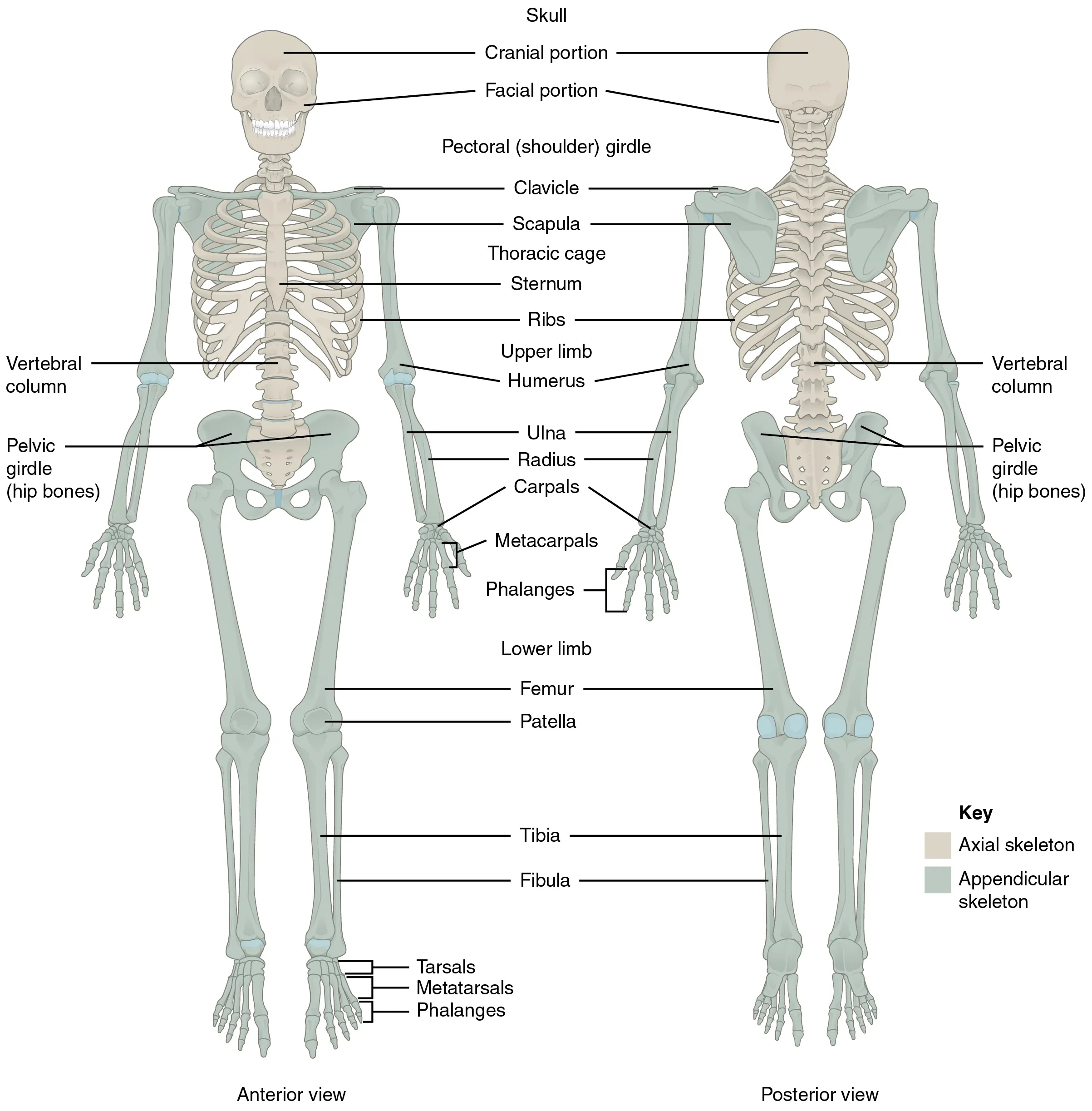
Osteology is the study of bones. The axial skeleton forms the central framework: skull and associated bones, vertebral column and rib cage. The appendicular skeleton consists of the limbs and their attachment girdles.
Further reading: OpenStax · Skeletal divisions ↗
02 · Study
Why children have a different count
The notes say a child has 340 bones and suggest fusion finishes at ages 20–22. Those should not be used as universal facts. The number depends on age and what is being counted; separate developing parts fuse over time, and different bones mature at different ages.
206 is the conventional adult teaching count. Individual anatomical variation means it is not an exact count for every adult.
Further reading: OpenStax · Skeletal divisions ↗
03 · Study
What bones do
The first three functions come directly from the notes. The remaining three complete the usual introductory explanation. Bone is living tissue, not an inert framework.
| Function | Example |
|---|---|
| Support | A framework for the body |
| Movement and locomotion | Levers acted on by muscles |
| Protection | The skull around the brain |
| Mineral storage | Calcium and phosphate |
| Blood-cell production | Red bone marrow |
| Energy storage | Fat in yellow marrow |
Further reading: OpenStax · Functions of the skeletal system ↗
04 · Study
Upper limb: 30 bones on each side
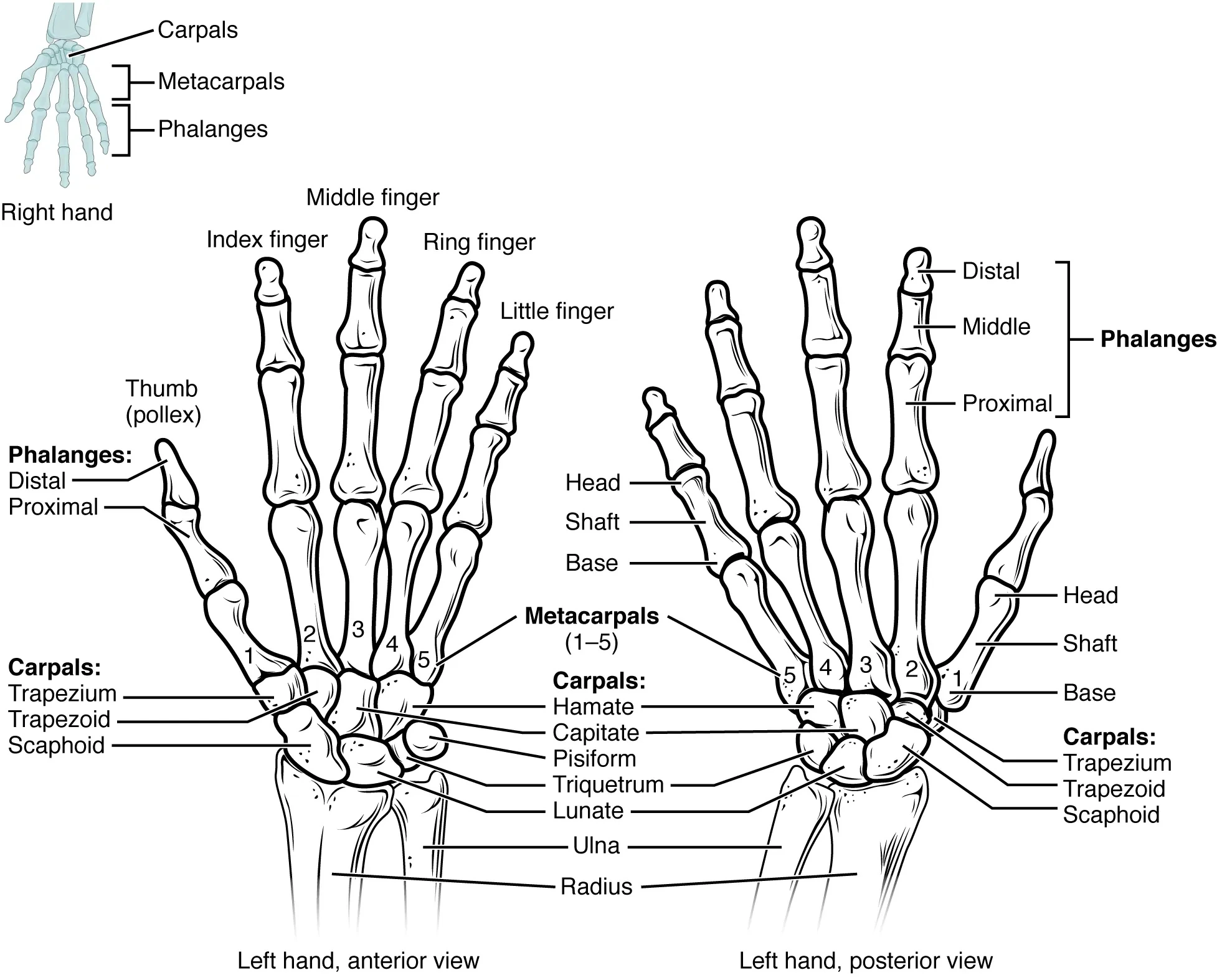
The 27 bones of one hand, including its wrist, are 8 + 5 + 14. Adding the humerus, radius and ulna gives the 30-bone upper limb. The shoulder girdle is counted separately.
| Bone or group | One side | Where |
|---|---|---|
| Humerus | 1 | Upper arm |
| Radius + ulna | 2 | Forearm |
| Carpals | 8 | Wrist |
| Metacarpals | 5 | Palm |
| Phalanges | 14 | Fingers and thumb |
| Total | 30 | 60 across both upper limbs |
Further reading: OpenStax · Bones of the upper limb ↗
05 · Study
Lower limb: 30 bones on each side
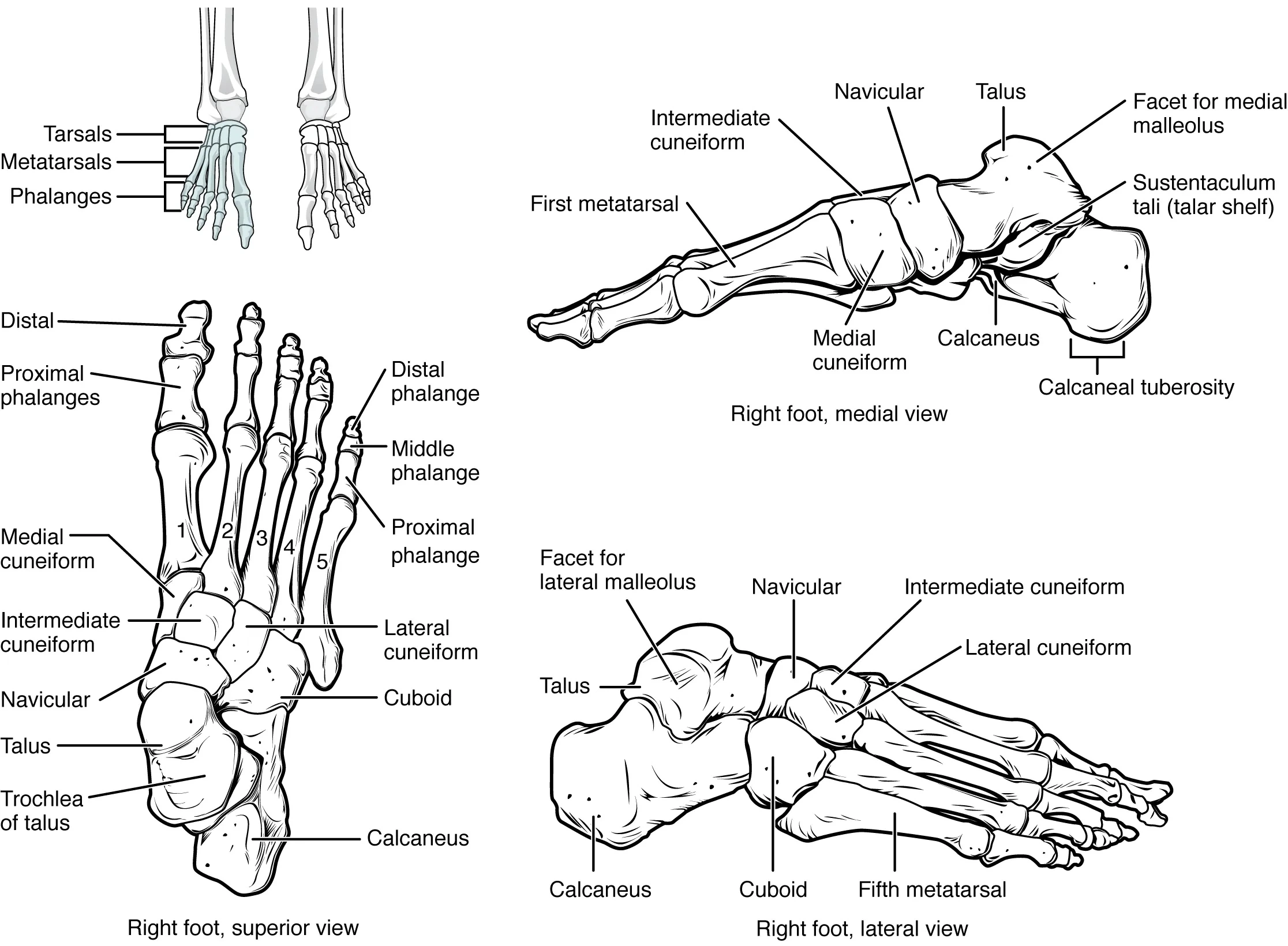
One foot contains 7 + 5 + 14 = 26 bones in the conventional count. Add femur, patella, tibia and fibula to reach 30 for the limb.
| Bone or group | One side | Where |
|---|---|---|
| Femur | 1 | Thigh |
| Patella | 1 | Kneecap |
| Tibia + fibula | 2 | Leg below the knee |
| Tarsals | 7 | Ankle and rear/midfoot |
| Metatarsals | 5 | Forefoot |
| Phalanges | 14 | Toes |
| Total | 30 | 60 across both lower limbs |
Further reading: OpenStax · Bones of the lower limb ↗
06 · Study
The girdles connect the limbs
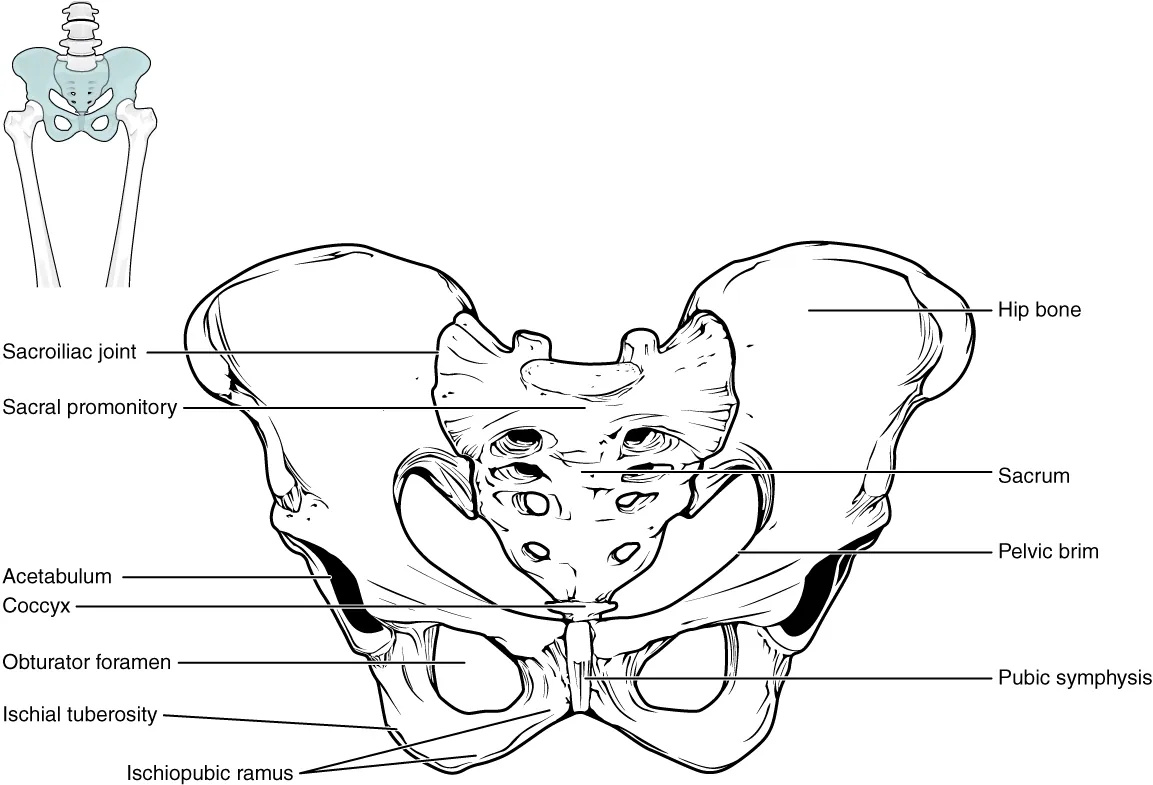
Each adult hip bone forms from the ilium, ischium and pubis. The bony pelvis also includes the sacrum and coccyx; these belong to the axial skeleton, not the two-bone pelvic-girdle count.
| Girdle | Adult bones | Both sides |
|---|---|---|
| Pectoral / shoulder girdle | One clavicle and one scapula per side | 4 |
| Pelvic girdle | One hip bone per side | 2 |
Further reading: OpenStax · Skeletal divisions ↗ · OpenStax · Pelvic girdle and pelvis ↗
07 · Study
Use the map without forcing the shape
Knowing the names helps you follow instructions and locate a question. It does not tell you how far a particular person should fold, turn out a foot or move a shoulder. Joint shape and movement capacity vary. Bring the map into conversation with sensation and a teacher’s guidance.
08 · Study
Axial skeleton: reconciling the 80-bone count
IMG_1589 uses “skull = 29” by including the ear ossicles and hyoid. That is a broader head-associated grouping, not 29 bones in the skull proper. The notation can be understood without losing the standard anatomical distinction.
| Group | Conventional adult count | Clarification |
|---|---|---|
| Skull proper | 22 | 8 cranial + 14 facial bones |
| Auditory ossicles | 6 | 3 per middle ear |
| Hyoid | 1 | Separate from the skull proper |
| Vertebral column | 26 | 24 separate vertebrae + sacrum + coccyx |
| Ribs | 24 | 12 pairs |
| Sternum | 1 | Breastbone |
| Total | 80 | 22 + 6 + 1 + 26 + 24 + 1 |
Further reading: OpenStax · Skeletal divisions ↗
09 · Study
Five spinal regions, two ways of counting
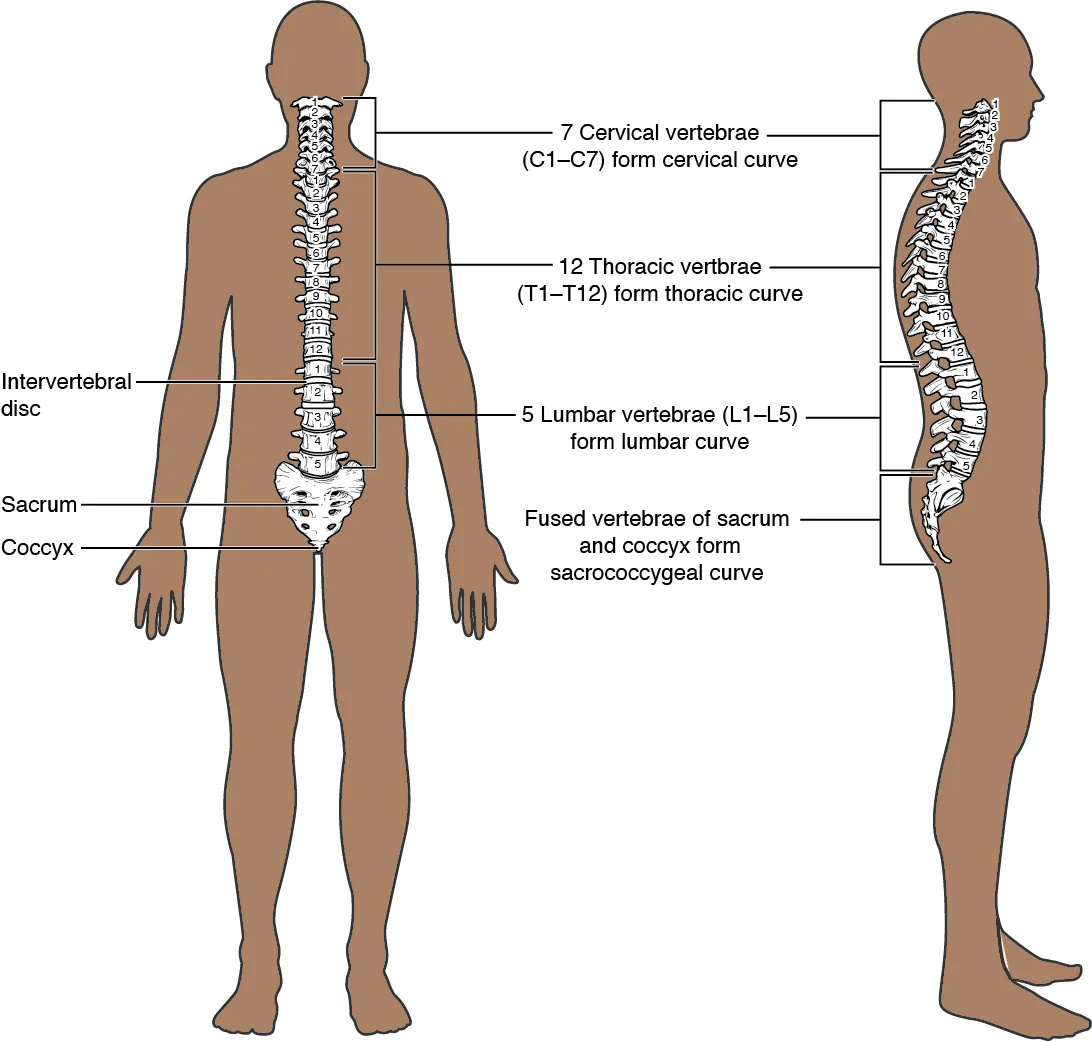
The notebook’s “26 vertebrae” should be read as 26 adult bones in the column, rather than 26 separate mobile vertebrae. The sacrum and coccyx contain fused segments. A typical developmental count is 33 vertebral segments; anatomical variation occurs. Fusion is a developmental process, not a single event at one birthday.
| Region | Label | Adult count |
|---|---|---|
| Cervical | C1–C7 | 7 |
| Thoracic | T1–T12 | 12 |
| Lumbar | L1–L5 | 5 |
| Sacrum | 5 fused sacral segments | 1 bone |
| Coccyx | Usually 4 fused segments; variable | 1 bone |
Further reading: OpenStax · Vertebral column ↗
10 · Study
Ribs and girdles: useful refinements
- Rib pairs 1–7 are true ribs, connected to the sternum through their own costal cartilages.
- Pairs 8–10 connect indirectly through the cartilage above.
- Pairs 11–12 are floating ribs with no anterior sternal attachment. They are also a subset of false ribs in standard classification.
- The shoulder girdles contain two clavicles and two scapulae in total.
- Ilium, ischium and pubis fuse into each adult hip bone. “Iliac” and “pubic” are descriptive forms; ilium and pubis are the bone names.
Further reading: OpenStax · Thoracic cage ↗
From notebook to page
Drawn from the anatomy, upper-limb and blurred lower-limb pages, plus the hand-and-foot calculation. The lower-limb table is a standard anatomical reconstruction, not a claim that every word in the blurred photograph is legible. The hip-girdle heading has been completed with explanatory material.
Spelling has been standardised and explanations added. Traditional teaching cues, anatomical facts and uncertain handwriting are distinguished in the text. These pages support learning alongside appropriate teaching.