 House of AnandaMovement · Stillness · Wisdom · Journey
Lesson 9 of 14 · Yoga & anatomy
Reading Sanskrit pose names
Learn the parts, understand the name.
Read Sanskrit pose names: dog poses, Warriors, Triangle, Side Angle, standing folds and Pyramid, connected to the illustrated practice guides.
01 · Study
A compact vocabulary
| Word | Meaning | How it helps |
|---|---|---|
| Āsana | Posture / seat | Common ending of pose names. |
| Ardha | Half | A qualifier; not a command to use exactly half a measured angle. |
| Ūrdhva | Upward | Direction, as in upward-facing. |
| Adho | Downward | Direction, as in downward-facing. |
| Uttāna | Intense stretch / extension | In Uttānāsana, the familiar standing forward-fold name. |
| Catur | Four | Combines with aṅga in caturaṅga. |
| Aṅga | Limb | Also appears in aṣṭāṅga: eight limbs. |
| Daṇḍa | Staff / rod | The staff image in Daṇḍāsana. |
02 · Study
The three postures in context
These notes provide naming and orientation, not a full alignment prescription. Use the existing illustrated pose library for adaptations, gaze and breathing context. Naming a demanding pose does not establish readiness to practise it.
| Sanskrit | Common English name | What the notes clarify |
|---|---|---|
| Uttānāsana | Standing Forward Fold | Not a requirement to keep knees locked. |
| Ardha Uttānāsana | Half Standing Forward Fold | Often taught as a lengthening or half-lift; height varies. |
| Caturaṅga Daṇḍāsana | Four-Limbed Staff Pose | “Four limbs + staff + posture”, rather than four separate poses. |
Further reading: AYI · Traditional Ashtanga practice series ↗
03 · Study
A vocabulary list is not a sequence
The earlier vocabulary list does not specify a complete sequence. The later IMG_1839, IMG_1840 and IMG_1843 add Sun Salutation and vinyāsa notes. Their interpretation is integrated into the existing Ashtanga guide, where the full tables, illustrations and breath cues are maintained.
04 · Study
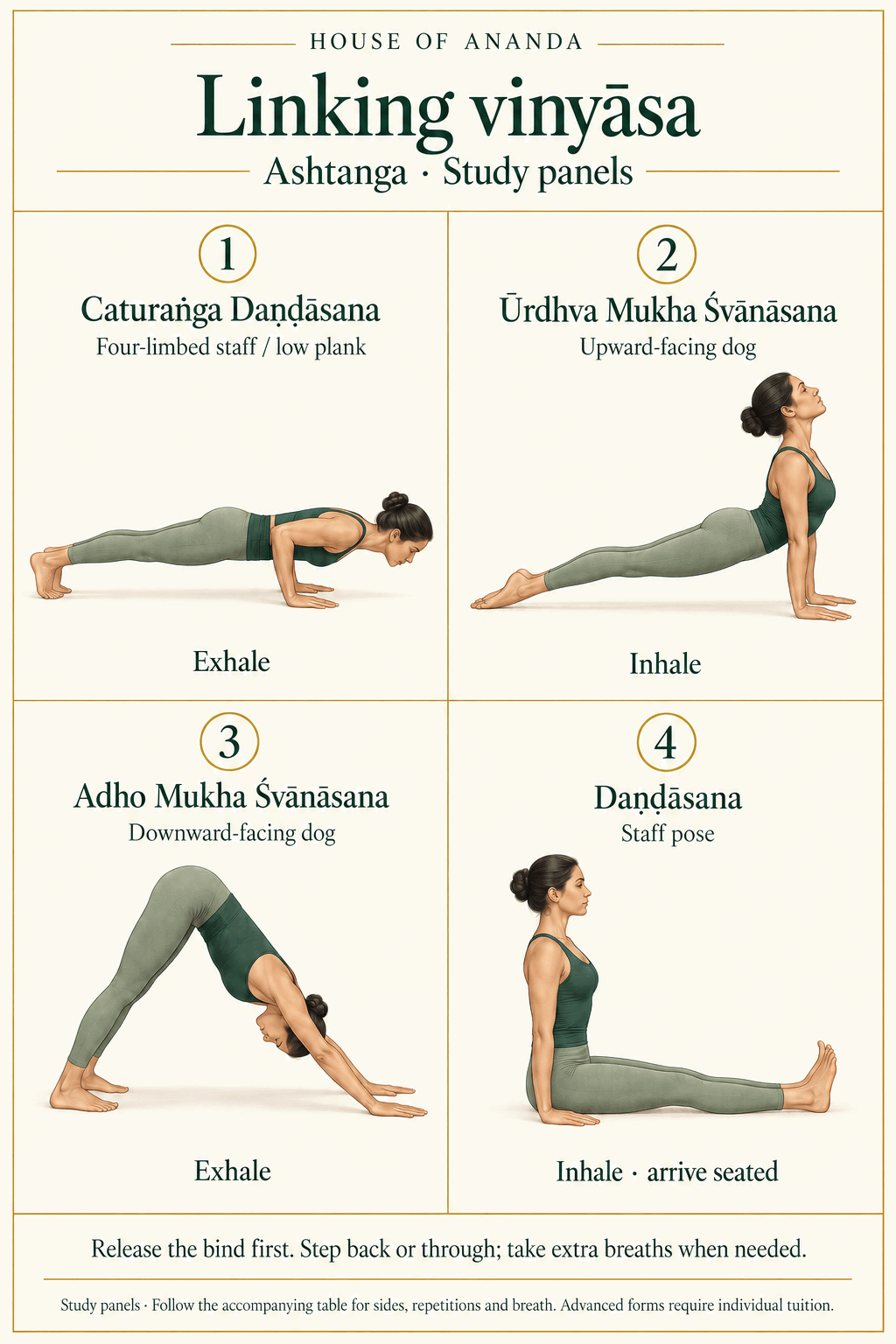
Upward-facing and downward-facing dog
Śvāna (dog) and śava (corpse) are different words. Keep the spelling distinct from Śavāsana. The two dog poses also have different loading and spinal actions; one is not merely the other with the gaze reversed.
| Sanskrit | Read the parts | English |
|---|---|---|
| Ūrdhva Mukha Śvānāsana | Ūrdhva: upward · mukha: face · śvāna: dog · āsana: posture | Upward-Facing Dog |
| Adho Mukha Śvānāsana | Adho: downward · mukha: face · śvāna: dog · āsana: posture | Downward-Facing Dog |
05 · Study
The next names in the alignment lesson
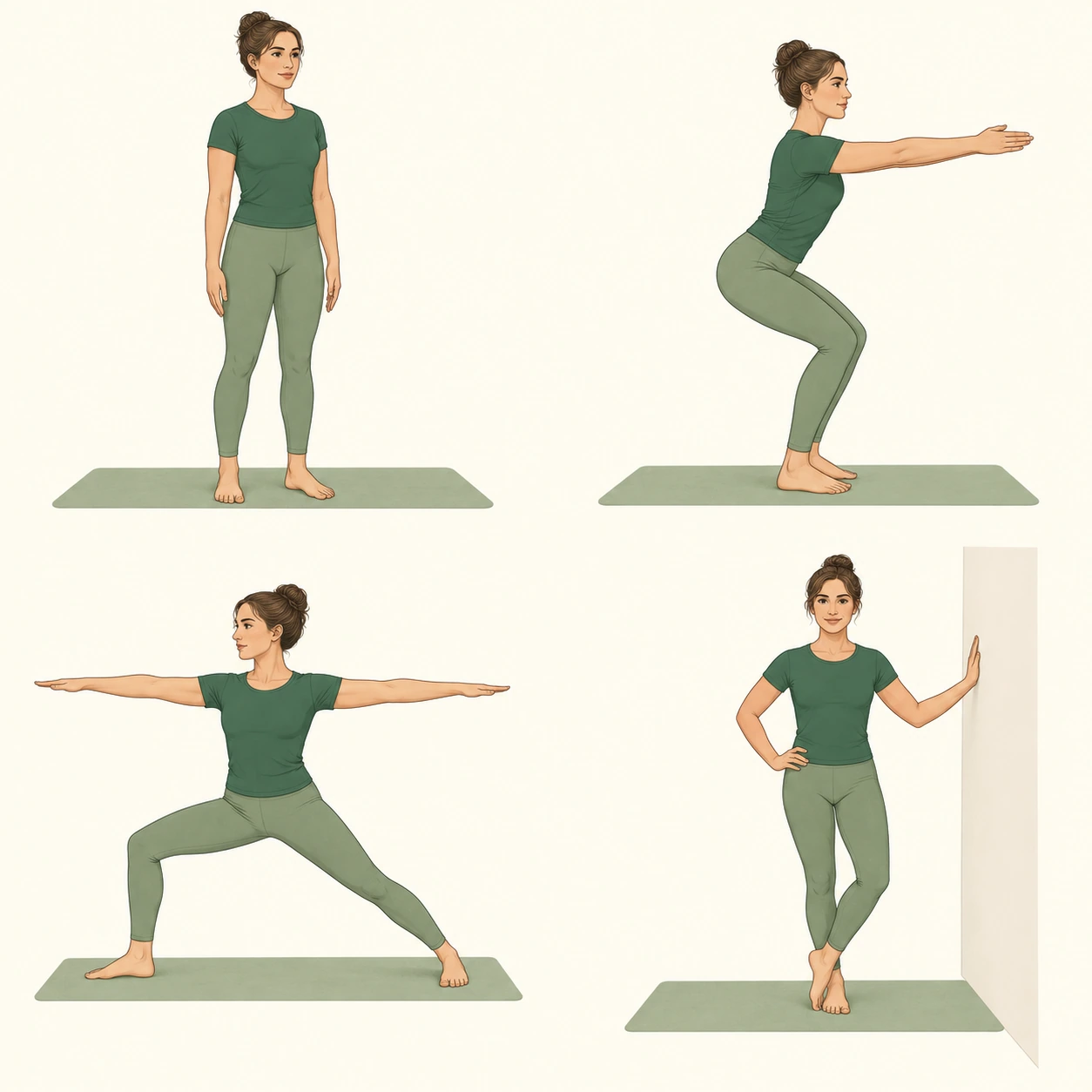
A Sanskrit name identifies a practice family, not one universally suitable alignment. Half Camel does not necessarily mean reaching one heel: the teacher may use hands at the waist or another supported variation. Headstand needs individual preparation and is optional.
| Sanskrit | English | Study cue |
|---|---|---|
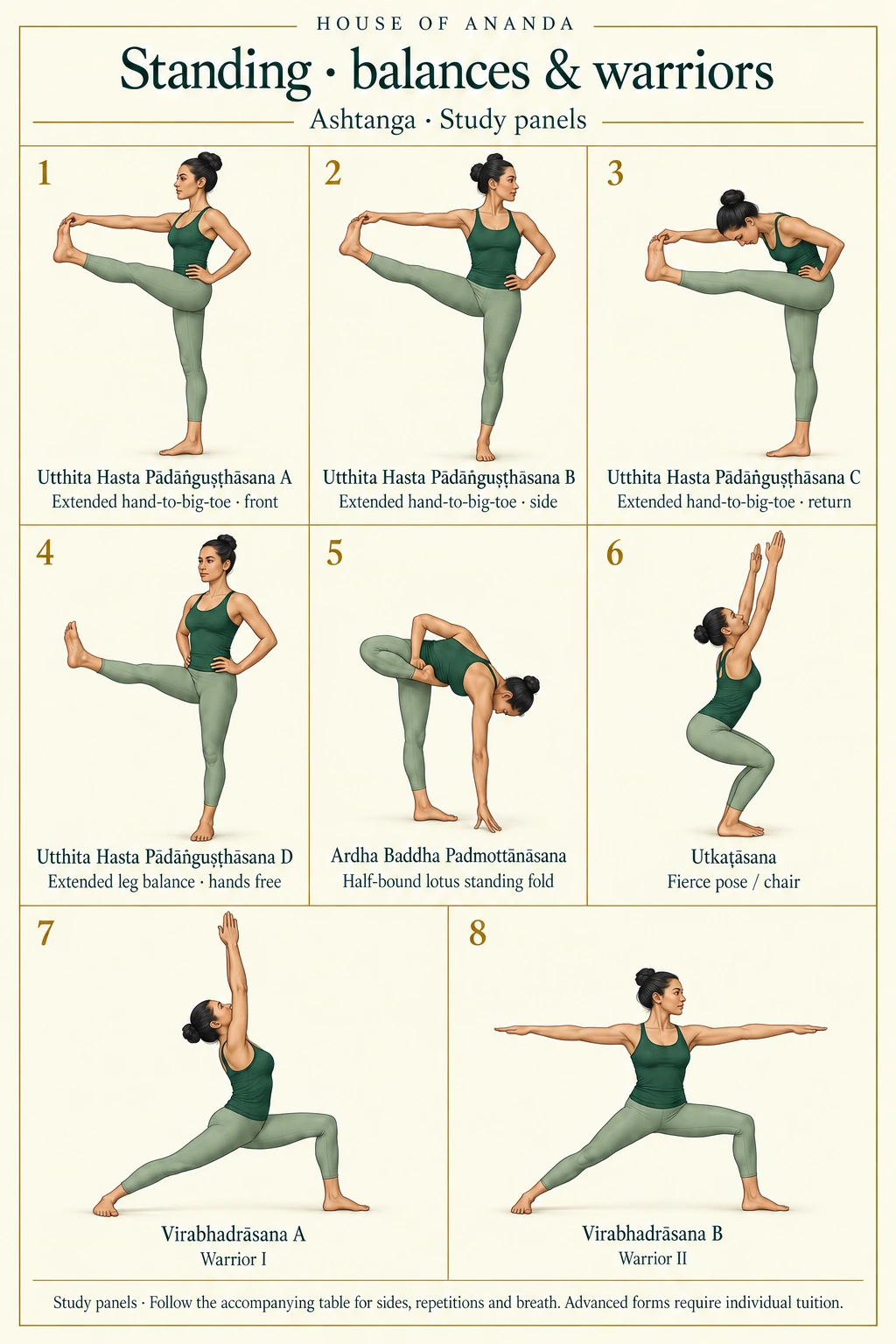
| Utkaṭāsana | Chair / fierce pose | Bend the knees to a manageable depth; the chair is an image, not a fixed shape. |
| Vīrabhadrāsana I / A | Warrior I | “Closed hips” is a classroom orientation cue, not a demand to force the pelvis square. Adjust the stance. |
| Vīrabhadrāsana II / B | Warrior II | A distinct open-stance posture; do not replace Warrior I in standard Sun B. |
| Pādāṅguṣṭhāsana | Big-Toe Pose | Pāda: foot · aṅguṣṭha: big toe. A strap or bent knees can reduce reaching demands. |
| Pādahastāsana | Hand-under-Foot Pose | Pāda: foot · hasta: hand. Do not load painful wrists to achieve the grip. |
| Ardha Uṣṭrāsana | Half Camel | A modified kneeling backbend; arm position and depth vary by school. |
| Śīrṣāsana | Headstand | “King of āsanas” is an honorific, not proof that everyone needs a neck-loaded inversion. |
06 · Study
Triangle, side angle and standing folds
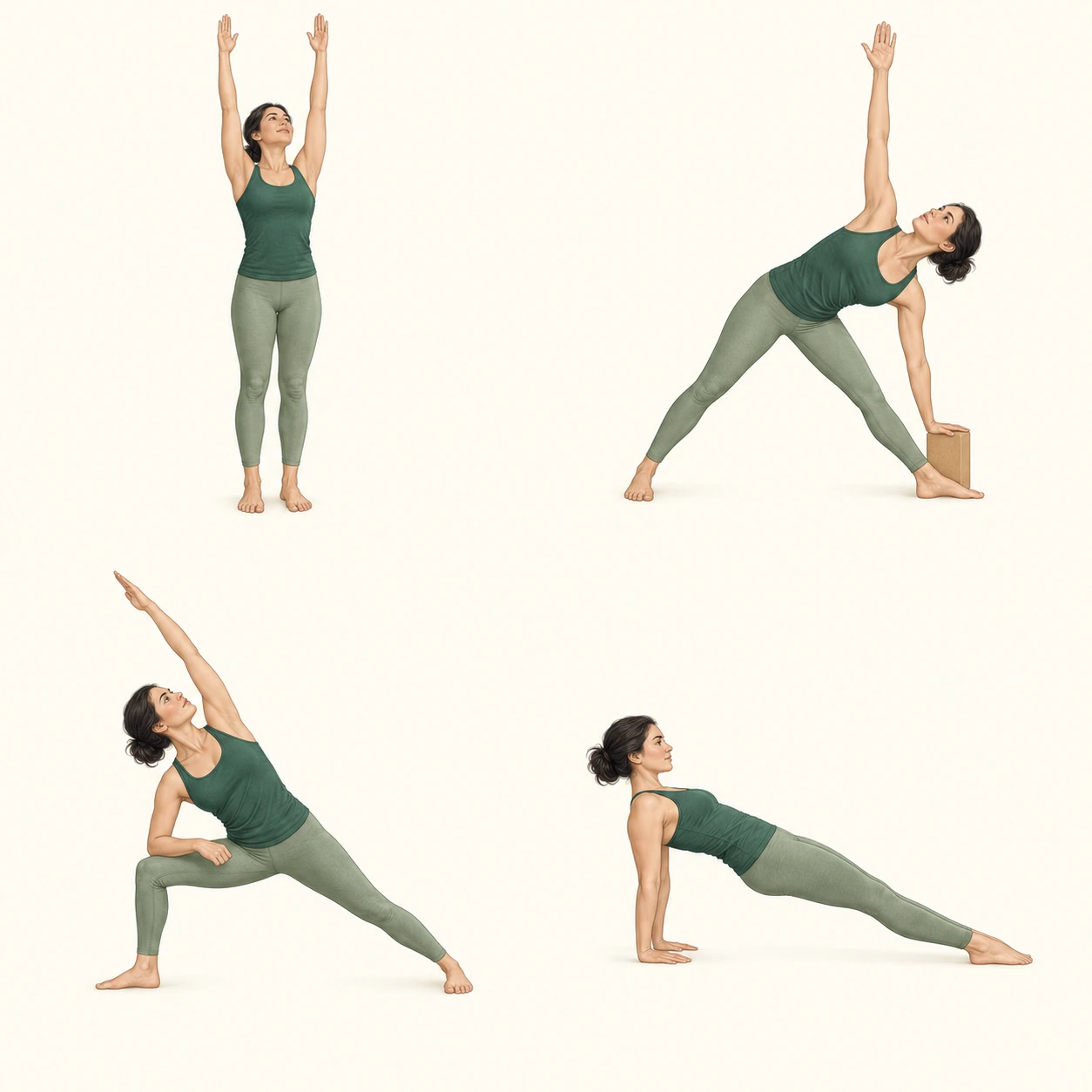
“Open hips” and “closed hips” are classroom shorthand for orientation. They are not instructions to wrench the pelvis to a fixed angle. Change stance, use support and keep the movement comfortable. The full pose library remains the place for illustrated adaptations and the established sequence holds the A–D variations.
| Sanskrit | English | Reading the class cue |
|---|---|---|
| Utthita Trikoṇāsana | Extended Triangle | Utthita: extended; tri: three; koṇa: angle. |
| Parivṛtta Trikoṇāsana | Revolved Triangle | Parivṛtta: revolved; rotation is added, not forced. |
| Utthita Pārśvakoṇāsana | Extended Side Angle | Pārśva: side; a distinct bent-front-knee posture. |
| Parivṛtta Pārśvakoṇāsana | Revolved Side Angle | A revolved variation, not another name for Triangle. |
| Prasārita Pādottānāsana A–D | Wide-Legged Standing Forward Fold variations | A–D distinguish arm and hand arrangements in the Ashtanga sequence. |
| Pārśvottānāsana | Intense Side Stretch / Pyramid | Different from Pārśvakoṇāsana despite the shared “side” word. |
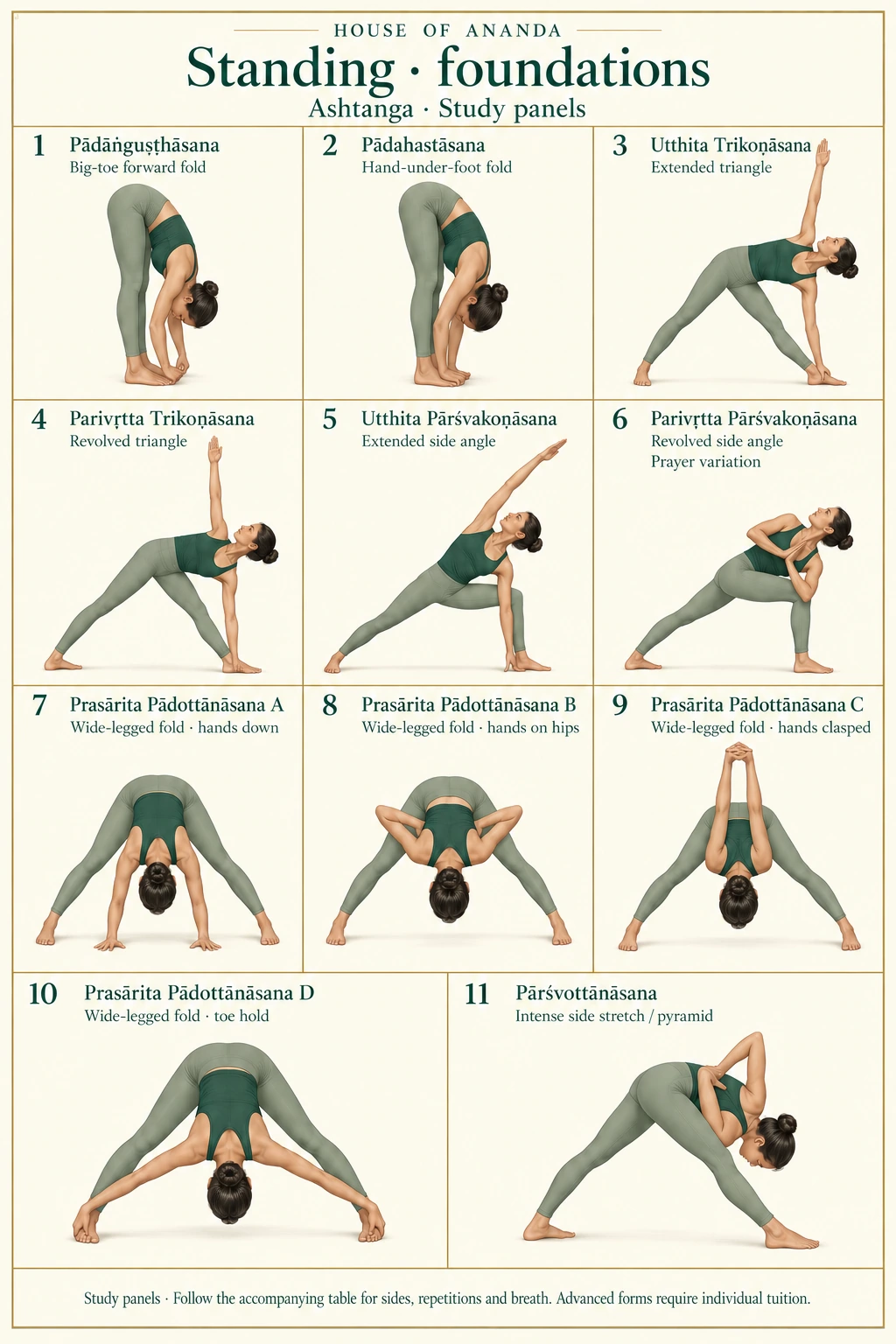
07 · Study
A fragment that needs its teacher’s context
IMG_1853/1854 also lists Brahmā, Viṣṇu and Mahesh, with a partly unclear heading and a name resembling Marīci beside “ray of light”. The page does not supply a complete chant or explain how the names connect. No mantra, mythology or pose sequence has been reconstructed from this fragment.
08 · Study
Standing balance, half lotus and the Pigeon heading
The notes do not supply enough detail to reconstruct the Pigeon version or A–D instructions. Use the existing standing sequence and individual teaching for these variations; a pose name alone is not a readiness assessment.
| Notebook name | Standardised reading | Important distinction |
|---|---|---|
| Utthita Hasta Pādāṅguṣṭhāsana A–D | Extended Hand-to-Big-Toe Pose variations | The hand, big toe and extended leg explain the name; a strap or bent knee can replace the grip. |
| Ardha Baddha Padmottānāsana | Half-Bound Lotus Standing Forward Fold | A demanding half-lotus bind and fold; never torque the knee into lotus. |
| Kapot āsana / Pigeon | Kapota means pigeon | The heading alone does not distinguish a modern one-legged Pigeon preparation from the kneeling backbend Kapotāsana. |
From notebook to page
IMG_1588, left page. “Ardha forward fold/bend” is expanded to Ardha Uttānāsana in this standing-pose context. The brief directional words are vocabulary, not a complete flow. Expanded with IMG_1839, IMG_1842 and IMG_1846. Sun Salutation sequences are developed on the existing Ashtanga page. Further study: IMG_1851/1852 and IMG_1857–1858: standing-pose vocabulary. Duplicate photographs counted once. Further study: IMG_1864 and IMG_1869: balancing, half-bound lotus and Pigeon headings.
Spelling has been standardised and explanations added. Traditional teaching cues, anatomical facts and uncertain handwriting are distinguished in the text. These pages support learning alongside appropriate teaching.