House of AnandaMovement · Stillness · Wisdom · Journey

Movement · illustrated practice & study

Aṣṭāṅga
Primary Series.

See every pose. Learn its name. Follow the breath.

Complete Sun Salutations A and B, standing, seated and finishing sequences, with individual pose images, Sanskrit and English names, and visual practice maps. Sun Salutation C from Daniel’s class notes is available as a separate illustrated study sequence.

Your practice reference

The whole route,
one breath at a time.

Choose a sequence to study its photographed poses. Switch to the follow view for a single clear card and the next movement.

Read left to right, then continue on the next row. Numbers show practice order; coloured labels give breath cues. Right and left refer to your body, regardless of the photograph’s direction.

Sun Salutation A

Sūrya Namaskāra A

Sūrya: sun · namaskāra: salutation

One complete cycle: nine counted movements, with equal standing before and after. Common opening practice is five rounds, adjusted with your teacher.

One movement per inhale or exhale; stay for five breaths in downward dog.

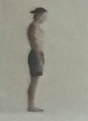
  1. 01Centre / both
    Equal standing — Samasthitiḥ. Posture reference.
    Photograph · Daniel’s training sheets

    Samasthitiḥ

    Equal standing

    Settle

    Stand evenly through both feet. Let the arms rest and settle the breath.

    Meaning, gaze & accessible option
    Word meaning
    sama: equal; sthiti: standing
    Gaze · dṛṣṭi
    Forward / tip of nose
    Accessible option
    Separate the feet slightly for balance.
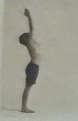
  2. 02Centre / both
    Raised arms — Ūrdhva Hastāsana. Posture reference.
    Photograph · Daniel’s training sheets

    Ūrdhva Hastāsana

    Raised arms

    Inhale1 · Ekam

    Inhale and reach upward without pushing the ribs forward.

    Meaning, gaze & accessible option
    Word meaning
    ūrdhva: upward; hasta: hand
    Gaze · dṛṣṭi
    Thumbs
    Accessible option
    Keep hands apart and look forward if the neck prefers.
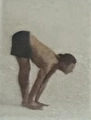
  3. 03Centre / both
    Standing forward fold — Uttānāsana. Posture reference.
    Photograph · Daniel’s training sheets

    Uttānāsana

    Standing forward fold

    Exhale2 · Dve

    Exhale and hinge at the hips; allow the head to release.

    Meaning, gaze & accessible option
    Word meaning
    uttāna: intense stretch
    Gaze · dṛṣṭi
    Tip of nose
    Accessible option
    Bend the knees and place hands on blocks.
  4. 04Centre / both
    Half forward fold / half lift — Ardha Uttānāsana. Posture reference.
    Photograph · Daniel’s training sheets

    Ardha Uttānāsana

    Half forward fold / half lift

    Inhale3 · Trīṇi

    Inhale, lengthen the chest forward and lift the gaze slightly. Called Uttānāsana B on the training sheet.

    Meaning, gaze & accessible option
    Word meaning
    ardha: half; uttāna: intense stretch
    Gaze · dṛṣṭi
    Forward
    Accessible option
    Rest hands on shins or blocks; keep knees soft.
  5. 05Centre / both
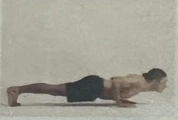
    Four-limbed staff / low plank — Caturaṅga Daṇḍāsana. Posture reference.
    Photograph · Daniel’s training sheets

    Caturaṅga Daṇḍāsana

    Four-limbed staff / low plank

    Exhale4 · Catvāri

    Exhale into a controlled low plank, keeping the shoulders from sinking below the elbows.

    Meaning, gaze & accessible option
    Word meaning
    catur: four; aṅga: limb; daṇḍa: staff
    Gaze · dṛṣṭi
    Tip of nose
    Accessible option
    Step back, lower the knees, then lower only as far as you control.
  6. 06Centre / both
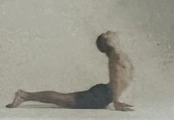
    Upward-facing dog — Ūrdhva Mukha Śvānāsana. Posture reference.
    Photograph · Daniel’s training sheets

    Ūrdhva Mukha Śvānāsana

    Upward-facing dog

    Inhale5 · Pañca

    Inhale, press through hands and tops of feet, lift the chest and keep the legs active.

    Meaning, gaze & accessible option
    Word meaning
    ūrdhva: upward; mukha: face; śvāna: dog
    Gaze · dṛṣṭi
    Upward, without neck compression
    Accessible option
    Use a small cobra with thighs grounded instead; keep the neck long.
  7. 07Centre / both
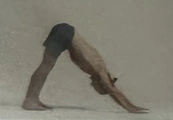
    Downward-facing dog — Adho Mukha Śvānāsana. Posture reference.
    Photograph · Daniel’s training sheets

    Adho Mukha Śvānāsana

    Downward-facing dog

    Exhale · hold 5 breaths6 · Ṣaṭ

    Exhale and lift the hips back and up. Spread pressure through the hands.

    Meaning, gaze & accessible option
    Word meaning
    adhas: downward; mukha: face; śvāna: dog
    Gaze · dṛṣṭi
    Navel or between the feet
    Accessible option
    Bend the knees and lift the heels to make room for the spine.
  8. 08Centre / both
    Half forward fold / half lift — Ardha Uttānāsana. Posture reference.
    Photograph · Daniel’s training sheets

    Ardha Uttānāsana

    Half forward fold / half lift

    Inhale7 · Sapta

    Step or float forward and lengthen.

    Inhale, lengthen the chest forward and lift the gaze slightly. Called Uttānāsana B on the training sheet.

    Meaning, gaze & accessible option
    Word meaning
    ardha: half; uttāna: intense stretch
    Gaze · dṛṣṭi
    Forward
    Accessible option
    Rest hands on shins or blocks; keep knees soft.
  9. 09Centre / both
    Standing forward fold — Uttānāsana. Posture reference.
    Photograph · Daniel’s training sheets

    Uttānāsana

    Standing forward fold

    Exhale8 · Aṣṭau

    Exhale and hinge at the hips; allow the head to release.

    Meaning, gaze & accessible option
    Word meaning
    uttāna: intense stretch
    Gaze · dṛṣṭi
    Tip of nose
    Accessible option
    Bend the knees and place hands on blocks.
  10. 10Centre / both
    Raised arms — Ūrdhva Hastāsana. Posture reference.
    Photograph · Daniel’s training sheets

    Ūrdhva Hastāsana

    Raised arms

    Inhale9 · Nava

    Inhale and reach upward without pushing the ribs forward.

    Meaning, gaze & accessible option
    Word meaning
    ūrdhva: upward; hasta: hand
    Gaze · dṛṣṭi
    Thumbs
    Accessible option
    Keep hands apart and look forward if the neck prefers.
  11. 11Centre / both
    Equal standing — Samasthitiḥ. Posture reference.
    Photograph · Daniel’s training sheets

    Samasthitiḥ

    Equal standing

    Exhale

    Stand evenly through both feet. Let the arms rest and settle the breath.

    Meaning, gaze & accessible option
    Word meaning
    sama: equal; sthiti: standing
    Gaze · dṛṣṭi
    Forward / tip of nose
    Accessible option
    Separate the feet slightly for balance.

Keep the sequence beside your mat

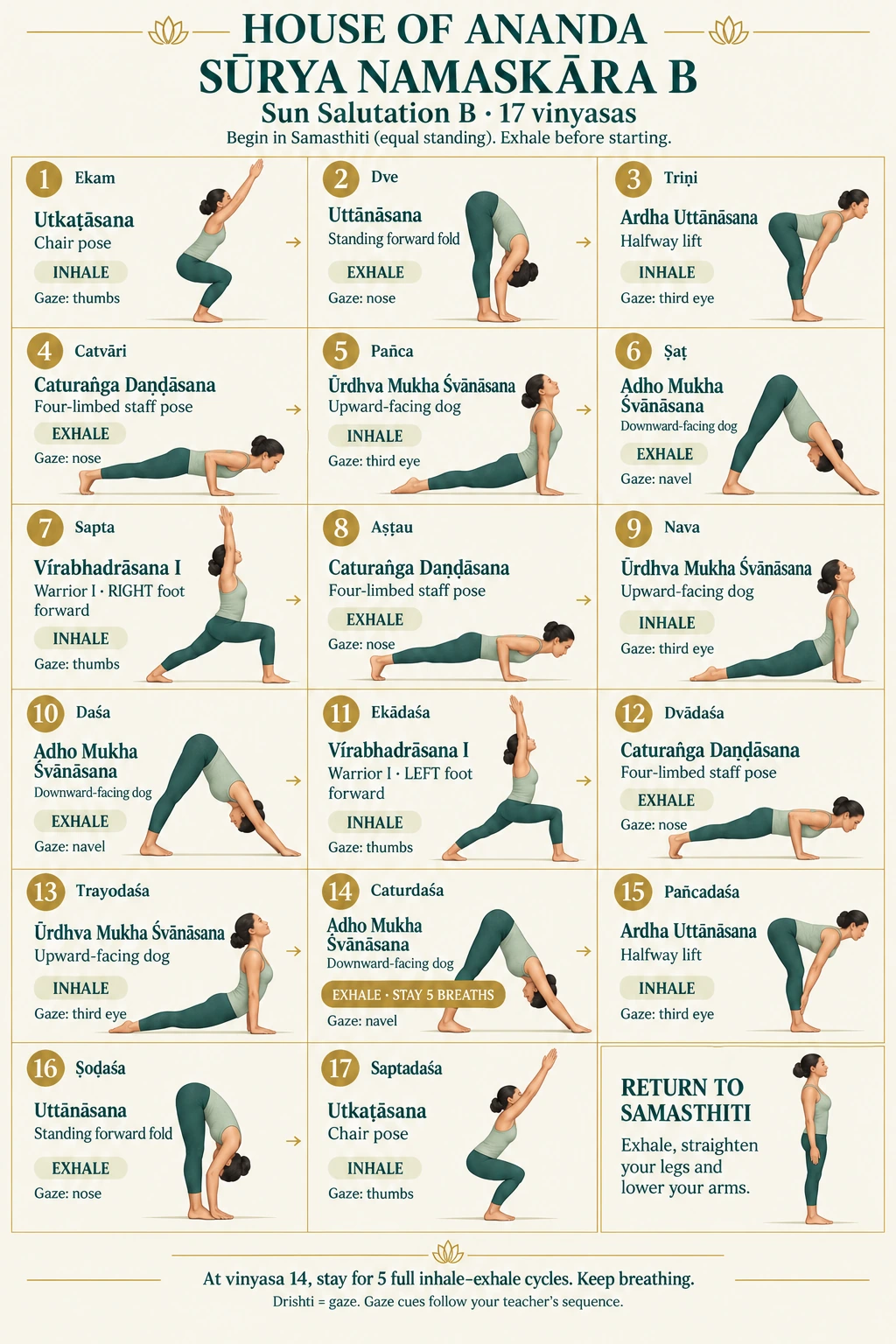
Eight illustrated practice maps.

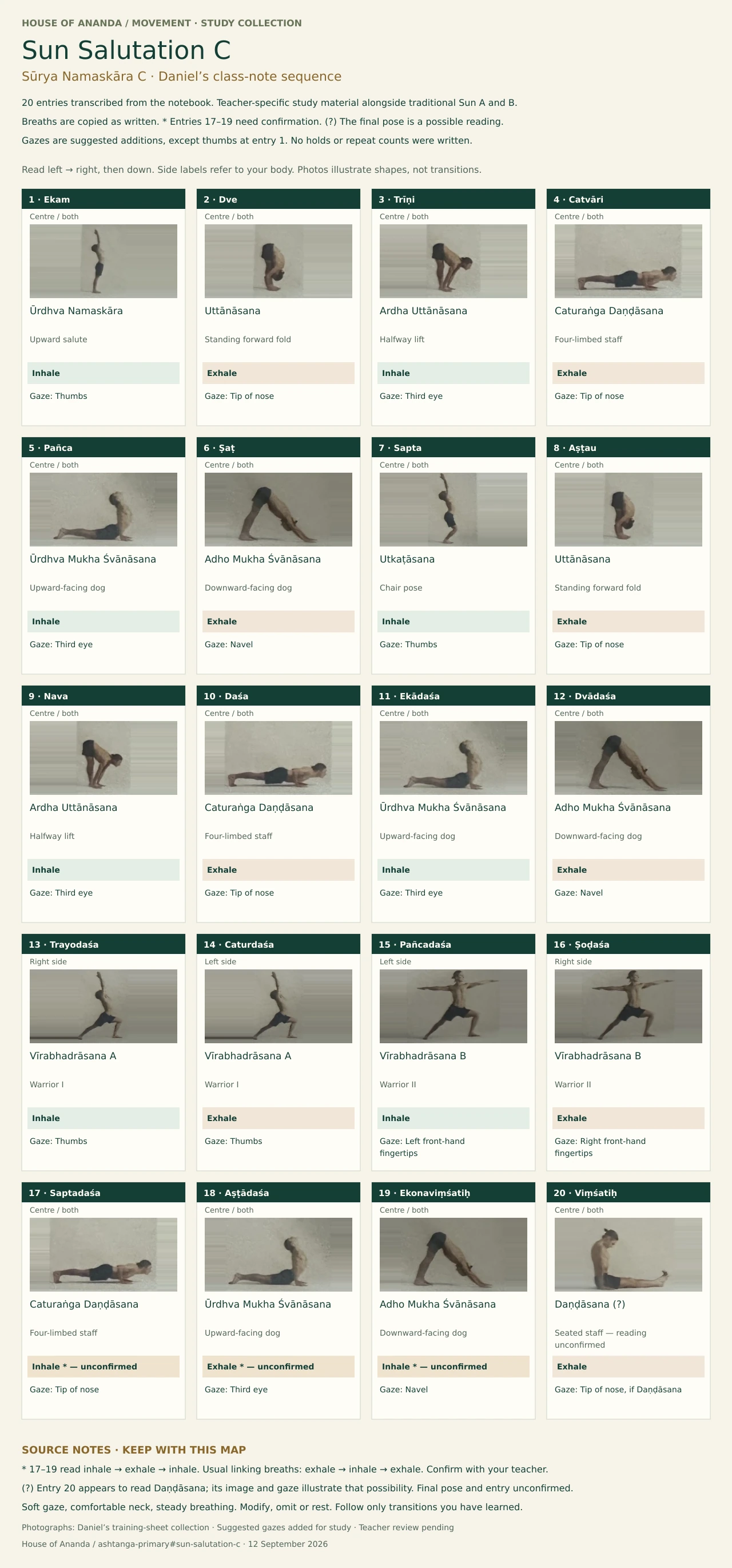
Every map contains the poses in order, Sanskrit and English names, side labels and breath cues. Sun Salutations A and B now use newly created House of Ananda pose illustrations drawn from the written vinyasa instructions—not images from the uploaded training sheets. Each shows one complete round. Sun C adds a 20-entry photographic study map from Daniel’s class notes, with suggested gazes and unresolved entries marked.

Breath · posture · gaze

Sun Salutation vinyasa tables.

Each vinyasa is one movement coordinated with the breath. At the marked downward-facing dog, stay for five complete inhale–exhale cycles without holding the breath. Dṛṣṭi means gaze; these gaze cues follow Daniel’s teacher-led sequence and may vary between schools.

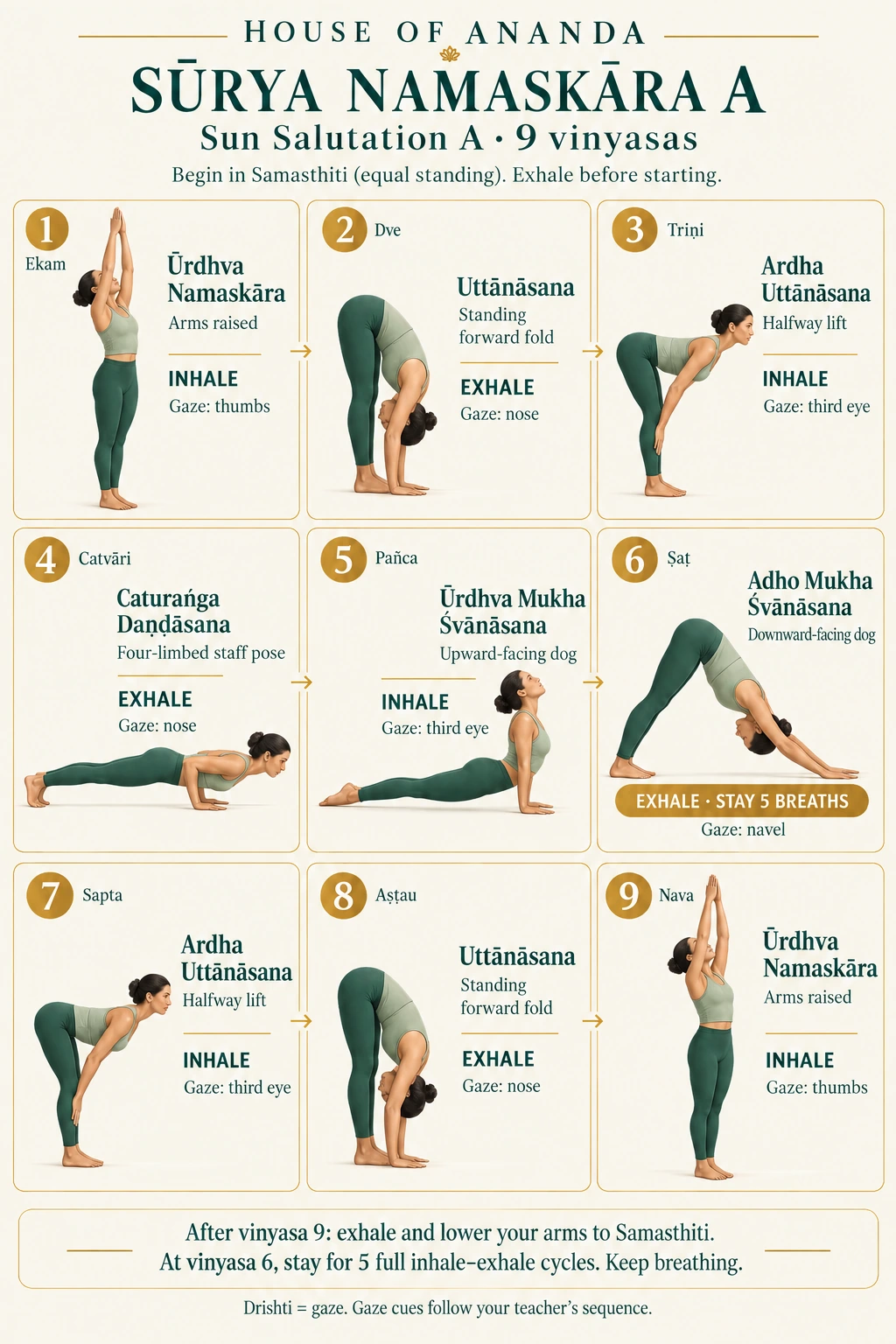
Sun Salutation A · 9 vinyasas

Sūrya Namaskāra A

Begin in Samasthiti with your arms by your sides. Exhale before starting.

Sūrya Namaskāra A breath, posture and gaze reference
VinyasaBreathSanskrit postureEnglishDṛṣṭi · gaze
1 · EkamInhaleŪrdhva NamaskāraArms raisedThumbs
2 · DveExhaleUttānāsanaStanding forward foldNose
3 · TrīṇiInhaleArdha UttānāsanaHalfway liftThird eye
4 · CatvāriExhaleCaturaṅga DaṇḍāsanaFour-limbed staff poseNose
5 · PañcaInhaleŪrdhva Mukha ŚvānāsanaUpward-facing dogThird eye
6 · ṢaṭExhale · stay 5 breathsAdho Mukha ŚvānāsanaDownward-facing dogNavel
7 · SaptaInhaleArdha UttānāsanaReturn and lift halfwayThird eye
8 · AṣṭauExhaleUttānāsanaStanding forward foldNose
9 · NavaInhaleŪrdhva NamaskāraRise with arms overheadThumbs

After vinyasa 9, exhale and lower your arms to Samasthiti to complete the round.

Sun Salutation B · 17 vinyasas

Sūrya Namaskāra B

Begin in Samasthiti with your arms by your sides. Exhale before starting.

Sūrya Namaskāra B breath, posture and gaze reference
VinyasaBreathSanskrit postureEnglishDṛṣṭi · gaze
1 · EkamInhaleUtkaṭāsanaChair poseThumbs
2 · DveExhaleUttānāsanaStanding forward foldNose
3 · TrīṇiInhaleArdha UttānāsanaHalfway liftThird eye
4 · CatvāriExhaleCaturaṅga DaṇḍāsanaFour-limbed staff poseNose
5 · PañcaInhaleŪrdhva Mukha ŚvānāsanaUpward-facing dogThird eye
6 · ṢaṭExhaleAdho Mukha ŚvānāsanaDownward-facing dogNavel
7 · SaptaInhaleVīrabhadrāsana IWarrior I · right foot forwardThumbs
8 · AṣṭauExhaleCaturaṅga DaṇḍāsanaFour-limbed staff poseNose
9 · NavaInhaleŪrdhva Mukha ŚvānāsanaUpward-facing dogThird eye
10 · DaśaExhaleAdho Mukha ŚvānāsanaDownward-facing dogNavel
11 · EkādaśaInhaleVīrabhadrāsana IWarrior I · left foot forwardThumbs
12 · DvādaśaExhaleCaturaṅga DaṇḍāsanaFour-limbed staff poseNose
13 · TrayodaśaInhaleŪrdhva Mukha ŚvānāsanaUpward-facing dogThird eye
14 · CaturdaśaExhale · stay 5 breathsAdho Mukha ŚvānāsanaDownward-facing dogNavel
15 · PañcadaśaInhaleArdha UttānāsanaReturn and lift halfwayThird eye
16 · ṢoḍaśaExhaleUttānāsanaStanding forward foldNose
17 · SaptadaśaInhaleUtkaṭāsanaChair poseThumbs

After vinyasa 17, exhale, straighten your legs and lower your arms to Samasthiti to complete the round.

Daniel’s class notes · teacher-specific study sequence

Sun Salutation C.

Twenty entries, illustrated in the order written in Daniel’s notebook. Study the Sanskrit and English names, breath notes, suggested gazes and accessible options alongside Sun A and B.

Sun Salutation C: twenty numbered pose photographs with Sanskrit and English names, sides, source breaths and suggested gaze. Breaths 17–19 and final staff pose are marked unconfirmed.
Read left to right, then down. Photographic references from Daniel’s training-sheet collection. Open to zoom.

A familiar visual guide.
Your written sequence.

This is a teacher-specific study sequence, not a third standard Ashtanga opening salutation. Traditional Sun A and B and the existing Full Primary Series remain available in the same collection.

What the sequence explores

Folds and half lifts practise hip hinging and spinal length. Chair and the Warriors develop standing control; the linking shapes explore upper-body support. These are movement aims, not promised medical benefits.

Use a soft gaze

Thumbs: aṅguṣṭha. Nose tip: nāsāgra. Third eye: bhrūmadhya. Navel: nābhi. Front fingertips: hastāgra. Keep the neck comfortable and the eyes relaxed; use a neutral gaze when needed.

Only “thumbs” at entry 1 was written in the gaze column. All other gazes are suggested additions, matching the conventions used in this collection where applicable. They have not been confirmed by Daniel’s teacher.

20 study entries · source breaths with suggested gazes

Sūrya Namaskāra C

Breaths copied from the notebook; gazes added for study. Counts are the numbers 1–20, shown in numerals and Sanskrit.

Sūrya Namaskāra C breath, posture and gaze reference
Count · numberBreathSanskrit postureEnglishDṛṣṭi · gaze
1 · EkamInhaleŪrdhva NamaskāraUpward saluteThumbs
2 · DveExhaleUttānāsanaStanding forward foldTip of nose
3 · TrīṇiInhaleArdha UttānāsanaHalfway liftThird eye
4 · CatvāriExhaleCaturaṅga DaṇḍāsanaFour-limbed staffTip of nose
5 · PañcaInhaleŪrdhva Mukha ŚvānāsanaUpward-facing dogThird eye
6 · ṢaṭExhaleAdho Mukha ŚvānāsanaDownward-facing dogNavel
7 · SaptaInhaleUtkaṭāsanaChair poseThumbs
8 · AṣṭauExhaleUttānāsanaStanding forward foldTip of nose
9 · NavaInhaleArdha UttānāsanaHalfway liftThird eye
10 · DaśaExhaleCaturaṅga DaṇḍāsanaFour-limbed staffTip of nose
11 · EkādaśaInhaleŪrdhva Mukha ŚvānāsanaUpward-facing dogThird eye
12 · DvādaśaExhaleAdho Mukha ŚvānāsanaDownward-facing dogNavel
13 · TrayodaśaInhaleVīrabhadrāsana AWarrior I · RightThumbs
14 · CaturdaśaExhaleVīrabhadrāsana AWarrior I · LeftThumbs
15 · PañcadaśaInhaleVīrabhadrāsana BWarrior II · LeftLeft front-hand fingertips
16 · ṢoḍaśaExhaleVīrabhadrāsana BWarrior II · RightRight front-hand fingertips
17 · SaptadaśaInhale *Caturaṅga DaṇḍāsanaFour-limbed staffTip of nose
18 · AṣṭādaśaExhale *Ūrdhva Mukha ŚvānāsanaUpward-facing dogThird eye
19 · EkonaviṃśatiḥInhale *Adho Mukha ŚvānāsanaDownward-facing dogNavel
20 · ViṃśatiḥExhaleDaṇḍāsana (?)Seated staff — reading unconfirmedTip of nose, if Daṇḍāsana

* Source breath unconfirmed at entries 17–19. (?) Final pose reading unconfirmed. Confirm these entries with your teacher before using them as movement instructions.

Continue your study: Sun Salutations A & B · Pose library, benefits & accessible options · Primary Series atlas. Gaze references: Yoga Synergy’s Sun Salutation teaching and AYI practice charts. These sources do not establish this C sequence or imply teacher approval.

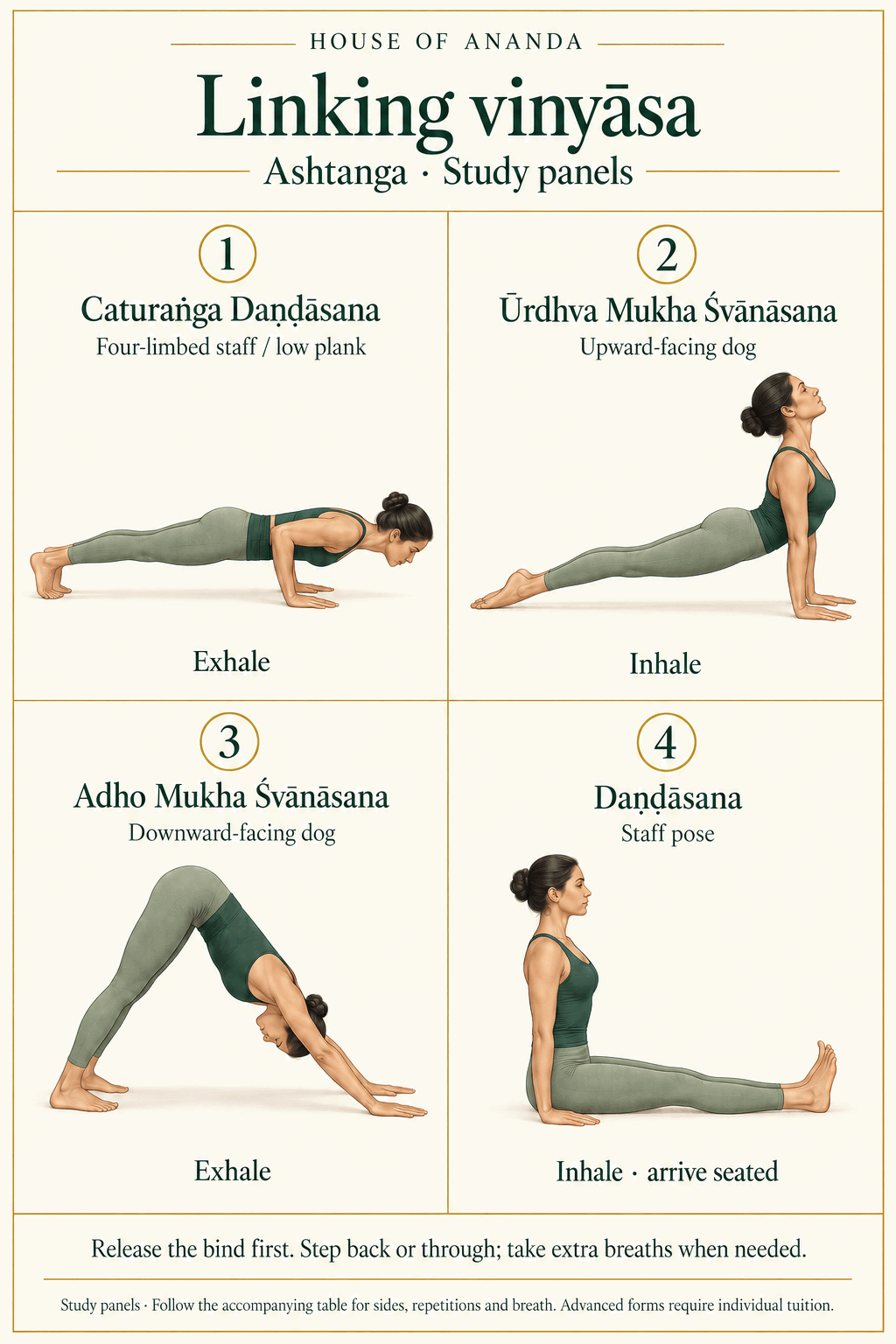
How the seated poses connect

Vinyāsa · the linking sequence.

A “Then linking vinyāsa” marker leads through these shapes before the next side or family. The follow view inserts the link for you. Release any bind before moving; stepping is welcome and may take extra breaths.

After reclining poses, sit up and use a step-back transition. The traditional Cakrāsana backward rollover is a separately taught option, not required here.

  1. Four-limbed staff / low plank1 · Caturaṅga DaṇḍāsanaFour-limbed staff / low plankExhale
  2. Upward-facing dog2 · Ūrdhva Mukha ŚvānāsanaUpward-facing dogInhale
  3. Downward-facing dog3 · Adho Mukha ŚvānāsanaDownward-facing dogExhale
  4. Staff pose4 · DaṇḍāsanaStaff poseInhale · arrive seated
Study the transition cards ↑

House of Ananda · Primary Series study atlas

The complete practice, in pictures and tables.

Nine original illustrated sheets cover standing, seated, linking and finishing forms. Use the accompanying tables for every side, repetition, breath cue and gaze point. The Sun Salutation A and B tables and posters remain above.

Sheet numbers identify study panels. Table numbers show practice order; they are not the traditional Sanskrit vinyāsa count. A five-breath stay means five full breathing cycles. Follow your teacher’s timing and adaptations.

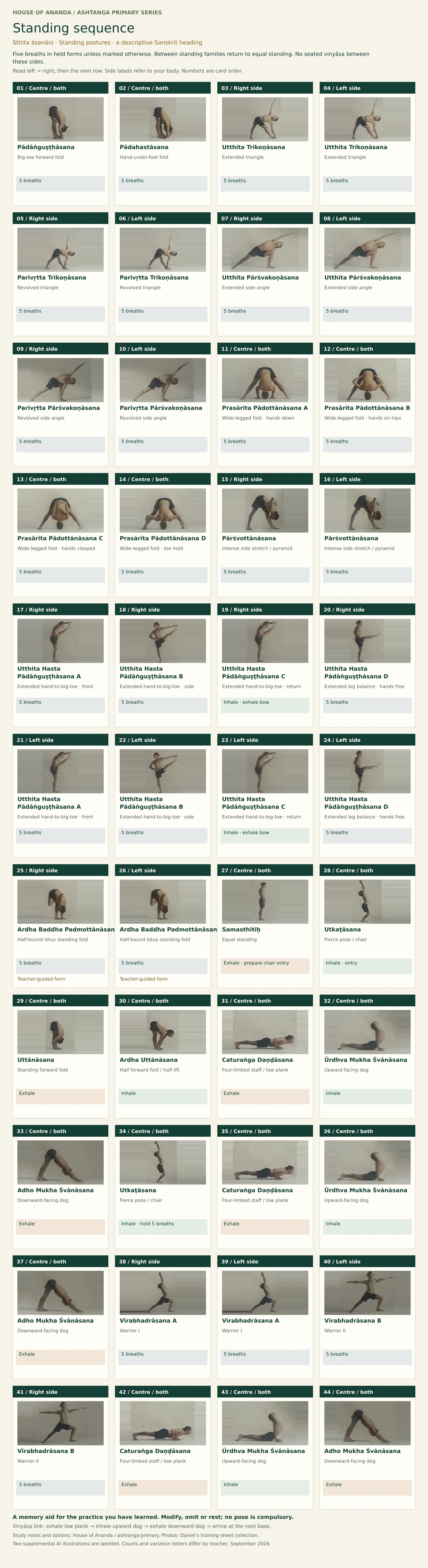
Sthita āsanāni

Standing sequence

The fundamental standing poses lead into balances, chair and warriors. Right and left are written out; the balance family completes one whole side before the other.

Five breaths in held forms unless marked otherwise. Between standing families return to equal standing. No seated vinyāsa between these sides.

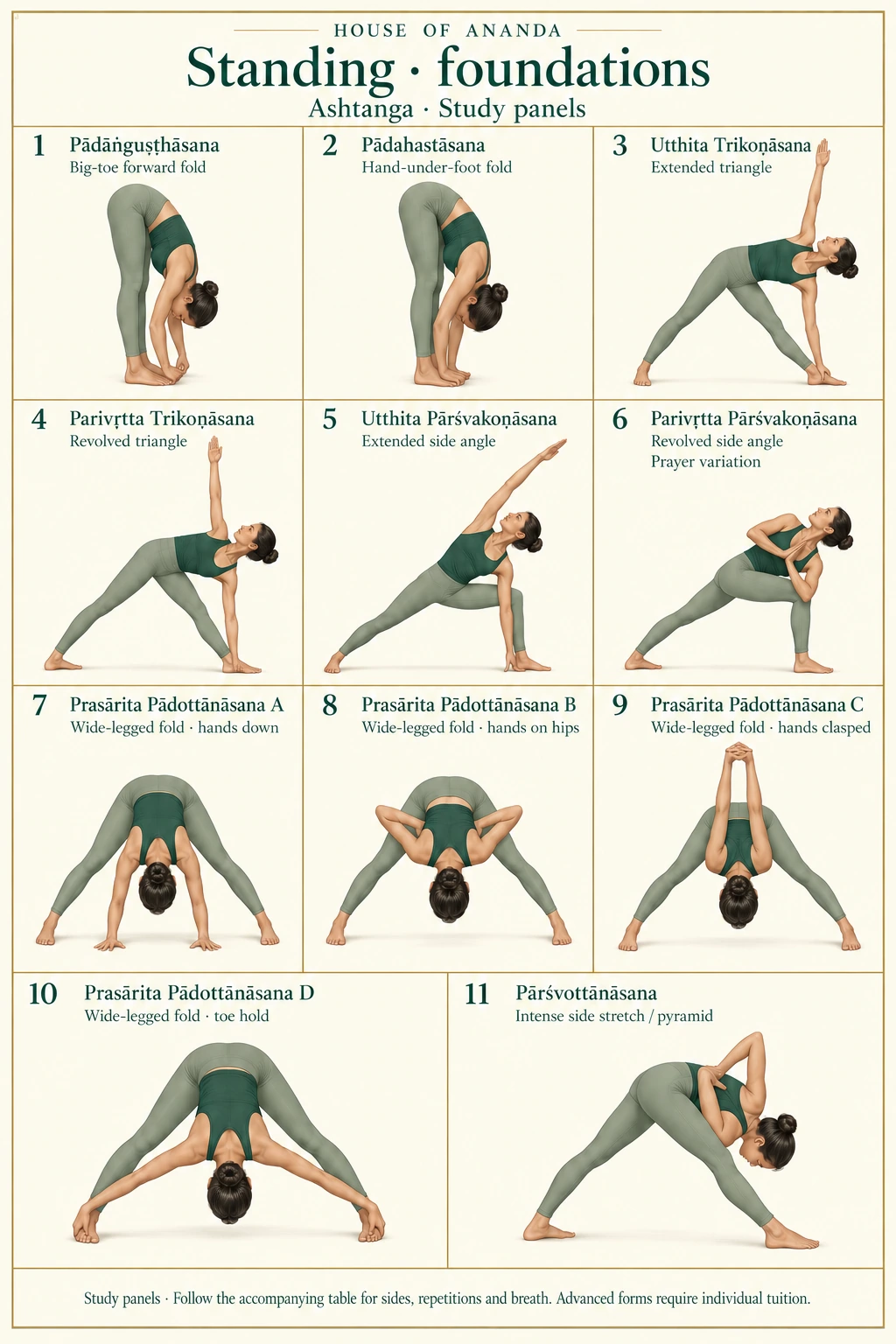
Standing · foundations: original illustrations of Big-toe forward fold; Hand-under-foot fold; Extended triangle; Revolved triangle; Extended side angle; Revolved side angle; Wide-legged fold · hands down; Wide-legged fold · hands on hips; Wide-legged fold · hands clasped; Wide-legged fold · toe hold; Intense side stretch / pyramid.

Standing · foundations

Folds, triangles and side angles

Panel 6 illustrates the prayer-hands variation of revolved side angle. The traditional extended-arm form is described in the table; choose a comfortable gaze for the variation you practise.

Original AI illustrations · read with the posture notes
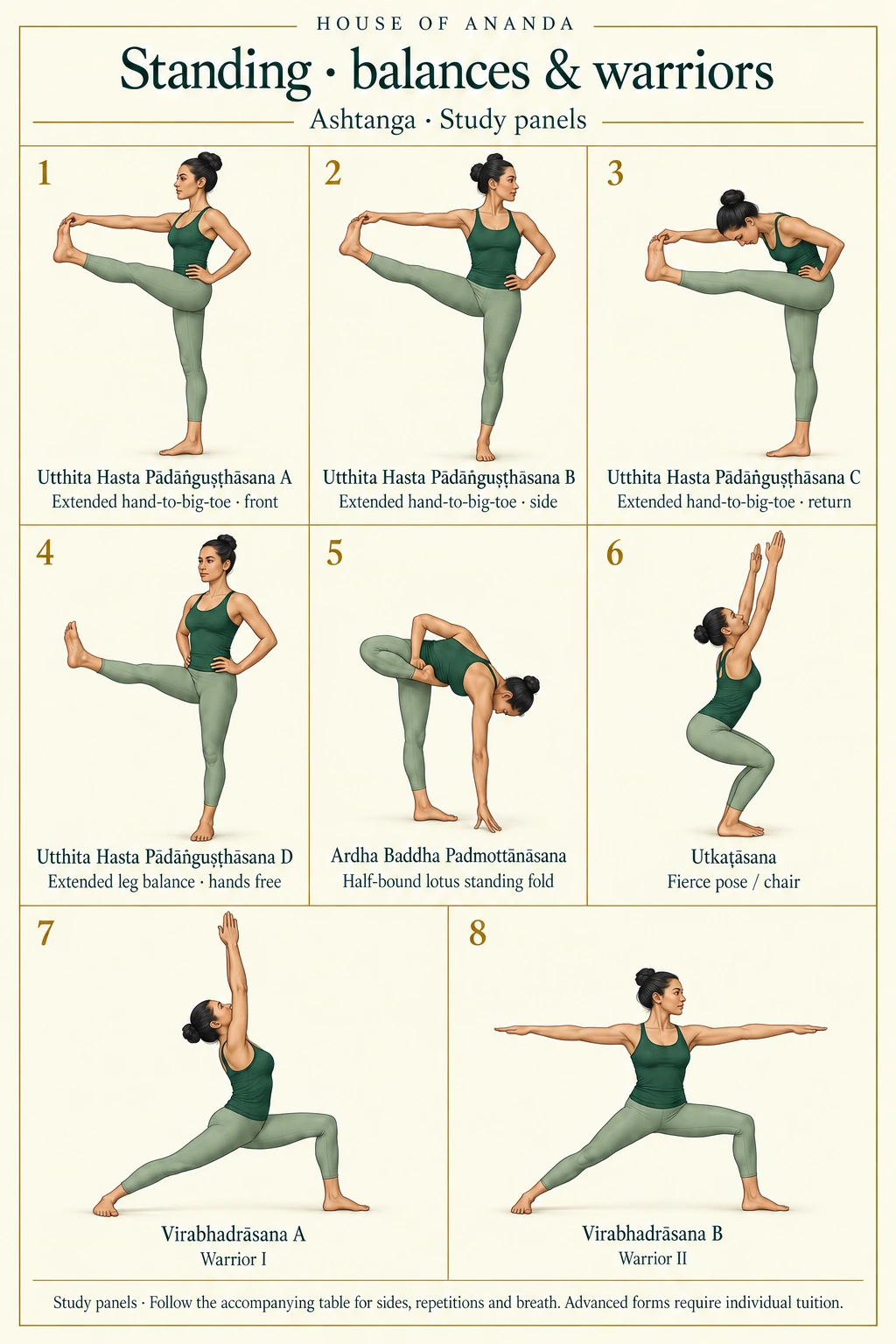
Standing · balances & warriors: original illustrations of Extended hand-to-big-toe · front; Extended hand-to-big-toe · side; Extended hand-to-big-toe · return; Extended leg balance · hands free; Half-bound lotus standing fold; Fierce pose / chair; Warrior I; Warrior II.

Standing · balances & warriors

Complete one balance side before the other

Original AI illustrations · read with the posture notes

Read in order. On a small screen, scroll the table sideways to see the gaze and practice notes. Right and left always refer to your body.

Standing sequence · 44 practice entries, including all written sides and repetitions.
Practice orderSanskrit / English postureSideBreath / stayDṛṣṭi · gazePractice notes
1PādāṅguṣṭhāsanaBig-toe forward foldCentre / both5 breathsTip of nose
Cue, meaning & alternative

With feet hip-width, take the big toes; inhale to lengthen, exhale to fold.

Accessible option: Bend the knees or hold a strap rather than pulling down.

Word meaning: pāda: foot; aṅguṣṭha: big toe

2PādahastāsanaHand-under-foot foldCentre / both5 breathsTip of nose
Cue, meaning & alternative

Slide palms under the feet only as far as the wrists are comfortable; lengthen before folding.

Accessible option: Keep hands on blocks if wrist pressure is uncomfortable.

Word meaning: pāda: foot; hasta: hand

3Utthita TrikoṇāsanaExtended triangleRight5 breathsUpper hand
Cue, meaning & alternative

Reach over the front leg and rotate the chest gently upward. Keep both sides of the waist long.

Accessible option: Place the lower hand on a block; look down for balance.

Word meaning: utthita: extended; tri: three; koṇa: angle

4Utthita TrikoṇāsanaExtended triangleLeft5 breathsUpper hand
Cue, meaning & alternative

Reach over the front leg and rotate the chest gently upward. Keep both sides of the waist long.

Accessible option: Place the lower hand on a block; look down for balance.

Word meaning: utthita: extended; tri: three; koṇa: angle

5Parivṛtta TrikoṇāsanaRevolved triangleRight5 breathsUpper hand or down
Cue, meaning & alternative

Lengthen over the front leg before turning the ribs. Keep both feet steady.

Accessible option: Raise the lower hand onto a block and shorten the stance.

Word meaning: parivṛtta: revolved; trikoṇa: triangle

6Parivṛtta TrikoṇāsanaRevolved triangleLeft5 breathsUpper hand or down
Cue, meaning & alternative

Lengthen over the front leg before turning the ribs. Keep both feet steady.

Accessible option: Raise the lower hand onto a block and shorten the stance.

Word meaning: parivṛtta: revolved; trikoṇa: triangle

7Utthita PārśvakoṇāsanaExtended side angleRight5 breathsUpper hand
Cue, meaning & alternative

Bend the front knee and reach from the back heel through the upper fingertips.

Accessible option: Rest the lower forearm on the thigh; use a block.

Word meaning: utthita: extended; pārśva: side; koṇa: angle

8Utthita PārśvakoṇāsanaExtended side angleLeft5 breathsUpper hand
Cue, meaning & alternative

Bend the front knee and reach from the back heel through the upper fingertips.

Accessible option: Rest the lower forearm on the thigh; use a block.

Word meaning: utthita: extended; pārśva: side; koṇa: angle

9Parivṛtta PārśvakoṇāsanaRevolved side angleRight5 breathsUpper hand or down
Cue, meaning & alternative

Turn from a lengthened torso and keep space to breathe. Avoid levering hard with the elbow.

Accessible option: Use a supported lunge twist with the back knee down.

Word meaning: parivṛtta: revolved; pārśva: side; koṇa: angle

10Parivṛtta PārśvakoṇāsanaRevolved side angleLeft5 breathsUpper hand or down
Cue, meaning & alternative

Turn from a lengthened torso and keep space to breathe. Avoid levering hard with the elbow.

Accessible option: Use a supported lunge twist with the back knee down.

Word meaning: parivṛtta: revolved; pārśva: side; koṇa: angle

11Prasārita Pādottānāsana AWide-legged fold · hands downCentre / both5 breathsTip of nose
Cue, meaning & alternative

Stand wide, bring hands to the floor and fold with the weight balanced through both feet.

Accessible option: Use blocks and let the head remain above the ground.

Word meaning: prasārita: spread; pāda: foot; uttāna: stretch

12Prasārita Pādottānāsana BWide-legged fold · hands on hipsCentre / both5 breathsTip of nose
Cue, meaning & alternative

Keep hands at the waist. Lengthen on the inhale and fold on the exhale.

Accessible option: Reduce the fold or bend the knees slightly.

Word meaning: prasārita: spread; pāda: foot; uttāna: stretch

13Prasārita Pādottānāsana CWide-legged fold · hands claspedCentre / both5 breathsTip of nose
Cue, meaning & alternative

Clasp hands behind the back and allow the arms to move only within an easy shoulder range.

Accessible option: Hold a strap with hands apart; never pull the arms toward the floor.

Word meaning: prasārita: spread; pāda: foot; uttāna: stretch

14Prasārita Pādottānāsana DWide-legged fold · toe holdCentre / both5 breathsTip of nose
Cue, meaning & alternative

Hold the big toes and hinge forward with elbows opening to the sides.

Accessible option: Use a strap or return to hands on blocks.

Word meaning: prasārita: spread; pāda: foot; uttāna: stretch

15PārśvottānāsanaIntense side stretch / pyramidRight5 breathsFront foot
Cue, meaning & alternative

Turn over the front leg and fold with both hips supported by the legs.

Accessible option: Use blocks or hands on hips instead of reverse prayer.

Word meaning: pārśva: side; uttāna: intense stretch

16PārśvottānāsanaIntense side stretch / pyramidLeft5 breathsFront foot
Cue, meaning & alternative

Turn over the front leg and fold with both hips supported by the legs.

Accessible option: Use blocks or hands on hips instead of reverse prayer.

Word meaning: pārśva: side; uttāna: intense stretch

17Utthita Hasta Pādāṅguṣṭhāsana AExtended hand-to-big-toe · frontRight5 breathsRaised foot
Cue, meaning & alternative

Raise the working leg forward and hold the big toe. Establish an upright balance before any forward bow shown in the photo.

Accessible option: Keep the knee bent, use a strap and hold a wall.

Word meaning: utthita: extended; hasta: hand; pāda: foot; aṅguṣṭha: big toe

18Utthita Hasta Pādāṅguṣṭhāsana BExtended hand-to-big-toe · sideRight5 breathsOpposite side, or forward
Cue, meaning & alternative

Open the raised leg to its own side while keeping the standing foot steady.

Accessible option: Hold a wall and keep the lifted knee bent.

Word meaning: Also called Utthita Pārśvasahita: extended to the side

19Utthita Hasta Pādāṅguṣṭhāsana CExtended hand-to-big-toe · returnRightInhale · exhale bowRaised foot
Cue, meaning & alternative

Return the leg to the front. Inhale to lengthen; exhale into the brief forward bow if taught.

Accessible option: Remain upright with the leg supported.

Word meaning: The returning front phase; lettering varies by school

20Utthita Hasta Pādāṅguṣṭhāsana DExtended leg balance · hands freeRight5 breathsForward
Cue, meaning & alternative

Return upright, release the toe and place hands on hips; keep the raised leg at a manageable height.

Accessible option: Bend the lifted knee or lightly touch the toes down.

Word meaning: The unsupported front-leg phase

21Utthita Hasta Pādāṅguṣṭhāsana AExtended hand-to-big-toe · frontLeft5 breathsRaised foot
Cue, meaning & alternative

Raise the working leg forward and hold the big toe. Establish an upright balance before any forward bow shown in the photo.

Accessible option: Keep the knee bent, use a strap and hold a wall.

Word meaning: utthita: extended; hasta: hand; pāda: foot; aṅguṣṭha: big toe

22Utthita Hasta Pādāṅguṣṭhāsana BExtended hand-to-big-toe · sideLeft5 breathsOpposite side, or forward
Cue, meaning & alternative

Open the raised leg to its own side while keeping the standing foot steady.

Accessible option: Hold a wall and keep the lifted knee bent.

Word meaning: Also called Utthita Pārśvasahita: extended to the side

23Utthita Hasta Pādāṅguṣṭhāsana CExtended hand-to-big-toe · returnLeftInhale · exhale bowRaised foot
Cue, meaning & alternative

Return the leg to the front. Inhale to lengthen; exhale into the brief forward bow if taught.

Accessible option: Remain upright with the leg supported.

Word meaning: The returning front phase; lettering varies by school

24Utthita Hasta Pādāṅguṣṭhāsana DExtended leg balance · hands freeLeft5 breathsForward
Cue, meaning & alternative

Return upright, release the toe and place hands on hips; keep the raised leg at a manageable height.

Accessible option: Bend the lifted knee or lightly touch the toes down.

Word meaning: The unsupported front-leg phase

25Ardha Baddha PadmottānāsanaHalf-bound lotus standing foldRight5 breathsTip of nose
Teacher-guided form · cue & alternative

A teacher-guided half-lotus balance and fold. The rotation must come from the hip, with no pressure at the knee.

Accessible option: Practise a supported standing balance without lotus or binding.

Word meaning: ardha: half; baddha: bound; padma: lotus; uttāna: stretch

26Ardha Baddha PadmottānāsanaHalf-bound lotus standing foldLeft5 breathsTip of nose
Teacher-guided form · cue & alternative

A teacher-guided half-lotus balance and fold. The rotation must come from the hip, with no pressure at the knee.

Accessible option: Practise a supported standing balance without lotus or binding.

Word meaning: ardha: half; baddha: bound; padma: lotus; uttāna: stretch

27SamasthitiḥEqual standingCentre / bothExhale · prepare chair entryForward / tip of nose
Cue, meaning & alternative

Stand evenly through both feet. Let the arms rest and settle the breath.

Accessible option: Separate the feet slightly for balance.

Word meaning: sama: equal; sthiti: standing

28UtkaṭāsanaFierce pose / chairCentre / bothInhale · entryThumbs
Cue, meaning & alternative

Bend the knees and lift the arms while keeping the heels grounded.

Accessible option: Use a shallower bend and keep the arms forward.

Word meaning: utkaṭa: fierce or powerful

29UttānāsanaStanding forward foldCentre / bothExhaleTip of nose
Cue, meaning & alternative

Exhale and hinge at the hips; allow the head to release.

Accessible option: Bend the knees and place hands on blocks.

Word meaning: uttāna: intense stretch

30Ardha UttānāsanaHalf forward fold / half liftCentre / bothInhaleForward
Cue, meaning & alternative

Inhale, lengthen the chest forward and lift the gaze slightly. Called Uttānāsana B on the training sheet.

Accessible option: Rest hands on shins or blocks; keep knees soft.

Word meaning: ardha: half; uttāna: intense stretch

31Caturaṅga DaṇḍāsanaFour-limbed staff / low plankCentre / bothExhaleTip of nose
Cue, meaning & alternative

Exhale into a controlled low plank, keeping the shoulders from sinking below the elbows.

Accessible option: Step back, lower the knees, then lower only as far as you control.

Word meaning: catur: four; aṅga: limb; daṇḍa: staff

32Ūrdhva Mukha ŚvānāsanaUpward-facing dogCentre / bothInhaleUpward, without neck compression
Cue, meaning & alternative

Inhale, press through hands and tops of feet, lift the chest and keep the legs active.

Accessible option: Use a small cobra with thighs grounded instead; keep the neck long.

Word meaning: ūrdhva: upward; mukha: face; śvāna: dog

33Adho Mukha ŚvānāsanaDownward-facing dogCentre / bothExhaleNavel or between the feet
Cue, meaning & alternative

Exhale and lift the hips back and up. Spread pressure through the hands.

Accessible option: Bend the knees and lift the heels to make room for the spine.

Word meaning: adhas: downward; mukha: face; śvāna: dog

34UtkaṭāsanaFierce pose / chairCentre / bothInhale · stay 5 breathsThumbs

Step or float forward into the held chair. After the hold, place hands down, lift only if taught, and lower into the next vinyāsa.

Cue, meaning & alternative

Bend the knees and lift the arms while keeping the heels grounded.

Accessible option: Use a shallower bend and keep the arms forward.

Word meaning: utkaṭa: fierce or powerful

35Caturaṅga DaṇḍāsanaFour-limbed staff / low plankCentre / bothExhaleTip of nose
Cue, meaning & alternative

Exhale into a controlled low plank, keeping the shoulders from sinking below the elbows.

Accessible option: Step back, lower the knees, then lower only as far as you control.

Word meaning: catur: four; aṅga: limb; daṇḍa: staff

36Ūrdhva Mukha ŚvānāsanaUpward-facing dogCentre / bothInhaleUpward, without neck compression
Cue, meaning & alternative

Inhale, press through hands and tops of feet, lift the chest and keep the legs active.

Accessible option: Use a small cobra with thighs grounded instead; keep the neck long.

Word meaning: ūrdhva: upward; mukha: face; śvāna: dog

37Adho Mukha ŚvānāsanaDownward-facing dogCentre / bothExhaleNavel or between the feet
Cue, meaning & alternative

Exhale and lift the hips back and up. Spread pressure through the hands.

Accessible option: Bend the knees and lift the heels to make room for the spine.

Word meaning: adhas: downward; mukha: face; śvāna: dog

38Vīrabhadrāsana AWarrior IRight5 breathsThumbs
Cue, meaning & alternative

Bend the front knee in the direction of the toes; ground the back foot and lift through the chest.

Accessible option: Shorten or widen the stance; keep hands on hips.

Word meaning: Vīrabhadra: a mythic warrior

39Vīrabhadrāsana AWarrior ILeft5 breathsThumbs
Cue, meaning & alternative

Bend the front knee in the direction of the toes; ground the back foot and lift through the chest.

Accessible option: Shorten or widen the stance; keep hands on hips.

Word meaning: Vīrabhadra: a mythic warrior

40Vīrabhadrāsana BWarrior IILeft5 breathsFront fingertips
Cue, meaning & alternative

Open the pelvis to the long edge of the mat and reach through both arms.

Accessible option: Use a shorter stance and a gentler front-knee bend.

Word meaning: Vīrabhadra: a mythic warrior

41Vīrabhadrāsana BWarrior IIRight5 breathsFront fingertips
Cue, meaning & alternative

Open the pelvis to the long edge of the mat and reach through both arms.

Accessible option: Use a shorter stance and a gentler front-knee bend.

Word meaning: Vīrabhadra: a mythic warrior

42Caturaṅga DaṇḍāsanaFour-limbed staff / low plankCentre / bothExhaleTip of nose
Cue, meaning & alternative

Exhale into a controlled low plank, keeping the shoulders from sinking below the elbows.

Accessible option: Step back, lower the knees, then lower only as far as you control.

Word meaning: catur: four; aṅga: limb; daṇḍa: staff

43Ūrdhva Mukha ŚvānāsanaUpward-facing dogCentre / bothInhaleUpward, without neck compression
Cue, meaning & alternative

Inhale, press through hands and tops of feet, lift the chest and keep the legs active.

Accessible option: Use a small cobra with thighs grounded instead; keep the neck long.

Word meaning: ūrdhva: upward; mukha: face; śvāna: dog

44Adho Mukha ŚvānāsanaDownward-facing dogCentre / bothExhaleNavel or between the feet

Step or float through on the next inhale to arrive in Daṇḍāsana, the first seated pose.

Cue, meaning & alternative

Exhale and lift the hips back and up. Spread pressure through the hands.

Accessible option: Bend the knees and lift the heels to make room for the spine.

Word meaning: adhas: downward; mukha: face; śvāna: dog

Back to atlas contents ↑

Yoga Cikitsā

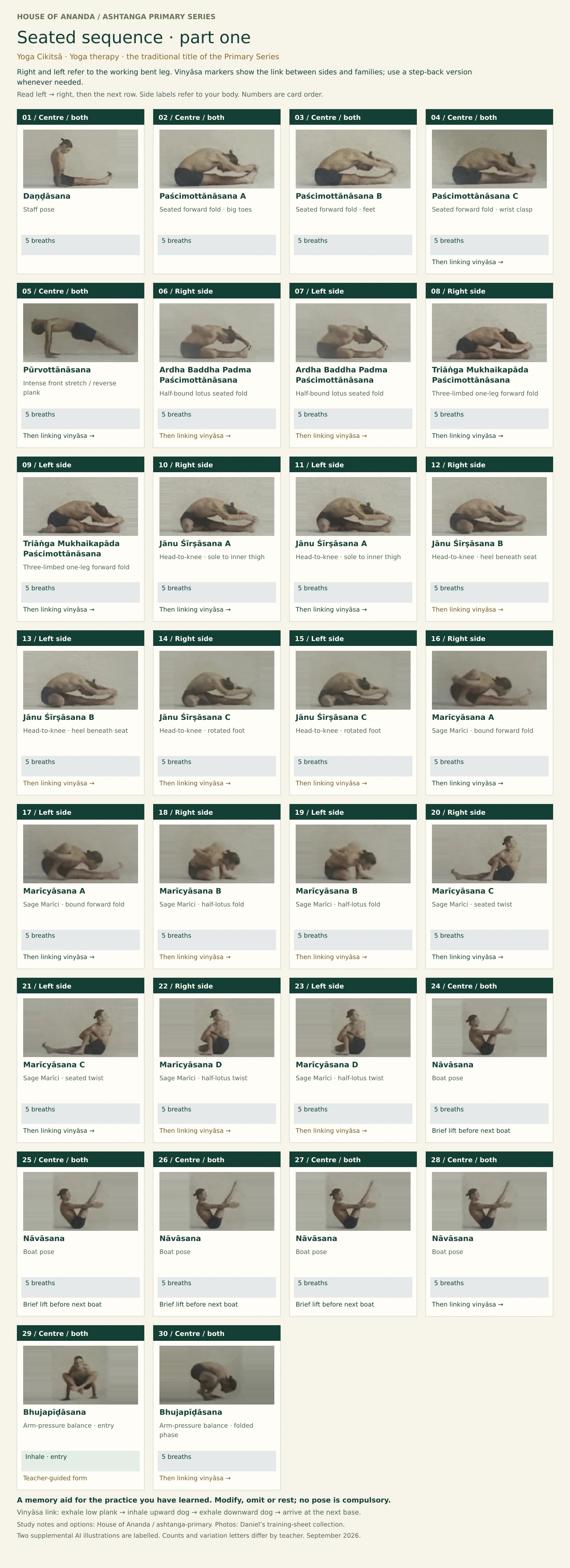
Seated sequence · part one

Staff pose, forward folds, asymmetric folds, twists and boat. The traditional name is not a promise of medical treatment. Learn the sequence progressively.

Right and left refer to the working bent leg. Vinyāsa markers show the link between sides and families; use a step-back version whenever needed.

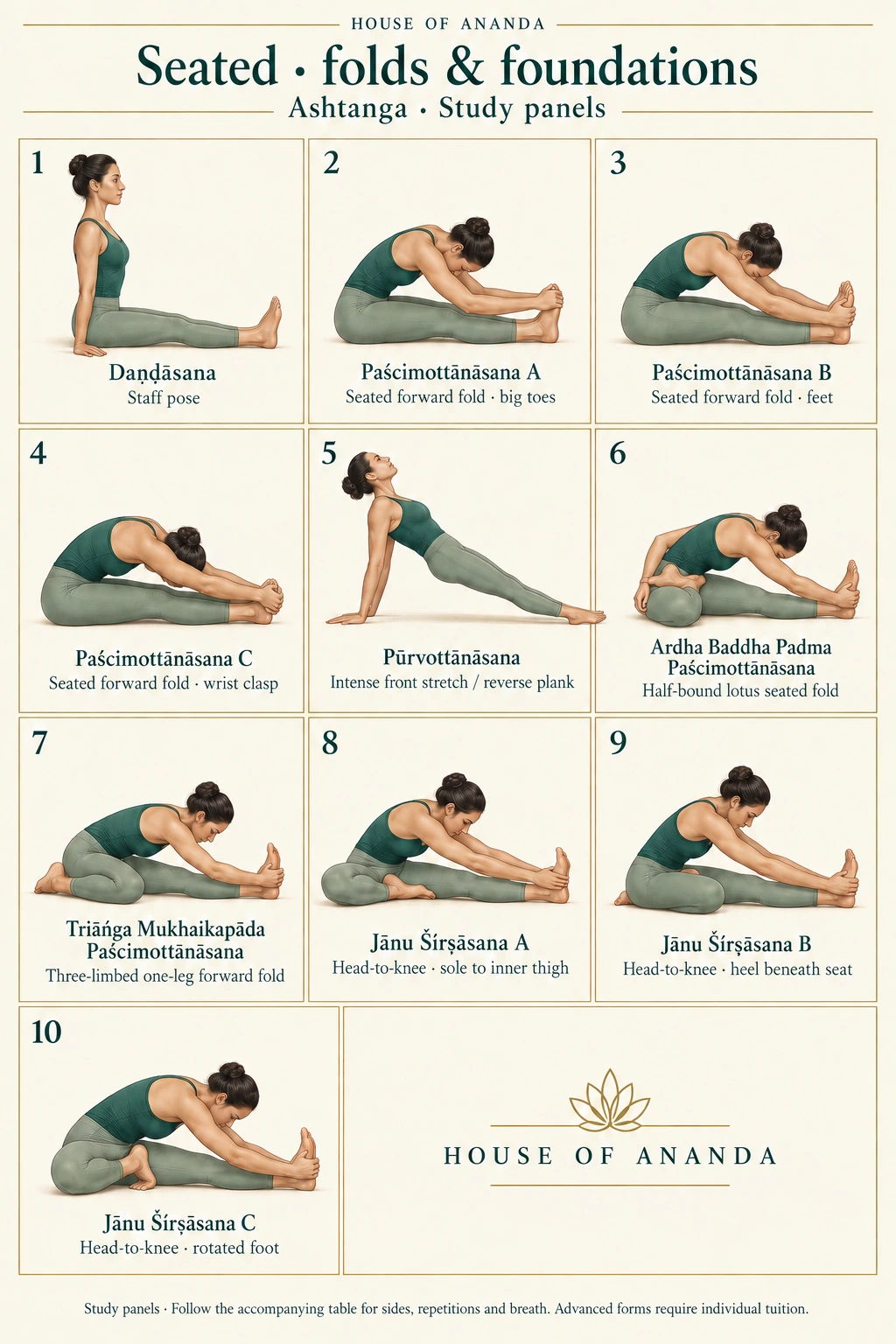
Seated · folds & foundations: original illustrations of Staff pose; Seated forward fold · big toes; Seated forward fold · feet; Seated forward fold · wrist clasp; Intense front stretch / reverse plank; Half-bound lotus seated fold; Three-limbed one-leg forward fold; Head-to-knee · sole to inner thigh; Head-to-knee · heel beneath seat; Head-to-knee · rotated foot.

Seated · folds & foundations

Staff, forward folds and head-to-knee variations

The A–C seated folds differ by grip: toes, feet, then wrist beyond the feet. Grip details are simplified in the drawings; read the table cues.

Original AI illustrations · read with the posture notes
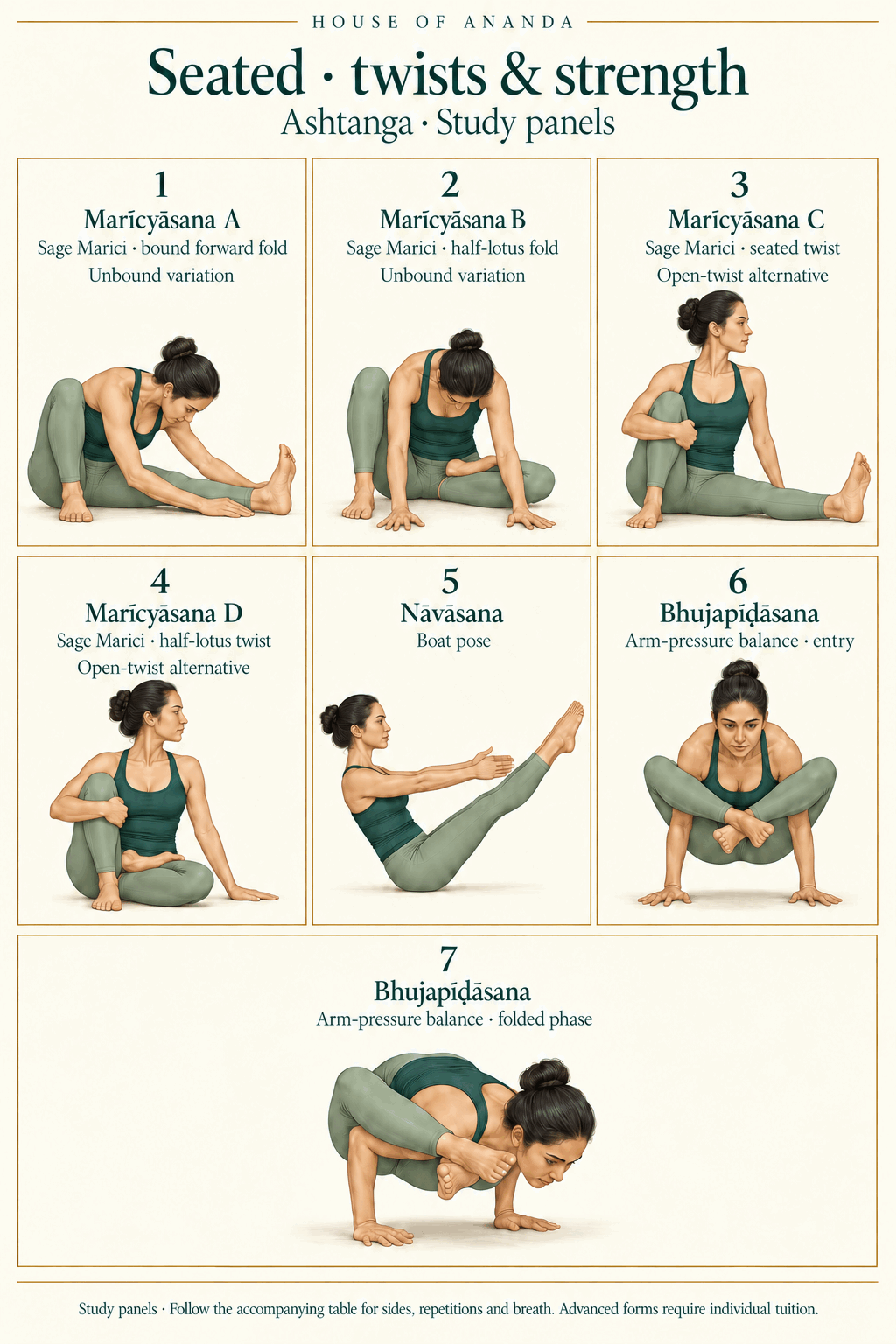
Seated · twists & strength: original illustrations of Sage Marīci · bound forward fold; Sage Marīci · half-lotus fold; Sage Marīci · seated twist; Sage Marīci · half-lotus twist; Boat pose; Arm-pressure balance · entry; Arm-pressure balance · folded phase.

Seated · twists & strength

Marīci A–D, five boat rounds and arm pressure

Panels 1–4 show adaptations without the bind. Panels 3–4 illustrate open-twist alternatives, turning away from the bent leg. Traditional Marīcyāsana C and D turn towards the bent leg, as described in the table.

Original AI illustrations · read with the posture notes

Read in order. On a small screen, scroll the table sideways to see the gaze and practice notes. Right and left always refer to your body.

Seated sequence · part one · 30 practice entries, including all written sides and repetitions.
Practice orderSanskrit / English postureSideBreath / stayDṛṣṭi · gazePractice notes
1DaṇḍāsanaStaff poseCentre / both5 breathsTip of nose
Cue, meaning & alternative

Sit upright with legs forward and hands beside the hips. Lift through the chest without stiffening the breath.

Accessible option: Sit on a folded blanket and soften the knees.

Word meaning: daṇḍa: staff

2Paścimottānāsana ASeated forward fold · big toesCentre / both5 breathsFeet
Cue, meaning & alternative

Take the big toes, inhale to lengthen and exhale to fold from the hips.

Accessible option: Use a strap and bend the knees.

Word meaning: paścima: west / back of the body; uttāna: stretch

3Paścimottānāsana BSeated forward fold · feetCentre / both5 breathsFeet
Cue, meaning & alternative

Lengthen between variations, then hold the feet and refold without tugging the shoulders forward.

Accessible option: Keep the same accessible grip as variation A.

Word meaning: paścima: west / back of the body; uttāna: stretch

4Paścimottānāsana CSeated forward fold · wrist claspCentre / both5 breathsFeet

Then linking vinyāsa ↓

Cue, meaning & alternative

If available, clasp a wrist beyond the feet. The grip follows the fold; it does not create it.

Accessible option: Continue with a strap or hold the shins.

Word meaning: paścima: west / back of the body; uttāna: stretch

5PūrvottānāsanaIntense front stretch / reverse plankCentre / both5 breathsUpward, with an easy neck

Then linking vinyāsa ↓

Cue, meaning & alternative

Place hands behind the hips and inhale to lift the chest and pelvis. Keep the shoulders active.

Accessible option: Bend the knees for a reverse tabletop; keep the gaze forward.

Word meaning: pūrva: east / front of the body; uttāna: stretch

6Ardha Baddha Padma PaścimottānāsanaHalf-bound lotus seated foldRight5 breathsExtended foot

Then linking vinyāsa ↓

Teacher-guided form · cue & alternative

Fold over the straight leg only after a comfortable teacher-taught half-lotus setup.

Accessible option: Use head-to-knee A with an unbound foot and a supported knee.

Word meaning: ardha: half; baddha: bound; padma: lotus; paścima: back

7Ardha Baddha Padma PaścimottānāsanaHalf-bound lotus seated foldLeft5 breathsExtended foot

Then linking vinyāsa ↓

Teacher-guided form · cue & alternative

Fold over the straight leg only after a comfortable teacher-taught half-lotus setup.

Accessible option: Use head-to-knee A with an unbound foot and a supported knee.

Word meaning: ardha: half; baddha: bound; padma: lotus; paścima: back

8Triāṅga Mukhaikapāda PaścimottānāsanaThree-limbed one-leg forward foldRight5 breathsExtended foot

Then linking vinyāsa ↓

Cue, meaning & alternative

Fold one shin back beside the hip and lengthen over the extended leg, keeping the pelvis balanced.

Accessible option: Sit on support; use head-to-knee A if the bent knee is uncomfortable.

Word meaning: tri-aṅga: three limbs; mukha: facing; eka-pāda: one leg

9Triāṅga Mukhaikapāda PaścimottānāsanaThree-limbed one-leg forward foldLeft5 breathsExtended foot

Then linking vinyāsa ↓

Cue, meaning & alternative

Fold one shin back beside the hip and lengthen over the extended leg, keeping the pelvis balanced.

Accessible option: Sit on support; use head-to-knee A if the bent knee is uncomfortable.

Word meaning: tri-aṅga: three limbs; mukha: facing; eka-pāda: one leg

10Jānu Śīrṣāsana AHead-to-knee · sole to inner thighRight5 breathsExtended foot

Then linking vinyāsa ↓

Cue, meaning & alternative

Rest the bent-leg sole against the inner thigh and turn the torso toward the straight leg before folding.

Accessible option: Support the bent knee and use a strap around the extended foot.

Word meaning: jānu: knee; śīrṣa: head

11Jānu Śīrṣāsana AHead-to-knee · sole to inner thighLeft5 breathsExtended foot

Then linking vinyāsa ↓

Cue, meaning & alternative

Rest the bent-leg sole against the inner thigh and turn the torso toward the straight leg before folding.

Accessible option: Support the bent knee and use a strap around the extended foot.

Word meaning: jānu: knee; śīrṣa: head

12Jānu Śīrṣāsana BHead-to-knee · heel beneath seatRight5 breathsExtended foot

Then linking vinyāsa ↓

Teacher-guided form · cue & alternative

This variation changes the bent-foot position beneath the seat. Learn that placement without twisting the knee.

Accessible option: Repeat variation A if the foot or knee cannot settle comfortably.

Word meaning: jānu: knee; śīrṣa: head

13Jānu Śīrṣāsana BHead-to-knee · heel beneath seatLeft5 breathsExtended foot

Then linking vinyāsa ↓

Teacher-guided form · cue & alternative

This variation changes the bent-foot position beneath the seat. Learn that placement without twisting the knee.

Accessible option: Repeat variation A if the foot or knee cannot settle comfortably.

Word meaning: jānu: knee; śīrṣa: head

14Jānu Śīrṣāsana CHead-to-knee · rotated footRight5 breathsExtended foot

Then linking vinyāsa ↓

Teacher-guided form · cue & alternative

The heel rises and the toes turn down in this teacher-guided foot position. Do not lever the ankle or knee into place.

Accessible option: Repeat variation A with the foot relaxed.

Word meaning: jānu: knee; śīrṣa: head

15Jānu Śīrṣāsana CHead-to-knee · rotated footLeft5 breathsExtended foot

Then linking vinyāsa ↓

Teacher-guided form · cue & alternative

The heel rises and the toes turn down in this teacher-guided foot position. Do not lever the ankle or knee into place.

Accessible option: Repeat variation A with the foot relaxed.

Word meaning: jānu: knee; śīrṣa: head

16Marīcyāsana ASage Marīci · bound forward foldRight5 breathsExtended foot

Then linking vinyāsa ↓

Cue, meaning & alternative

Draw one knee up with its foot grounded. Wrap only as far as comfortable and lengthen over the straight leg.

Accessible option: Keep hands on the floor or use a strap between the hands.

Word meaning: Marīci: the sage whose name means ray of light

17Marīcyāsana ASage Marīci · bound forward foldLeft5 breathsExtended foot

Then linking vinyāsa ↓

Cue, meaning & alternative

Draw one knee up with its foot grounded. Wrap only as far as comfortable and lengthen over the straight leg.

Accessible option: Keep hands on the floor or use a strap between the hands.

Word meaning: Marīci: the sage whose name means ray of light

18Marīcyāsana BSage Marīci · half-lotus foldRight5 breathsTip of nose

Then linking vinyāsa ↓

Teacher-guided form · cue & alternative

Combine a bent standing knee with half lotus in the other leg, then fold with a teacher-taught bind.

Accessible option: Use the A variation and omit lotus.

Word meaning: Marīci: ray of light; a sage’s name

19Marīcyāsana BSage Marīci · half-lotus foldLeft5 breathsTip of nose

Then linking vinyāsa ↓

Teacher-guided form · cue & alternative

Combine a bent standing knee with half lotus in the other leg, then fold with a teacher-taught bind.

Accessible option: Use the A variation and omit lotus.

Word meaning: Marīci: ray of light; a sage’s name

20Marīcyāsana CSage Marīci · seated twistRight5 breathsDirection of the twist

Then linking vinyāsa ↓

Cue, meaning & alternative

Keep one leg long and twist toward the upright knee, growing taller before turning.

Accessible option: Hug the knee and place the back hand on support; omit the bind.

Word meaning: Marīci: ray of light; a sage’s name

21Marīcyāsana CSage Marīci · seated twistLeft5 breathsDirection of the twist

Then linking vinyāsa ↓

Cue, meaning & alternative

Keep one leg long and twist toward the upright knee, growing taller before turning.

Accessible option: Hug the knee and place the back hand on support; omit the bind.

Word meaning: Marīci: ray of light; a sage’s name

22Marīcyāsana DSage Marīci · half-lotus twistRight5 breathsDirection of the twist

Then linking vinyāsa ↓

Teacher-guided form · cue & alternative

This combines half lotus and a deep bound twist towards the upright knee. Keep it within an individually taught progression.

Accessible option: Use the C variation without lotus or binding.

Word meaning: Marīci: ray of light; a sage’s name

23Marīcyāsana DSage Marīci · half-lotus twistLeft5 breathsDirection of the twist

Then linking vinyāsa ↓

Teacher-guided form · cue & alternative

This combines half lotus and a deep bound twist towards the upright knee. Keep it within an individually taught progression.

Accessible option: Use the C variation without lotus or binding.

Word meaning: Marīci: ray of light; a sage’s name

24NāvāsanaBoat poseCentre / both5 breathsToes

Round 1 of 5. Cross the shins and press or lift briefly between rounds; return to boat. This is not a full vinyāsa.

Cue, meaning & alternative

Balance behind the sitting bones with the chest lifted. Extend the legs only while the breath stays easy.

Accessible option: Bend the knees, hold behind the thighs or keep toes grounded.

Word meaning: nāva: boat

25NāvāsanaBoat poseCentre / both5 breathsToes

Round 2 of 5. Cross the shins and press or lift briefly between rounds; return to boat. This is not a full vinyāsa.

Cue, meaning & alternative

Balance behind the sitting bones with the chest lifted. Extend the legs only while the breath stays easy.

Accessible option: Bend the knees, hold behind the thighs or keep toes grounded.

Word meaning: nāva: boat

26NāvāsanaBoat poseCentre / both5 breathsToes

Round 3 of 5. Cross the shins and press or lift briefly between rounds; return to boat. This is not a full vinyāsa.

Cue, meaning & alternative

Balance behind the sitting bones with the chest lifted. Extend the legs only while the breath stays easy.

Accessible option: Bend the knees, hold behind the thighs or keep toes grounded.

Word meaning: nāva: boat

27NāvāsanaBoat poseCentre / both5 breathsToes

Round 4 of 5. Cross the shins and press or lift briefly between rounds; return to boat. This is not a full vinyāsa.

Cue, meaning & alternative

Balance behind the sitting bones with the chest lifted. Extend the legs only while the breath stays easy.

Accessible option: Bend the knees, hold behind the thighs or keep toes grounded.

Word meaning: nāva: boat

28NāvāsanaBoat poseCentre / both5 breathsToes

Round 5 of 5. Take a vinyāsa after the fifth round.

Then linking vinyāsa ↓

Cue, meaning & alternative

Balance behind the sitting bones with the chest lifted. Extend the legs only while the breath stays easy.

Accessible option: Bend the knees, hold behind the thighs or keep toes grounded.

Word meaning: nāva: boat

29BhujapīḍāsanaArm-pressure balance · entryCentre / bothInhale · entryTip of nose
Teacher-guided form · cue & alternative

Place the legs high on the upper arms, then learn the crossed-ankle balance through controlled preparation.

Accessible option: Keep feet grounded and work on a supported squat with a teacher.

Word meaning: bhuja: arm / shoulder; pīḍā: pressure

30BhujapīḍāsanaArm-pressure balance · folded phaseCentre / both5 breathsTip of nose

Inhale to the balanced entry, exhale to lower if taught. After the hold, lift back up and take your teacher-taught exit or place the feet down.

Then linking vinyāsa ↓

Teacher-guided form · cue & alternative

The photographed lowering and return require controlled balance. Avoid dropping weight onto the chin or head.

Accessible option: Stay with the feet-supported entry; omit the lowering.

Word meaning: bhuja: arm / shoulder; pīḍā: pressure

Back to atlas contents ↑

Yoga Cikitsā

Seated sequence · part two

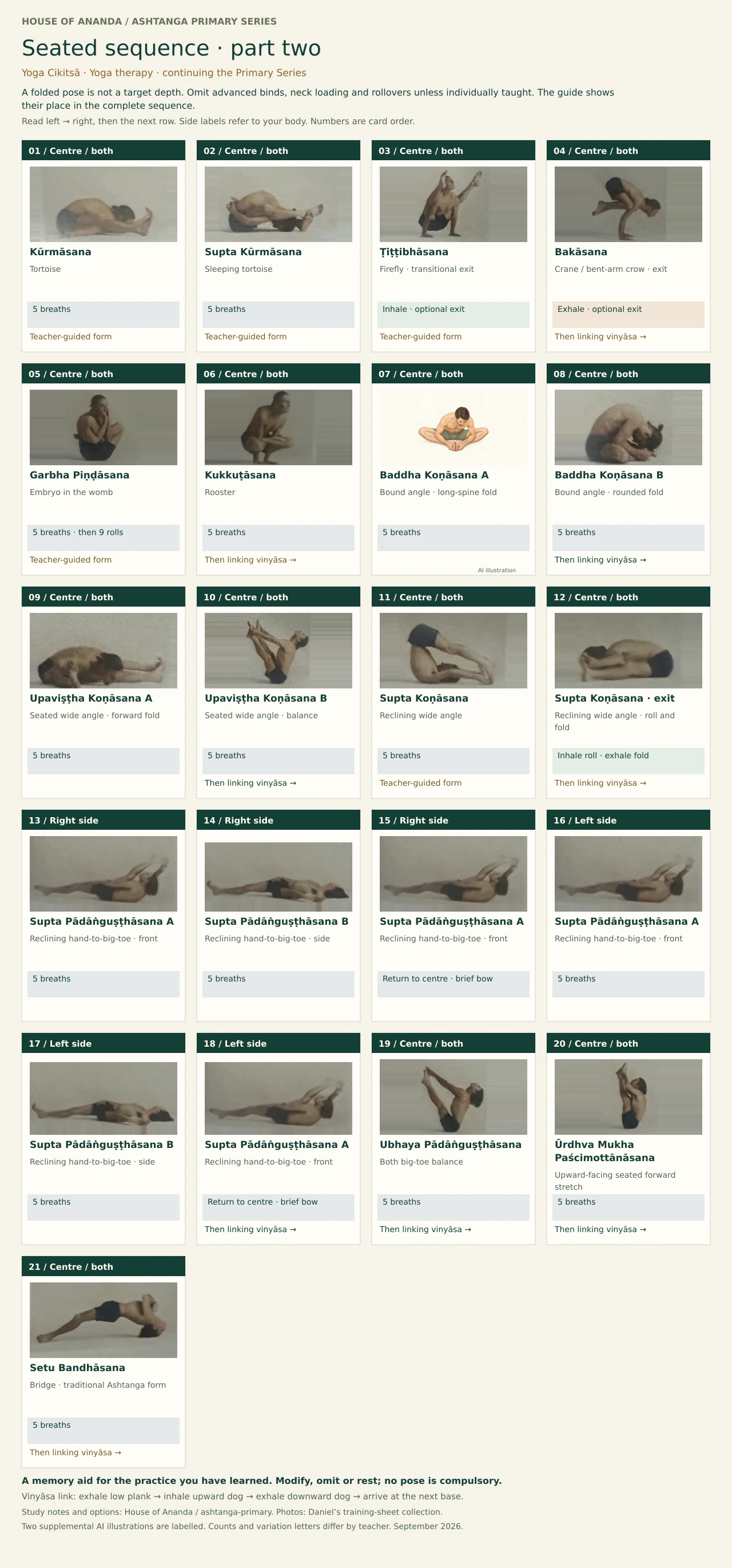
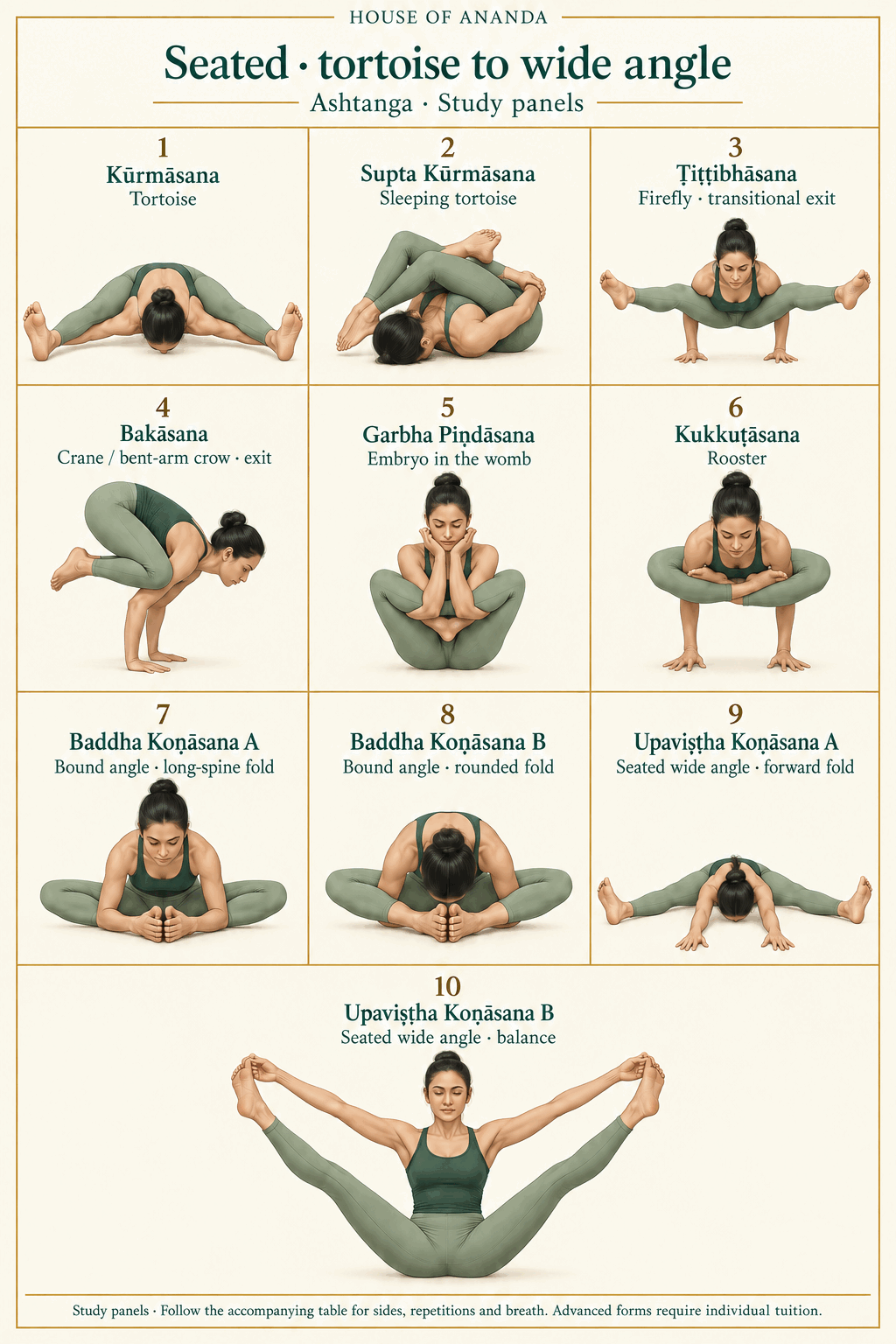
Tortoise, lotus balances, wide-angle forms, reclining work and the final bridge. The arm-balance exits are identified as transitions, with seated alternatives.

A folded pose is not a target depth. Omit advanced binds, neck loading and rollovers unless individually taught. The guide shows their place in the complete sequence.

Seated · tortoise to wide angle: original illustrations of Tortoise; Sleeping tortoise; Firefly · transitional exit; Crane / bent-arm crow · exit; Embryo in the womb; Rooster; Bound angle · long-spine fold; Bound angle · rounded fold; Seated wide angle · forward fold; Seated wide angle · balance.

Seated · tortoise to wide angle

Deep forms, optional exits and seated balances

Original AI illustrations · read with the posture notes
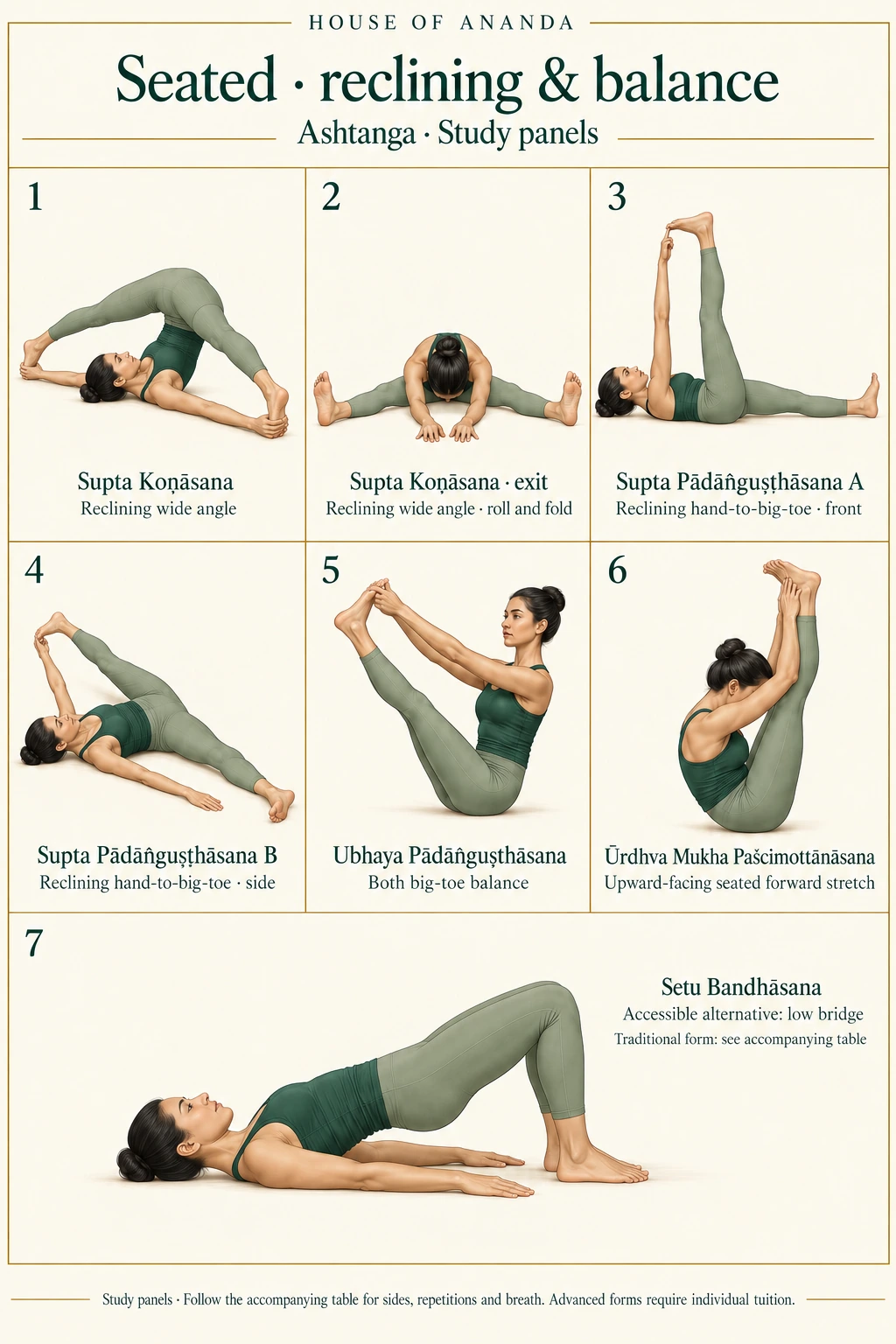
Seated · reclining & balance: original illustrations of Reclining wide angle; Reclining wide angle · roll and fold; Reclining hand-to-big-toe · front; Reclining hand-to-big-toe · side; Both big-toe balance; Upward-facing seated forward stretch; Bridge · traditional Ashtanga form.

Seated · reclining & balance

Reclining work, rolling transitions and bridge

Panel 7 shows the accessible low-bridge alternative. The traditional Ashtanga Setu Bandhāsana is a different, teacher-guided form described in the table.

Original AI illustrations · read with the posture notes

Read in order. On a small screen, scroll the table sideways to see the gaze and practice notes. Right and left always refer to your body.

Seated sequence · part two · 21 practice entries, including all written sides and repetitions.
Practice orderSanskrit / English postureSideBreath / stayDṛṣṭi · gazePractice notes
1KūrmāsanaTortoiseCentre / both5 breathsTip of nose
Teacher-guided form · cue & alternative

Widen the legs and bring the arms beneath them only within a spacious, unforced forward fold.

Accessible option: Bend the knees and keep the hands in front.

Word meaning: kūrma: tortoise

2Supta KūrmāsanaSleeping tortoiseCentre / both5 breathsTip of nose
Teacher-guided form · cue & alternative

The deep bind and leg-behind-head arrangement are advanced forms to study directly with a teacher.

Accessible option: Use an open, supported wide-legged fold; omit the bind.

Word meaning: supta: reclining / sleeping; kūrma: tortoise

3ṬiṭṭibhāsanaFirefly · transitional exitCentre / bothInhale · optional exitForward
Teacher-guided form · cue & alternative

An optional teacher-taught lift out of sleeping tortoise; extend the legs only with controlled arm support.

Accessible option: Release the legs, sit down and take a step-back transition.

Word meaning: ṭiṭṭibha: traditionally rendered firefly in pose naming

4BakāsanaCrane / bent-arm crow · exitCentre / bothExhale · optional exitForward on the floor

Then linking vinyāsa ↓

Teacher-guided form · cue & alternative

The arm-balance exit gathers the knees onto the arms before the next vinyāsa. It is not an added long hold.

Accessible option: Set the feet down and step back instead.

Word meaning: baka: crane

5Garbha PiṇḍāsanaEmbryo in the wombCentre / both5 breaths · then 9 rollsTip of nose

Nine small rolls clockwise only if taught. Use an easy crossed-leg balance or omit the rolling.

Teacher-guided form · cue & alternative

The full form threads the arms through lotus. Nine controlled rolls form a clockwise circle when taught.

Accessible option: Use loose crossed legs and hold the shins; omit rolling or lotus as needed.

Word meaning: garbha: womb; piṇḍa: compact body

6KukkuṭāsanaRoosterCentre / both5 breathsTip of nose

Then linking vinyāsa ↓

Teacher-guided form · cue & alternative

From the threaded lotus position, press through the hands and lift with steady shoulders.

Accessible option: Use a simple seated press with feet supported; omit threaded lotus.

Word meaning: kukkuṭa: rooster

7Baddha Koṇāsana ABound angle · long-spine foldCentre / both5 breathsForward / tip of nose
Cue, meaning & alternative

Begin upright with soles together. Lengthen forward from the hips without pressing down on the knees.

Accessible option: Move the feet farther forward and support the thighs. This is B on the photographed sheet.

Word meaning: baddha: bound; koṇa: angle

8Baddha Koṇāsana BBound angle · rounded foldCentre / both5 breathsTip of nose

Then linking vinyāsa ↓

Cue, meaning & alternative

If taught, soften into the rounded phase without pulling the head to the feet.

Accessible option: Remain upright or repeat the comfortable long-spine fold. This is C on the sheet.

Word meaning: baddha: bound; koṇa: angle

9Upaviṣṭha Koṇāsana ASeated wide angle · forward foldCentre / both5 breathsForward / tip of nose
Cue, meaning & alternative

Spread the legs to a comfortable width and lengthen forward while both thighs remain grounded.

Accessible option: Bend the knees, sit on support and use hands on the floor.

Word meaning: upaviṣṭha: seated; koṇa: angle

10Upaviṣṭha Koṇāsana BSeated wide angle · balanceCentre / both5 breathsUpward or forward

Then linking vinyāsa ↓

Cue, meaning & alternative

Lift the open legs into a balanced V, keeping the chest broad.

Accessible option: Bend the knees and hold behind the thighs.

Word meaning: upaviṣṭha: seated; koṇa: angle

11Supta KoṇāsanaReclining wide angleCentre / both5 breathsTip of nose
Teacher-guided form · cue & alternative

The inverted wide-leg position and its roll forward require a teacher-taught shoulder-supported entry.

Accessible option: Remain seated in a supported wide angle; omit rolling over the neck.

Word meaning: supta: reclining; koṇa: angle

12Supta Koṇāsana · exitReclining wide angle · roll and foldCentre / bothInhale roll · exhale foldForward

Then linking vinyāsa ↓

Teacher-guided form · cue & alternative

The photographed forward fold follows a controlled roll to balance. It is the exit phase, not a separate required long hold.

Accessible option: Sit up without rolling and place the feet down gently.

Word meaning: supta: reclining; koṇa: angle

13Supta Pādāṅguṣṭhāsana AReclining hand-to-big-toe · frontRight5 breathsRaised foot
Cue, meaning & alternative

Lie down, raise one leg and take the toe. Lift toward the leg only if the neck remains comfortable.

Accessible option: Keep the head down and use a strap; bend the grounded knee.

Word meaning: supta: reclining; pāda: foot; aṅguṣṭha: big toe

14Supta Pādāṅguṣṭhāsana BReclining hand-to-big-toe · sideRight5 breathsOpposite side or upward
Cue, meaning & alternative

Open the lifted leg to the side while keeping the opposite hip settled. Return to centre before changing sides.

Accessible option: Rest the opened leg on support and keep the head centred.

Word meaning: Also called Supta Pārśvasahita: reclining to the side

15Supta Pādāṅguṣṭhāsana AReclining hand-to-big-toe · frontRightReturn to centre · brief bowRaised foot

Bring the leg back to centre before lowering. Complete both phases on one side before changing sides.

Cue, meaning & alternative

Lie down, raise one leg and take the toe. Lift toward the leg only if the neck remains comfortable.

Accessible option: Keep the head down and use a strap; bend the grounded knee.

Word meaning: supta: reclining; pāda: foot; aṅguṣṭha: big toe

16Supta Pādāṅguṣṭhāsana AReclining hand-to-big-toe · frontLeft5 breathsRaised foot
Cue, meaning & alternative

Lie down, raise one leg and take the toe. Lift toward the leg only if the neck remains comfortable.

Accessible option: Keep the head down and use a strap; bend the grounded knee.

Word meaning: supta: reclining; pāda: foot; aṅguṣṭha: big toe

17Supta Pādāṅguṣṭhāsana BReclining hand-to-big-toe · sideLeft5 breathsOpposite side or upward
Cue, meaning & alternative

Open the lifted leg to the side while keeping the opposite hip settled. Return to centre before changing sides.

Accessible option: Rest the opened leg on support and keep the head centred.

Word meaning: Also called Supta Pārśvasahita: reclining to the side

18Supta Pādāṅguṣṭhāsana AReclining hand-to-big-toe · frontLeftReturn to centre · brief bowRaised foot

Bring the leg back to centre before lowering. Complete both phases on one side before changing sides.

Then linking vinyāsa ↓

Cue, meaning & alternative

Lie down, raise one leg and take the toe. Lift toward the leg only if the neck remains comfortable.

Accessible option: Keep the head down and use a strap; bend the grounded knee.

Word meaning: supta: reclining; pāda: foot; aṅguṣṭha: big toe

19Ubhaya PādāṅguṣṭhāsanaBoth big-toe balanceCentre / both5 breathsUpward or forward

Then linking vinyāsa ↓

Cue, meaning & alternative

Balance upright holding both toes, with a teacher-taught roll-up or a seated entry.

Accessible option: Begin seated, bend the knees and hold the legs.

Word meaning: ubhaya: both; pāda: foot; aṅguṣṭha: big toe

20Ūrdhva Mukha PaścimottānāsanaUpward-facing seated forward stretchCentre / both5 breathsFeet

Then linking vinyāsa ↓

Cue, meaning & alternative

Balance on the seat and bring the torso toward the raised legs without collapsing the chest.

Accessible option: Keep knees bent and retain space between the chest and thighs.

Word meaning: ūrdhva mukha: upward-facing; paścima: back; uttāna: stretch

21Setu BandhāsanaBridge · traditional Ashtanga formCentre / both5 breathsTip of nose

Then linking vinyāsa ↓

Teacher-guided form · cue & alternative

This advanced version places load through the head and neck. Study the pictured form with a teacher; do not copy it from a card.

Accessible option: Choose a low bridge with feet flat, shoulders grounded and no weight on the head, or rest.

Word meaning: setu: bridge; bandha: binding

Back to atlas contents ↑

Samāpana

Backbends & finishing

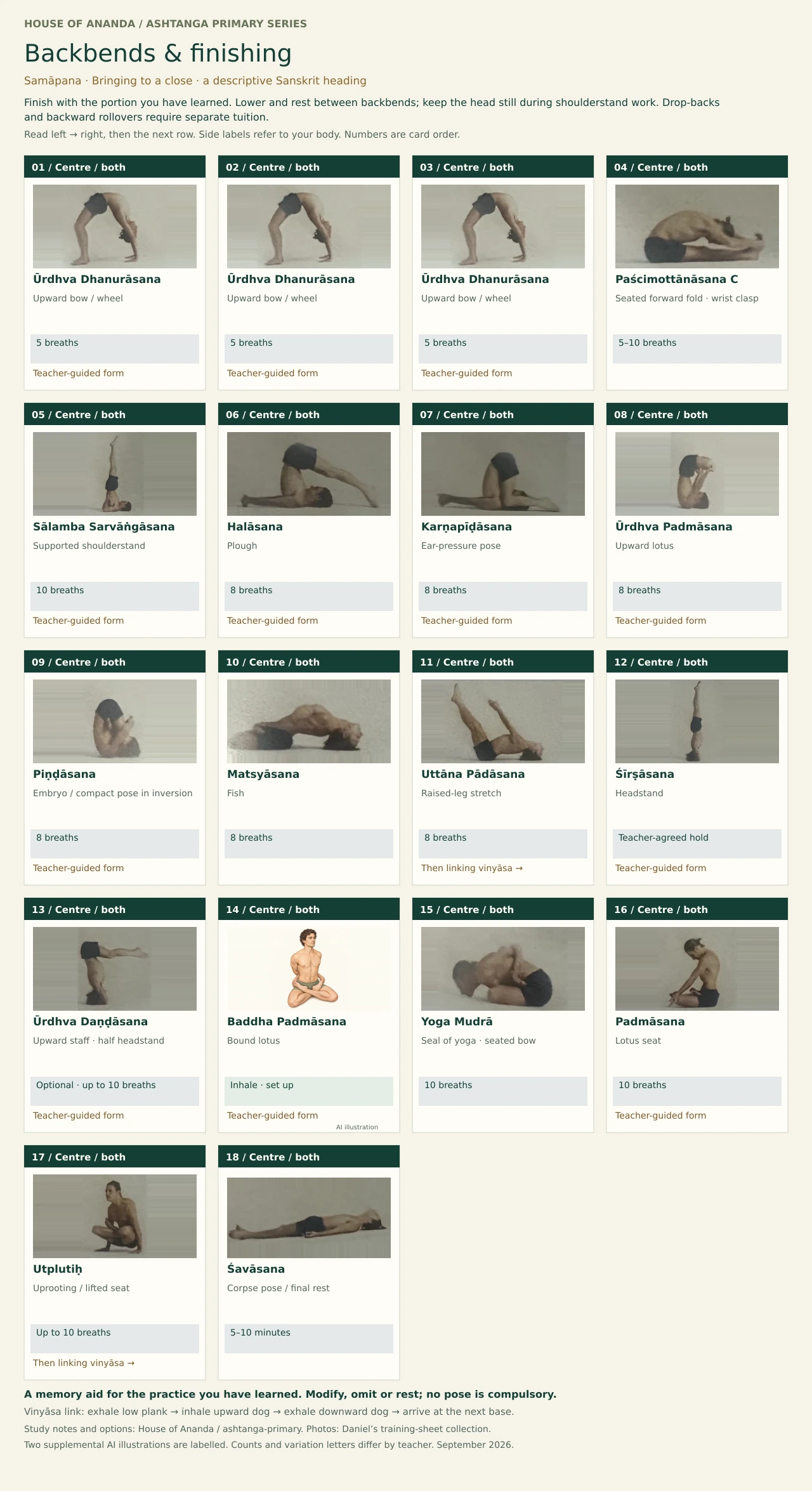
The closing arc includes backbends, a forward fold, optional inversions, seated closing forms and final rest. Counts vary by teacher; these are common study counts, never minimum requirements.

Finish with the portion you have learned. Lower and rest between backbends; keep the head still during shoulderstand work. Drop-backs and backward rollovers require separate tuition.

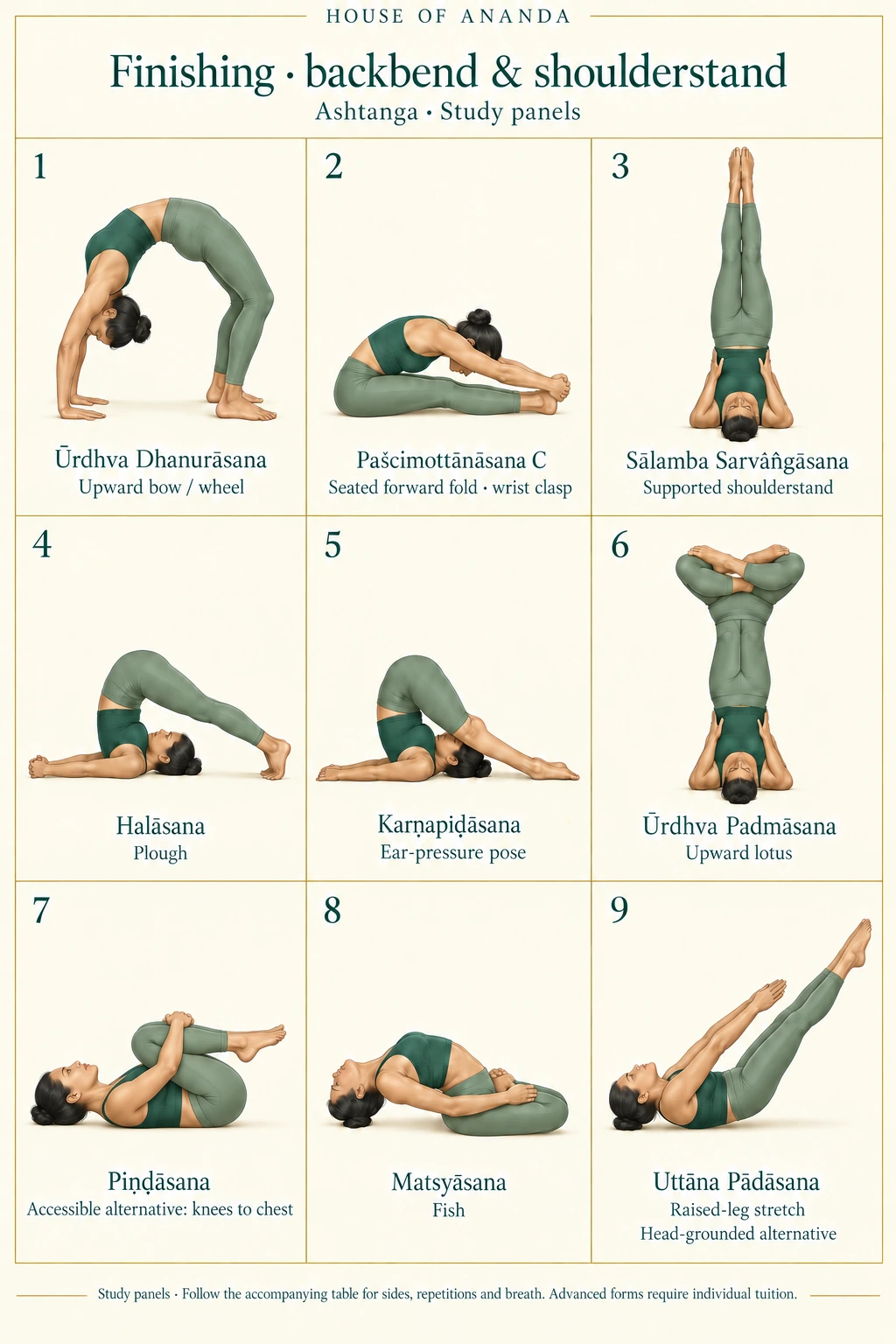
Finishing · backbend & shoulderstand: original illustrations of Upward bow / wheel; Seated forward fold · wrist clasp; Supported shoulderstand; Plough; Ear-pressure pose; Upward lotus; Embryo / compact pose in inversion; Fish; Raised-leg stretch.

Finishing · backbend & shoulderstand

Three backbends, forward fold and the closing inversion family

Panel 7 shows a supine knees-to-chest alternative to Piṇḍāsana. Panel 9 shows a head-grounded alternative to the traditional chest-opening form. The table distinguishes the traditional forms and adaptations.

Original AI illustrations · read with the posture notes
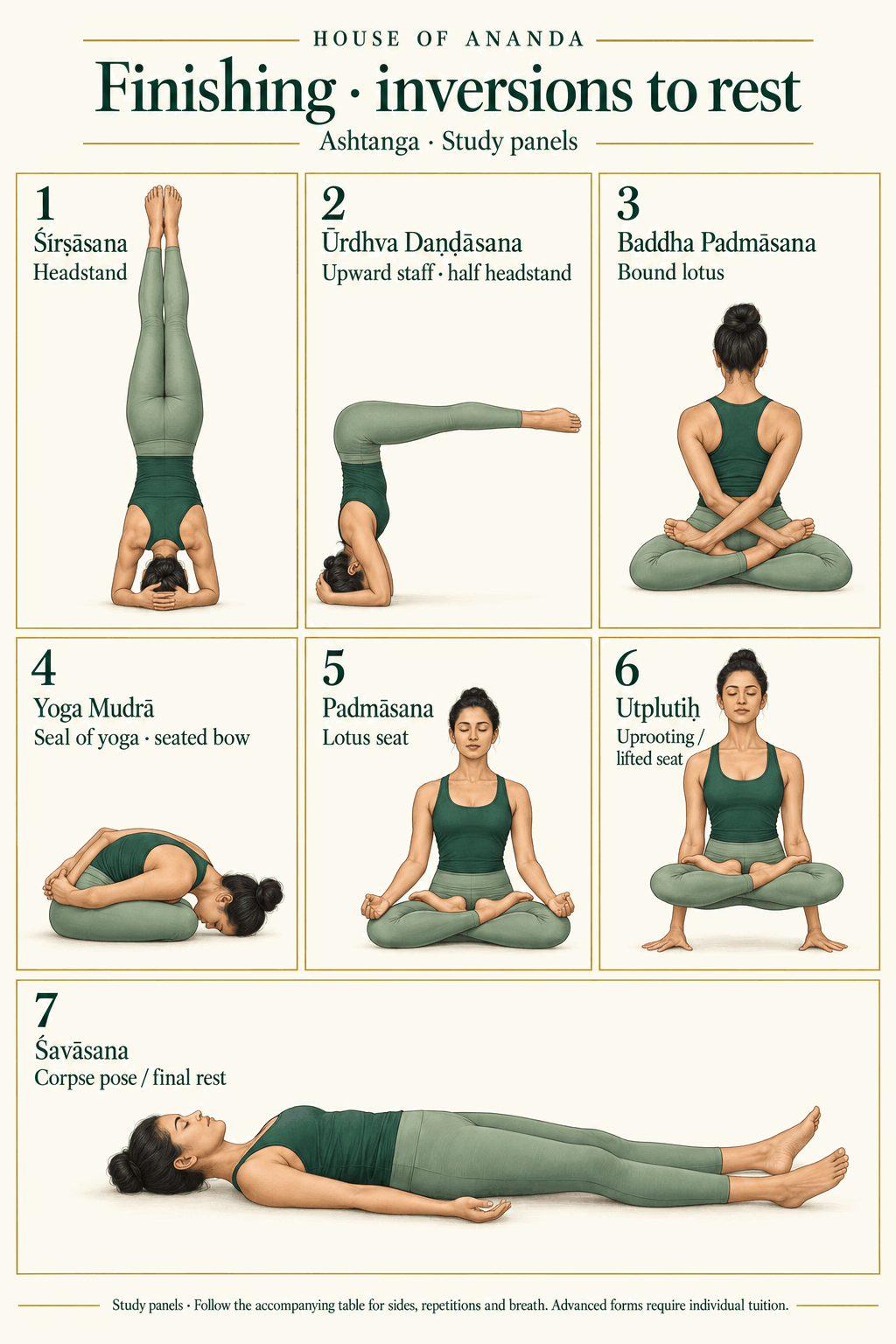
Finishing · inversions to rest: original illustrations of Headstand; Upward staff · half headstand; Bound lotus; Seal of yoga · seated bow; Lotus seat; Uprooting / lifted seat; Corpse pose / final rest.

Finishing · inversions to rest

Optional headstand, seated closing forms and final rest

Original AI illustrations · read with the posture notes

Read in order. On a small screen, scroll the table sideways to see the gaze and practice notes. Right and left always refer to your body.

Backbends & finishing · 18 practice entries, including all written sides and repetitions.
Practice orderSanskrit / English postureSideBreath / stayDṛṣṭi · gazePractice notes
1Ūrdhva DhanurāsanaUpward bow / wheelCentre / both5 breathsToward the floor between hands

Backbend 1 of 3. Lower to the mat and rest between rounds. A low bridge or rest may replace this form.

Teacher-guided form · cue & alternative

Press evenly through hands and feet into the backbend you have been taught. Lower with control between rounds.

Accessible option: Use a low bridge or your teacher’s preparation. Drop-backs are a separate supervised skill.

Word meaning: ūrdhva: upward; dhanus: bow

2Ūrdhva DhanurāsanaUpward bow / wheelCentre / both5 breathsToward the floor between hands

Backbend 2 of 3. Lower to the mat and rest between rounds. A low bridge or rest may replace this form.

Teacher-guided form · cue & alternative

Press evenly through hands and feet into the backbend you have been taught. Lower with control between rounds.

Accessible option: Use a low bridge or your teacher’s preparation. Drop-backs are a separate supervised skill.

Word meaning: ūrdhva: upward; dhanus: bow

3Ūrdhva DhanurāsanaUpward bow / wheelCentre / both5 breathsToward the floor between hands

Backbend 3 of 3. Lower to the mat and rest between rounds. A low bridge or rest may replace this form.

Teacher-guided form · cue & alternative

Press evenly through hands and feet into the backbend you have been taught. Lower with control between rounds.

Accessible option: Use a low bridge or your teacher’s preparation. Drop-backs are a separate supervised skill.

Word meaning: ūrdhva: upward; dhanus: bow

4Paścimottānāsana CSeated forward fold · wrist claspCentre / both5–10 breathsFeet

Come up carefully into an easy forward fold after backbending; use a strap and soft knees.

Cue, meaning & alternative

If available, clasp a wrist beyond the feet. The grip follows the fold; it does not create it.

Accessible option: Continue with a strap or hold the shins.

Word meaning: paścima: west / back of the body; uttāna: stretch

5Sālamba SarvāṅgāsanaSupported shoulderstandCentre / both10 breathsTip of nose
Teacher-guided form · cue & alternative

Learn the shoulder-supported setup and exit in person. Keep the head still throughout.

Accessible option: Omit the inversion and rest with the lower legs supported on a chair.

Word meaning: sālamba: with support; sarva-aṅga: whole body

6HalāsanaPloughCentre / both8 breathsTip of nose
Teacher-guided form · cue & alternative

From a stable taught inversion, take the legs overhead only as far as the neck stays unloaded and the breath remains free.

Accessible option: Use the agreed non-inverted resting alternative.

Word meaning: hala: plough

7KarṇapīḍāsanaEar-pressure poseCentre / both8 breathsTip of nose
Teacher-guided form · cue & alternative

A compact variation of plough. Knees approach the ears without forcing the spine or compressing the breath.

Accessible option: Stay with an appropriate supported alternative; do not push the knees down.

Word meaning: karṇa: ear; pīḍā: pressure

8Ūrdhva PadmāsanaUpward lotusCentre / both8 breathsTip of nose
Teacher-guided form · cue & alternative

This combines an inversion and lotus. It belongs only in a stable teacher-guided practice.

Accessible option: Omit lotus and use the inversion alternative agreed with your teacher.

Word meaning: ūrdhva: upward; padma: lotus

9PiṇḍāsanaEmbryo / compact pose in inversionCentre / both8 breathsTip of nose
Teacher-guided form · cue & alternative

The inverted lotus folds toward the torso. Enter and leave slowly with the head still.

Accessible option: Omit this compact inversion and rest.

Word meaning: piṇḍa: compact body or mass

10MatsyāsanaFishCentre / both8 breathsToward the brow, without strain
Cue, meaning & alternative

Open the chest with support through the forearms; use lotus only if already comfortable.

Accessible option: Keep legs straight or use a supported chest opening without loading the crown.

Word meaning: matsya: fish

11Uttāna PādāsanaRaised-leg stretchCentre / both8 breathsToes

Then linking vinyāsa ↓

Teacher-guided form · cue & alternative

The traditional finishing form raises the legs and arms from the chest-opening shape. Keep the support controlled.

Accessible option: Rest the head and shoulders on the mat and lift bent legs, or omit.

Word meaning: uttāna: extended; pāda: foot / leg

12ŚīrṣāsanaHeadstandCentre / bothTeacher-agreed stayTip of nose

Some led counts use 15–25 breaths. Do not extend a hold to meet a number.

Teacher-guided form · cue & alternative

Practise only after learning the forearm base, lift and controlled descent with a qualified teacher. Do not kick up.

Accessible option: Use a non-inverted resting position; headstand is optional.

Word meaning: śīrṣa: head

13Ūrdhva DaṇḍāsanaUpward staff · half headstandCentre / bothOptional · up to 10 breathsTip of nose

Return to vertical only if taught, then lower with control. Pause in a comfortable kneeling rest before the closing seated forms; use a vinyāsa only if taught.

Teacher-guided form · cue & alternative

The legs lower to horizontal from a stable headstand. This advanced phase requires its own preparation.

Accessible option: Omit it. Come down using your teacher-taught exit and pause before sitting.

Word meaning: ūrdhva: upward; daṇḍa: staff

14Baddha PadmāsanaBound lotusCentre / bothInhale · set upTip of nose
Teacher-guided form · cue & alternative

Sit in a comfortable taught lotus and take the arms behind only if the shoulders and knees remain free.

Accessible option: Use an easy crossed-leg seat with hands resting behind or beside you.

Word meaning: baddha: bound; padma: lotus

15Yoga MudrāSeal of yoga · seated bowCentre / both10 breathsTip of nose
Cue, meaning & alternative

From the seated base, exhale into an unforced forward bow and keep breathing.

Accessible option: Bow from an easy crossed-leg seat onto support.

Word meaning: yoga: union / discipline; mudrā: seal

16PadmāsanaLotus seatCentre / both10 breathsTip of nose / softly lowered
Teacher-guided form · cue & alternative

Sit quietly, let the spine rise and allow the shoulders and face to soften.

Accessible option: Choose an easy crossed-leg seat or a chair. Never lever the knees into lotus.

Word meaning: padma: lotus

17UtplutiḥUprooting / lifted seatCentre / bothUp to 10 breathsTip of nose

Then linking vinyāsa ↓

Teacher-guided form · cue & alternative

Press the hands down and lift the seat in the form taught to you, keeping breath moving.

Accessible option: Use loose crossed legs and keep the feet down; blocks can support the hands.

Word meaning: utpluti: springing up or uplift

18ŚavāsanaCorpse pose / final restCentre / both5–10 minutesEyes closed or softly open

Take longer if needed. Let the breath return to its natural rhythm; roll to one side and rise slowly when ready.

Cue, meaning & alternative

Lie down, release the technique of the breath and allow the whole body to settle. Roll to the side before rising.

Accessible option: Support the knees or rest on your side.

Word meaning: śava: corpse

Back to atlas contents ↑

Vinyāsa

Linking vinyāsa

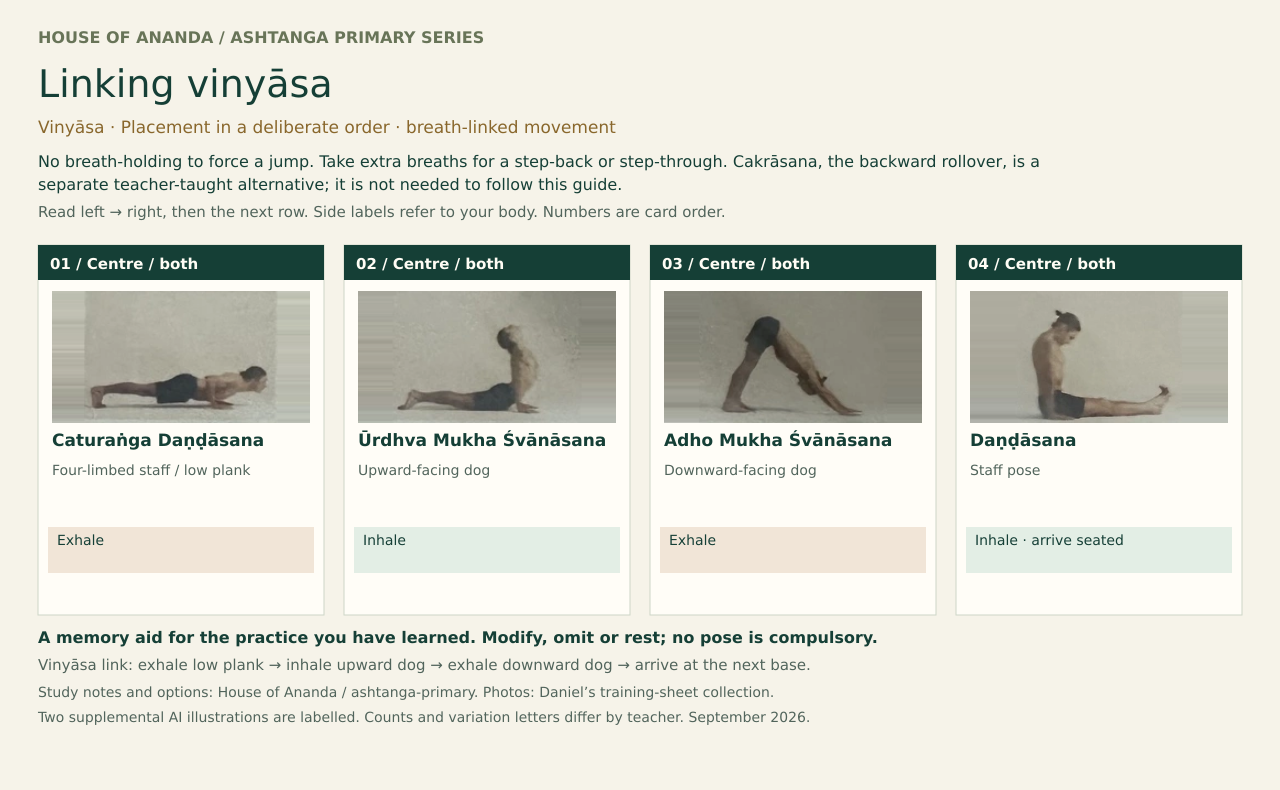
This illustrated link joins most seated families and many right and left sides. The photos show the destination shapes. Stepping is an equally usable transition option.

No breath-holding to force a jump. Take extra breaths for a step-back or step-through. Cakrāsana, the backward rollover, is a separate teacher-taught alternative; it is not needed to follow this guide.

Linking vinyāsa: original illustrations of Four-limbed staff / low plank; Upward-facing dog; Downward-facing dog; Staff pose.

Linking vinyāsa

Four breath-linked destinations between seated forms

Original AI illustrations · read with the posture notes

Read in order. On a small screen, scroll the table sideways to see the gaze and practice notes. Right and left always refer to your body.

Linking vinyāsa · 4 practice entries, including all written sides and repetitions.
Practice orderSanskrit / English postureSideBreath / stayDṛṣṭi · gazePractice notes
1Caturaṅga DaṇḍāsanaFour-limbed staff / low plankCentre / bothExhaleTip of nose

From sitting, release the bind and place hands down. Lift only if taught, then step or float back and lower with control. Knees may lower first.

Cue, meaning & alternative

Exhale into a controlled low plank, keeping the shoulders from sinking below the elbows.

Accessible option: Step back, lower the knees, then lower only as far as you control.

Word meaning: catur: four; aṅga: limb; daṇḍa: staff

2Ūrdhva Mukha ŚvānāsanaUpward-facing dogCentre / bothInhaleUpward, without neck compression
Cue, meaning & alternative

Inhale, press through hands and tops of feet, lift the chest and keep the legs active.

Accessible option: Use a small cobra with thighs grounded instead; keep the neck long.

Word meaning: ūrdhva: upward; mukha: face; śvāna: dog

3Adho Mukha ŚvānāsanaDownward-facing dogCentre / bothExhaleNavel or between the feet
Cue, meaning & alternative

Exhale and lift the hips back and up. Spread pressure through the hands.

Accessible option: Bend the knees and lift the heels to make room for the spine.

Word meaning: adhas: downward; mukha: face; śvāna: dog

4DaṇḍāsanaStaff poseCentre / bothInhale · arrive seatedTip of nose

Step or float through to sit. Take extra breaths as needed for stepping, and set up the next side or posture on an exhale.

Cue, meaning & alternative

Sit upright with legs forward and hands beside the hips. Lift through the chest without stiffening the breath.

Accessible option: Sit on a folded blanket and soften the knees.

Word meaning: daṇḍa: staff

Back to atlas contents ↑

Daniel’s alignment notes · expanded 17 September 2026

Read the notebook beside the sequence.

New count sheets: A, B and a class extension

IMG_1864 records Sun A’s nine counted movements; IMG_1865 records Sun B’s seventeen. They reinforce the existing tables rather than creating a second sequence. Ekam, dve, trīṇi and the following Sanskrit numbers are movement counts, not repetition targets. Samasthitiḥ frames the round.

IMG_1868 continues into Warrior A/B on both sides and a seated Daṇḍāsana entry. It is retained as a class extension, not relabelled as standard Sun B. Use the standing and seated references for those postures.

Read the canonical count tables ↑

Dṛṣṭi: a steady focus, not neck strain

The sheets use thumbs, nose, third eye and navel. These are the class’s gaze labels already represented in the tables. A symbolic “third-eye” focus does not require crossing the eyes or forcing the head backwards. Gaze conventions vary between teachers; a comfortable neutral gaze is an adaptation.

Breath, movement, action and pose ↗

Sun A: fold and half-lift

IMG_1839 records the two dog poses and the outline of Sun A. Its handwritten “Uttānāsana A / B” labels are class shorthand, not the names of Sun Salutations A and B. The return normally moves from Downward Dog into a half-lift, then a fold, before rising. Use the complete table on this page to resolve the order.

Open the existing Sun A & B tables ↑

Sun B: the Warrior I passages

IMG_1840 begins with Chair and includes a Warrior entry. The standard Sun B reference has Warrior I on the right and left, each linked through Caturaṅga and the two dogs. IMG_1843 goes on to longer Warrior A/B holds and seated transitions: these are classroom extensions, not additional movements inserted into the standard Sun B table.

Entry, exit and extra breaths

The notes describe jumping through with crossed legs. This is a skill to learn progressively, not an entry requirement. Stepping, lowering the knees and sitting down with support are alternatives. Do not cross the ankles into lotus or swing through painful wrists to reproduce an abbreviation.

Review the linking-pose adaptations ↗

One home for each reference

The illustrated sequences, Sanskrit counts, breath and gaze stay in the tables already on this page. Study the newly expanded vocabulary for the names, then return here for their order. The earlier twelve-position haṭha class sequence remains a separate tradition-specific lesson.

Sanskrit names & alignment ↗

Twelve-position haṭha class sequence ↗

Reference for the standard sequence: AshtangaYoga.info · Traditional practice series. The notebook commentary distinguishes the recorded class variations from that reference.

How to use the guide

Learn in layers.

01 · Study the route

Use the sequence map first, then read each card. The Sanskrit names use IAST transliteration; the English line gives a familiar pose name, followed by a short word meaning in the learning notes.

The images show one expression of each pose. Follow your own right and left labels. A photographed depth, bind or straight leg is never a requirement.

02 · Let breath lead

In the salutations, each numbered movement has an inhale or an exhale. A five-breath hold means five complete breathing cycles. Breathe steadily without forcing sound, length or breath retention.

The follow view advances when you choose “Next”; it does not set your pace. It includes the linking vinyāsas marked in the seated maps. Stepping may take extra breaths.

03 · Choose your portion

Start with the section your teacher has introduced and add poses gradually. Use “Go to final rest” whenever you need to finish. A shorter familiar sequence can be a complete practice for that day.

Inversions, lotus work, deep binds, backbends and rollovers need preparation specific to you. With an injury, pregnancy or a medical condition, discuss adaptations with your teacher and clinician.

NCCIH · yoga safety guidance ↗

04 · Understand variations

Schools use different letters for some phases. This guide keeps the three seated-forward-fold grips from Daniel’s sheets. For bound angle, it labels the long-spine fold A and rounded fold B; these are B and C on his photographed sheet, with upright sitting as the setup.

Standing hand-to-big-toe includes the returning front phase C. The forward exit from reclining angle is a transition. Teacher-specific counts and entries can differ.

Sanskrit & English

A small practice vocabulary.

Aṣṭāṅga
Eight limbs. Here the name refers to the Ashtanga Vinyasa practice tradition.
Āsana
Posture or seat. The photographs show one practitioner’s expression of each shape.
Sūrya Namaskāra
Sun salutation. A has nine vinyasas; B has seventeen.
Vinyāsa
A sequence of movements linked with breathing. A step-back adaptation may need extra breaths.
Dṛṣṭi
Gaze point. Keep the gaze soft; neck comfort takes priority over a prescribed direction.
Bandha
A binding or lock in traditional yoga language; learn its use directly rather than gripping or holding the breath.
Pūraka / recaka
Inhalation / exhalation. A held pose uses complete, unforced breathing cycles.
Dakṣiṇa / vāma
Right / left. Follow your own body’s side label, not the direction the photograph faces.
Ardha / baddha / supta
Half / bound / reclining or sleeping. These words help decode pose names.
Ūrdhva / adho / parivṛtta
Upward / downward / revolved. Direction words used in many names.
IAST
The Roman-letter Sanskrit system used here. A macron in ā, ī or ū marks a long vowel; ś and ṣ are distinct Sanskrit sibilants.

House of Ananda · study notes · updated 17 September 2026

Sources & original sheets.

The two Sun Salutation posters and nine Primary Series atlas sheets use original AI pose illustrations created from written briefs. Use their accompanying tables for sequence order, sides, breath and gaze. The earlier photographic sequence cards and maps remain available for comparison, with orientation-corrected extracts from Daniel’s training sheets. Two supplemental illustrations on those cards are individually labelled.

Open Daniel’s five original photographic sheets

Scope: the complete Primary Series practice framework, with its opening and closing sequences. Intermediate and Advanced Series are separate curricula.