House of AnandaMovement · Stillness · Wisdom · Journey

Movement / Illustrated practice & study

Haṭha Yoga.
Steady. Spacious. Present.

Learn the posture. Find your breath. Make the practice your own.

Six complete classes, an illustrated pose atlas and a guide that follows your pace—with Sanskrit and English names, breath, gaze and supported alternatives.

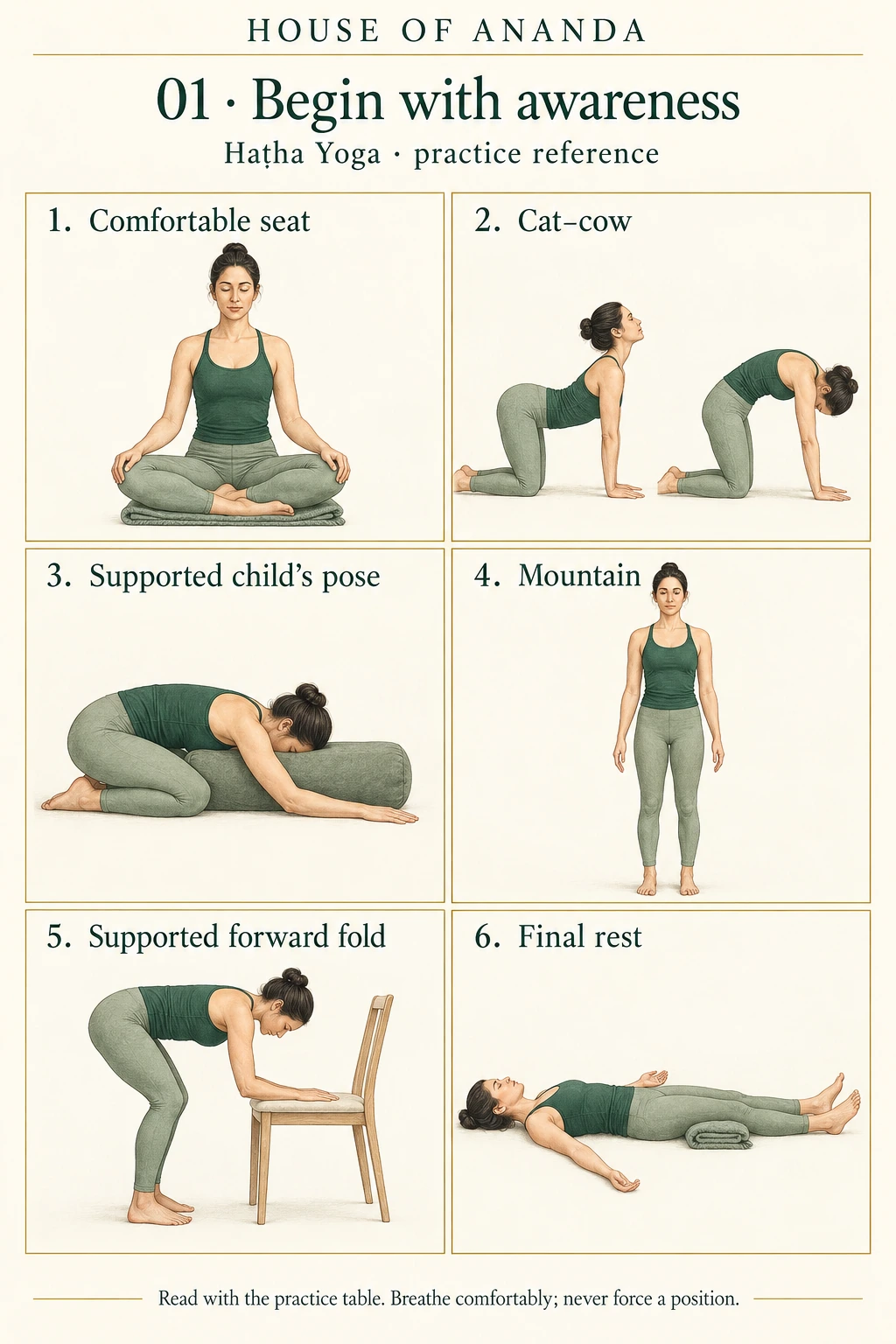
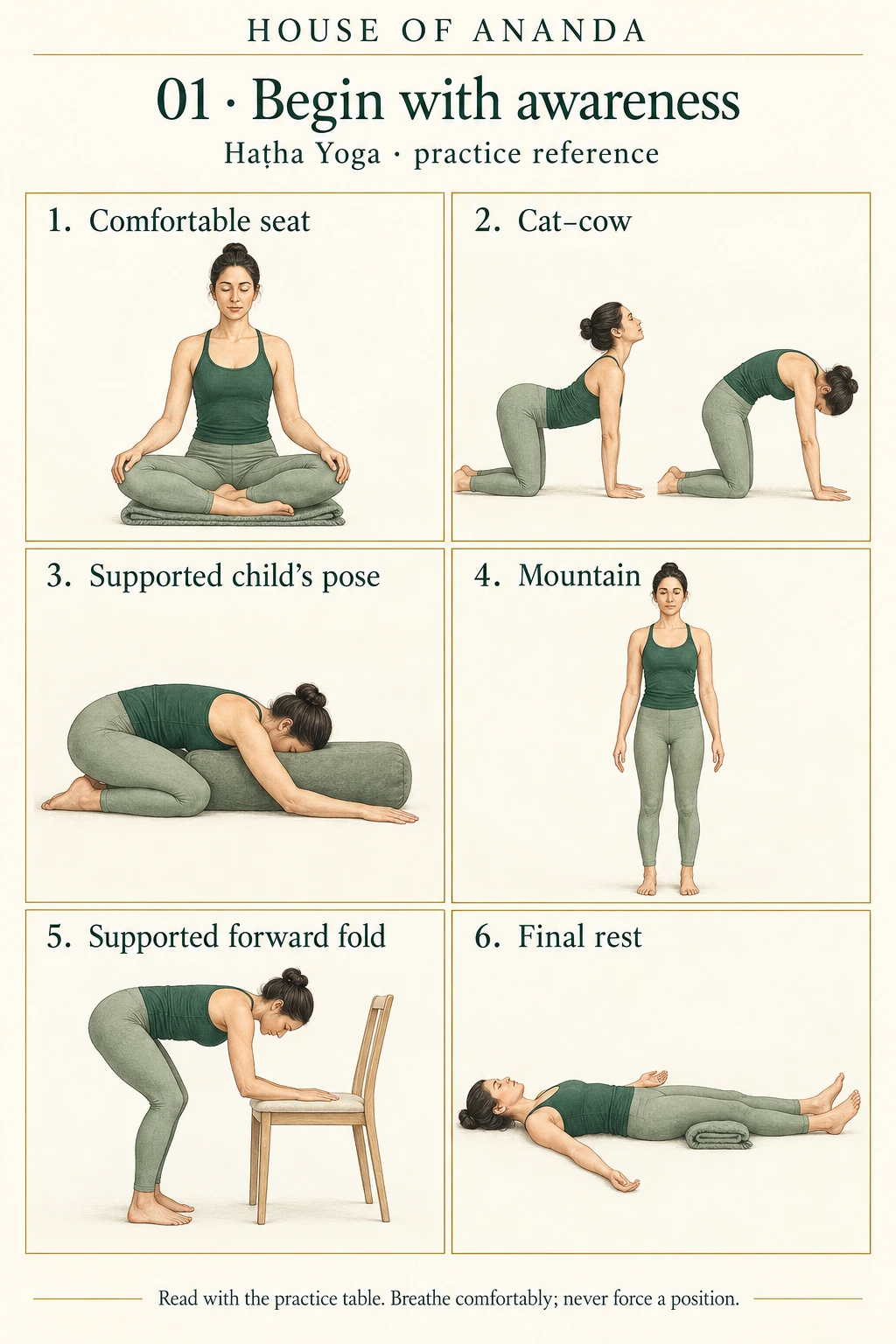
House of Ananda illustrated Hatha foundations: seated awareness, cat–cow, supported child’s pose, mountain, forward fold and rest.
Begin with awareness · one of three original practice sheets

Learn · practise · return

Your Haṭha practice room.

Six classes from 15 to 60 minutes. Twenty illustrated postures. Begin with a familiar practice or explore the pose atlas.

Approximately 20 minutes · 6 practice blocks

Begin with awareness

Learn to enter, settle and leave a posture without rushing.

A first practice for people comfortable moving between the floor and standing; chair options are included.

Begin with awareness · full practice table

Read the order, side changes and breath cues before starting. On a phone, scroll the table sideways.

Step / blockSanskrit / EnglishSide / breath / gazePractice & adaptation
12 minSukhāsanaComfortable seatCentre; change leg crossing halfway

Notice 6 natural breathing cycles without making them deeper.

Gaze: Softly ahead or eyes closed

Sit on a folded blanket with an easy leg crossing. Let the spine rise without stiffening. Notice the contact with the floor, the breath and the room around you.

Option: Use a chair with feet flat and hands resting on thighs. No lotus position is needed.

23 minMārjāryāsana–BitilāsanaCat–cowCentre

Inhale into a small chest opening; exhale to gently round.

Gaze: Down in neutral; follow the spine gently

From hands and knees, place wrists under shoulders and knees under hips. Move through 6 slow cycles without throwing the head back. Pause in neutral, rest, then repeat only if comfortable.

Option: Sit in a chair with hands on thighs and make small movements of the spine; avoid pressure on wrists or knees.

32 minBālāsana · supported variationSupported child’s poseCentre

Quiet, unforced breathing.

Gaze: Down; forehead supported

From kneeling, take knees comfortably apart and ease hips towards heels. Support chest and forehead on a bolster or stacked cushions. Stay for 3–5 breaths, then return to hands and knees; rest or repeat.

Option: If knees dislike kneeling, sit in a chair and rest forearms on a table with the head comfortably supported.

43 minTāḍāsanaMountainCentre

Breathe normally; no breath retention.

Gaze: A steady point ahead

Stand with feet comfortably apart and knees unlocked. Feel the floor, let the arms settle and take 5 easy breaths. Add gentle shoulder rolls and small weight shifts, pausing between them.

Option: Stand beside a wall or sit upright with both feet supported.

53 minUttānāsana · supported variationSupported forward foldCentre

Exhale to hinge; breathe freely while supported.

Gaze: Down without straining the neck

With a stable chair against a wall, bend the knees and hinge from the hips, placing hands on the seat or a higher support. Keep the neck relaxed. Stay 3 easy breaths; come up slowly with bent knees. Rest upright between 2–3 gentle repetitions.

Option: Use hands on a wall at shoulder height for a shallower hinge, or remain seated. Do not chase straight knees or floor contact.

67 minŚavāsanaFinal restCentre

Let the breath settle naturally.

Gaze: Eyes closed or softly open

Lower to the floor slowly. Rest on your back with arms comfortably away from your body. For the final minute, move fingers and toes, roll to one side, pause, then use your hands to return to sitting.

Option: Place a cushion under the knees, rest on your side, or sit supported in a chair.

Understanding the practice

More than a posture sequence.

Historical Haṭha & modern classes

Haṭha traditions include bodily and breath disciplines within a wider spiritual path. A modern steady-paced Hatha class is one expression of a much broader history. The classes here are original House of Ananda sequences, with no claim to be one universal traditional syllabus.

Explore yoga’s history →

Breath & attention

Begin with natural breathing in a comfortable seat. Notice the inhale and exhale without changing their length. The practice guides use no forced breathing or breath retention. Follow the separate breath lessons when you want to study further.

Prāṇāyāma study collection →

Sun, moon & the subtle body

Explore Haṭha symbolism, Iḍā, Piṅgalā and Suṣumṇā in the existing notebook lesson. Traditional subtle-body descriptions belong to their philosophical setting; they are not equivalent to anatomical structures.

Read the Haṭha philosophy lesson →

Sun Salutation · twelve positions

The existing class-note lesson contains the twelve-position sequence, its second leading side and breath cues. It also marks an uncertain breath instruction. Use that single reference alongside your teacher’s demonstration.

Open the Sun Salutation table →

Opening, stillness & closing

Settle, notice the breath and choose a simple intention. Chanting is optional: use a familiar mantra with understanding, or sit quietly. Finish with rest and return gradually. Hatha has no universally required opening or closing chant.

Explore the mantra collection →

What practice may support

Yoga research suggests possible benefits for balance, sleep and stress. Findings vary by population and style; they do not establish a special medical effect for each pose. Treat the atlas’s purposes as movement and attention skills.

Read the evidence · NCCIH →

Keep beside your mat

Three illustrated practice sheets.

Open, zoom or download the original charts. Their six numbered panels match the reference tables below. The longer classes combine these postures with the shared pose collection; print their current class table from the practice room.

Practice 01 · approximately 20 minutes

Begin with awareness

Learn to enter, settle and leave a posture without rushing.

A first practice for people comfortable moving between the floor and standing; chair options are included.

Begin with awareness: 1. Comfortable seat; 2. Cat–cow; 3. Supported child’s pose; 4. Mountain; 5. Supported forward fold; 6. Final rest. Read the table for both sides and alternatives.
Illustrated practice reference

Original AI illustrations. Panel numbers match the table; they are not traditional vinyāsa counts. Each two-sided pose is pictured on one representative side.

Scroll the table sideways on smaller screens. “Block” includes rests and transitions—not one continuous hold.

Step / blockPosture / sideBreath / gazeEnter, practise & leaveSupported alternative
12 min blockSukhāsanaComfortable seatCentre; change leg crossing halfwayNotice 6 natural breathing cycles without making them deeper.Gaze: Softly ahead or eyes closedSit on a folded blanket with an easy leg crossing. Let the spine rise without stiffening. Notice the contact with the floor, the breath and the room around you.Use a chair with feet flat and hands resting on thighs. No lotus position is needed.
23 min blockMārjāryāsana–BitilāsanaCat–cowCentreInhale into a small chest opening; exhale to gently round.Gaze: Down in neutral; follow the spine gentlyFrom hands and knees, place wrists under shoulders and knees under hips. Move through 6 slow cycles without throwing the head back. Pause in neutral, rest, then repeat only if comfortable.Sit in a chair with hands on thighs and make small movements of the spine; avoid pressure on wrists or knees.
32 min blockBālāsana · supported variationSupported child’s poseCentreQuiet, unforced breathing.Gaze: Down; forehead supportedFrom kneeling, take knees comfortably apart and ease hips towards heels. Support chest and forehead on a bolster or stacked cushions. Stay for 3–5 breaths, then return to hands and knees; rest or repeat.If knees dislike kneeling, sit in a chair and rest forearms on a table with the head comfortably supported.
43 min blockTāḍāsanaMountainCentreBreathe normally; no breath retention.Gaze: A steady point aheadStand with feet comfortably apart and knees unlocked. Feel the floor, let the arms settle and take 5 easy breaths. Add gentle shoulder rolls and small weight shifts, pausing between them.Stand beside a wall or sit upright with both feet supported.
53 min blockUttānāsana · supported variationSupported forward foldCentreExhale to hinge; breathe freely while supported.Gaze: Down without straining the neckWith a stable chair against a wall, bend the knees and hinge from the hips, placing hands on the seat or a higher support. Keep the neck relaxed. Stay 3 easy breaths; come up slowly with bent knees. Rest upright between 2–3 gentle repetitions.Use hands on a wall at shoulder height for a shallower hinge, or remain seated. Do not chase straight knees or floor contact.
67 min blockŚavāsanaFinal restCentreLet the breath settle naturally.Gaze: Eyes closed or softly openLower to the floor slowly. Rest on your back with arms comfortably away from your body. For the final minute, move fingers and toes, roll to one side, pause, then use your hands to return to sitting.Place a cushion under the knees, rest on your side, or sit supported in a chair.

After practice, notice how you feel without grading your flexibility or comparing yourself with the drawings. Return to the series.

Practice 02 · approximately 30 minutes

Steadiness & balance

Explore supported standing work, coordination and an unhurried gaze.

Use a wall, stable chair and two blocks. Repeat the first practice if transitions still feel unfamiliar.

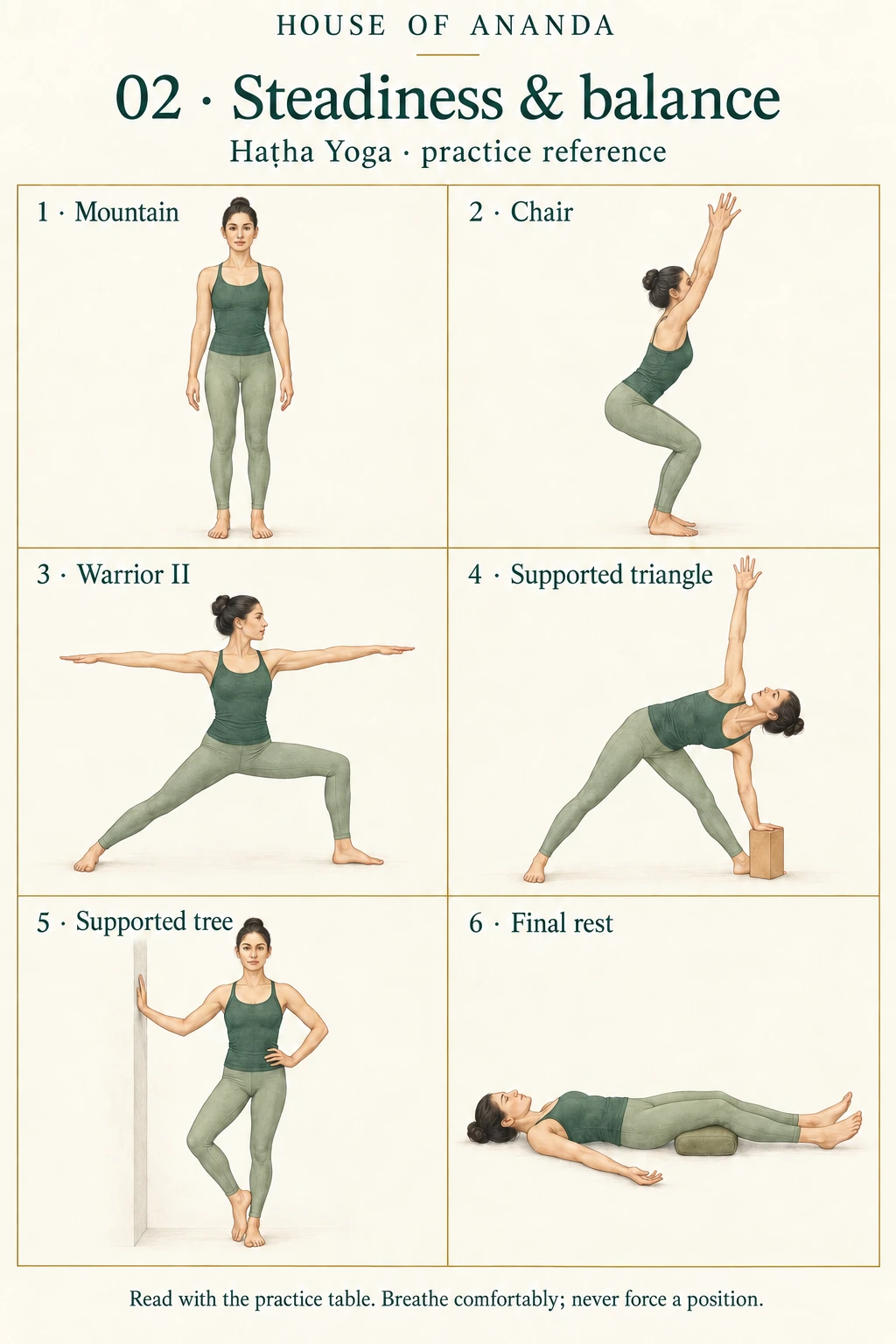
Steadiness & balance: 1. Mountain; 2. Chair; 3. Warrior II; 4. Supported triangle; 5. Supported tree; 6. Final rest. Read the table for both sides and alternatives.
Illustrated practice reference

Original AI illustrations. Panel numbers match the table; they are not traditional vinyāsa counts. Each two-sided pose is pictured on one representative side.

Scroll the table sideways on smaller screens. “Block” includes rests and transitions—not one continuous hold.

Step / blockPosture / sideBreath / gazeEnter, practise & leaveSupported alternative
13 min blockTāḍāsanaMountainCentreBreathe normally; no breath retention.Gaze: A steady point aheadStand with feet comfortably apart and knees unlocked. Feel the floor, let the arms settle and take 5 easy breaths. Add gentle shoulder rolls and small weight shifts, pausing between them.Stand beside a wall or sit upright with both feet supported.
24 min blockUtkaṭāsanaChairCentreExhale to bend; inhale to return to standing.Gaze: Ahead with the neck easyBegin with 4 shallow bend-and-rise movements. Then bend knees and move hips back, keeping heels grounded. Lift arms only as high as comfortable. Stay for 2–3 breaths, stand and rest; repeat up to 3 times.Keep hands on hips or use a supported partial sit-to-stand from a sturdy chair.
36 min blockVīrabhadrāsana IIWarrior IIRight first, then left; equal timeBreathe steadily during each short stay.Gaze: Over the front hand, or straight ahead if easierTake a comfortable wide stance. Turn the right foot out and bend the right knee towards the direction of its toes, keeping the back leg long. Open arms if comfortable. Stay 3–5 breaths, straighten the knee and pause. Repeat on the left. Take a standing rest before a second round if wanted.Shorten the stance, bend less and hold a chair or keep hands on hips.
46 min blockUtthita Trikoṇāsana · supportedSupported triangleRight first, then left; equal timeExhale into a small hinge; breathe normally.Gaze: Down or ahead; looking up is optionalFrom a comfortable wide stance, turn right toes out and keep the right knee soft. Reach sideways and place the lower hand on a high block or chair. Turn the chest only as far as easy. Stay 3 breaths, rise and rest. Repeat left; take a second short round only if comfortable.Keep the upper hand on the hip and use a high chair support. A small range is enough.
55 min blockVṛkṣāsana · supported variationSupported treeStand on left, then right; equal timeNatural breathing; do not brace or hold.Gaze: One steady point in frontStand beside a wall with one hand supported. Shift weight onto the left foot. Keep the right toes on the floor with the heel resting near the left ankle. Pause for 3 breaths, release and repeat on the other side. Rest between up to 3 rounds.Keep both feet grounded and practise gentle weight shifts. Never press the lifted foot into the standing knee.
66 min blockŚavāsanaFinal restCentreLet the breath settle naturally.Gaze: Eyes closed or softly openLower to the floor slowly. Rest on your back with arms comfortably away from your body. For the final minute, move fingers and toes, roll to one side, pause, then use your hands to return to sitting.Place a cushion under the knees, rest on your side, or sit supported in a chair.

After practice, notice how you feel without grading your flexibility or comparing yourself with the drawings. Return to the series.

Practice 03 · approximately 35 minutes

A balanced practice

Bring together gentle spinal movement, supported lunging and a longer rest.

A floor-based practice with kneeling and lying on the front and back. Use the alternatives when a position is unsuitable.

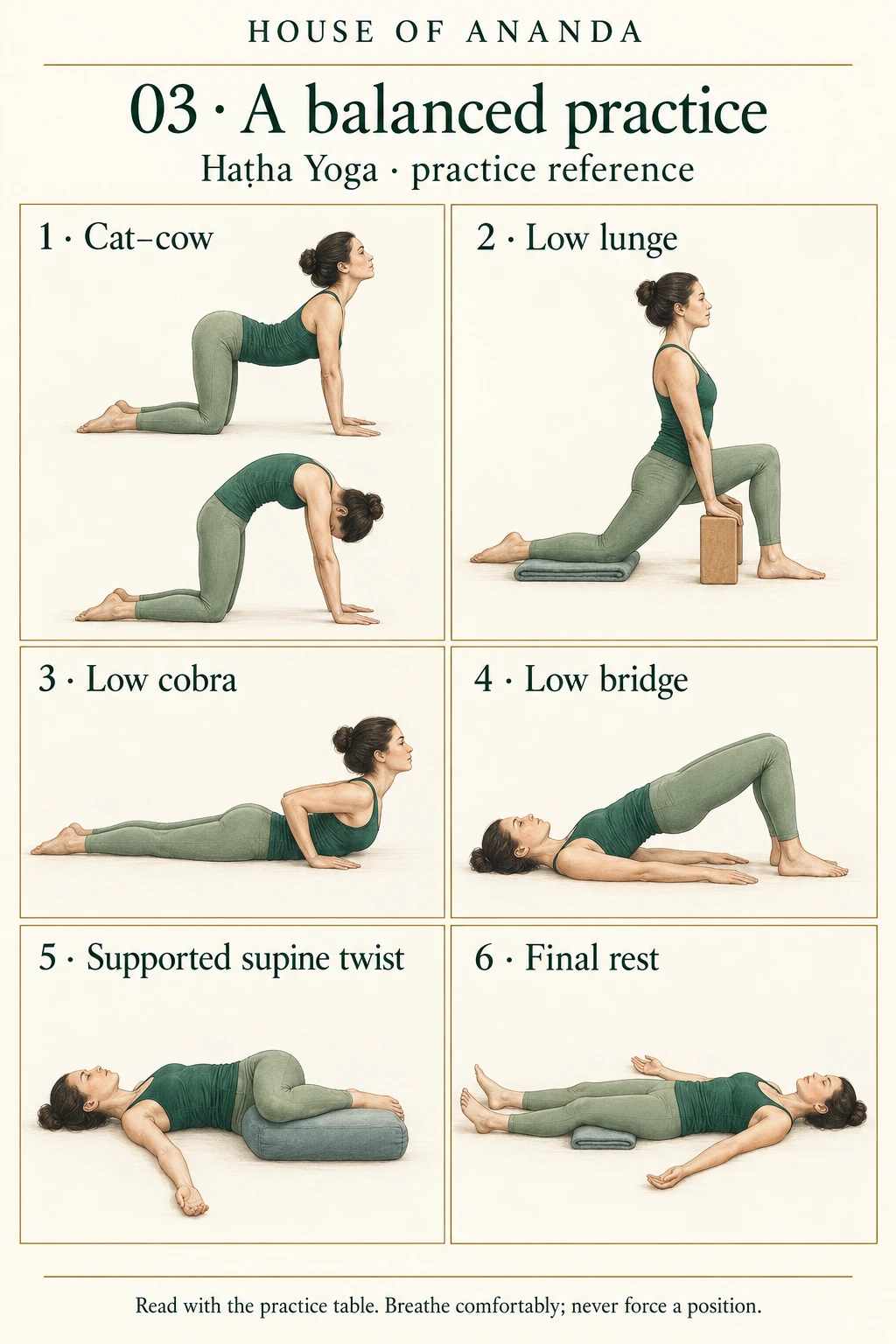
A balanced practice: 1. Cat–cow; 2. Low lunge; 3. Low cobra; 4. Low bridge; 5. Supported supine twist; 6. Final rest. Read the table for both sides and alternatives.
Illustrated practice reference

Original AI illustrations. Panel numbers match the table; they are not traditional vinyāsa counts. Each two-sided pose is pictured on one representative side.

Scroll the table sideways on smaller screens. “Block” includes rests and transitions—not one continuous hold.

Step / blockPosture / sideBreath / gazeEnter, practise & leaveSupported alternative
14 min blockMārjāryāsana–BitilāsanaCat–cowCentreInhale into a small chest opening; exhale to gently round.Gaze: Down in neutral; follow the spine gentlyFrom hands and knees, place wrists under shoulders and knees under hips. Move through 6 slow cycles without throwing the head back. Pause in neutral, rest, then repeat only if comfortable.Sit in a chair with hands on thighs and make small movements of the spine; avoid pressure on wrists or knees.
28 min blockAñjaneyāsana · supported variationLow lungeRight foot forward, then left; equal timeExhale to settle into a small lunge; keep breathing.Gaze: Slightly ahead with the neck longFrom hands and knees, bring the right foot forward, helping it with a hand if needed. Pad the back knee and place hands on high blocks. Keep the front knee near the ankle and lift the chest without pushing the hips down. Stay 3 breaths, return to all fours and pause; repeat left. Rest between a second short round.Use a small standing split stance with both hands on a chair; keep the back heel lifted and avoid kneeling.
34 min blockBhujaṅgāsana · low variationLow cobraCentreInhale to lift slightly; exhale to lower.Gaze: Down and slightly forwardLower onto the front and place hands near the ribs. Keep pelvis, thighs and tops of feet grounded. Lift the chest a little, with elbows bent and minimal pressure through hands. Lower again. Repeat 3–5 times with a resting breath between repetitions.Remain resting on the front if comfortable, or sit in a chair and gently broaden the chest without arching deeply.
45 min blockSetu Bandha Sarvāṅgāsana · low variationLow bridgeCentreInhale to lift a little; exhale to lower slowly.Gaze: Up; head stays stillRoll onto the back with knees bent, feet flat and arms resting beside you. Press through the feet to lift the pelvis modestly, keeping head and shoulders grounded. Lower with control. Make 4 slow repetitions; rest before an optional second round. Do not turn the head while lifted.Keep the pelvis down and practise a small pelvic tilt, or simply rest with knees bent. This is not the neck-loaded Ashtanga bridge.
56 min blockSupta Matsyendrāsana · supported variationSupported supine twistKnees right, then left; equal timeExhale to move a little; breathe naturally in the stay.Gaze: Up or eyes softly closedWith knees bent and feet on the floor, let both knees move a short distance to the right onto a bolster or cushions. Keep the shoulders comfortable and head neutral. Stay for 3–5 breaths, return to centre and pause. Repeat to the left; use extra time for neutral rest.Make a tiny knee sway instead, or stay still with feet grounded. Do not force knees to the floor.
68 min blockŚavāsanaFinal restCentreLet the breath settle naturally.Gaze: Eyes closed or softly openLower to the floor slowly. Rest on your back with arms comfortably away from your body. For the final minute, move fingers and toes, roll to one side, pause, then use your hands to return to sitting.Place a cushion under the knees, rest on your side, or sit supported in a chair.

After practice, notice how you feel without grading your flexibility or comparing yourself with the drawings. Return to the series.

Progress through familiarity, not force.

Repeat a practice until the breathing, positions and transitions feel familiar. The next session adds variety, not an obligation to stretch further. These practices involve floor transfers; if you need a fully chair-based sequence, choose individual chair options with a teacher rather than attempting unsupported transitions.

Practice design: House of Ananda. Posture names and teaching conventions vary between schools. Health and safety reference: NCCIH: Yoga—Effectiveness and Safety. Historical context and further sources: History of Yoga. These introductory practices omit breath retention, forceful breathing, deep binds and head-loaded inversions.