 House of AnandaMovement · Stillness · Wisdom · Journey
Lesson 14 of 14 · Yoga & anatomy
Haṭha, nāḍīs & subtle-body symbolism
Read the traditional map without mistaking it for anatomy.
The four-H teaching aid, sun and moon, Iḍā, Piṅgalā, Suṣumṇā and the notebook’s kuṇḍalinī drawings.
01 · Study
Head, hand, heart and Haṭha
The four-H list is a classroom memory aid, not the only classification of yoga. The notes use determination, oath and commitment to describe practice. Commitment need not mean stubbornness, ignoring injury or forcing an experience.
| Class memory aid | Associated path | Reflective emphasis |
|---|---|---|
| Head | Jñāna yoga | Inquiry and discernment. |
| Hand | Karma yoga | Action and service. |
| Heart | Bhakti yoga | Devotion. |
| Haṭha | Bodily and breath disciplines | Steadiness and embodied practice. |
02 · Study
Ha and ṭha: a symbolic interpretation
The notebook reads ha as sun and ṭha as moon, joining complementary qualities. This is a traditional symbolic interpretation of Haṭha, not its only meaning; the Sanskrit word is also associated with force or forceful effort.
Hot/active and cool/receptive, rejection and acceptance, are class analogies. “Male” and “female” labels here should not prescribe personality or practice according to sex or gender. No person needs to fit one pole.
Further reading: Sivananda · The Science of Pranayama (traditional account) ↗
03 · Study
Three central names in the drawing
Nāḍī means a channel in this context. The notes record 72,000, another much larger count and a narrowing towards three and one. Counts differ in traditional literature; the larger handwritten number is not securely attributable to a source and is not treated as anatomical measurement.
| Nāḍī | Traditional association in this lesson | Keep distinct from |
|---|---|---|
| Iḍā | Moon; left-side association | A measured parasympathetic nerve. |
| Piṅgalā | Sun; right-side association | A measured sympathetic nerve. |
| Suṣumṇā | Central subtle channel; central axis of the drawing | The physical spinal cord. |
Further reading: Sivananda · The Science of Pranayama (traditional account) ↗
04 · Study
“Fight or flight” and “rest and digest” are not two nostrils
Sympathetic and parasympathetic name divisions of the autonomic nervous system, with complex, organ-specific functions. The familiar stress and rest phrases are useful shorthand, not an on/off switch.
The notebook’s pairing of Piṅgalā with sympathetic and Iḍā with parasympathetic activity is an analogy. It does not establish that breathing through one nostril selectively turns an entire nervous-system division on or off.
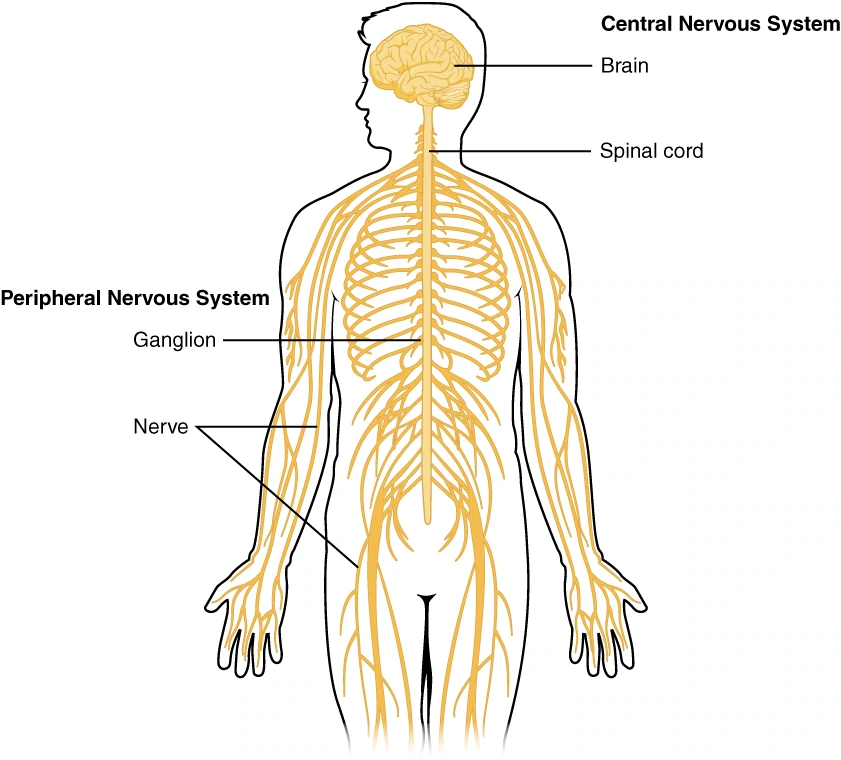

Further reading: OpenStax · Autonomic nervous system ↗
05 · Study
Reading the coiled-serpent image
The coiled figure represents kuṇḍalinī-śakti in the lesson: spiritual power pictured as dormant and capable of awakening. The central axis and surrounding centres belong to a subtle-body model; neither the serpent nor its ascent is a literal structure found in dissection.
The notebook relates awakening, Śiva, samādhi, mokṣa and release from rebirth. These are religious and philosophical teachings. Their meanings differ between schools, and a strong bodily sensation is not proof of liberation.
“Astral body” and “astral projection” appear alongside the drawing. They describe metaphysical ideas or reported experiences, not scientifically verified separation of a body. The Vedas heading does not establish that every nearby diagram comes directly from a Vedic text.
06 · Study
Study does not require forced awakening
No forceful breathing, retention, bandha or awakening sequence is reconstructed from these sketches. A shorter, ordinary practice can be complete. If a practice produces distress, sleep disruption or disorientation, stop and seek appropriate support rather than interpreting every symptom as progress.
Further reading: NCCIH · Yoga effectiveness and safety ↗
From notebook to page
IMG_1863, IMG_1867 and IMG_1869. These pages combine yogic philosophy, devotional language and modern nervous-system comparisons; they are not one universal doctrine.
Spelling has been standardised and explanations added. Traditional teaching cues, anatomical facts and uncertain handwriting are distinguished in the text. These pages support learning alongside appropriate teaching.