Emotions affect the body.
Feeling, breathing, movement and muscular effort can influence one another.
 House of AnandaMovement · Stillness · Wisdom · Journey
Wisdom / Emotions, Muscles & the Body
House of Ananda · Embodiment studies
Memory, interoception, autonomic responses, fascia and the limits of the evidence.
Feeling, breathing, movement and muscular effort can influence one another.
Some relaxation and movement practices help some outcomes. Benefits and mechanisms need separate evaluation.
No established chart assigns a stored emotion or a hidden memory to each muscle.
From the thesis · page 11
A plausible account does not need hidden deposits. An anticipated confrontation, a painful movement or a familiar cue can alter appraisal, attention, breathing and motor preparation. The resulting sensations can feed back into interpretation. A person may then brace more, move less or avoid the situation. This is a systems-level explanation, not a claim that every episode follows a rigid sequence.
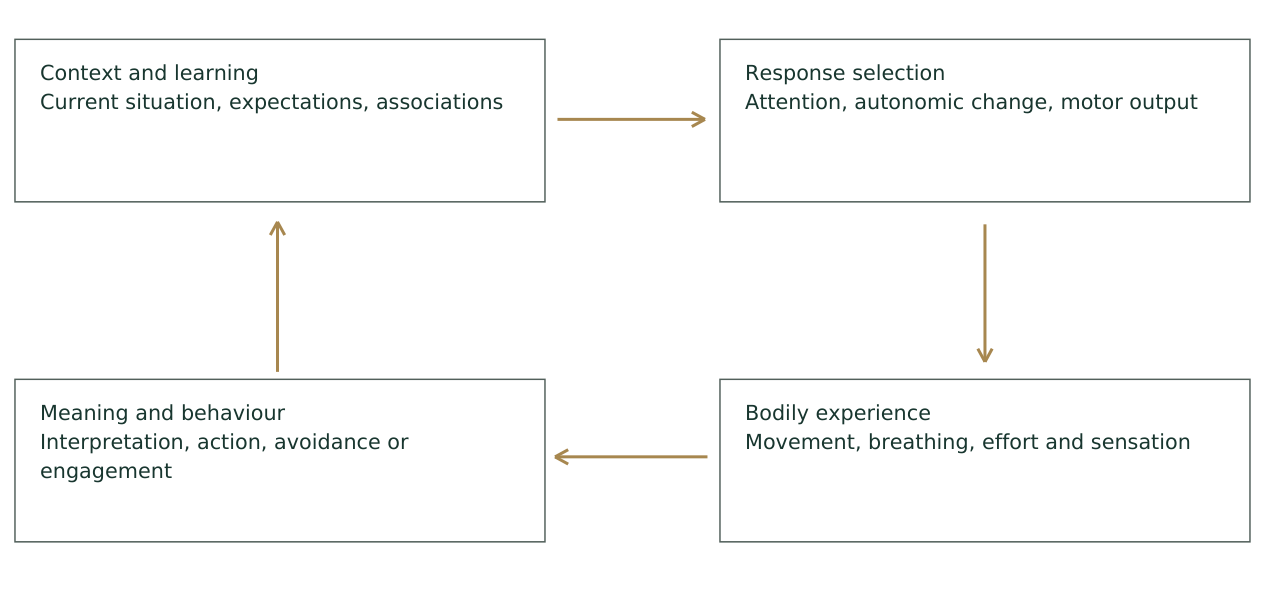
Motor commands arrive through somatic motor pathways and neuromuscular junctions. A protective contraction may involve neck, trunk or limb muscles depending on the task. Autonomic arousal and skeletal motor activity are coordinated but are not identical systems: most skeletal muscles are not directly relaxed by a vagal command.
Repeated habits can become easy to re-enact. Fatigue, poor sleep, ongoing demands and pain can keep them prominent. An exercise may help by changing the immediate pattern, creating a tolerable experience of movement, or restoring a sense of choice. These are candidate explanations; not every beneficial exercise acts through the same mechanism.
From the thesis · page 12
Autobiographical memory concerns events in one's life. Procedural learning concerns skills and habits. Conditioning concerns learned relationships among cues, responses and consequences. These processes involve neural systems. A learned protective movement can feel automatic without a conscious recollection accompanying it.
“Muscle memory” in sport usually refers to skilled movement becoming well learned. Muscle tissue can also retain training-related biological adaptations. Neither use means that a muscle contains a particular childhood episode, emotion or verbal message. Biological persistence is not the same as psychological content.
A person may tense on hearing a door slam because that sound has become associated with danger. The response can include startle, breath-holding or an urge to leave. The cue, interpretation and motor response form an interaction; the frightened experience need not be stored in the specific muscles that contract.
A posture, smell, touch, room, song or internal sensation can act as an associative cue. Attention may make a previously unnoticed feeling more salient. A memory arriving during stretching therefore does not locate its storage in the stretched tissue. Nor does it establish that every detail of the memory is accurate.
Vividness, tears and bodily certainty are experiences to treat respectfully, not independent corroboration of historical facts. Practitioners should avoid suggesting an event, naming a perpetrator or interpreting a sensation as proof of abuse. Trauma-informed care can address present distress without requiring a recovered-memory narrative.
If the problem involves learned protection and present conditions, help can include better sleep, safer relationships, pacing, physiotherapy, psychotherapy, comfortable movement and practical changes. There is no need to locate and excavate every supposed pocket of emotion. Some people recover with little dramatic bodily expression.
From the thesis · page 13
Antonio Damasio's somatic-marker account proposes that bodily signals or their neural representations help guide decisions, especially when outcomes are uncertain. A “gut feeling” can be understood as information influencing choice. A marker is not a parcel of emotion inside abdominal muscle.[33]
Predictive accounts propose that prior experience and current context shape the interpretation of sensory signals. Barrett's theory of constructed emotion gives interoception and learned concepts a central role. This is an influential theoretical account, not the sole settled model of emotion. It helps explain why similar sensations can receive different meanings.[15]
Nummenmaa and colleagues' 2014 study is widely cited for maps of reported bodily activation and deactivation during emotions. Its maps concern where people report feeling changes. They are not a muscle dissection, a tissue assay or a map of long-term storage. Full-text access was restricted for this review, so detailed numerical claims are not reproduced.[16]
A 2025 theoretical preprint proposes that such maps can combine physiological signals, behavioural engagement and concepts or metaphors. That is a useful caution: a body drawing is a structured account of experience, not necessarily a direct measurement of muscle activity.[37]
Imagine three situations: anticipating a first date, waiting for a difficult meeting and climbing a hill. A strong heartbeat can occur in all three. Naming the feeling requires information about context and the person's interpretation. A chest location alone cannot distinguish excitement, fear or exertion.
Body awareness is therefore best paired with curiosity: “What is the sensation? What is happening around me? What do I need?” Constantly searching for hidden emotion in every sensation may increase preoccupation rather than understanding. External attention is a valid alternative when inward attention becomes overwhelming.
From the thesis · page 14
The autonomic nervous system helps regulate internal organs. Sympathetic and parasympathetic activity interact; neither is simply “bad” or “good.” Healthy functioning involves appropriate mobilisation and recovery. Skeletal muscle bracing, breathing and cardiovascular changes can occur together, but their presence does not identify one specific emotion.
Stephen Porges introduced polyvagal theory in the 1990s. It connects autonomic organisation with defensive behaviour and social engagement, using concepts including neuroception and co-regulation. Its clinical language commonly describes mobilisation, immobilisation and connection. Porges' 2025 article defends and develops this account.[12]
Critics challenge important evolutionary and physiological premises. Doody and colleagues' 2023 author manuscript objects to an overly simple contrast between asocial reptiles and social mammals. Grossman's 2023 critique is an important further-reading source, although its full text was not accessible here. Porges disputes the critiques. The model should therefore be labelled contested rather than presented as established autonomic anatomy.[12][13][14]
Feeling calm after a supportive conversation does not distinguish polyvagal theory from alternative explanations involving attention, learning, attachment, expectations and ordinary autonomic regulation. A beneficial practice can remain useful even if its proposed explanatory theory is disputed.
| Shortcut | More accurate interpretation |
|---|---|
| “Freeze means dorsal vagal shutdown.” | Freezing, fainting, dissociation and fatigue are different phenomena and require context. |
| “A higher HRV proves trauma has released.” | Heart-rate variability is affected by breathing, posture, measurement and other factors; it is not a trauma meter. |
| “This pose resets the vagus and releases the psoas.” | A comfortable posture may change experience; a specific reset or release mechanism has not been established. |
From the thesis · page 15
Fascia is connective tissue associated with muscles and other structures. It has mechanical and sensory roles. Manual treatment can change perceived stiffness or pain, but a felt softening does not show that emotional material left the fascia. Some bodywork schools describe “somatoemotional release” or tissue memory; these are proposed explanations, not established records that can be read from touch.
Candace Pert's popular work helped spread the idea of extensive body-mind chemical communication. Chemical signalling outside the brain is real. The further claim that a particular feeling is permanently held in a particular muscle does not follow from receptors or peptides being present. Receptor distribution is not a map of the semantic content of memories.[35]
Immune memory, epigenetic changes and exercise adaptation are distinct biological phenomena. Calling them “memory” does not establish that they encode shame, anger or a relationship event in a muscle. Transgenerational and cellular-trauma claims require particular caution about mechanism, population and what was actually measured.
John Sarno proposed that some pain was linked to unconscious emotional conflict; his historical tension-myositis explanation included a physiological account that should not be assumed established. Contemporary pain reprocessing therapy investigates different, more testable ideas about threat beliefs and pain. Evidence for one cannot retrospectively prove every aspect of Sarno's account.[36]
Pain can involve nociceptive input, nerve disease or injury, altered nociceptive processing, and combinations of these. Psychological and social influences do not make pain imaginary. Equally, attributing all pain to emotion can miss physical disease. A positive response to psychological treatment does not mean the original symptoms were fabricated.[24]
The question “What maintains this person's symptoms?” is clinically more productive than “Which emotion is hiding in this knot?” It leaves room for physical findings, nervous-system processes, meaningful stressors and rehabilitation together.
From the thesis · page 16
Peter Levine's approach attends to sensation, resources and defensive responses, often using gradual contact with difficult experience. Titration means proceeding in small tolerable amounts; pendulation describes moving attention between more and less activating experience. These are clinical concepts. The proposed completion or discharge of a defensive response should not be equated with a measured substance leaving a muscle.[7][8]
Pat Ogden's work integrates bodily patterns with emotional and cognitive processing. Her institute describes roots in the 1970s and establishment of her school in 1981 following involvement with Hakomi. The therapeutic focus may include posture, impulses and boundaries. This provides a way to explore present patterns, not a test that determines what happened in the past.[9]
Tension and Trauma Releasing Exercises, associated with David Berceli, aim to elicit tremoring after muscular activity. Proponents interpret this as a route to reducing stress or discharging defensive activation. The evidence assessed here does not establish a muscle-specific trauma-release mechanism. This review does not provide a forced-tremor protocol or treat tremoring as necessary for recovery.
Tremor can have multiple explanations: effort, fatigue, cold, anxiety, medication effects or neurological causes. An involuntary movement is not automatically therapeutic. New, unexplained or persistent tremor deserves assessment rather than an assumption that “trauma is coming out.”
The Body Keeps the Score helped popularise the lasting bodily consequences of trauma. Its influence is not evidence for a literal muscle archive. “The body remembers” can serve as shorthand for enduring responses; it becomes misleading when used as proof that a therapist can locate or extract a specific event.[34]
A trauma treatment may incorporate body awareness while still depending on careful assessment, a therapeutic relationship and individual pacing. The exact mechanisms remain open to investigation.
From the thesis · page 17
| Evidence / example | What it supports | What it cannot establish |
|---|---|---|
| Body-map questionnaires: Nummenmaa et al., 2014 | Reported feelings have bodily locations and patterns. | A map of fibres containing emotional memory. |
| Somatic Experiencing RCT: Brom et al., 2017 | 63 adults with PTSD; 15 weekly sessions compared with a waitlist; symptom improvement favoured treatment. | Superiority to established trauma therapies or proof of muscular discharge. |
| Structured breathing trial: Yilmaz Balban et al., 2023 | Daily five-minute practices over a month; exhale-focused cyclic sighing showed promising mood and breathing-rate findings. | That an emotion left the diaphragm; a general cure for PTSD. |
| Pain reprocessing RCT: Ashar et al., online 2021 | A test of a psychological intervention in selected people with chronic back pain. | That all pain is emotional, or that every pain mechanism is the same. |
| Yoga and massage clinical literature | Possible benefits for some symptoms and populations; certainty varies by condition. | That specific poses or pressure points remove specific emotions. |
| Laboratory EMG | Electrical activation associated with motor-unit activity under defined conditions. | A detector of a person's hidden history or the meaning of a contraction. |
A package of care can combine attention, education, practice, expectation, social support and movement. If people improve, the package may have helped. To show that a specific mechanism caused improvement, investigators need additional measurements and comparisons that isolate it. “People felt better” and “the proposed mechanism is correct” are separate conclusions.
An illustration: a shoulder massage helps after a difficult week. Reduced pain, quiet time, supportive touch, expectations and the passing of time are competing explanations. The experience alone cannot decide among them.
From the thesis · page 18
In Brom and colleagues' trial, allocation was 33 participants to treatment and 30 to waiting. The waitlist subsequently received treatment. This design supports preliminary effectiveness but does not control fully for therapist contact or expectancy. It was not a muscle-storage experiment. Replication, active comparison and longer follow-up matter.[10]
The 2021 Somatic Experiencing scoping review maps an emerging literature. A scoping review helps identify available work and gaps; it is not equivalent to a large body of independent, high-certainty trials. Training organisations' clinical claims should remain distinct from independent assessment.[11]
The breathing trial tested particular practices and outcomes in a remote setting. Its findings should not be generalised to all breathwork. In particular, a benefit from one brief breathing technique is not a reason to recommend intense hyperventilation, long breath holds or deliberately induced distress.[18]
A small 2026 experimental preprint involving 19 participants found that trapezius EMG in its protocol was driven mainly by physical exertion, with no reliable effect of its stress task. This does not refute all stress-related muscle activity. It shows why task conditions matter and why a single physiological signal is an unreliable emotional label.[39]
A 2020 mindfulness trial preprint in veterans examined brain measures related to internal bodily signals. Such work provides hypotheses about regulation and interoception, rather than evidence that memories are held in muscle. A mediator in a statistical model is not automatically a uniquely established causal mechanism.[38]
The US National Center for PTSD summarises guideline support for trauma-focused treatments including prolonged exposure, cognitive processing therapy and EMDR. Body-based self-care can be an adjunct. It should not be sold as an assured substitute for assessed treatment, particularly when symptoms are persistent or disabling.[22]
Keep the complete reference
36 pages · 12 illustrated practices · 39 source entries