Emotions affect the body.
Feeling, breathing, movement and muscular effort can influence one another.
 House of AnandaMovement · Stillness · Wisdom · Journey
Wisdom / Emotions, Muscles & the Body
House of Ananda · Embodiment studies
Front, back and deep regions: what muscles do, what we may feel and what a sensation cannot tell us.
Feeling, breathing, movement and muscular effort can influence one another.
Some relaxation and movement practices help some outcomes. Benefits and mechanisms need separate evaluation.
No established chart assigns a stored emotion or a hidden memory to each muscle.
From the thesis · page 19
Possible experiences include clenching, bracing, restricted breathing, heaviness or restlessness. Any of these can accompany more than one emotion, physical exertion or a non-emotional condition.
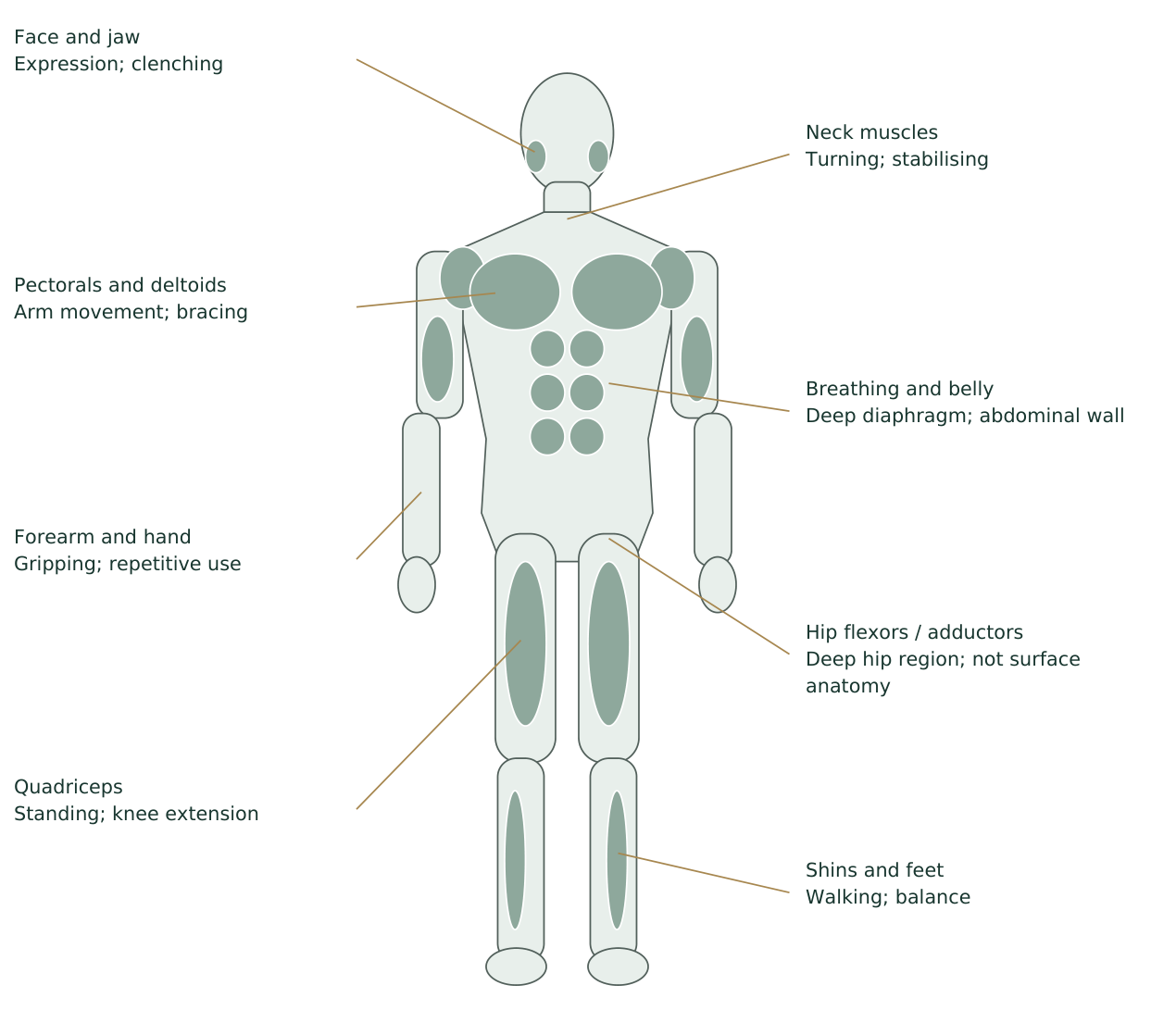
Deep structures are identified by region rather than drawn as visible superficial muscles. The diaphragm lies beneath the lungs; the psoas lies deep beside the lumbar spine and crosses the hip. Neither has a validated emotional storage assignment.
From the thesis · page 20
Back and hip tension may be influenced by workload, movement habits, pain and stress. The locations below cannot diagnose an emotion or a past event. Anatomical overlap is not evidence of a shared emotional meaning.
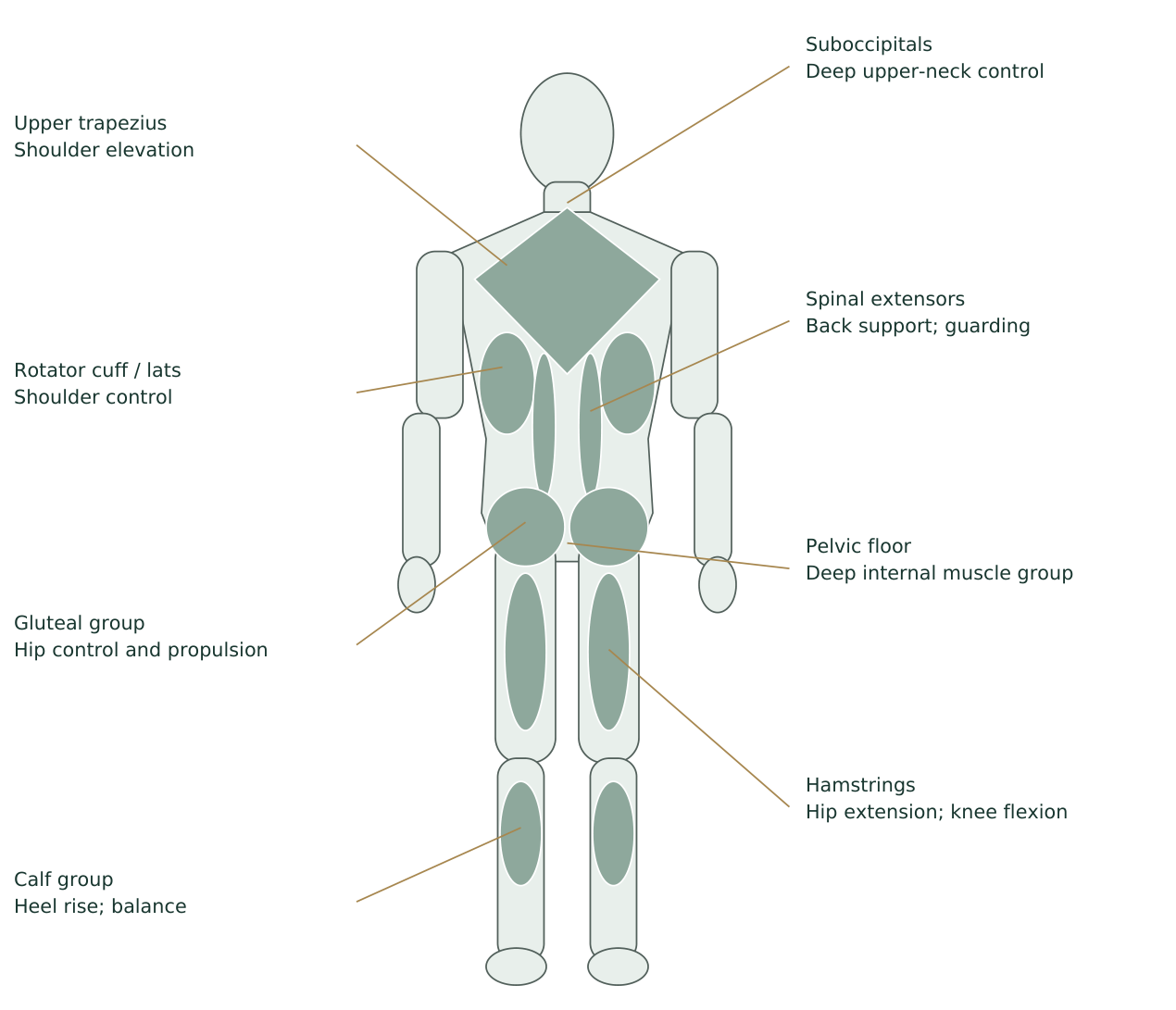
A tense pelvic floor does not establish sexual trauma. A stiff back does not establish suppressed anger. These symptoms deserve a history and, when appropriate, physical assessment rather than a fixed emotional interpretation.
From the thesis · page 21
| Region and representative muscles | Possible function or experience | Emotion-storage assignment |
|---|---|---|
| Forehead / eyes: frontalis, corrugator supercilii, orbicularis oculi | Brow movement, eye closure, effort and expression. | None validated. |
| Mouth: zygomaticus major, orbicularis oris, buccinator, mentalis | Smiling, lip movement, chewing assistance and speech. | None validated. |
| Jaw: masseter, temporalis, medial and lateral pterygoids | Chewing and jaw movement; clenching can be habitual. | None validated; not an anger test. |
| Neck: sternocleidomastoid, scalenes, suboccipitals, splenius group | Head control; some assist breathing. | None validated. |
| Shoulder: trapezius, levator scapulae, rhomboids, deltoid | Scapular and arm movement; sustained effort. | None validated; “burden” is metaphor. |
| Rotator cuff: supraspinatus, infraspinatus, teres minor, subscapularis | Shoulder stability and rotation. | None validated. |
| Arm / hand: biceps, triceps, wrist and finger flexors/extensors, intrinsic hand muscles | Reaching, pushing, gripping and fine movement. | None validated. |
| Chest: pectoralis major/minor, serratus anterior; intercostals | Arm/scapular actions and rib movement. | None validated; not a grief container. |
| Diaphragm; rectus abdominis, obliques, transversus abdominis | Breathing and abdominal pressure; trunk control. | None validated. |
| Back: erector spinae, multifidus, quadratus lumborum, latissimus dorsi | Spinal control and movement; shoulder actions for lats. | None validated. |
Emotion can accompany activity in these muscles. The statement “none validated” concerns a specific storage assignment, not a denial of bodily feelings. Exercise choices follow function and comfort, not inferred emotional content.
From the thesis · page 22
| Region and representative muscles | Possible function or experience | Emotion-storage assignment |
|---|---|---|
| Iliopsoas: psoas major and iliacus | Hip flexion and lumbopelvic mechanics; deep, not directly visible. | None validated; “fear muscle” is not a scientific diagnosis. |
| Gluteus maximus, medius and minimus | Hip extension, abduction and pelvic control. | None validated. |
| Deep rotators: piriformis, obturators, gemelli, quadratus femoris | Hip rotation and stabilisation. | None validated. |
| Adductors: longus, brevis, magnus; gracilis and pectineus | Control of thigh position and movement. | None validated. |
| Pelvic floor: levator ani group and coccygeus | Pelvic support and continence; may become overactive or weak. | None validated; symptoms alone do not establish trauma. |
| Quadriceps: rectus femoris; vastus lateralis, medialis and intermedius | Knee extension; rectus femoris also flexes the hip. | None validated. |
| Hamstrings: biceps femoris, semitendinosus, semimembranosus | Knee flexion and hip extension, with anatomical exceptions. | None validated. |
| Lower leg: gastrocnemius, soleus, tibialis anterior/posterior, fibularis group | Walking, ankle movement and foot support. | None validated. |
| Foot: long toe flexors/extensors and intrinsic muscles | Toe movement and balance. | None validated; grounding is a practice, not emotion drainage. |
The psoas participates in movement and posture and can be involved in protective strategies, as can many muscles. Its proximity to other structures and participation in curling or moving do not make it a unique trauma reservoir. Deep abdominal pressure is not needed to explore comfortable hip movement and is not included in this guide.
From the thesis · page 23
This is an illustrative vocabulary, not a diagnostic chart or a reproduction of measured body-map data. The experiences listed are possible examples; any may be absent, reversed or shared by other emotions. No row identifies a muscle in which the emotion is stored.
| Emotion or state | Possible bodily experience | Gentle starting option |
|---|---|---|
| Fear / anxiety | Bracing, fast breathing, trembling, cold hands or urge to move. | Look around; easy walking; unforced breathing. |
| Anger / frustration | Jaw or hand clenching, heat, increased effort; sometimes withdrawal. | Unclench; release a light grip; take a walking break. |
| Sadness / grief | Chest or throat sensations, tears, heaviness; sometimes agitation. | Supported sitting; comfortable breathing; connection. |
| Shame / embarrassment | Looking down, face warmth, hiding or tightening. | Eyes-open orientation and a freely chosen posture. |
| Disgust | Facial movement, nausea, withdrawal. | Move away from the trigger; find physical comfort. |
| Joy / excitement | Smiling, lively movement, butterflies, strong heartbeat. | Allow comfortable movement; no release required. |
| Love / affection / tenderness | Warmth, softening, reaching; individual variation. | Enjoy chosen contact or quiet attention. |
| Worry / guilt / rumination | Repeated bracing or restlessness; sometimes no clear sensation. | Movement break followed by a practical next action. |
| Loneliness / yearning | Heaviness, restlessness or little distinct sensation. | Gentle activity plus meaningful social contact. |
| Relief / calm / contentment | Easier breathing or reduced effort; not necessarily limp muscles. | Notice comfort without trying to intensify it. |
| Numbness / disconnection | Feeling distant, flat, unreal or less aware of the body. | External orientation; stop prolonged inward scanning. |
Emotions are not contaminants. Often the helpful response is understanding, action, support or time. A movement practice can support that process without needing to eliminate the emotion itself.
Keep the complete reference
36 pages · 12 illustrated practices · 39 source entries