 House of AnandaMovement · Stillness · Wisdom · Journey
Wisdom / Emotions, Muscles & the Body
House of Ananda · Embodiment studies
Histories & theories
From traditional correspondences and bodily expression to muscular armour and body psychotherapy.
From the thesis · page 3
1. Definitions: what does “stored” mean?
| Term | Definition and important distinction |
|---|---|
| Emotion | A context-sensitive episode involving feeling, appraisal, bodily change and tendencies to act. Different theories give these components different priority. |
| Feeling | The conscious experience of an emotion or bodily state. A felt location is not necessarily the location of its cause. |
| Muscle tension | Active contraction or perceived tightness. Perceived tightness does not always imply unusually high resting electrical activity. |
| Guarding | Protective movement or bracing around pain, threat or anticipated discomfort. It can be useful initially and restrictive when persistent. |
| Interoception | Sensing and interpreting internal bodily signals. Proprioception concerns position, movement and force; the domains interact. |
| Somatic / embodied | Relating to the body, or involving the body in experience and action. Neither term establishes tissue-based memory. |
| Trauma and PTSD | Trauma may refer to an overwhelming event or its consequences. PTSD is a defined clinical syndrome; everyday tension alone does not diagnose it. |
| Release | An ambiguous word: less contraction, easier movement, reduced distress, emotional expression or a change in interpretation. These are different outcomes. |
“Storage” can mean a present sensation, a learned response that returns, long-term biological adaptation, a metaphor for suffering, or a literal tissue archive. The first four meanings do not logically establish the fifth. Ask which meaning is intended before judging the claim.
A useful example is clenching before a difficult conversation. The jaw contraction is physical, its timing may be learned, and the event can feel emotionally charged. None of those observations reveals an anger molecule or a hidden memory inside the masseter.
From the thesis · page 4
2. A historical timeline
- Classical antiquity
Indian contemplative and medical texts; Chinese medical correspondences; Greek humoral medicine.
Mind, sensation, conduct and bodily health understood together; not modern muscle-specific evidence.
- 1872-1880s
Darwin on expression; James and Lange on bodily feeling.
Movement and physiology become central to scientific accounts of emotion.
- 1880s-1890s
Janet's dissociation; Breuer and Freud's early work.
Experience can have effects outside deliberate awareness; catharsis becomes influential.
- 1910s-1930s
Cannon's physiological work; Jacobson's relaxation; Reich's character analysis.
Different paths: stress physiology, learned relaxation and defensive muscular armour.
- 1940s-1970s
Lowen and Pierrakos; Feldenkrais; Rolf; Gestalt; humanistic and experiential therapies.
Posture, breathing, movement, touch and expression become therapeutic entry points.
- 1970s-1990s
Somatic Experiencing, Hakomi, sensorimotor work; trauma research; Damasio and Porges.
Body awareness, defensive responses, interoception and autonomic regulation gain prominence.
- 2000s onward
Trauma-sensitive yoga, TRE, pain science, body-map studies and online release claims.
Research, clinical metaphors and untested fixed maps are often blended together.
This is a map of intersecting traditions, not a single chain of discoveries. Yoga did not experimentally prove Reich; autonomic neuroscience did not validate organ-emotion correspondences; modern tissue research did not establish that grief resides in fascia. Similar language can conceal very different meanings.
From the thesis · page 5
3. Indian traditions: impressions and practice
Yoga: samskara, vritti and embodied discipline
In classical yoga, samskaras are latent impressions or dispositions that shape subsequent experience. Vrittis are activities or modifications of mind; practice and non-attachment address their hold on experience. These ideas can illuminate recurring habits without equating an impression with a deposit in a hip muscle. Patanjali's discussion of posture centres on steadiness and ease rather than a catalogue of emotions assigned to muscles.[30]
Prana belongs to a traditional account of vitality; nadis and chakras belong to subtle-body frameworks whose details differ across texts and lineages. They are not interchangeable with measurable oxygen, peripheral nerves, lymphatic vessels or endocrine glands. A chakra practice may be personally meaningful without its imagery constituting verified anatomical information.
Ayurveda: mind, constitution and tissue
Ayurveda considers body, mind, daily routine, environment and constitution together. Vata, pitta and kapha are traditional organising principles. Sattva, rajas and tamas provide another vocabulary for qualities of mind. Mamsa dhatu refers to muscle tissue, but a traditional tissue category does not establish that individual muscles retain discrete emotional memories. Clinical evidence must be evaluated for each treatment and condition.[29]
Where modern “hip-opening” claims fit
Statements such as “the hips store sadness” are common in modern wellness settings, but should not be represented as a universal conclusion of ancient yoga. Hips participate in sitting, standing, locomotion, protection and intimate movement. Stretching them may therefore feel vulnerable, effortful, pleasant, frustrating or emotionally evocative depending on context.
A respectful teaching approach offers both levels explicitly: “This tradition associates the pelvic region with particular themes; anatomically, we are exploring a comfortable range of hip movement.” It leaves interpretation with the participant and does not promise that a posture removes grief, sexual trauma or a karmic obstruction.
Example
Someone feels tears during a supported rest after movement. A contemplative interpretation might emphasise allowing experience to arise. A psychological interpretation might emphasise attention, relief or association. Both can be explored as interpretations; neither makes the hip the proven storage site.
From the thesis · page 6
4. Chinese and other correspondence systems
Traditional Chinese medicine
Classical Chinese medicine describes reciprocal relationships between emotional life and functional organ systems. In a familiar five-phase presentation, anger relates to the Liver system, joy to Heart, pensiveness to Spleen, grief to Lung and fear to Kidney. These are traditional correspondences; translations and elaborations vary. Capitalised organ names indicate a broader traditional functional concept, not simply the anatomical organ.[31]
| Traditional association | What it does not establish |
|---|---|
| Liver / wood / anger | Anger is not proven to be stored in the liver, tendons or an individual muscle. |
| Heart / fire / joy | Joy is not a pathological deposit in cardiac muscle. |
| Spleen / earth / pensiveness | Thinking or worry cannot be diagnosed from a muscle assigned to a meridian. |
| Lung / metal / grief | Breathing-related grief sensations do not locate grief in lung tissue. |
| Kidney / water / fear | Fear does not establish kidney disease or psoas storage. |
Meridian-based muscle charts used in some modern applied-kinesiology systems add another interpretive layer. Testing a muscle's resistance does not provide a validated test of an unseen emotion, truthfulness, an organ disorder or a traumatic event. Ordinary clinical strength testing has a different purpose: assessing force and neurological or musculoskeletal function.
Greek humours and later body symbolism
Humoral medicine associated temperament with bodily fluids, including the historical connection between melancholy and black bile. Modern “body language” dictionaries sometimes assign fixed meanings to left versus right sides, knees, feet or particular pains. These historical and symbolic systems should be understood on their own terms, not relabelled as findings from neuroscience.
TCM includes multiple practices, and evidence for one intervention cannot validate the entire explanatory system. A clinical benefit from acupuncture, tai chi or another practice would still require a separate investigation to establish an emotion-storage mechanism.[28]
From the thesis · page 7
5. Expression, bodily feeling and appraisal
Darwin and emotional expression
Darwin's 1872 work examined expressions in humans and other animals. Habits, antagonistic movements and nervous activity helped explain visible behaviour. The lasting insight is that muscles participate in communication and action. A facial expression is an event or pattern, not a container in which its meaning is permanently kept.[1]
James-Lange and Cannon-Bard
James's 1884 proposal placed the perception of bodily changes at the centre of emotional experience; Lange independently emphasised bodily physiology. On this view, trembling and other changes contribute to the experience of fear. Cannon challenged the sufficiency and specificity of peripheral feedback, helping establish a central-brain account associated with Cannon and Bard. Neither account demonstrates long-term emotion storage in muscle fibres.[2][3]
Two-factor and appraisal accounts
Schachter and Singer's two-factor approach emphasised arousal plus its interpretation. Appraisal theories, associated especially with researchers such as Richard Lazarus and Klaus Scherer, examine evaluations of relevance, threat, responsibility and coping. They help explain why a racing heart can feel exciting in one setting and frightening in another. Their predictions concern appraisal and response, not a fixed muscular address.[2]
Facial feedback and posture
The facial-feedback hypothesis asks whether making an expression can influence emotion. Postural-feedback theories ask related questions about uprightness, openness and movement. Even if a bodily manipulation changes a feeling, that would demonstrate influence rather than storage. Effects can depend on task, expectations, social setting and how the manipulation is performed.
The distinction matters practically: choosing a more comfortable posture may help someone engage with a conversation. It does not mean a slumped posture reveals depression, a smile guarantees happiness, or a stretch reveals a suppressed memory. The same person can use a facial or postural pattern for several different purposes.
A unifying question
Does the body express emotion, help generate it, shape its interpretation, or all three? Contemporary research addresses these interacting possibilities. None requires a one-muscle, one-emotion inventory.
From the thesis · page 8
6. Dissociation, catharsis and muscular armour
Janet, Breuer and Freud
Late nineteenth-century work on dissociation and hysteria helped make persistent, involuntary consequences of overwhelming experience a subject of psychological inquiry. Pierre Janet emphasised failures of psychological integration. Breuer and Freud's early cathartic approach connected symptoms with emotionally charged experiences and their expression. These were historically important clinical interpretations, not controlled demonstrations of memory in tissue.[4]
Catharsis is the idea that expressing an inhibited emotion can bring relief. Relief may occur, but intense expression is not a universal treatment mechanism. Feeling worse during an exercise is not proof that it is working, and increasing emotional intensity is not inherently therapeutic.
Wilhelm Reich
Reich's character analysis connected enduring psychological defences with characteristic bodily restraint. His “muscular armour” described habitual tension that he interpreted as limiting expression and protecting against painful feeling. Breath, posture and bodily interventions became part of his work. Character Analysis began in 1933 and changed substantially in later editions; the mature segment model should not be projected wholesale onto the earliest edition.[5]
The clinically interesting observation is that protection can become habitual. The additional claim that a bodily pattern reliably identifies a specific buried conflict requires separate evidence. Reich's later orgone-energy claims are not an accepted mechanism in contemporary physiology.
What remains useful, and what does not follow
“Armour” can be an optional metaphor for a person who notices bracing when exposed or criticised. It should not become a diagnosis imposed on a stranger's posture. Pain, disability, occupation, training, injury and anatomy can all shape movement. No body shape establishes someone's character, morality, sexuality or trauma history.
A collaborative question is “What do you notice when your shoulders settle?” A leading claim is “Your shoulders prove that you are carrying childhood rejection.” The first invites observation; the second manufactures certainty that the examination cannot support.
From the thesis · page 9
7. Reich's seven armour segments
Historical schematic only. These are broad rings in a therapeutic theory, not anatomical compartments or a validated emotion map. The short descriptions below summarise themes in Reichian and later body-therapy language; formulations vary by school.
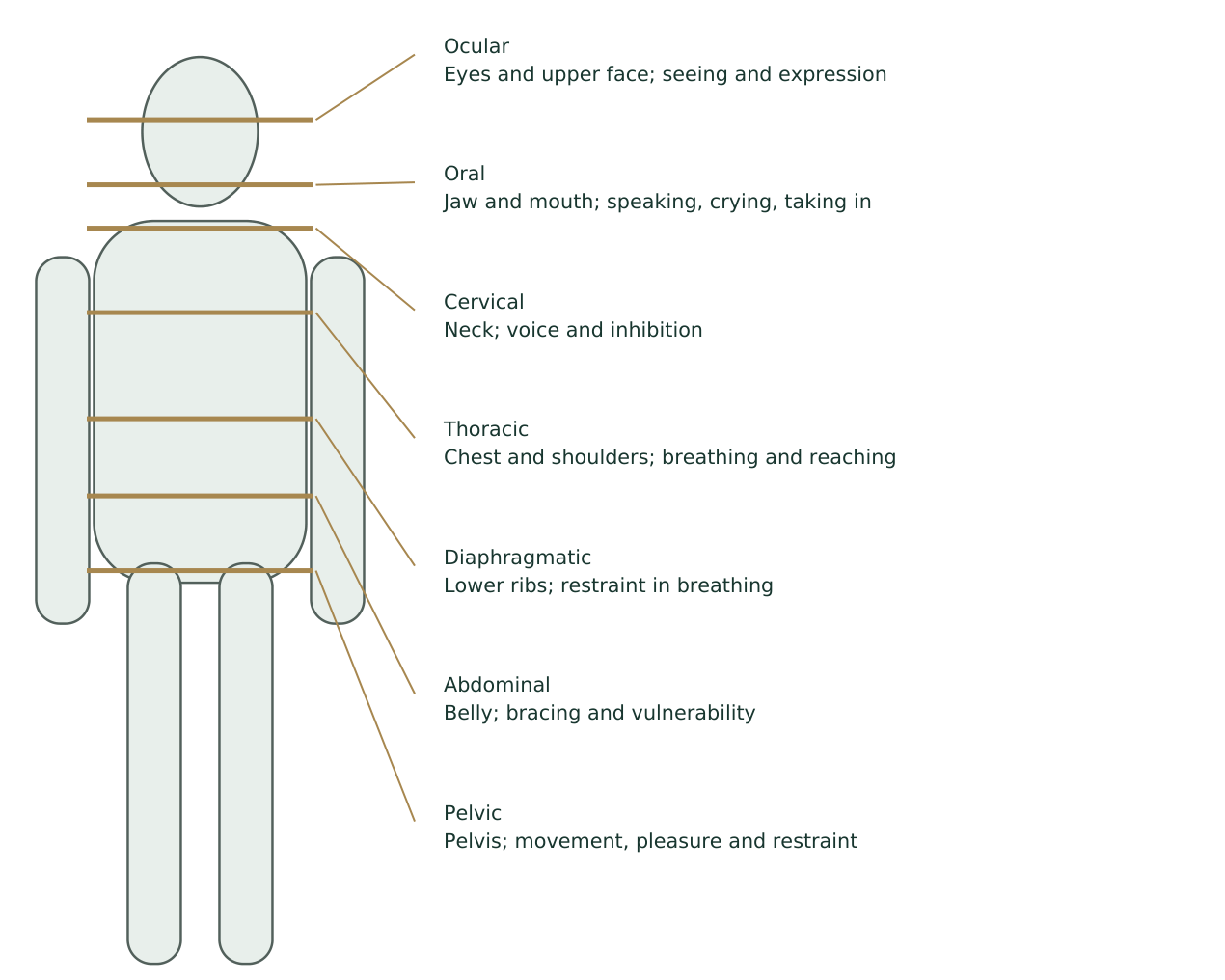
Some practitioners use this model to explore expression, but it has not established that a specific ring contains a specific emotion. There is no evidence-based instruction to “break” armour through painful pressure, forced breathing or emotional confrontation.
Use the drawing to understand the history of a theory. Do not use it to diagnose an emotion, find a memory or determine where another person needs to be touched.
From the thesis · page 10
8. Later schools of body-oriented work
| School / influential figures | Central idea | Evidence boundary |
|---|---|---|
| Bioenergetic analysis: Alexander Lowen and John Pierrakos | Breathing, grounding, movement and expression are combined with psychotherapy; habitual tensions are interpreted as defences. | Practitioner theory. “Energy” here should not be confused with laboratory cellular bioenergetics. |
| Gestalt and experiential approaches | Awareness of present experience, gesture and unfinished interpersonal concerns. | A movement experiment may reveal meaning to the participant; it cannot read tissue memory. |
| Feldenkrais and Alexander Technique | Learned movement, coordination, attention and unnecessary effort. | Movement education does not require a muscle-specific emotion theory. |
| Structural integration / Rolfing | Manual work and movement education directed at relationships among posture and connective tissues. | Changes in comfort or movement do not show emotions being removed from fascia. |
| Hakomi: Ron Kurtz; sensorimotor work: Pat Ogden | Mindful attention to habitual experience and body patterns; developmental and relational themes. | These are clinical frameworks. Technique-specific claims need technique-specific trials. |
| Primal and cathartic approaches | Strong emotional expression is treated as a route to early pain or unmet needs. | Intensity, screaming or exhaustion is not evidence of recovery or factual memory retrieval. |
| Bodynamic and other muscle-character systems | Specific muscular patterns are interpreted in relation to development and psychological functions. | No universally validated muscle-by-muscle emotional diagnostic map is established. |
These approaches are not interchangeable. Some primarily teach movement; some are psychotherapy; some use hands-on work. A certificate in one modality does not necessarily qualify a practitioner to diagnose or treat PTSD. Ask about the person's underlying professional training, scope and referral practice.
Keep the complete reference
A study to return to.
36 pages · 12 illustrated practices · 39 source entries