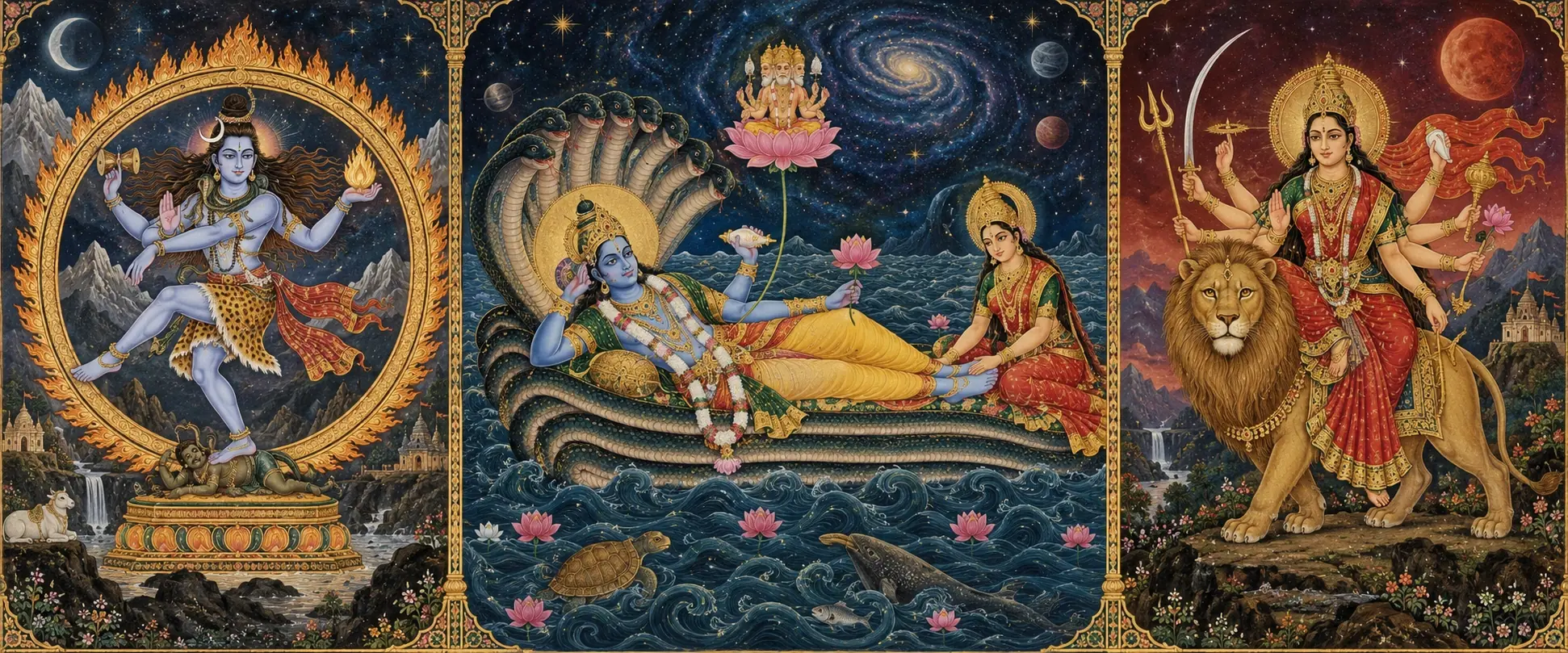
An orientation to major Hindu gods and goddesses, their iconography, relationships, texts and living traditions.
Begin with context
There is no single Hindu pantheon or universally binding account of every deity. A divine form may be approached as a supreme person, a manifestation of ultimate reality, a member of a sacred family, a guardian of place, or an iṣṭa-devatā—a personally cherished form of God.
01
Three great devotional constellations
Vaiṣṇava traditions centre Viṣṇu and forms such as Kṛṣṇa, Rāma, Narasiṃha and Venkateśvara. Śaiva traditions centre Śiva as lord, yogin, householder, dancer, teacher and ultimate reality. Śākta traditions recognise Devī—the Goddess and divine power—as supreme, meeting her through forms such as Durgā, Kālī, Lalitā, Pārvatī and local goddesses.
These are internally diverse families, not three single denominations.
Smārta practice may honour several deities while interpreting them through non-dual philosophy.
Regional and village traditions cannot be reduced to a neat pan-Indian list.
02
How to read a sacred image
Attributes help identify a form: Viṣṇu’s conch and discus, Śiva’s trident and drum, Sarasvatī’s vīṇā, or Gaṇeśa’s broken tusk. A vāhana, or associated vehicle, may place the deity within a larger symbolic world. Hand gestures, posture, number of arms, attendants and setting all matter.
Multiple arms make simultaneous powers visible; they are not anatomical claims.
A mūrti is a sacred embodied form encountered through ritual and darśana, not simply an art object.
The same deity may look different across centuries, regions and materials.
03
Families, avatāras and forms
Sacred relationships organise theology and story: Śiva, Pārvatī, Gaṇeśa and Skanda; Rāma, Sītā, Lakṣmaṇa and Hanumān; Kṛṣṇa with Rādhā or Rukmiṇī in different traditions. Vaiṣṇava texts describe divine descents, or avatāras, but even the familiar ten-form list varies.
Buddha replaces Balarāma in some daśāvatāra lists.
Devī’s forms may be related without being interchangeable.
Syncretic forms such as Harihara express relation rather than erasing difference.
04
Enter the illustrated library
The House of Ananda deity room contains twenty-four searchable profiles, a guide to the daśāvatāra and six sacred-story introductions. Each profile names the textual and regional context and flags where popular summaries conceal important variation.
Continue into Vedic deities, river goddesses and regional forms.
Use the source path to move from overview to primary text and museum collections.
Twenty-four profiles
Continue into the illustrated deity library.
Search major divine forms by name and tradition, compare attributes and vehicles, and enter each profile through a carefully contextualised sacred story.
These introductions are educational orientations. Dates, translations and interpretations remain debated; follow the linked institutions and compare more than one scholarly and community perspective.