
Classical yoga · an illustrated study
Patañjali’s
Yoga Sūtras.
Four chapters on the mind,
practice and the possibility of freedom.
Meet the teachings of Patañjali through original artwork, clear visual guides and selected Sanskrit verses. Expanded from Daniel’s class notes, with historical context and reflections for daily life.
Explore the four chapters- 01SamādhiMeditative absorption51sūtras
- 02SādhanaPractice & discipline55sūtras
- 03VibhūtiAttainments & powers56sūtras
- 04KaivalyaLiberation & independence34sūtras
51 + 55 + 56 + 34 = 196
01 / A thread of teaching
A small text.
A deep inquiry.
A sūtra is a concise teaching or aphorism; the word is associated with a thread. A pāda is a section or chapter. These short statements belong to a much larger tradition of teaching and commentary.
Patañjali is traditionally credited with organising the Yoga Sūtras. Yoga existed before this text. Very little about his life is historically secure, and identifying him with the Sanskrit grammarian of the same name remains disputed. His dates should not be presented as certain.
Scholar Philipp Maas places the work around 400 CE and argues that the sūtras and earliest commentary may have formed a single composition. Other scholars favour earlier dates. The commentary, the Yoga Bhāṣya, is traditionally attributed to Vyāsa. Research on the text’s formation ↗
The text explores ethics, attention, suffering and liberation. It is foundational to classical Yoga philosophy, rather than a catalogue of exercise sequences. Historical and philosophical context ↗
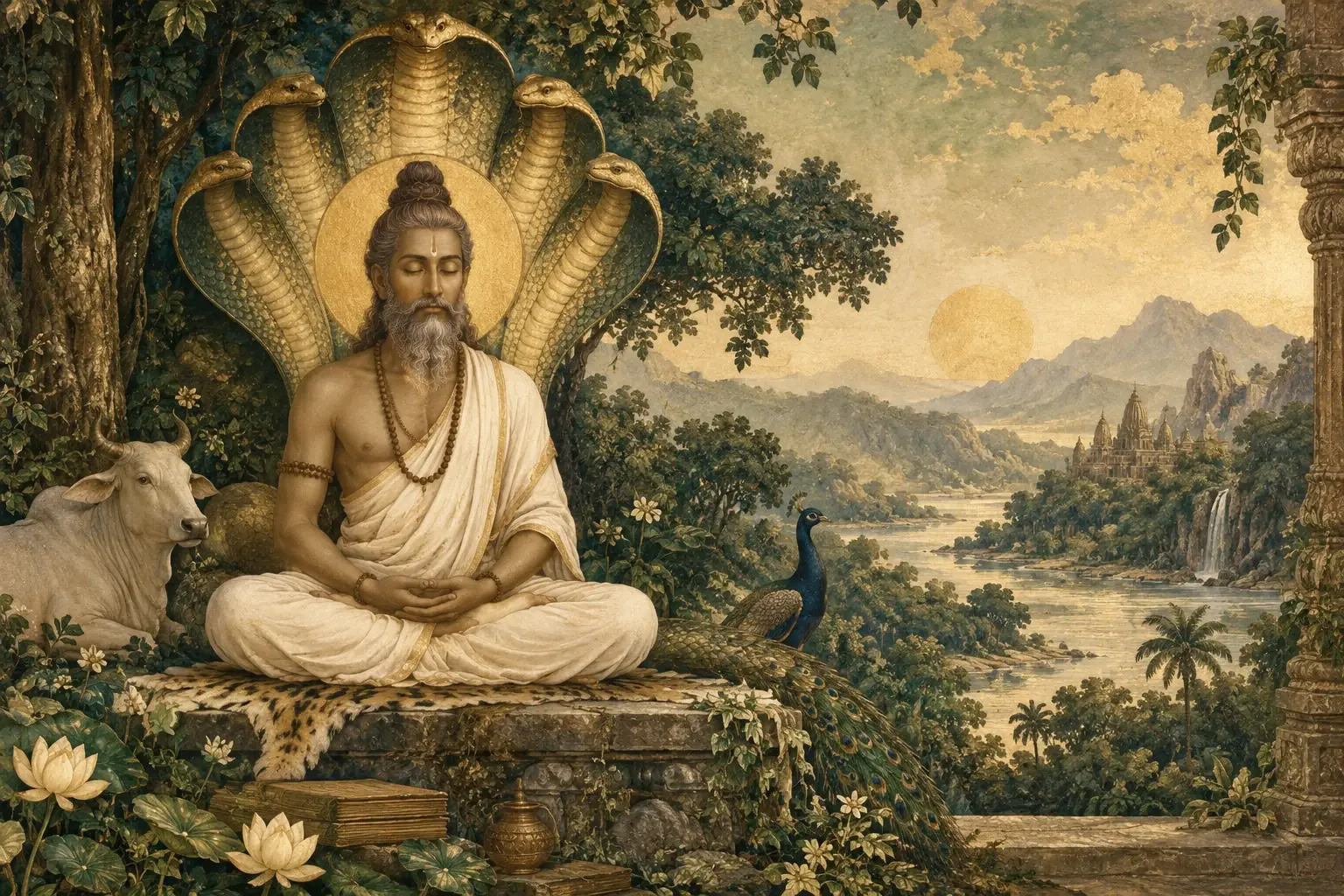
Understanding the central teaching · 1.2 & 1.12
The mind, its movements
and the work of practice.
The definition yogaś citta-vṛtti-nirodhaḥ condenses a whole discipline into a few words. Reading the terms separately helps reveal what the sentence asks us to study.
Citta
The mindThe mental field through which thinking, remembering and perceiving occur.
Vṛtti
Its changing activitiesThe movements or modifications of that mental field.
Nirodha
Restraint or stillingThe cessation or restraint of those activities in the text’s meditative discipline.
Return to practice.
Keep cultivating steadiness. A modest, sustained commitment gives the inquiry somewhere to grow.
Loosen the grasp.
Develop dispassion towards what attracts the mind, including the wish to reproduce a particular experience.
02 / The four pādas
Read the map.
Explore the meaning.
The words in your notes are memory aids. The expanded meanings below help preserve the distinctions between the chapters.
| Chapter | Sūtras | Classroom cue | Fuller meaning |
|---|---|---|---|
| 1. Samādhi Pāda | 51 | Realisation | Meditative absorption |
| 2. Sādhana Pāda | 55 | Practice | Practice & discipline |
| 3. Vibhūti Pāda | 56 | Experience | Attainments & powers |
| 4. Kaivalya Pāda | 34 | Enlightenment | Liberation & independence |
| Total | 196 | Four connected chapters | |
समाधि
Samādhi
Pāda
51 sūtras1.1–1.51
Meditative absorption
What is yoga pointing towards?
The opening chapter examines the mind and the possibility of profound stillness. It introduces yoga through the restraint or cessation of mental fluctuations, then explores practice, non-attachment, obstacles and forms of meditative absorption.
- Citta: the mind, including its changing activities.
- Abhyāsa and vairāgya: sustained practice and non-attachment (1.12–1.16).
- Īśvara and Oṃ: devotion, repetition and contemplation of meaning (1.23–1.29).
- Samādhi: increasingly subtle absorption, discussed in several forms.
A modern reflectionWhen you sit quietly, what repeatedly catches your attention? Notice it, then gently return to one chosen point. The reflection is an introduction to attention, not a claim to have attained samādhi.
Read chapter text & comparative notes ↗साधन
Sādhana
Pāda
55 sūtras2.1–2.55
Practice & discipline
How do we prepare and practise?
The second chapter turns towards the work of practice. It introduces kriyā yoga—tapas, svādhyāya and dedication to Īśvara—and examines the kleśas, the afflictions that sustain suffering. It then introduces the eight limbs of yoga.
- Tapas: disciplined effort or austerity.
- Svādhyāya: sacred study and recitation, often extended to self-study in modern teaching.
- Īśvara-praṇidhāna: dedication or surrender to Īśvara.
- Five kleśas: ignorance, ego-identification, attachment, aversion and clinging to life (2.3).
A modern reflectionChoose one manageable commitment: a few minutes of study, a more truthful conversation or a consistent time to sit. What would make this practice sustainable?
Read chapter text & comparative notes ↗विभूति
Vibhūti
Pāda
56 sūtras3.1–3.56 · 196-sūtra numbering
Attainments & powers
What unfolds as attention deepens?
The third chapter describes dhāraṇā, dhyāna and samādhi. Their combined application is called saṃyama. The text associates this discipline with extraordinary knowledge and abilities, traditionally called siddhis, while also examining discernment and liberation.
- Dhāraṇā: fixing attention on a chosen place or object (3.1).
- Dhyāna: continuity of attention towards that object (3.2).
- Samādhi: absorption in which the object predominates (3.3).
- Saṃyama: these three applied together (3.4).
A modern reflectionIf a practice feels unusually peaceful or vivid, can you appreciate it without chasing a repeat performance? Consider whether fascination with an experience is taking attention away from steady practice.
Read chapter text & comparative notes ↗कैवल्य
Kaivalya
Pāda
34 sūtras4.1–4.34
Liberation & independence
What does freedom mean here?
The final chapter returns to mind, impressions, action and the nature of freedom. In classical Yoga, puruṣa—the seer or consciousness—is distinguished from prakṛti, the changing field that includes body and mind. Kaivalya names liberation through this distinction.
- Mental impressions and habits help explain the continuity of experience.
- The mind changes and can itself be known.
- Discernment distinguishes consciousness from what is observed.
- The closing sūtra, 4.34, describes the culmination in kaivalya.
A modern reflectionTry noticing the difference between ‘a thought is present’ and ‘this thought defines me’. Use it as a question for inquiry, without treating a brief exercise as the attainment of liberation.
Read chapter text & comparative notes ↗03 / Aṣṭāṅga · eight limbs
Where the eight limbs
fit into the text.
The complete list appears in 2.29. Chapter two develops the first five; chapter three opens with the final three. They form an integrated discipline. Here, aṣṭāṅga means “eight limbs”; the modern Aṣṭāṅga Vinyāsa posture system is a distinct historical development.
Chapter II Sādhana · foundations of practice
- 1
Yama Ethical restraints
Non-harming, truthfulness, non-stealing, celibacy or sexual restraint, and non-grasping.
- 2
Niyama Personal observances
Purity, contentment, discipline, sacred study and dedication to Īśvara.
- 3
Āsana Posture
A stable and easeful posture; the text gives this limb a brief treatment.
- 4
Prāṇāyāma Breath regulation
Working with the movement and regulation of breath.
- 5
Pratyāhāra Withdrawal of the senses
The senses cease following their objects and follow the mind’s orientation.
Chapter III Vibhūti · deepening attention
- 6
Dhāraṇā Concentration
Holding attention to a chosen object or place.
- 7
Dhyāna Meditation
A continuing flow of attention towards that object.
- 8
Samādhi Absorption
The object of meditation becomes predominant in awareness.
The five kleśas · 2.3–2.9
Recognising the patterns
that bind experience.
Patañjali describes five afflictions within a spiritual account of suffering. The questions below are contemporary prompts for inquiry, not diagnoses or an explanation of every hardship.
Avidyā
MisunderstandingMistaking what changes for what is permanent, and confusing the self with what is not the self.
What am I treating as a certainty?
Asmitā
Ego-identificationConfusing the power of seeing with the instruments through which experience is known.
Am I making a thought or role my whole identity?
Rāga
AttachmentGrasping towards pleasure and the desire to repeat a satisfying experience.
What am I insisting must happen again?
Dveṣa
AversionResistance shaped by painful experience; the impulse to push away what is unwelcome.
What is my resistance asking me to notice?
Abhiniveśa
Clinging to lifeThe deeply rooted impulse to continue existing, commonly explained through fear of death.
How do I meet uncertainty with care?
Ethical foundations · 2.30 & 2.32
How we act.
What we cultivate.
The first two limbs place ethics and disciplined living at the heart of practice. These study meanings preserve the traditional terms while opening questions for daily life.
Yama
- AhiṃsāNon-harming
- Let care for living beings inform action, speech and intention.
- SatyaTruthfulness
- Value accuracy and sincerity, with regard for non-harming.
- AsteyaNon-stealing
- Respect what belongs to others; do not take what is not given.
- BrahmacaryaSexual restraint
- Traditionally continence or celibacy. ‘Wise use of energy’ is a broader modern interpretation.
- AparigrahaNon-grasping
- Examine acquisitiveness and the impulse to accumulate possessions.
Niyama
- ŚaucaPurity & cleanliness
- Attend to bodily cleanliness and the cultivation of clarity in the mind.
- SantoṣaContentment
- Cultivate enoughness without making satisfaction depend on always obtaining more.
- TapasDiscipline & austerity
- Sustain purposeful effort. Intensity or self-punishment is not a measure of progress.
- SvādhyāyaSacred study
- Traditionally scripture study and recitation; modern teaching often adds self-reflection.
- Īśvara-praṇidhānaDedication to Īśvara
- Orient practice towards the Lord. This term has a devotional meaning in the text.
04 / Words to sit with
Six starting points
for study.
Brief English study renderings below are House of Ananda’s paraphrases. Translations differ; compare them with your teacher’s edition.
अथ योगानुशासनम्
atha yogānuśāsanam
Now begins the teaching of yoga.
What does beginning deliberately mean for you today?
योगश्चित्तवृत्तिनिरोधः
yogaś citta-vṛtti-nirodhaḥ
Yoga is the restraint or cessation of the mind’s fluctuations.
This is a technical definition of yoga’s aim; it is not a demand to force away every thought.
अभ्यासवैराग्याभ्यां तन्निरोधः
abhyāsa-vairāgyābhyāṃ tan-nirodhaḥ
That stilling is approached through practice and non-attachment.
Can you return to your practice without demanding a particular experience?
तज्जपस्तदर्थभावनम्
taj-japas tad-artha-bhāvanam
Repeat Oṃ and contemplate its meaning.
Connect the sound with the devotional meaning being studied, rather than treating repetition as merely mechanical.
मैत्रीकरुणामुदितोपेक्षाणां सुखदुःखपुण्यापुण्यविषयाणां भावनातश्चित्तप्रसादनम्
maitrī-karuṇā-muditopekṣāṇāṃ sukha-duḥkha-puṇyāpuṇya-viṣayāṇāṃ bhāvanātaś citta-prasādanam
Cultivate friendliness, compassion, joy and equanimity to clarify the mind.
These attitudes concern happiness, suffering, virtue and wrongdoing respectively. Explore their full mapping below.
स्थिरसुखमासनम्
sthira-sukham āsanam
Posture is steady and easeful.
In a comfortable seat, explore support and steadiness without forcing your body.
Sound & relationship · 1.27–1.28 & 1.33
Let meaning accompany
the sound.

Sūtra 1.27 identifies the praṇava, Oṃ, as the expression of Īśvara. Sūtra 1.28 joins repetition with contemplation of its meaning. In this setting, mantra is a devotional and attentional practice.
Repetition of Oṃ alongside contemplation of what it signifies.
A modern study suggestion: before chanting, spend a moment considering the meaning you are learning. Afterwards, sit quietly and notice your attention. The text does not specify a musical frequency in hertz.
Read Sūtra 1.28 and commentary ↗Four attitudes for a clearer mind
Sūtra 1.33 connects the cultivation of these attitudes with clarity of mind:
- MaitrīFriendliness
- Towards those who are happy
- KaruṇāCompassion
- Towards those who suffer
- MuditāJoy
- In goodness and virtue
- UpekṣāEquanimity
- Towards wrongdoing
As a modern application, equanimity can mean responding without being consumed by hostility; it need not mean overlooking harm. Read Sūtra 1.33 ↗
05 / Bring the learning into life
Read slowly.
Return often.
These are modern study suggestions, not a prescribed ancient four-day programme.
Take your reflections to My Ananda ↗- Read one short passage.
Note the chapter, verse number and translator. Write down what you understand and what remains unclear.
- Compare one key word.
Look at how two editions explain a term such as nirodha or kaivalya. A difference in wording can reveal an interpretive choice.
- Choose one everyday application.
Practise patient attention, an honest response or a small commitment. Keep the task realistic and observe what happens.
- Return with a question.
Bring the uncertainty to a knowledgeable teacher. Study can deepen without needing an extraordinary experience.
06 / Reading room
Sources &
study notes.
Expanded from Daniel’s notebook and classroom whiteboard photographs, with historical research, primary-text references and original editorial illustrations. Everyday reflection prompts are modern applications, not quotations from Patañjali.
- Sanskrit Documents · Pātañjala Yoga Sūtras
Original-language text for checking terms, selected verses and numbering.
- Edwin Bryant · Internet Encyclopedia of Philosophy
Historical background, classical Yoga’s philosophical setting and the role of commentary.
- Internet Sacred Text Archive · English translation
One interpretive rendering for comparison; its numbering differs from the classroom arrangement.
- Philipp Maas · Research on the Pātañjalayogaśāstra
A scholarly account of the dating and possible joint composition of the sūtras and commentary.
- Rama Prasada · Sūtras with classical commentaries
Historical English translation of the Sanskrit text with Vyāsa and Vācaspati Miśra. Used for the term guides, ethics, kleśas and mantra passages; historical dating follows the research sources above rather than this website’s introductory dates.
- Comparative chapter notes · Sanskrit Documents
Text, selected translations and study commentary. Some entries are incomplete; consult a full published commentary for sustained study.