Power Yoga · Session 3 of 3
A longer steady rhythm
Editorial guidance · awaiting teacher review · about 36 minutes
Listen & follow
Spoken guidance for the full session
Hear the opening, every movement, breath cues, adaptations and the closing. Quiet spaces give you time to practise and rest. Pictures advance with the spoken session.
Keep this page open and the screen unlocked. Hiding the page pauses the session. Resume repeats an interrupted sentence. Voice quality and availability depend on your device; some voices need an internet connection. Spoken cues use English names; Sanskrit remains on screen. Timing may extend so a cue is never cut short.
Read the complete spoken transcript
Before you begin
Welcome to A longer steady rhythm. This is editorial guidance awaiting teacher review. Have a stable chair, a mat and suitable cushions nearby. Read the full series for supports and adaptations; use only comfortable, familiar transfers. Choose only movements and transfers that are comfortable and familiar. Stop for pain, dizziness or feeling unwell. The session will move on automatically, with quiet spaces for practice and rest. Pause whenever you need more time. Timed blocks include setup, short repetitions, side changes and rest; they are not continuous holds. Keep breathing naturally. English movement names will be spoken. Sanskrit names remain on screen.
1. Supported chair seat
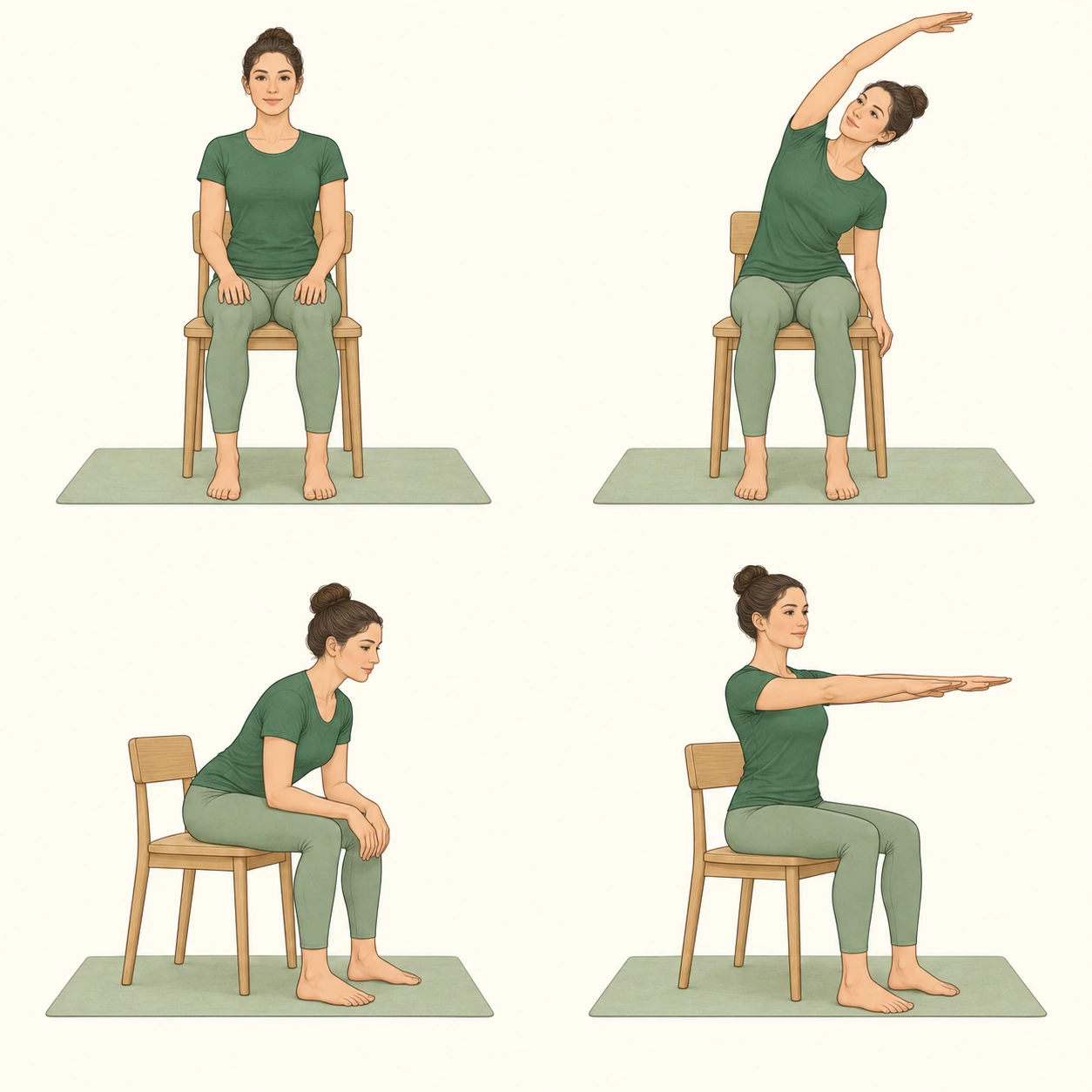
Movement 1 of 10. Supported chair seat. Arrange your supports and choose a comfortable starting position before beginning. Breath cue. Natural breathing. Use a stable chair without wheels, feet on the floor or blocks. Rest hands on thighs. Notice contact with the seat and the room. Adjust whenever needed. Another option. Use back support and a comfortable footrest; do not force an upright position. Use the quiet space for familiar practice or rest. You do not need to keep holding a position until the next cue.
Quiet practice and rest within a 2-minute block. Follow the short stays described, not a continuous hold.
2. Seated arm reach
Movement 2 of 10. Seated arm reach. Release the previous position. Pause in a comfortable neutral position and arrange any support before continuing. Breath cue. Inhale to reach; exhale to lower. Sit supported. Reach arms forward no higher than comfortable shoulder height, then lower slowly. Repeat 4 to 6 times without lifting the shoulders towards the ears. Another option. Move one arm at a time or keep hands in the lap. Use the quiet space for familiar practice or rest. You do not need to keep holding a position until the next cue.
Quiet practice and rest within a 2-minute block. Follow the short stays described, not a continuous hold.
3. Mountain
Movement 3 of 10. Mountain. Bring feet to a secure position, use stable support to rise and pause until steady before standing work. Breath cue. Natural, comfortable breathing. Stand feet comfortably apart, knees unlocked, arms by the sides. Take 3 to 5 breaths; add small weight shifts and return to stillness. Another option. Use a wall or sit upright with feet supported. Use the quiet space for familiar practice or rest. You do not need to keep holding a position until the next cue.
Quiet practice and rest within a 2-minute block. Follow the short stays described, not a continuous hold.
4. Chair
Movement 4 of 10. Chair. Release the previous position. Pause in a comfortable neutral position and arrange any support before continuing. Breath cue. Exhale to bend; inhale to rise. From standing, bend knees a little and move hips back with heels grounded. Reach arms forward if comfortable. Rise after 2 breaths; rest and repeat up to 4 times. Another option. Use a shallow supported sit-to-stand from a stable chair. Use the quiet space for familiar practice or rest. You do not need to keep holding a position until the next cue.
Quiet practice and rest within a 4-minute block. Follow the short stays described, not a continuous hold.
5. Warrior II
Movement 5 of 10. Warrior II. Release the previous position. Pause in a comfortable neutral position and arrange any support before continuing. Breath cue. Exhale to bend the front knee; breathe freely. Take a comfortable wide stance. Turn the front foot out, bend its knee in the direction of the toes, keep back leg long and extend arms. Stay 3 breaths, straighten and rest. Change sides before repeating. Another option. Shorten the stance, bend less and keep hands on hips or support. Complete both sides, returning to neutral between them. Keep to the short repetitions or stays described and rest between efforts. Use the quiet space for familiar practice or rest. You do not need to keep holding a position until the next cue.
After about 2:30 in this block, once earlier guidance has finished:
If you have not already changed sides, return to neutral, take a rest and then practise the other side. If you have finished both sides, use this time to rest.
Quiet practice and rest within a 5-minute block. Follow the short stays described, not a continuous hold.
6. Supported tree
Movement 6 of 10. Supported tree. Release the previous position. Pause in a comfortable neutral position and arrange any support before continuing. Breath cue. Keep breathing normally; no holding. Stand by a wall with one hand supported. Keep free toes on the floor and heel near the standing ankle. Pause for 3 breaths, release and change legs. Repeat up to 3 times. Another option. Keep both feet on the floor and practise small weight shifts. Do not press into the knee. Complete both sides, returning to neutral between them. Keep to the short repetitions or stays described and rest between efforts. Use the quiet space for familiar practice or rest. You do not need to keep holding a position until the next cue.
After about 2:00 in this block, once earlier guidance has finished:
If you have not already changed sides, return to neutral, take a rest and then practise the other side. If you have finished both sides, use this time to rest.
Quiet practice and rest within a 4-minute block. Follow the short stays described, not a continuous hold.
7. Cat–cow
Movement 7 of 10. Cat, cow. Use stable support and a floor transfer you already know. Pause in a comfortable seat before arranging the next position; use the seated alternative if needed. Breath cue. Inhale into a small chest opening; exhale to round. On hands and knees, put hands below shoulders and knees below hips. Alternate a small chest opening with gentle rounding for 4 to 6 cycles. Rest in neutral. Keep the neck easy. Another option. Sit in a chair, hands on thighs, and use a smaller spinal movement. Use the quiet space for familiar practice or rest. You do not need to keep holding a position until the next cue.
Quiet practice and rest within a 3-minute block. Follow the short stays described, not a continuous hold.
8. Low bridge
Movement 8 of 10. Low bridge. Release the previous position, come to a comfortable seat using your hands, then lower through one side to arrange yourself on your back. Take your time. Breath cue. Inhale to lift a little; exhale to lower. Lie on the back, knees bent and feet flat. Lift the pelvis modestly with head and shoulders grounded, then lower slowly. Repeat 4 times with pauses. Do not turn the head while lifted. Another option. Keep the pelvis grounded and make a small pelvic tilt; not the neck-loaded Ashtanga bridge. Use the quiet space for familiar practice or rest. You do not need to keep holding a position until the next cue.
Quiet practice and rest within a 4-minute block. Follow the short stays described, not a continuous hold.
9. Supported reclining twist
Movement 9 of 10. Supported reclining twist. Release the previous position. Pause in a comfortable neutral position and arrange any support before continuing. Breath cue. Exhale into a small movement; breathe freely. Lie on the back with knees bent. Let knees move together onto cushions to one side. Keep shoulders comfortable and head neutral. Stay 3 to 5 breaths; return to centre before changing sides. Another option. Make a tiny knee sway instead; do not force knees towards the floor. Complete both sides, returning to neutral between them. Keep to the short repetitions or stays described and rest between efforts. Use the quiet space for familiar practice or rest. You do not need to keep holding a position until the next cue.
After about 2:00 in this block, once earlier guidance has finished:
If you have not already changed sides, return to neutral, take a rest and then practise the other side. If you have finished both sides, use this time to rest.
Quiet practice and rest within a 4-minute block. Follow the short stays described, not a continuous hold.
10. Final rest
Movement 10 of 10. Final rest. Release the previous position. Pause in a comfortable neutral position and arrange any support before continuing. Breath cue. Let the breath settle naturally. Rest with legs comfortable, arms away from the body and support under knees if wanted. Another option. Rest on your side or in a supported chair. Eyes may stay open. Use the quiet space for familiar practice or rest. You do not need to keep holding a position until the next cue.
After about 5:00 in this block, once earlier guidance has finished:
Take your time to finish this rest. When ready, move fingers and toes, roll to a side, pause, then use hands to sit up slowly.
Quiet practice and rest within a 6-minute block. Follow the short stays described, not a continuous hold.
Closing the session
This session is complete. Remain comfortably supported for a moment and let your breathing settle. There is no need to stand up quickly. Notice the room around you. You can record your practice in My Ananda, or simply finish here. Return to a familiar session whenever it suits you.
Movement 1 of 102 min suggested block
Your movement
Supported chair seat
No established Sanskrit name
To begin: Arrange your supports and choose a comfortable starting position before beginning.
Use a stable chair without wheels, feet on the floor or blocks. Rest hands on thighs. Notice contact with the seat and the room. Adjust whenever needed.
Another option: Use back support and a comfortable footrest; do not force an upright position.
Follow at your own pace, with as many extra breaths and pauses as you need. You choose when to move on.
Next: Seated arm reach
Equipment, scope & review status
Have a stable chair, a mat and suitable cushions nearby. Read the full series for supports and adaptations; use only comfortable, familiar transfers.
Stop for pain, dizziness or feeling unwell. This general practice is not an individual clinical plan.
Read the review status and context. The timer pauses when the page is hidden. Moving to another stage resets it; start it again when ready.